
Numbers 21:4
in Numbers 21Then they set out from Mount Hor along the route to the Red Sea, in order to bypass the land of Edom. But the people grew impatient on the journey
BSB
The same verse in ASV and KJV ▾
ASV
And they journeyed from mount Hor by the way to the Red Sea, to compass the land of Edom: and the soul of the people was much discouraged because of the way.
KJV
And they journeyed from mount Hor by the way of the Red sea, to compass the land of Edom: and the soul of the people was much discouraged because of the way.
⋯
This verse in Numbers 21
Commentary
9 notes on this verseA commentator
Albert Barnes1798–1870
Notes, Explanatory and Practical, on the Old and New Testaments (1832-1869)
The direct route to Moab through the valleys of Edom being closed against them Num 20:20-21, they were compelled to turn southward. Their course lay down the Arabah; until, a few hours north of Akaba (Ezion-Geber) the Wady Ithm opened to them a gap in the hostile mountains, allowed them to turn to their left, and to march northward toward Moab Deu 2:
This site's exposition
the soul of the people was much discouraged
on Numbers 21:4-5
The long way around Edom is what Edom's refusal at 20:21 cost them, and it turns the march back south toward the Red sea. The complaint holds two things at once, that there is no bread and that they loathe the bread they have, since the light bread is the manna of Exodus 16. In Exodus a complaint of this kind was answered with food or water, and from Numbers 11:1 onward the same complaints are answered with fire, with plague, and here with serpents.
The record, by era
The Puritans and the Awakening3 voices
Christ was lifted up by the rulers of the Jews, who were the successors of Moses. (3.) That which cured was shaped in the likeness of that which wounded. So Christ, though perfectly free from sin himself, yet was made in the likeness of sinful flesh ( Rom. viii.
quarantine:debris (2026-07-29) — unbalanced-parens
And they journeyed from Mount Hor,....
Perhaps the way was rough and uneven, or foul and dirty; or it fretted them to go far about, and that they were not permitted to force their passage through the Edomites' country. Those that are of a fretful discontented spirit will always find something or other to make them uneasy.
The Nineteenth Century2 voices
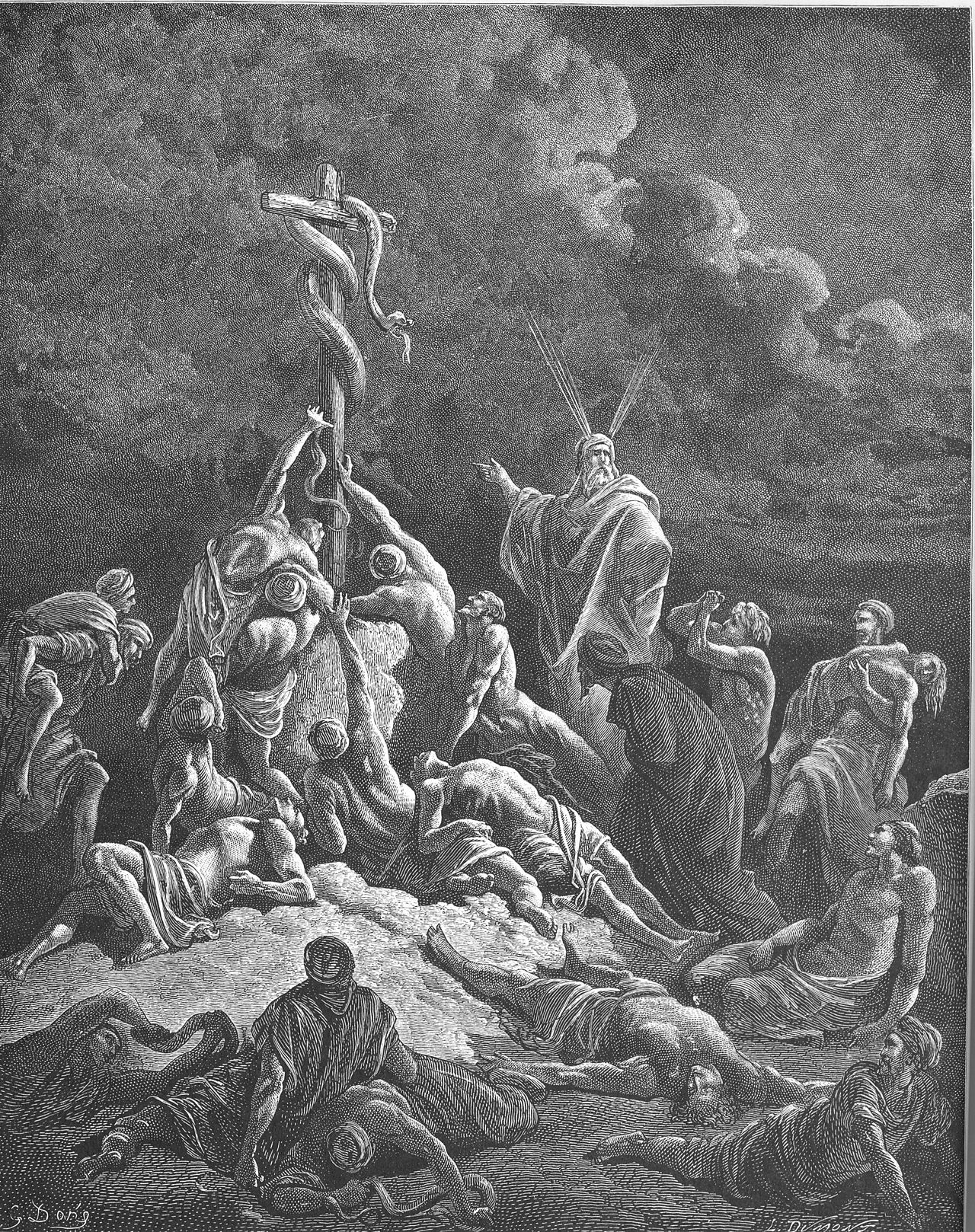
I HAVE frequently expounded to you the type of the bronze serpent as our Lord interprets it in the third of John. I thought it meet, tonight, to take that type in its connection and look at the original circumstances which led to the setting of it up—for while the general doctrine of looking for salvation to Christ as the bronze serpent is always to be preached and is most usefully set forth in the midst of the unconverted—yet I take it that its original institution teaches us much which ought not to be overlooked.
I HAVE frequently expounded to you the type of the bronze serpent as our Lord interprets it in the third of John. I thought it meet, tonight, to take that type in its connection and look at the original circumstances which led to the setting of it up—for while the general doctrine of looking for salvation to Christ as the bronze serpent is always to be preached and is most usefully set forth in the midst of the unconverted—yet I take it that its original institution teaches us much which ought not to be overlooked. It is very clear that this type has its first voice to the people of God, for it was among Israel—among the nominal people of God—that this bronze serpent was first needed and first set up. And while the instruction which it gives is wide as the universe, for whoever looks shall live, nevertheless it has an inner circle to which it, first of all, addresses itself—the professed members of the Church of God. The Book of Numbers might be called, without any impropriety, "Moses' Pilgrim's Progress." It contains a full account of the progress of the pilgrims through the wilderness until they came to the promised land. And, like Bunyan's "Pilgrim's Progress," it is not only a history of any one person or nation, but it is the picture of the life of all God's people. Probably no one among us will pass through all the troubles of the Israelites, so as to become in one person an epitome of all wilderness experience, and yet even this may be, for so it was with David, and so it has been with others by whom the Lord would instruct His Church. This, however, is exceptional. But, take the whole of us together as the Church of God, and you will find that our lives are mirrored, pictured and foreseen in the travels of God's chosen people from the land of Egypt to Canaan. I am afraid that many of us can see ourselves even in the passage before us.
2 more voices on this verse
The Nineteenth Century2 voices
A commentator
Charles Spurgeon1834–1892
The Metropolitan Tabernacle Pulpit, Sermon No. 3214: “Two Wilderness Incidents” (lightly modernized text, CCEL edition) · Written before 1892.
proposed
OUR text is a long one, but we must have it all in order to get the sense of the passage, so as to contrast the two wilderness incidents which are here mentioned and to learn how we may use them to our own spiritual profit. I. So, in the first place, LET US CONTRAST THESE TWO WILDERNESS INCIDENTS. First of all, let us examine the details of the first incident. We learn, from this part of the narrative, that the children of Israel were in real danger.
A commentator
Charles Spurgeon1834–1892
The Metropolitan Tabernacle Pulpit, Sermon No. 3214: “Two Wilderness Incidents” (lightly modernized text, CCEL edition) · Written before 1892.
proposed
OUR text is a long one, but we must have it all in order to get the sense of the passage, so as to contrast the two wilderness incidents which are here mentioned and to learn how we may use them to our own spiritual profit. I. So, in the first place, LET US CONTRAST THESE TWO WILDERNESS INCIDENTS. First of all, let us examine the details of the first incident. We learn, from this part of the narrative, that the children of Israel were in real danger. They were attacked by a ferocious foe who, being probably aware that he was doomed to destruction, determined to anticipate the contest by fighting against the Israelites while they were unprepared, and so injuring them as much as he could. Arad appears to have been a king of some considerable power and his skill in warfare is proved by the fact that he was at least partially successful against the Israelites, for he, "took some of them prisoners." So that the people were in real danger. And have you not noticed, dear Friends, that God's people often behave best when they are in their worst case? Usually, when they are in imminent peril, they cry to their God to deliver them, and so they soon obtain relief—but when they make trouble for themselves by a willful fretfulness of spirit—then it is that they lose their confidence in God and, instead of playing the man, they play the fool! You must have noticed how often accidents happen to people when they are engaged in play rather than when they are at work. I always warn our friends to be especially careful when they are leaving for a holiday, for I have observed how frequently they come back with signs of having suffered injuries of one kind or another, though they have been perfectly well while occupied with their usual avocations. It is very much the same in spiritual things.
The words behind it
14 Hebrew wordsEvery Hebrew word of this verse in the order it stands, with what it means and the door to its own study. The last column counts the times a word stands in the whole Bible: the rarer the word, the more the places it appears belong together.
| Hebrew | Sound | Meaning | Word study | In the Bible |
|---|---|---|---|---|
| וַיִּסְע֞וּ | vaiyisu | and they set out | H5265 → | 146 times |
| מֵהֹ֤ר | mehor | from Hor | H2023 → | 12 times |
| הָהָר֙ | hahar | the mountain | H2022 → | 546 times |
| דֶּ֣רֶךְ | derekh | [the] direction of | H1870 → | 707 times |
| יַם־ | yam- | [the] sea of | H3220 → | 396 times |
| ס֔וּף | suf | reed[s] | H5488 → | 28 times |
| לִסְבֹ֖ב | lisvo | to go around | H5437 → | 161 times |
| אֶת־ | ʾet- | <obj.> | H853 → | 10935 times |
| אֶ֣רֶץ | ʾeretz | [the] land of | H776 → | 2504 times |
| אֱד֑וֹם | ʾedom | Edom | H123 → | 99 times |
| וַתִּקְצַ֥ר | vatiktzar | and it became short | H7114 → | |
| נֶֽפֶשׁ־ | nefesh- | [the] self of | H5315 → | 754 times |
| הָעָ֖ם | haam | the people | H5971 → | 1873 times |
| בַּדָּֽרֶךְ׃ | badarekh | on the way | H1870 → | 707 times |
וַיִּסְע֞וּand they set out
vaiyisuH5265 →146 times
מֵהֹ֤רfrom Hor
mehorH2023 →12 times
הָהָר֙the mountain
haharH2022 →546 times
דֶּ֣רֶךְ[the] direction of
derekhH1870 →707 times
יַם־[the] sea of
yam-H3220 →396 times
ס֔וּףreed[s]
sufH5488 →28 times
לִסְבֹ֖בto go around
lisvoH5437 →161 times
אֶת־<obj.>
ʾet-H853 →10935 times
אֶ֣רֶץ[the] land of
ʾeretzH776 →2504 times
אֱד֑וֹםEdom
ʾedomH123 →99 times
וַתִּקְצַ֥רand it became short
vatiktzarH7114 →
נֶֽפֶשׁ־[the] self of
nefesh-H5315 →754 times
הָעָ֖םthe people
haamH5971 →1873 times
בַּדָּֽרֶךְ׃on the way
badarekhH1870 →707 times
A shaded row is a word that stands 400 times or fewer in the Bible.
The walk
8 stopsEach card is a verse this one points to, and under it the verses that one points to in turn. Where several paths arrive at the same place, that place is listed first: the text keeps returning to it.
Through
Acts 14:22strengthening the souls of the disciples and encouraging them to continue in the faith. “We must endure many hardships to enter the kingdom of God,” they said.
it leads to
- 1 Peter 5:10
And after you have suffered for a little while, the God of all grace, who has called you to His eternal glory in Christ, will Himself restore you, secure you, strengthen you, and establish…
- 2 Timothy 3:12
Indeed, all who desire to live godly lives in Christ Jesus will be persecuted,
- John 16:33
I have told you these things so that in Me you may have peace. In the world you will have tribulation. But take courage; I have overcome the world!”
- Romans 8:17
And if we are children, then we are heirs: heirs of God and co-heirs with Christ—if indeed we suffer with Him, so that we may also be glorified with Him.
- 1 Thessalonians 3:2–4
We sent Timothy, our brother and fellow worker for God in the gospel of Christ, to strengthen and encourage you in your faith,
- 1 Peter 5:10
Through
Exodus 6:9Moses relayed this message to the Israelites, but on account of their broken spirit and cruel bondage, they did not listen to him.
it leads to
- Exodus 5:21
“May the LORD look upon you and judge you,” the foremen said, “for you have made us a stench before Pharaoh and his officials; you have placed in their hand a sword to kill…
- Exodus 5:21
Through
Judges 11:18Then Israel traveled through the wilderness and bypassed the lands of Edom and Moab. They came to the east side of the land of Moab and camped on the other side of the Arnon.…
it leads to
- Deuteronomy 2:1–8
Then we turned back and headed for the wilderness by way of the Red Sea, as the LORD had instructed me, and for many days we wandered around Mount Seir.
- Numbers 21:4–13
Then they set out from Mount Hor along the route to the Red Sea, in order to bypass the land of Edom. But the people grew impatient on the journey
- Deuteronomy 2:1–8
Where this verse is studied
On this page
Studies3
On this verse
On this chapter
About Numbers
Who and where
1 name in this verse with a page on the site.
This page draws on Albert Barnes, Notes, Explanatory and Practical, on the Old and New Testaments (1832-1869); Charles Spurgeon, The Metropolitan Tabernacle Pulpit, Sermon No. 1722: “The First Setting Up of the Bronze Serpent” (lightly modernized text, CCEL edition); Charles Spurgeon, The Metropolitan Tabernacle Pulpit, Sermon No. 3214: “Two Wilderness Incidents” (lightly modernized text, CCEL edition); John Gill, Exposition of the Old Testament (1748-1763); Keil and Delitzsch, Biblical Commentary on the Old Testament: The Pentateuch and Matthew Henry, Commentary on the Whole Bible.