
Concept
AnthropologyEden
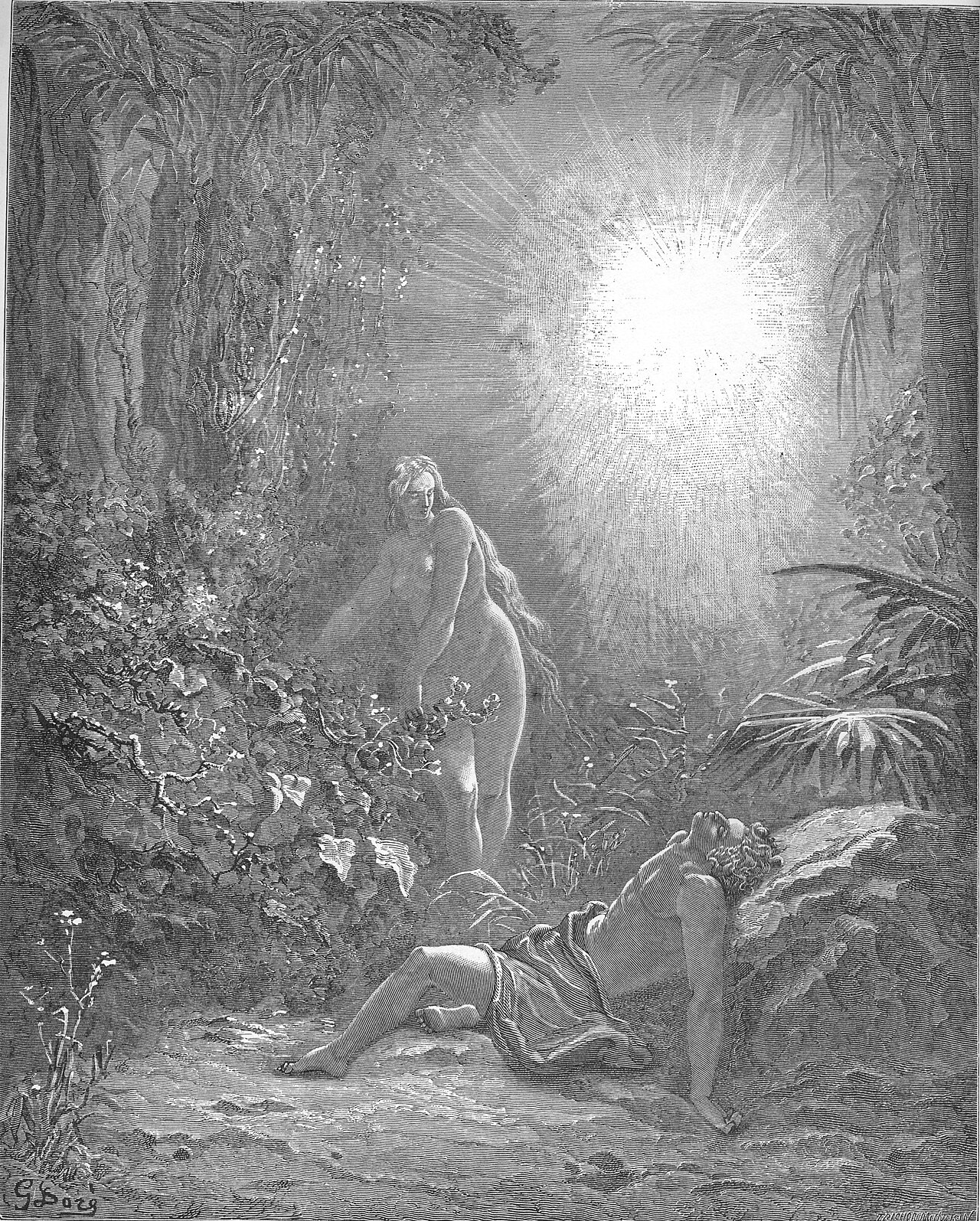
The garden God planted eastward: a sanctuary with a river, two trees, and a job description, lost by one command broken.
#garden#sanctuary
- 29passages
- 123original words
- 240cross-references
- 1thread through it
The words behind it
Hebrew and Greek standing in the 18 passages listed below, not a lexicon of "eden" itself. The number on each word is how often it occurs in those passages; the connecting words the languages use everywhere are set aside so the words that carry meaning can be seen.
Hebrew123
113 more hebrew words ▾
The passages
The first 18 of 29 passages this site attaches to the concept, in canon order. Each row says where it came from.
Old Testament18
- Genesis 2:8listed key text
And the LORD God planted a garden in Eden, in the east, where He placed the man He had formed.(opening verse of the passage)
Commentary on Genesis 2:82 voices
“And the Lord God planted a garden eastward in Eden,.... Or ‘had planted’ (m), for this was not now done after the formation of man, but before; and so the word translated ‘eastward’ may be rendered, as it is by some, ‘before’ (n): for the plain meaning is, that God had planted a garden before he made man, even on the third day, when all herbs, and plants, and trees were produced out of the earth.”
John Gill · Exposition of the Old Testament (1748-1763)Reformed
“A garden eastward in Eden - Though the word עדן Eden signifies pleasure or delight, it is certainly the name of a place. See Gen 4:16; 2Ki 19:12; Isa 37:12; Eze 27:23; Amo 1:5. And such places probably received their name from their fertility, pleasant situation, etc. In this light the Septuagint have viewed it, as they render the passage thus: Εφυτευσεν ὁ Θεος παραδεισον εν Εδεν, God planted a paradise in Eden. Hence the word paradise has been introduced into the New Testament, and is generally used to signify a place of exquisite pleasure and delight.”
Adam Clarke · Commentary on the BibleEvangelical
- Genesis 2:9thread stop
Out of the ground the LORD God gave growth to every tree that is pleasing to the eye and good for food. And in the middle of the garden were the tree of life and the tree of the knowledge of good and evil.
- Genesis 2:15listed key text
Then the LORD God took the man and placed him in the Garden of Eden to cultivate and keep it.(opening verse of the passage)
Commentary on Genesis 2:151 voice
“Note, now, the person who was taken and the land where he was formed. The virtue of God, therefore, took man and breathed into him, so that man's virtue will advance and increase. God set him apart in Paradise that you may know that man was taken up, that is to say, was breathed upon by the power of God. Note the fact that man was created outside Paradise, whereas woman was made within it. This teaches us that each person acquires grace by reason of virtue, not because of locality or of race.”
Ambrose of Milan · On ParadisePatristic
- Genesis 3:6thread stop
When the woman saw that the tree was good for food and pleasing to the eyes, and that it was desirable for obtaining wisdom, she took the fruit and ate it. She also gave some to her husband who was with her, and he ate it.
Commentary on Genesis 3:61 voice
“That the Lord then was manifestly coming to His own things, and was sustaining them by means of that creation which is supported by Himself, and was making a recapitulation of that disobedience which had occurred in connection with a tree, through the obedience which was [exhibited by Himself when He hung] upon a tree, [the effects] also of that deception being done away with, by which that virgin Eve, who was already espoused to a man, was unhappily misled,-was happily announced, through means of the truth [spoken] by the angel to the Virgin Mary, who was [also espoused] to a man.”
Irenaeus · Against Heresies 5.19.1Patristic
- Genesis 3:22thread stop
Then the LORD God said, “Behold, the man has become like one of Us, knowing good and evil. And now, lest he reach out his hand and take also from the tree of life, and eat, and live forever...”(opening verse of the passage)
Commentary on Genesis 3:222 voices
“Behold, the man is become as one of us, to know good and evil - See what he has got, what advantages, by eating forbidden fruit! This is said to humble them, and to bring them to a sense of their sin and folly, that seeing themselves thus wretchedly deceived by following the devil's counsel, they might henceforth pursue the happiness God offers, in the way he prescribes.”
John Wesley · Explanatory Notes upon the Old Testament, 1765Evangelical
“And how will that statement of the Lord stand, after the sin of the first man: ‘Behold, Adam is become like one of us, knowing good and evil?’ For he must not to be thought to have been such before the sin that he was wholly ignorant of good. Otherwise, it must be admitted that he was created like an irrational and senseless animal; and this is quite absurd and foreign to the Catholic faith. No, rather, according to the pronouncement of the most wise Solomon, ‘God made man right,’ that is, to enjoy continually the knowledge of good alone.”
John Cassian · CONFERENCES 13.12.1-2Patristic
- Genesis 3:23topical floor
Therefore the LORD God banished him from the Garden of Eden to work the ground from which he had been taken.
- Genesis 3:24listed key text
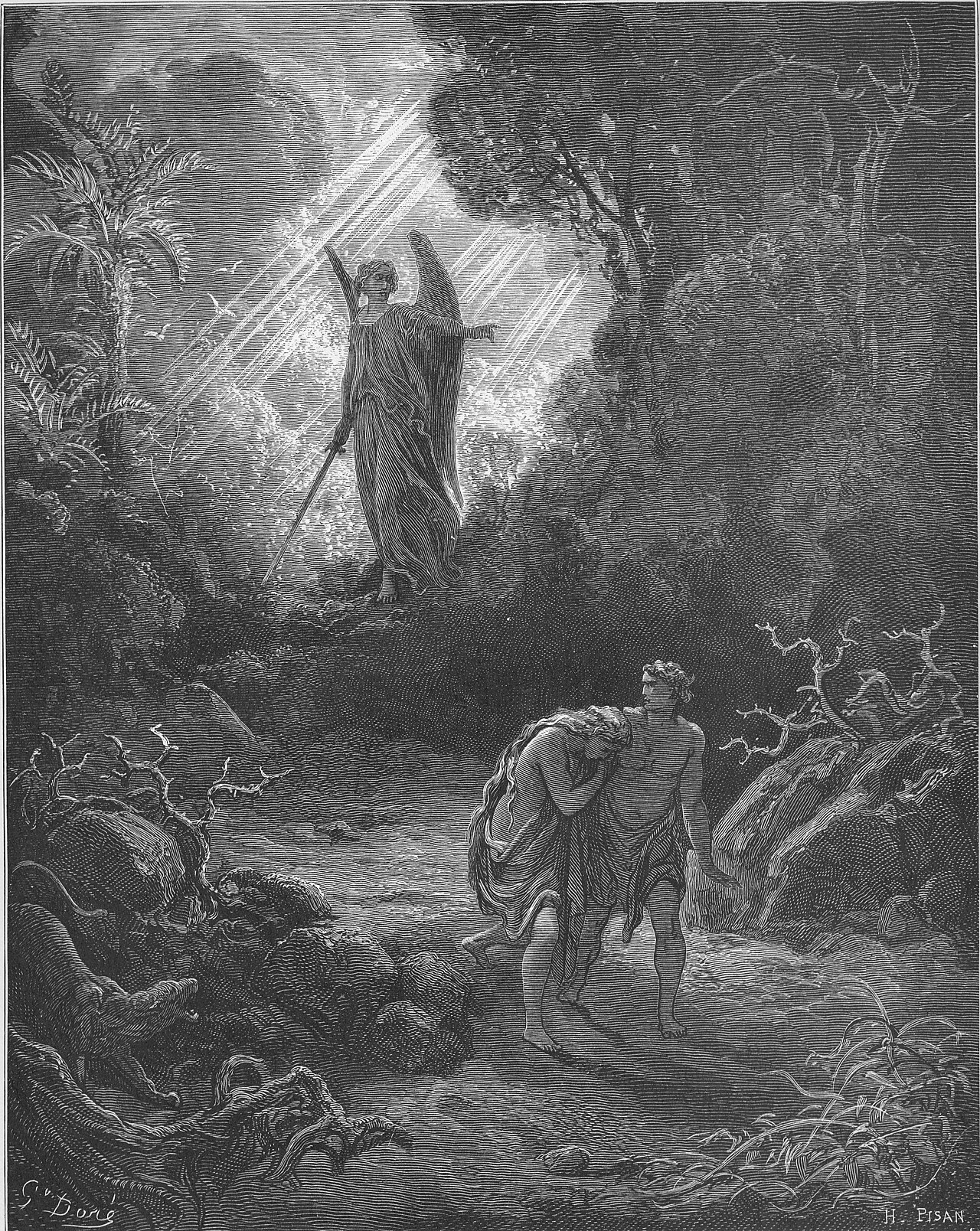
So He drove out the man and stationed cherubim on the east side of the Garden of Eden, along with a whirling sword of flame to guard the way to the tree of life.(opening verse of the passage)
Commentary on Genesis 3:241 voice
“So he drove out the man - Three things are noted here: 1. God’s displeasure against sinful man, evidenced by his expelling him from this place of blessedness; 2. Man’s unfitness for the place, of which he had rendered himself unworthy by his ingratitude and transgression; and, 3. His reluctance to leave this place of happiness. He was, as we may naturally conclude, unwilling to depart, and God drove him out. He placed at the east - מכדם mikkedem, or before the garden of Eden, before what may be conceived its gate or entrance; Cherubims, הכרבים hakkerubim, The cherubim.”
Adam Clarke · Commentary on the BibleEvangelical
- Genesis 4:16topical floor
So Cain went out from the presence of the LORD and settled in the land of Nod, east of Eden.
Commentary on Genesis 4:162 voices
“The land of Nod - As נוד nod signifies the same as נד sa , a vagabond, some think this verse should be rendered, And Cain went out from the presence of the Lord, from the east of Eden, and dwelt a vagabond on the earth; thus the curse pronounced on him, Gen 4:12, was accomplished.”
Adam Clarke · Commentary on the BibleEvangelical
“By means of righteousness we come into God's presence, as Moses did when he entered the thick cloud where God was. On the other hand, by the practice of evil a person leaves the presence of the Lord. For example, Cain, when he killed his brother, left the Lord's presence as far as his will was concerned.”
Athanasius of Alexandria · Festal Letters 10Patristic
- Deuteronomy 21:22thread stop
If a man has committed a sin worthy of death, and he is executed, and you hang his body on a tree,(opening verse of the passage)
Commentary on Deuteronomy 21:221 voice
“There were four methods of execution in use among the ancient Jews; stoning (Exo 17:4; Deu 13:10, etc.), burning Lev 20:14; Lev 21:9, the sword Exo 32:27, and strangulation. The latter, though not named in Scripture, is regarded by the rabbis as the most common, and the proper one to be adopted when no other is expressly enjoined by the Law. Suspension, whether from cross, stake, or gallows, was not used as a mode of taking life, but was sometimes added after death as an enhancement of punishment.”
Albert Barnes · Notes, Explanatory and Practical, on the Old and New Testaments (1832-1869)Evangelical
- 2 Kings 19:12topical floor
Did the gods of the nations destroyed by my fathers rescue those nations—the gods of Gozan, Haran, and Rezeph, and of the people of Eden in Telassar?
Commentary on 2 Kings 19:121 voice
“Haran - Harran, the Carrhae of the Greeks and Romans Gen 11:31, was among the earliest conquests of the Assyrians; being subject to them from the 12th century. Its conquest would have naturally followed that of Gozan (Gauzanitis, 2Ki 17:6), which lay between it and Assyria proper. Rezeph - Probably the Rozappa of the Assyrian inscriptions, a city in the neighborhood of Haran. The children of Eden - Or, ‘the Beni-Eden,’ who appear from the Assyrian inscriptions to have inhabited the country on the east bank of the Euphrates, about the modern Balis.”
Albert Barnes · Notes, Explanatory and Practical, on the Old and New Testaments (1832-1869)Evangelical
- 2 Chronicles 29:12topical floor
Then the Levites set to work: Mahath son of Amasai and Joel son of Azariah from the Kohathites; Kish son of Abdi and Azariah son of Jehallelel from the Merarites; Joah son of Zimmah and Eden son of Joah from the Gershonites;
Commentary on 2 Chronicles 29:121 voice
“On the triple division of the Levites, see 1Ch 23:6; and on the musical Levites, see 1Ch 25:1-6. 2Ch 29:13 The descendants of Elizaphan - a grandson of Kohath Exo 6:22, and chief of the Kohathites at the time of the census in the wilderness Num 3:30 - appear at all times to have formed a distinct branch of the Kohathites with special privileges 1Ch 15:8.”
Albert Barnes · Notes, Explanatory and Practical, on the Old and New Testaments (1832-1869)Evangelical
- 2 Chronicles 31:15topical floor
Under his authority, Eden, Miniamin, Jeshua, Shemaiah, Amariah, and Shecaniah faithfully distributed portions to their fellow priests in their cities, according to their divisions, old and young alike.
Commentary on 2 Chronicles 31:151 voice
“The cities of the priests - i. e. the Levitical cities (compare marginal reference). Of these, some had gone to decay, while others, as Libnah and Beth-shemesh 2Ch 21:10; 2Ch 28:18, had been lost, so that the original number, thirteen, was now, apparently, reduced to six. In their set office - Rather, as in marg. These six Levites were stationed at the Levitical cities, with the trust following committed to them.”
Albert Barnes · Notes, Explanatory and Practical, on the Old and New Testaments (1832-1869)Evangelical
- Psalms 1:3thread stop
He is like a tree planted by streams of water, yielding its fruit in season, whose leaf does not wither, and who prospers in all he does.
Commentary on Psalms 1:32 voices
“(Verse 3.) And it shall be like a tree that is planted by the courses of water, which will yield its fruit in its season. And its leaf shall not wither, and whatever it does, it shall prosper. What is this blessedness that is compared to the tree, unless we understand it to be in paradise, that blessed place, the tree of life produced from the earth in the midst of other trees?”
Ambrose of Milan · Commentaries on the Twelve Davidic PsalmsPatristic
“And he shall be like a tree planted by the rivers of water,.... Or, ‘for then shall he be’, &c. as Alshech renders the words; and the Hebrew ‘vau’ is often used for ‘then’ (q).”
John Gill · Exposition of the Old Testament (1748-1763)Reformed
- Proverbs 3:18thread stop
She is a tree of life to those who embrace her, and those who lay hold of her are blessed.
Commentary on Proverbs 3:182 voices
“I turn to the most wise Solomon as a witness when he said about wisdom, ‘The tree of life is for all who embrace it.’ Therefore, if ‘wisdom is the tree of life,’ without a doubt, there is another tree of prudence, another of knowledge and another of justice. For logically it is not said that only wisdom, of all the virtues, was worthy to be called ‘the tree of life’ but that the other virtues by no means received names of a similar sort. Therefore, ‘the trees of the field will give their fruit.’”
Origen of Alexandria · Homilies on Leviticus 16:4.3Patristic
“She is a tree of life - עץ חיים ets chaiyim, ‘the tree of lives,’ alluding most manifestly to the tree so called which God in the beginning planted in the garden of Paradise, by eating the fruit of which all the wastes of nature might have been continually repaired, so as to prevent death for ever. This is an opinion which appears probable enough. The blessings which wisdom - true religion - gives to men, preserve them in life, comfort them through life, cause them to triumph in death, and ensure them a glorious immortality.”
Adam Clarke · Commentary on the BibleEvangelical
- Isaiah 11:1thread stop
Then a shoot will spring up from the stump of Jesse, and a Branch from his roots will bear fruit.
Commentary on Isaiah 11:11 voice
“And there shall come forth a rod - In the previous chapter, the prophet had represented the Assyrian monarch and his army under the image of a dense and flourishing forest, with all its glory and grandeur. In opposition to this, he describes the illustrious personage who is the subject of this chapter, under the image of a slender twig or shoot, sprouting up from the root of a decayed and fallen tree. Between the Assyrian, therefore, and the person who is the subject of this chapter, there is a most striking and beautiful contrast.”
Albert Barnes · Notes, Explanatory and Practical, on the Old and New Testaments (1832-1869)Evangelical
- Isaiah 37:12topical floor
Did the gods of the nations destroyed by my fathers rescue those nations—the gods of Gozan, Haran, and Rezeph, and of the people of Eden in Telassar?
Commentary on Isaiah 37:121 voice
“My fathers - My predecessors on the throne. Gozan - This was a region or country in the northern part of Mesopotamia, and on the river Chaboras. There was a river of the name of Gozan in Media, which ran through the province, and gave it its name. The river fell probably into the Chaboras. This region is known to have been under the dominion of Assyria, for Shalmaneser, when he had subdued the ten tribes, carried them away beyond the Euphrates to a country bordering on the river Gozan 2Ki 17:”
Albert Barnes · Notes, Explanatory and Practical, on the Old and New Testaments (1832-1869)Evangelical
- Isaiah 51:3topical floor
For the LORD will comfort Zion and will look with compassion on all her ruins; He will make her wilderness like Eden and her desert like the garden of the LORD. Joy and gladness will be found in her, thanksgiving and melodious song.
Commentary on Isaiah 51:32 voices
“924. [Second,] he deduces the benefit of divine comfort: the Lord therefore will comfort, as to the rebuilding of cities, all the ruins: you are comforted concerning the evil that I have brought upon Jerusalem, in all things (Ezek 14:22); as to the cultivation of …”
Thomas Aquinas · Commentary on IsaiahPatristic
“For the Lord shall comfort Zion - On the word ‘Zion,’ see the notes at Isa 1:8. The meaning here is, that he would again restore it from its ruins. The argument is drawn from the statement in the previous verses. If God had raised up so great a nation from so humble all origin, he had power to restore the waste places of Judea to more than their former beauty and prosperity (see the notes at Isa 40:1). And he will make her wilderness - Judea is here represented as lying waste.”
Albert Barnes · Notes, Explanatory and Practical, on the Old and New Testaments (1832-1869)Evangelical
- Ezekiel 27:23topical floor
Haran, Canneh, and Eden traded with you, and so did the merchants of Sheba, Asshur, and Chilmad.
Commentary on Ezekiel 27:232 voices
“(Verse 23, 24.) Aran, and Channe, and Eden, your traders were from Saba, Assur, Chelmad, your sellers: these traders of yours had various wrappings of hyacinth and precious gems, which were wrapped and tied with ropes. LXX: Charran, and Chana, and Edne, these were your traders: Sabba, Assur, and Chalman, your merchants, bringing merchandise + in Machalim, and in Galima ** hyacinth and + polymita ** precious treasures tied with ropes. And these are the names of the various places. The addition made by Theodotion to the Septuagint was interpreted by Symmachus as 'precious coverings' in Machalim and in Galima.”
Jerome · Commentary on EzekielPatristic
“Haran, and Canneh, and Eden,.... Haran was a city of Mesopotamia, the same with Haran, where Abraham dwelt awhile, Act 7:2, the Charrae of the Parthians, famous for the defeat of Crassus. Canneh is thought to be the same with Calneh, Gen 10:10, afterwards called Ctesiphon; and here, by the Targum, Netzibin, a place not far from Tigris; and Eden also was between Tigris and Euphrates. All three places seem to be in Mesopotamia, and not far from each other; the latter is thought by some to be the place where the garden of Eden was.”
John Gill · Exposition of the Old Testament (1748-1763)Reformed
Voices on these passages
Commentary matched to the verses above, each named with its source: the full pool sits on each verse page.
“And the Lord God planted a garden eastward in Eden,.... Or ‘had planted’ (m), for this was not now done after the formation of man, but before; and so the word translated ‘eastward’ may be rendered, as it is by some, ‘before’ (n): for the plain meaning is, that God had planted a garden before he made man, even on the third day, when all herbs, and plants, and trees were produced out of the earth.”
John Gill · Exposition of the Old Testament (1748-1763)Reformed
Genesis 2:8
“Note, now, the person who was taken and the land where he was formed. The virtue of God, therefore, took man and breathed into him, so that man's virtue will advance and increase. God set him apart in Paradise that you may know that man was taken up, that is to say, was breathed upon by the power of God. Note the fact that man was created outside Paradise, whereas woman was made within it. This teaches us that each person acquires grace by reason of virtue, not because of locality or of race.”
Ambrose of Milan · On ParadisePatristic
Genesis 2:15
“That the Lord then was manifestly coming to His own things, and was sustaining them by means of that creation which is supported by Himself, and was making a recapitulation of that disobedience which had occurred in connection with a tree, through the obedience which was [exhibited by Himself when He hung] upon a tree, [the effects] also of that deception being done away with, by which that virgin Eve, who was already espoused to a man, was unhappily misled,-was happily announced, through means of the truth [spoken] by the angel to the Virgin Mary, who was [also espoused] to a man.”
Irenaeus · Against Heresies 5.19.1Patristic
Genesis 3:6
Study it deeper
5 moves a student can make from here. Every one opens a tool on this site.
Trace one word to every place it stands
A word page lists every verse that word occurs in, with its definition and its range of meaning. Start with the roots that occur most under the passages above.
Walk out from the passages
The passages above carry 240 cross-references between them, links from the Treasury of Scripture Knowledge, the great 1830s reference work, together with the reader-voted index at OpenBible.info. The most-linked destinations:
Read the whole chapter around it
A verse quoted alone can mean almost anything. Open Genesis 2 in the reader, where the Hebrew or Greek sits under every line.
See everywhere else it appears
The search page is a doorway: it returns verses, word studies, people, places and studies for one term at once.
Walk it stop by stop
A thread takes the passages in order and stops at each one with commentary, so the idea unfolds instead of arriving all at once.
Where this comes from
Eden is described the way the tabernacle will later be described: God walking in it, gold and precious stone at its borders, cherubim guarding the entrance, and a man placed there "to dress it and to keep it", the two verbs used later for priestly service.
What is lost at the gate in Genesis 3 is given back at the end of the book: the river, the tree, and the throne, with no flaming sword (Revelation 22:1-3).