
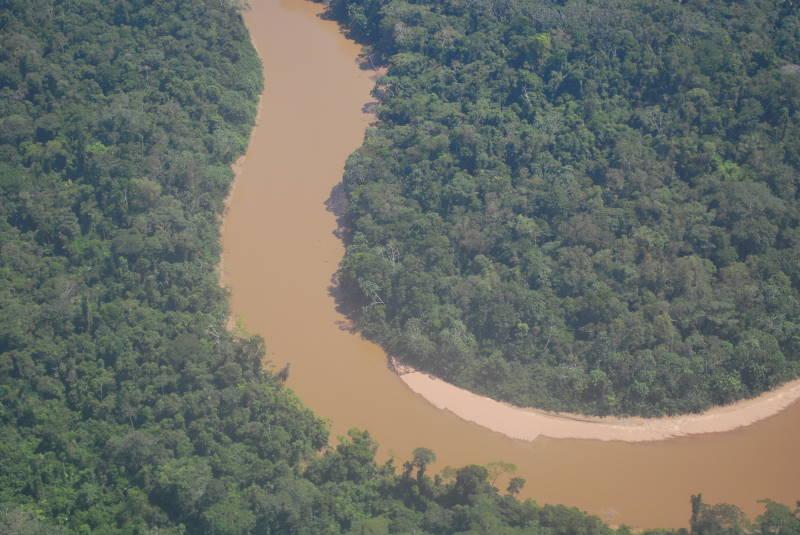
Diego Tirira, the Curaray river from the air, 2012. CC BY-SA 2.0.
The Curaray river, Ecuador, January 1956 · Story · Featured Study
Ecuador 1956 and the Widows
Five missionaries flew in to make friends with a people who had long killed outsiders, and those people killed them within days.
- Where
- Palm Beach on the Curaray, Arajuno, Tewæno, Quito
- Who
- Jim Elliot, Elisabeth Elliot, Rachel Saint, Gikita
- When
- January 1956 to October 1958
One spear driven into the men had pages of a Spanish Testament wrapped around it with Waorani thread.
For whoever wants to save his life will lose it, but whoever loses his life for My sake and for the gospel will save it.
Summary
On Sunday 8 January 1956 Waorani men killed five missionaries on a sandbar in Ecuador. They were Jim Elliot, Nate Saint, Ed McCully, Pete Fleming and Roger Youderian. Elisabeth Elliot, her daughter Valerie and Rachel Saint later went to live with those people. They went in October 1958, to a place called Tewæno.
- Wheaton College put out a larger exhibit on the story in 2026.
- The Wao New Testament came out in June 1992.
- Life printed the story that same month.
The Texts of the Beach
The first bulletins and the later Wao New Testament both reached for Paul.
This study asks how five missionaries came to be killed on the Curaray, why the Waorani did it, and what both sides did after. It gives the five men and their families, the days on the sandbar from the bulletins and the killers' accounts, and each widow's road. It sets out where Steve Saint, the Wheaton College archives and Kathryn Long differ, and it says on what witness each saying stands.
I eagerly expect and hope that I will in no way be ashamed, but will have complete boldness so that now as always Christ will be exalted in my body, whether by life or by death.
Abe Van der Puy, who wrote the mission's bulletins, set Paul's wish over the men in the first bulletin of that week.
Do not avenge yourselves, beloved, but leave room for God’s wrath. For it is written: “Vengeance is Mine; I will repay, says the Lord.”
The Wheaton archives close their account of the Waorani church on this verse, because revenge was what the people had lived by.
Romans 12:19BSB
The Five Men and Their Families
The Wheaton catalogue and the mission's bulletins name each man's mission, his wife and his children.
Three of the men served with Christian Missions in Many Lands, one flew for the Missionary Aviation Fellowship and one served the Gospel Missionary Union.
| The man | Years | His mission | Wife and children named |
|---|---|---|---|
| Jim Elliot | 1927 to 1956 | Christian Missions in Many Lands | Elisabeth; Valerie |
| Nate Saint | 1923 to 1956 | Missionary Aviation Fellowship | Marj; Kathy, Steve, Philip |
| Ed McCully | 1927 to 1956 | Christian Missions in Many Lands | Marilou; Steve, Mike |
| Pete Fleming | Died 1956 | Christian Missions in Many Lands | Olive; no child named |
| Roger Youderian | 1924 to 1956 | Gospel Missionary Union | Barbara; Beth, Jerry |
Steve Saint and the Wheaton archives both count nine children among the five families, and Saint says one of them was still unborn.
From the Flights to the Beach
The story runs from the first sighting to the burial.
The Waorani lived in small kin groups between the Napo and the Curaray. The Wheaton archives put them at 500 to 1,000 people in the mid-twentieth century. Those archives report genealogies of the 1970s and 1980s, with no counter named. They give about 40 percent of adult deaths over five generations to killing among themselves and 20 percent to outside raids.
Dayuma, a Waorani woman who had fled eleven years earlier after her father was speared, gave the men their phrases. She had lost much of the language, and what they shouted from the plane could not be understood.
The pilot's flight journal has the men sighting the Waorani from the air on 29 September 1955. They made twelve flights from 6 October to the year's end. The first gift came back on 12 November.
On Tuesday 3 January Saint flew McCully, Youderian and Elliot onto the sandbar they called Palm Beach, and he brought Fleming the next day. Fleming's diary times the first visit at about a quarter past eleven on Friday 6 January. A man and two women walked out of the forest, and the man took a ride in the plane.
The men's last word by radio came at noon on Sunday 8 January, and the call set for half past four was never made. Early that afternoon six Waorani men and four women reached the beach, by the Wheaton archives' count. Women showed themselves on the far bank, Elliot and Fleming waded out to greet them, and the men with spears came out of the trees.
Those archives have Elliot speared in the river, Fleming on the far shore, and Saint, McCully and Youderian on the sand. The Waorani then burned their own houses and fled, as their custom was after a revenge killing.
The search3 paragraphs
On 9 January the pilot Johnny Keenan found the plane stripped of its fabric, with Barbara Youderian aboard his own. The United States Air Rescue Squadron sent a helicopter, and Frank Drown led a land party of seven named missionaries, thirteen Ecuadorian soldiers and some Indians.
On 12 January Major Nurnberg located four bodies on the beach or in the water. A bulletin of 13 January said five were buried, and the next day's corrected it to four, after an Indian had taken effects from the fifth days earlier.
The land party buried the four together at the foot of the tree house on 13 January. Cornell Capa of Life was with them.
The Widows and the Going Back
The letters at Wheaton show five women taking five roads.
Elisabeth Elliot alone of the five went to live among the Waorani.
| The widow | What she did next | The year on the record |
|---|---|---|
| Elisabeth Elliot | Lived at Tewæno and then worked among the Quichua near Shandia | 1958 to 1961 |
| Marj Saint | Moved to the radio station HCJB in Quito and visited the Waorani with Philip | 1956 and 1959 |
| Marilou McCully | Planned to return to Quito to help run a home for missionaries' children | 1956 |
| Barbara Youderian | Planned to return to her mission work at Macuma | 1956 |
| Olive Fleming | Went home to Seattle and later married Walter Liefeld | 1956 |
Two Waorani women came out of the forest near Arajuno and met Elisabeth Elliot. She could not understand them, so she sent a tape to Dayuma and Nate Saint's sister Rachel in the United States. Dayuma knew them as her aunts Mankumu and Mintaka. The three went back to their kin in 1958, and a few weeks later Dayuma came out with the invitation.
The Wheaton archives say Elisabeth and Rachel's strong personalities and disagreements over method led to persistent conflict. Elisabeth left in December 1961, and Rachel stayed for the rest of her life.
In 1961 several Waorani men professed faith, Yowe of the raiding party among them, and Dr Everett Fuller of HCJB baptized them. At the Berlin congress of 1966 Kimo and Dayuma's husband Come spoke to the church's leaders.
Marj Saint's letter of August 1965 tells of a short service on Palm Beach. Rachel Saint led it with Kimo, one of the men who had killed there. Her children Kathy and Steve were baptized in that river with Oncaye and Iniwa.
Steve Saint writes that by Waorani custom the oldest son was bound to avenge his father, so for years he asked nothing. In 1995, by his article of the next year, Dyuwi, Kimo, Dawa, Gikita and Mincaye spoke openly to him of the killing. He writes that they had nothing to fear from him, since all of them had met God's forgiveness.
The Waorani had by then a martyr of their own. Saint writes that a young man named Tona was speared while carrying the gospel to his relatives downriver.
How the Key Verse Was Taught
Three writers, from the sixth century to Matthew Henry, on losing a life for Christ's sake.
Remigius of Rheims (died 533)
Catena Aurea by Aquinas
Remigius took the life lost here to mean this present life.
“And life is to be taken in this place for the present life, and not for the substance itself of the soul.”
on Mark 8:35Patristic
Gregory the Dialogist (died 604)
Forty Gospel Homilies, Homily 32
Gregory answered the verse with a farmer and his seed.
“For he that will save his life shall lose it; and he that shall lose his life for my sake and the gospel's shall save it. Thus it is said to the faithful: He that will save his life shall lose it; and he that shall lose his life for my sake shall save it. As if it were said to the farmer: If you keep your grain, you lose it; if you sow it, you renew it. For who does not know that when grain is cast as seed, it perishes from sight, it fails in the earth?”
on Mark 8:35Patristic
Matthew Henry (1662 to 1714)
Commentary on the Whole Bible
Matthew Henry set the honour paid to those who die for a prince beside what Christ gives.
“It is looked upon to be some kind of recompence to those who lose their lives in the service of their prince and country, to have their memories honoured and their families provided for; but what is that to the recompence which Christ makes in eternal life to all that die for him?”
on Mark 8:35Puritan
In Their Own Words
A journal, a letter and a narration from the families, and the words of the Waorani as others wrote them down.
Jim Elliot (1927 to 1956)
Journal, 28 October 1949
What he cannot keep
“He is no fool who gives what he cannot keep to gain that which he cannot lose.”
Plymouth Brethren
About this saying1 paragraph
Justin Taylor reports this entry from the journals at Wheaton under 28 October 1949, and Matthew Henry's life of his father gives Philip Henry a saying of the same shape.
A missionary at the river (died 1956)
Reported by Kimo and Gikita, in Christianity Today
Why are you killing us?
“We just came to meet you. We aren't going to hurt you. Why are you killing us?”
Waorani Christian
About this saying1 paragraph
Kimo and Gikita told Steve Saint they understood one of the two men at the river to call this from a log on 8 January 1956, and Saint reads him as Pete Fleming.
Elisabeth Elliot
Letter to her mother, in the Wheaton catalogue
Since Jim left
“I have been quite at peace since Jim left”
Evangelical
About this saying1 paragraph
Elisabeth Elliot wrote this to her mother on 6 January 1956, in a letter on the men's landing and camp, and the Wheaton catalogue carries the sentence.
Marj Saint
The filmstrip Unforgettable Friday, in the Wheaton catalogue
His watch
“I looked at Nate's camera, his airplane keys, the compass, his watch stopped at twelve minutes past three, then his tiny notebook used as a diary during those days and the little black New Testament and Psalms.”
Evangelical
About this saying1 paragraph
Marj Saint spoke this on the filmstrip Unforgettable Friday in 1956, of the things brought back to her from the beach.
Gikita
Reported in Christianity Today
Now let's finish it
“We came to kill them. Now let's finish it or die here ourselves.”
Waorani Christian
About this saying1 paragraph
Gikita, the oldest of the attackers, called this on 8 January 1956 after the younger men began to run, as Steve Saint heard it forty years later.
Gikita
Told to James Yost, in Ethos (2003)
Ceased killing
“After hearing and believing in God, Kemo and I told them not to spear on our behalf, no matter how we died. And we ceased killing others back and forth.”
Waorani Christian
About this saying1 paragraph
Gikita said this to the anthropologist James Yost in 1975, and a journal printed it in 2003, as the Wheaton archives give it.
Where the Witnesses Differ
Those who were there, those who gathered their words and one historian differ on the cause, the guns and the telling.
Why did they kill?2 paragraphs
Steve Saint, from Dawa and the men, holds that Naenkiwi, caught alone with a young girl, told the party the foreigners had attacked him. The older woman came back and denied it, and Gikita, recalling what outsiders had done, held to the attack.
The Wheaton archives put the anger in Nampa, the girl's brother, who resolved to kill the outsiders, whom the Waorani held to be cannibals. Saint himself writes that he finds the attack hard to explain, since the foreigners were a source of knives and pots.
Did the men fire?3 paragraphs
The bulletin says weapons were carried for dire emergency, and the land party found a bullet hole in the windshield. It saw no sign of harm to the Waorani.
Steve Saint writes that the men had vowed to one another not to defend themselves against human attack, and he names no witness to the vow. Kimo showed him a speared man firing into the air, and Dawa told him pellets hit her in hiding, which Saint reads as random warning shots.
Nampa was grazed in the struggle. The Wheaton archives say the wound killed him, and Saint, from Dawa, says he recovered and died about a year later while hunting.
How has the story been told?2 paragraphs
Van der Puy's bulletins of 1956 already set the wives among the people of Hebrews 11. His notes lay behind the Reader's Digest article of August that year, and Harper published Elisabeth Elliot's Through Gates of Splendor in May 1957.
Kathryn Long, in God in the Rainforest (Oxford, 2019), writes as First Things quotes her that the spread of Christianity is "complicated, even messy", more so than "either mythmakers or critics" allow. Her reviewer Lucy Austen says Long shows the details kept making a triumphal story and those laid aside conveying complexity. No answer to her from Steve Saint was found.
What did it do to the Waorani?2 paragraphs
Gikita told Yost that when young men killed his sister he refused to spear for her. He added, "Had I not believed, they would all be dead now." The Wheaton archives say the faith brought an end to the revenge killings for many at Tewæno.
Long, as a review by Madeline Arthington quotes her, writes that "for a time Christianity was practiced as little more than a means of social control". She names polio among the sufferings of the crowded settlement. The same archives list food scarcity, land disputes, forced relocations and contact diseases.
Books to Read Next
To Carry the Light Further
Wheaton College Archives · 2026
Wheaton's archivists set out the letters, film and photographs here.
Read the exhibit free at WheatonDid They Have to Die?
Steve Saint · 1996
The pilot's son gives the attackers' own account of the afternoon.
Read Saint free at Christianity TodayReport on Attempt to Establish Friendly Contact with Auca Indians
Abe Van der Puy · 1956
The bulletins were written in Ecuador during the search.
Read the bulletins free at WheatonWhat the Beach Left
The Wao New Testament gives its verse on vengeance as "Itota beyas, tsenonamai". The Wheaton archives put that into English as "On behalf of Jesus, do not spear".
Sources
Scripture is the Berean Standard Bible.
- The Holy Bible, Berean Standard Bible (read 2026)
- To Carry the Light Further: exhibit and catalogue, Wheaton College Archives and Special Collections (expanded 2026)
- Abe Van der Puy, Report on Attempt to Establish Friendly Contact with Auca Indians, bulletins of January 1956.
- Steve Saint, "Did They Have to Die?", Christianity Today, 16 September 1996.
- Life, 30 January 1956, the feature on the five men.
- Justin Taylor, on Jim Elliot's journal entry of 28 October 1949, The Gospel Coalition, 8 January 2016.
- Matthew Henry, An Account of the Life and Death of Mr. Philip Henry (third edition, 1712)
- Kathryn Long, God in the Rainforest (Oxford University Press, 2019), as First Things quotes her; the book was not opened.
- Lucy S. R. Austen, review of Kathryn Long, God in the Rainforest, The Gospel Coalition.
- Madeline Arthington on God in the Rainforest, International Mission Board, in the churchleaders.com copy.