
Mark 4:37
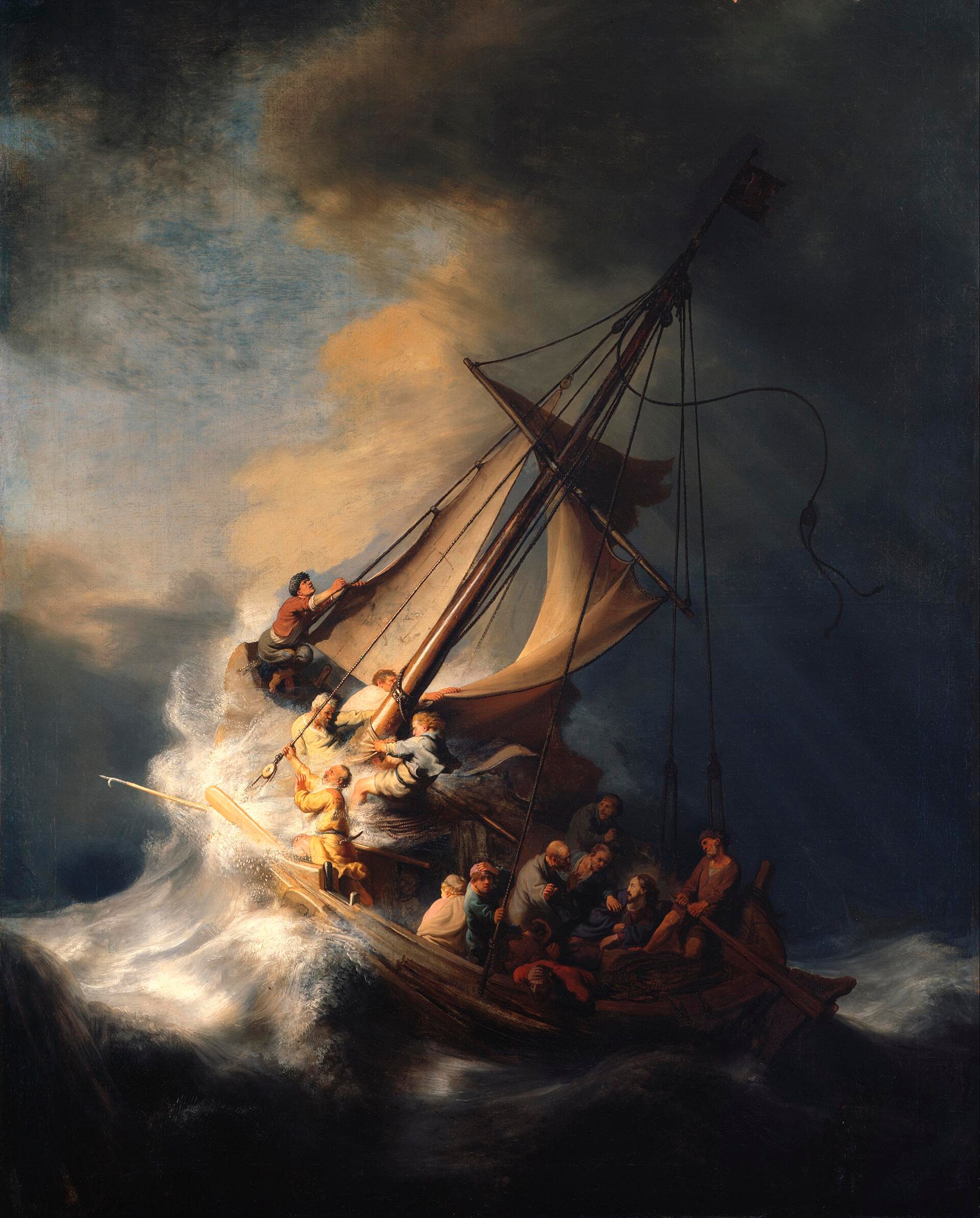
in Mark 4Soon a violent windstorm came up, and the waves were breaking over the boat, so that it was being swamped.
BSB
The same verse in ASV and KJV ▾
ASV
And there ariseth a great storm of wind, and the waves beat into the boat, insomuch that the boat was now filling.
KJV
And there arose a great storm of wind, and the waves beat into the ship, so that it was now full.
⋯
This verse in Mark 4
Commentary
14 notes on this verseAnd a great storm of wind arose, and the waves were beating into the boat, so that the boat was already filling. And he was in the stern, asleep on the cushion. While the disciples were sailing, Christ fell asleep, because when the faithful trample …
This site's exposition
a violent windstorm came up
on Mark 4:37-38
Soon a violent windstorm came up, and the waves were breaking over the boat, the kind of sudden squall the basin of the Sea of Galilee produces. Jesus was in the stern, sleeping on the cushion, a detail Mark alone keeps. The disciples wake Him with a charge of neglect, Teacher, don’t You care that we are perishing, fear reading indifference into His rest.
The record, by era
The Church Fathers1 voice
(Hom. in Matt. 28) The Lord took the disciples indeed, that they might be spectators of the miracle which was coming, but He took them alone, that no others might see that they were of such little faith. Wherefore, to show that others went across separately, it is said, And there were also with him other ships. Lest again the disciples might be proud of being alone taken, He permits them to be in danger; and besides this, in order that they might learn to bear temptations manfully. Wherefore it goes on, And there arose a great storm of wind; and that He might impress upon them a greater sense of the miracle which was to be done, He gives time for their fear, by sleeping. Wherefore there follows, And he was himself in the hinder part of the ship, &c. For if He had been awake, they would either not have feared, nor have asked Him to save them when the storm arose, or they would not have thought that He could do any such things. (Hom. in Matt. 28) showing His humility, and thus teaching us many lessons of wisdom. But not yet did the disciples who remained about Him know His glory; they thought indeed that if He arose He could command the winds, but could by no means do so reposing or asleep. And therefore there follows, And they awake him, and say unto him, Master, carest thou not that we perish?
The Medieval Church4 voices
(ubi sup.) Or else the ship into which He embarked, is taken to mean the tree of His passion, by which the faithful attain to the security of the safe shore. The other ships which are said to have been with the Lord, signify those, who are imbued with faith in the cross of Christ, and are not beaten about by the whirlwind of tribulation; or who, after the storms of temptation, are enjoying the serenity of peace.
After His teaching, they come from that place to the sea, and are tossed by the waves. Wherefore it is said, And the same day, when the even was come, &c. Mystically, however, the hinder part of the ship is the beginning of the Church, in which the Lord sleeps in the body only, for He never sleepeth who keepeth Israel; for the ship with its skins of dead animals keeps in the living, and keeps out the waves, and is bound together by wood, that is, by the cross and the death of the Lord the Church is saved. The pillow is the body of the Lord, on which His Divinity, which is as His head, has come down. But the wind and the sea are devils and persecutors, to whom He says Peace, when He restrains the edicts of impious kings, as He will. The great calm is the peace of the Church after oppression, or a contemplative after an active life.
But so that they would not become proud because He sent the others away and took them, and at the same time, to teach them to endure dangers, He allows them to be in danger from the storm.
Therefore He allowed them to fall into the fear of danger, that they might experience His power in themselves, who saw others benefitted by Him.
7 more voices on this verse
The Puritans and the Awakening3 voices
And there arose a great storm of wind,.... Called Laelaps, a wind that is suddenly whirled about upwards and downwards, and is said to be a storm, or tempest of wind with rain; it was a sort of a hurricane: and the waves beat into the ship, so that it was full; of water, and ready to sink. Beza says in one copy it read, βυθιζεσθαι, and so in one of Stephens's.
11 And he said unto them, Unto you it is given to know the mystery of the kingdom of God: but unto them that are without, all these things are done in parables: 12 That seeing they may see, and not perceive; and hearing they may hear, and not understand; lest at any time they should be converted, and their sins should be forgiven them.
quarantine:scripture (2026-07-29) — verbatim-scripture
When Christ seems as if he slept in a storm, he is awaked by the prayers of his people; when we know not what to do, our eye must be to him ( 2 Chron. xx. 12 ); we may be at our wits' end, but not at our faith's end, while we have such a Saviour to go to. Their address to Christ is here expressed very emphatically;
The Nineteenth Century4 voices
A commentator
J.C. Ryle1816–1900
Expository Thoughts on the Gospels: Mark (lightly modernized text, Grace Gems edition) (1857)
These verses describe a storm on the sea of Galilee, when our Lord and His disciples were crossing it, and a miracle performed by our Lord in calming the storm in a moment. Few miracles recorded in the Gospel were so likely to strike the minds of the apostles as this. Four of them at least were fishermen. Peter, Andrew, James, and John, had probably known the sea of Galilee, and its storms, from their youth. Few events in our Lord's journeyings to and fro upon earth, contain more rich instruction than the one related in this passage.
A commentator
Jamieson, Fausset & Brown1802–1910
Commentary Critical and Explanatory on the Whole Bible (1871)
It should be, "so that the ship was getting covered by the waves." So we must translate the word used in Luke (Lu 8:23) --not as in our version--"And there came down a storm on the lake, and they were filled [with water]"--but "they were getting filled," that is, those who sailed; meaning, of course, that their ship was so.
A commentator
J.C. Ryle1816–1900
Expository Thoughts on the Gospels: Mark (lightly modernized text, Grace Gems edition) (1857)
proposed
These verses describe a storm on the sea of Galilee, when our Lord and His disciples were crossing it, and a miracle performed by our Lord in calming the storm in a moment. Few miracles recorded in the Gospel were so likely to strike the minds of the apostles as this. Four of them at least were fishermen. Peter, Andrew, James, and John, had probably known the sea of Galilee, and its storms, from their youth. Few events in our Lord's journeyings to and fro upon earth, contain more rich instruction than the one related in this passage. Let us learn, in the first place, that Christ's service does not exempt His servants from storms . Here were the twelve disciples in the path of duty. They were obediently following Jesus, wherever He went. They were daily attending on His ministry, and hearkening to His word. They were daily testifying to the world, that, whatever Scribes and Pharisees might think, they believed on Jesus, loved Jesus, and were not ashamed to give up all for His sake. Yet here we see these men in trouble, tossed up and down by a tempest, and in danger of being drowned. Let us mark well this lesson. If we are true Christians, we must not expect everything smooth in our journey to heaven. We must count it no strange thing, if we have to endure sicknesses, losses, bereavements, and disappointments, just like other men. Free pardon and full forgiveness, grace along the way, and glory at the end — all this our Savior has promised to give. But He has never promised that we shall have no affliction. He loves us too well to promise that. By affliction He teaches us many precious lessons, which without it we should never learn. By affliction He shows us our emptiness and weakness, draws us to the throne of grace, purifies our affections, weans us from the world, makes us long for heaven.
A great storm of wind - See on Mat 8:24 (note).
The words behind it
17 Greek wordsEvery Greek word of this verse in the order it stands, with what it means and the door to its own study. The last column counts the times a word stands in the whole Bible: the rarer the word, the more the places it appears belong together.
| Greek | Sound | Meaning | Word study | In the Bible |
|---|---|---|---|---|
| καὶ | kai | And | G2532 → | 9120 times |
| γίνεται | ginetai | comes | G1096 → | 667 times |
| λαῖλαψ | lailaps | a storm | G2978 → | |
| μεγάλη | megale | violent | G3173 → | 243 times |
| ἀνέμου, | anemou | of wind | G417 → | 31 times |
| καὶ | kai | And | G2532 → | 9120 times |
| τὰ | ta | the | G3588 → | 19766 times |
| κύματα | kumata | waves | G2949 → | |
| ἐπέβαλλεν | epeballen | were breaking | G1911 → | 18 times |
| εἰς | eis | over | G1519 → | 1755 times |
| τὸ | to | the | G3588 → | 19766 times |
| πλοῖον | ploion | boat | G4143 → | 67 times |
| ὥστε | hoste | so that | G5620 → | 83 times |
| ἤδη | ede | already | G2235 → | 61 times |
| γεμίζεσθαι | gemizesthai | is being filled up | G1072 → | |
| τὸ | to | the | G3588 → | 19766 times |
| πλοῖον. | ploion | boat. | G4143 → | 67 times |
καὶAnd
kaiG2532 →9120 times
γίνεταιcomes
ginetaiG1096 →667 times
λαῖλαψa storm
lailapsG2978 →
μεγάληviolent
megaleG3173 →243 times
ἀνέμου,of wind
anemouG417 →31 times
καὶAnd
kaiG2532 →9120 times
τὰthe
taG3588 →19766 times
κύματαwaves
kumataG2949 →
ἐπέβαλλενwere breaking
epeballenG1911 →18 times
εἰςover
eisG1519 →1755 times
τὸthe
toG3588 →19766 times
πλοῖονboat
ploionG4143 →67 times
ὥστεso that
hosteG5620 →83 times
ἤδηalready
edeG2235 →61 times
γεμίζεσθαιis being filled up
gemizesthaiG1072 →
τὸthe
toG3588 →19766 times
πλοῖον.boat.
ploionG4143 →67 times
A shaded row is a word that stands 400 times or fewer in the Bible.
The walk
8 stopsEach card is a verse this one points to, and under it the verses that one points to in turn. Where several paths arrive at the same place, that place is listed first: the text keeps returning to it.
Through
Jonah 1:4Then the LORD hurled a great wind upon the sea, and such a violent storm arose that the ship was in danger of breaking apart.
it leads to
- Psalms 107:23–31
Others went out to sea in ships, conducting trade on the mighty waters.
- Matthew 8:24–27
Suddenly a violent storm came up on the sea, so that the boat was engulfed by the waves; but Jesus was sleeping.
- Exodus 14:21
Then Moses stretched out his hand over the sea, and all that night the LORD drove back the sea with a strong east wind that turned it into dry land. So the waters were…
- Amos 4:13
For behold, He who forms the mountains, who creates the wind and reveals His thoughts to man, who turns the dawn to darkness and strides on the heights of the earth—the LORD, the God…
- Psalms 135:7
He causes the clouds to rise from the ends of the earth. He generates the lightning with the rain and brings forth the wind from His storehouses.
- Psalms 107:23–31
Through
Job 1:19when suddenly a mighty wind swept in from the desert and struck the four corners of the house. It collapsed on the young people and they are dead, and I alone have escaped to…
it leads to
- 2 Samuel 18:33
The king was shaken and went up to the gate chamber and wept. And as he walked, he cried out, “O my son Absalom! My son, my son Absalom! If only I had died…
- Jeremiah 4:11–12
At that time it will be said to this people and to Jerusalem, “A searing wind from the barren heights in the desert blows toward the daughter of My people, but not to winnow…
- Luke 13:1–5
At that time some of those present told Jesus about the Galileans whose blood Pilate had mixed with their sacrifices.
- 2 Samuel 18:33
Where this verse is studied
About Mark
This page draws on 13 works. Open the list of works
This page draws on Adam Clarke, Commentary on the Bible; Albert Barnes, Notes, Explanatory and Practical, on the Gospels; Bede, On the Gospel of Mark; Bede, Catena Aurea by Aquinas; J. C. Ryle, Expository Thoughts on the Gospels, Mark; J.C. Ryle, Expository Thoughts on the Gospels: Mark (lightly modernized text, Grace Gems edition); Jamieson, Fausset & Brown, Commentary Critical and Explanatory on the Whole Bible; John Chrysostom, Catena Aurea by Aquinas; John Gill, Exposition of the New Testament (1746-1748); Matthew Henry, Commentary on the Whole Bible; Pseudo-Jerome, Catena Aurea by Aquinas; Theophylact of Ohrid, Commentary on Mark and Theophylact of Ohrid, Catena Aurea by Aquinas.