
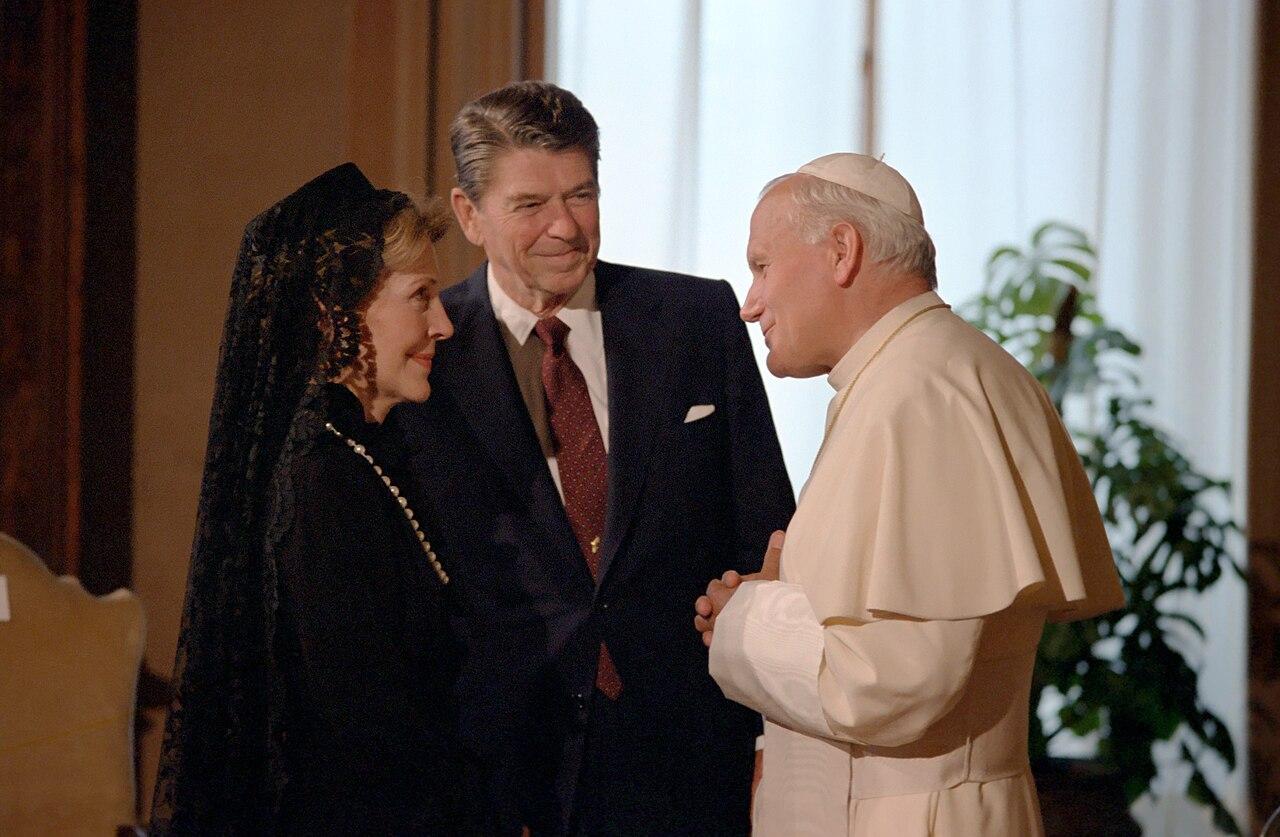
White House Photographic Office, 7 June 1982, public domain
Poland and Rome, 1920 to 2005 · Person · Featured Study
Pope John Paul II
The Archbishop of Krakow was elected pope and served for over twenty-six years.
- Born
- 18 May 1920, at Wadowice in Poland (probable)
- Died
- 2 April 2005, at the age of 84 (probable)
- Family
- father: Karol Wojtyla; mother: Emilia Kaczorowska; brother: not named, the eldest
- Places
- Wadowice, Krakow, Lublin, Rome, Washington
Two years after a gunman shot him in St Peter's Square, the pope visited the man in prison and forgave him.
He has shown you, O man, what is good. And what does the LORD require of you but to act justly, to love mercy, and to walk humbly with your God?
Summary
Karol Wojtyla grew up in Poland and came of age while the Nazis held it. He studied in secret to be a priest, and he was made one in 1946. He taught at Lublin and then led the church of Krakow under Communist rule. In 1978 he became the first Slavic pope. He went to 130 countries and died after a long illness.
- A Senate resolution sets out his life for the United States Senate.
- Margaret Thatcher and Mikhail Gorbachev credited him with a part in the end of Communist rule in Europe.
- Mehmet Ali Agca shot him, and the pope later visited him in prison and forgave him.
The Verses of His Calling
He began his White House address with Micah, and his first sermon ended its appeal with the words of Jesus on the sea.
At the White House on 6 October 1979 he told President Carter, "I take the liberty of beginning with the passage from the Prophet Micah". The appeal of his first sermon as pope closed with the words "Do not be afraid", the words Jesus spoke to the disciples on the sea.
The question of this life is how a priest who lived under two occupations came to stand, as pope, before the governments of East and West. The account below follows the record the United States kept, which printed his words and honoured him at his death.
But Jesus spoke up at once: “Take courage! It is I. Do not be afraid.”Jesus spoke this to the disciples in the boat as He came to them on the water.
The Life in Order
The dates follow the Senate and the House as they honoured him.
Thirty-two years as priest and bishop came before twenty-six years as pope.
- 18 May 1920Born at WadowiceS. Res. 94
- 1939Enrolled at the JagiellonianS. Res. 94
- 1942Arrested and sparedS. Res. 94
- 1 November 1946Ordained a priestRepresentative Higgins
- 1958Auxiliary bishop of KrakowRepresentative Gonzalez
- January 1964Archbishop of KrakowRepresentative Gonzalez
- 26 June 1967CardinalRepresentative Higgins
- 16 October 1978Elected popeS. Res. 94
- June 1979Nine days in PolandS. Res. 94
- 6 October 1979Received by President CarterPresidential Documents
- 13 May 1981Shot in St Peter's SquareSenator McConnell
- 1986First World Youth DayRepresentative Jones
- March 2000Asked forgivenessRepresentative Evans
- 2 April 2005DiedS. Res. 94
Each step of the life stands with its witness in the public record.
26 June 1967, 16 October 1978, June 1979, 6 October 1979, 13 May 1981, 1986, March 2000, 2 April 2005
From Wadowice to Rome
A student in occupied Krakow became a priest, a teacher and a bishop, and then the bishop of Rome.
He was born Karol Jozef Wojtyla at Wadowice to a father of the same name and to Emilia Kaczorowska, and he lost his mother, his eldest brother and his father before he was twenty-one.
He entered the Jagiellonian University in Krakow in 1939, and the Nazis closed it. The resolution says he was arrested in 1942 and spared because his work in a limestone quarry was held essential to the war. He helped found the underground Rhapsodic Theatre and studied in the clandestine seminary of Archbishop Sapieha. President Bush later said that he "eluded the Gestapo to attend an underground seminary".
The Communist government that followed the Nazis put religious liberty under its control. As a priest he became professor of ethics and chaplain at the Catholic University of Lublin. The resolution calls it the only Catholic university behind the Iron Curtain. He rose to be Archbishop of Krakow and then a cardinal.
He was elected pope in October 1978, the first Slavic pope and the first pope from outside Italy in more than four hundred years. In June 1979 he went home to Poland, and Representative Holt quoted his prayer there for the Spirit to "come and renew the face of the earth."
On 13 May 1981 Mehmet Ali Agca shot him as he rode through St Peter's Square. Senator McConnell said that two years later the pope visited Agca in an Italian prison and spoke with him face to face.
He began World Youth Day in 1986 and travelled widely. In his last years Parkinson's disease weakened him until his death.
Poland Under Two Occupations
The resolution sets his life against the Nazi and the Communist rule of his country.
The resolution says the Nazi occupation sent many of his professors and friends, and millions of Polish Jews, to camps where they were murdered. It records that he risked his life to protect Polish Jews and wrote two religious plays the Nazis counted subversive.
Back in Poland he often cited the Second Vatican Council's teaching that religious freedom was "the first of human rights", and the resolution says Polish Catholics took up the phrase against the Communist government.
Representative Evans counted twenty million Poles who greeted him on that first visit home. The resolution quotes Margaret Thatcher, that he provided "the main impetus for the revival of Solidarity", the free trade union of Poland. It quotes Mikhail Gorbachev, that what happened in Eastern Europe "would have been impossible without this Pope".
Read Brother Andrew, who carried Bibles behind the Iron Curtain
In Their Own Words
Five sayings as documents of the United States government print them.
Pope John Paul II (1920 to 2005)
words quoted in Senate Resolution 94, Honoring Pope John Paul II, 4 April 2005, page 5546
My first seminary
“Sometimes I would wake up during the night and find my father on his knees”
Catholic
About this saying1 paragraph
He spoke of his father's prayer after his mother's death, as Senate Resolution 94 quotes him on 4 April 2005.
Pope John Paul II
the inaugural sermon, October 1978, as quoted in Senate Resolution 94, 4 April 2005, page 5547
Do not be afraid
“open the boundaries of states, economic and political systems, the vast fields of culture, civilization, and development. Do not be afraid.”
Catholic
About this saying1 paragraph
The Senate prints these words from the end of his inaugural address of 1978.
Pope John Paul II
a prayer in Poland, June 1979, as quoted by Representative Holt in the Congressional Record, April 2005, page 5748
He prayed that the Spirit would renew the face of the earth.
“come and renew the face of the earth.”
Catholic
About this saying1 paragraph
He prayed this on his first visit to Poland as pope in 1979, as Representative Holt quoted him in the Congressional Record in April 2005.
Pope John Paul II
remarks at the White House, 6 October 1979, page 1828
The first pope in Washington
“It gives me great joy to be the first Pope in history to come to the Capital of this Nation, and I thank Almighty God for this blessing.”
Catholic
About this saying1 paragraph
He said this at the White House on 6 October 1979, as the Weekly Compilation of Presidential Documents prints it.
Pope John Paul II
words after his visit to Mehmet Ali Agca, as quoted in Senate Resolution 94, 4 April 2005, page 5547
A brother whom I have forgiven
“I spoke to him as I would speak to a brother whom I have forgiven and who enjoys my confidence”
Catholic
About this saying1 paragraph
He said this after he visited Mehmet Ali Agca in prison, and the Senate's resolution of 2005 gives the words.
The People Around Him
The record names his parents, the archbishop who trained him, the man who shot him and the leaders who spoke of him.
His father's prayer stands first in the record of his life.
| Person | Tie to John Paul II | The witness |
|---|---|---|
| Karol Wojtyla | His father, whose prayer he remembered. | S. Res. 94 |
| Emilia Kaczorowska | His mother, who died when he was nine. | Representative Beauprez |
| Archbishop Sapieha | Archbishop of Krakow, head of the secret seminary. | S. Res. 94 |
| Mehmet Ali Agca | Named by Senator McConnell as the man who fired. | Senator McConnell |
| Jimmy Carter | Received him in Washington. | Weekly Compilation, page 1832 |
| Ronald Reagan | Met him before his visit to Poland in 1987. | S. Res. 94 |
| Mikhail Gorbachev | Credited him with the change in Eastern Europe. | S. Res. 94 |
The Places of His Life
His life ran from a Polish town to Rome, and his journeys took him across the world.
Krakow held his university, his seminary and his see.
| Place | What the record says | The witness |
|---|---|---|
| Wadowice | His birthplace. | S. Res. 94 |
| Krakow | His university, his seminary and his see. | S. Res. 94; Representative Gonzalez |
| Lublin | The Catholic university where he taught ethics. | S. Res. 94 |
| Rome | St Peter's Square, where he was shot. | Senator McConnell |
| Washington | The first papal visit to the capital. | His own remarks of 6 October |
| Cuba | His visit of 1998, with a call for freedom. | S. Res. 94 |
What the Record Honours
The Senate named his forgiveness, his reach to other faiths and his witness through illness.
The resolution says he gave "a remarkable example of the power of grace" when he visited the man who shot him. It records the first papal visits to synagogues and mosques.
It closes his life with his illness. The Senate wrote that he died "after heroically proclaiming the value and dignity of human life through his long physical illness and suffering".
How the Key Verse Was Taught
Augustine, Matthew Henry and John Wesley read what the Lord requires.
Augustine of Hippo (died 430)
SERMON 48:2
Augustine preached that the offering God seeks is the worshipper himself.
“You ask what you should offer: offer yourself. For what else does the Lord seek of you but you? Because of all earthly creatures he has made nothing better than you, he seeks yourself from yourself, because you have lost yourself.”
on Micah 6:8Patristic
Matthew Henry (1662 to 1714)
Commentary on the Whole Bible
Matthew Henry taught that mercy is to be loved and that justice comes before it.
“We must love mercy; we must delight in it, as our God does, must be glad of an opportunity to do good, and do it cheerfully. Justice is put before mercy, for we must not give that in alms which is wrongfully got, or with which our debts should be paid.”
on Micah 6:8Puritan
John Wesley (1703 to 1791)
Explanatory Notes upon the Old Testament
John Wesley read the verse as a call to keep company with God by faith.
“Keep up a constant fellowship with God, by humble, holy faith.”
on Micah 6:8Evangelical
What the Record Leaves Open
The record gives two accounts of his family and two of the apology he made in 2000.
The children of the familySenate Resolution 94; Representative Visclosky
The Senate resolution calls him "the youngest of 3 children". Representative Visclosky told the House that he was the second son of his parents. The page follows the resolution and names one brother, the eldest.
What the apology of 2000 namedSenate Resolution 94; Representative Evans
The resolution speaks of his sadness and regret "for the individual acts of present and former Catholics who persecuted members of other faiths". Representative Evans wrote in the Congressional Record that in March 2000 "he asked forgiveness for many of his church's past sins". The first account places the fault in Catholics, and the second in the church.
Books to Read Next
Congressional Record, volume 151, part 4
The United States Congress · 2005
It holds Senate Resolution 94 and the House's statements on his death.
Read the volume free at the Internet ArchiveWeekly Compilation of Presidential Documents, volume 15, number 41
Office of the Federal Register · 1979
It prints his remarks and the President's welcome in full.
Read the issue free at the Internet ArchiveWhat John Paul II Left
He left the record of a forgiven assassin and the young people's gathering he began. President Bush recalled that on his first day as pope the square "rang with his words" when he told the crowd not to be afraid.
Sources
Scripture is the Berean Standard Bible.
- The Holy Bible, Berean Standard Bible (read 2026)
- Senate Resolution 94, Honoring Pope John Paul II, 4 April 2005, Congressional Record, volume 151, part 4, pages 5546 to 5547.
- Statements in the House on H. Res. 190 and in the Senate, in the bound Record of that month, volume 151, parts 4 and 5 (Representatives Higgins, Gonzalez, Visclosky, Beauprez, Jones, Holt and Evans; Senator McConnell)
- Weekly Compilation of Presidential Documents, volume 15, number 41, the visit of Pope John Paul II, 6 October 1979, pages 1827 to 1835.
- The President's radio address of 9 April 2005, printed in the Weekly Compilation for that week, number 15 of volume 41, page 583.
- Augustine of Hippo, Sermon 48.
- John Wesley, Explanatory Notes upon the Old Testament, on Micah 6:8.
- Matthew Henry, Commentary on the Whole Bible, on Micah 6:8.
Keep Studying
People and groups8
Church history1
Trials of life1