
Genesischapter 32
32 verses · Moses, by tradition · 15th to 13th century BC · The Law
The section titles are this site's own.
A.Esau Comes with Four Hundred Menvv. 1-8
Jacob sent messengers ahead of him to his brother Esau in the land of Seir, the country of Edom. He instructed them, “You are to say to my master Esau, ‘Your servant Jacob says: I have been staying with Laban and have remained there until now. I have oxen, donkeys, flocks, menservants, and maidservants. I have sent this message to inform my master, so that I may find favor in your sight.’” When the messengers returned to Jacob, they said, “We went to your brother Esau, and now he is coming to meet you—he and four hundred men with him.” In great fear and distress, Jacob divided his people into two camps, as well as the flocks and herds and camels. He thought, “If Esau comes and attacks one camp, then the other camp can escape.”
B.Jacob Prays for Deliverancevv. 9-12
Then Jacob declared, “O God of my father Abraham, God of my father Isaac, the LORD who told me, ‘Go back to your country and to your kindred, and I will make you prosper,’ I am unworthy of all the kindness and faithfulness You have shown Your servant. Indeed, with only my staff I came across the Jordan, but now I have become two camps. Please deliver me from the hand of my brother Esau, for I am afraid that he may come and attack me and the mothers and children with me. But You have said, ‘I will surely make you prosper, and I will make your offspring like the sand of the sea, too numerous to count.’”
C.A Present Sent Ahead in Drovesvv. 13-21
Jacob spent the night there, and from what he had brought with him, he selected a gift for his brother Esau: 200 female goats, 20 male goats, 200 ewes, 20 rams, 30 milk camels with their young, 40 cows, 10 bulls, 20 female donkeys, and 10 male donkeys. He entrusted them to his servants in separate herds and told them, “Go on ahead of me, and keep some distance between the herds.” He instructed the one in the lead, “When my brother Esau meets you and asks, ‘To whom do you belong, where are you going, and whose animals are these before you?’ then you are to say, ‘They belong to your servant Jacob. They are a gift, sent to my lord Esau. And behold, Jacob is behind us.’” He also instructed the second, the third, and all those following behind the herds: “When you meet Esau, you are to say the same thing to him. You are also to say, ‘Look, your servant Jacob is right behind us.’” For he thought, “I will appease Esau with the gift that is going before me. After that I can face him, and perhaps he will accept me.” So Jacob’s gifts went on before him, while he spent the night in the camp.
D.Wrestling Until the Break of Dayvv. 22-32
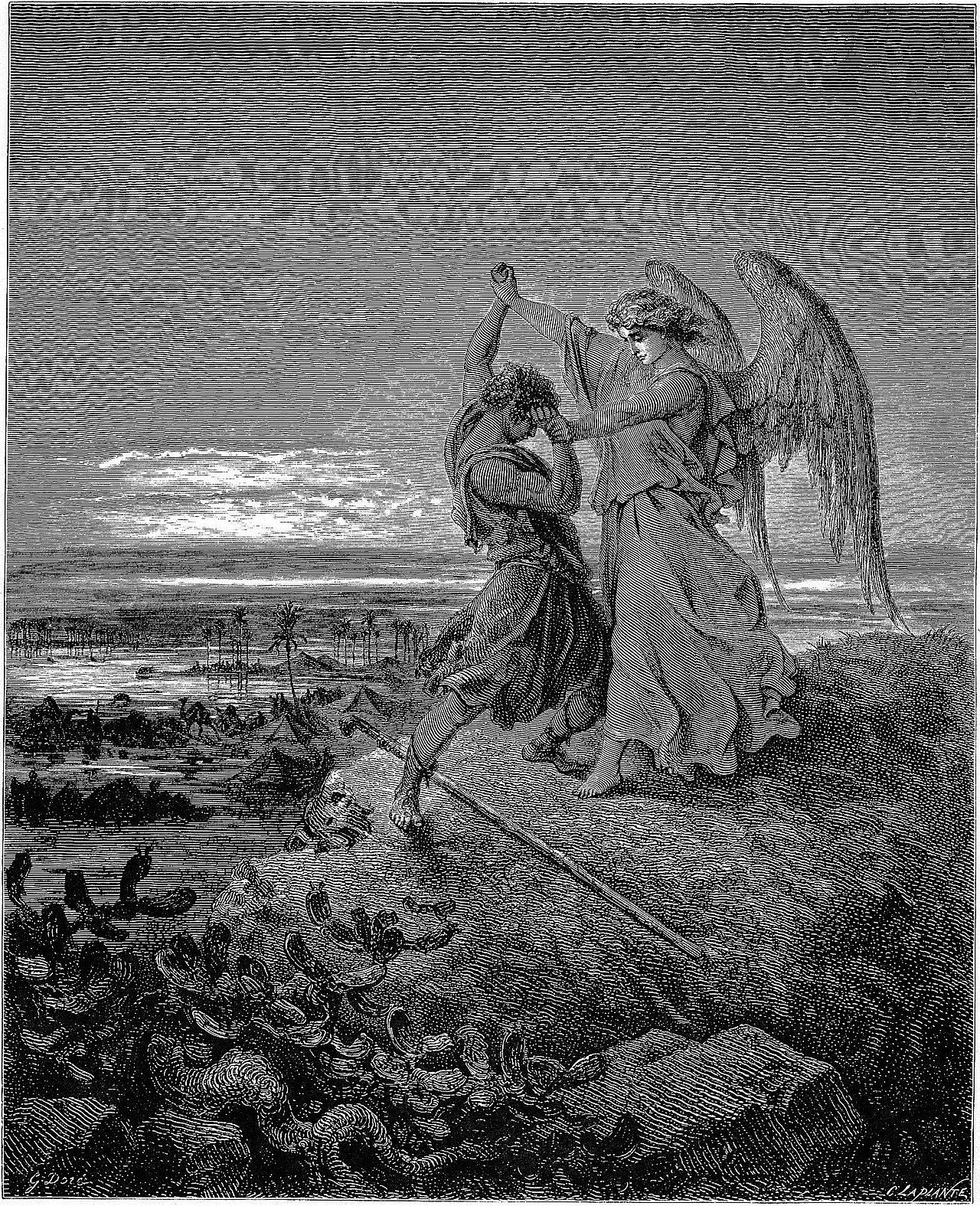
During the night Jacob got up and took his two wives, his two maidservants, and his eleven sons, and crossed the ford of the Jabbok. He took them and sent them across the stream, along with all his possessions. So Jacob was left all alone, and there a man wrestled with him until daybreak. When the man saw that he could not overpower Jacob, he struck the socket of Jacob’s hip and dislocated it as they wrestled. Then the man said, “Let me go, for it is daybreak.” But Jacob replied, “I will not let you go unless you bless me.” “What is your name?” the man asked. “Jacob,” he replied. Then the man said, “Your name will no longer be Jacob, but Israel, because you have struggled with God and with men, and you have prevailed.” And Jacob requested, “Please tell me your name.” But he replied, “Why do you ask my name?” Then he blessed Jacob there. So Jacob named the place Peniel, saying, “Indeed, I have seen God face to face, and yet my life was spared.” The sun rose above him as he passed by Penuel, and he was limping because of his hip. Therefore to this day the Israelites do not eat the tendon which is at the socket of the hip, because the socket of Jacob’s hip was struck near that tendon.