
Ephesians 4:12
in Ephesians 4to equip the saints for works of ministry and to build up the body of Christ,
BSB
The same verse in ASV and KJV ▾
ASV
for the perfecting of the saints, unto the work of ministering, unto the building up of the body of Christ:
KJV
For the perfecting of the saints, for the work of the ministry, for the edifying of the body of Christ:
⋯
This verse in Ephesians 4
Commentary
12 notes on this verseFor the perfecting of the saints - For the complete instruction, purification, and union of all who have believed in Christ Jesus, both Jews and Gentiles. For the meaning of καταρτισμος, perfecting, see the note on 2Co 13:9. For the work of the ministry - All these various officers, and the gifts and graces conferred upon them, were judged necessary, by the great Head of the Church, for its full instruction in the important doctrines of Christianity. The same officers and gifts are still necessary, and God gives them; but they do not know their places.
This site's exposition
for the perfecting of the saints, for the work of the ministry, for the edifying of the body of Christ
Perfecting translates katartismos, the same root Galatians 6:1 uses for restoring a fallen brother and Mark 1:19 for mending torn nets, equipping and setting right rather than a single finished completion. The three purposes named, perfecting the saints, the work of the ministry, and edifying the body, are read two ways: either the gifted offices of verse eleven do all three themselves, or they equip the saints for the work of the ministry, so that the saints themselves do the work that edifies the body. The second reading has gathered wide support because it matches the body language of verse sixteen, where every joint supplieth rather than the head alone.
The record, by era
The Church Fathers2 voices
He says that the church's order has been so formed as to join the human race together in the profession of unity, so that all may be in Christ, having Christ as their single head, that is, as the source of life.
What he said elsewhere, "Wherefore also God hath highly exalted Him," that saith he also here. "He that descended, is the same also that ascended." It did Him no injury that He came down into the lower parts of the earth, nor was it any hindrance to His becoming far higher than the Heavens. So that the more a man is humbled, so much the more is he exalted. For as in the case of water, the more a man presses it downwards, the more he forces it up; and the further a man retires to hurl a javelin, the surer his aim; so is it also with humility. However, when we speak of ascents with reference to God, we must needs conceive a descent first; but when with reference to man, not at all so. Then he goes on to show further His providential care, and His wisdom, for He who hath wrought such things as these, who had such might, and who refused not to go down even to those lower parts for our sakes, never would He have made these distributions of spiritual gifts without a purpose. Now elsewhere he tells us that this was the work of the Spirit, in the words, "In the which the Holy Ghost hath made you bishops to feed the Church of God." And here he saith that it is the Son; and elsewhere that it is God. "And He gave to the Church some apostles, and some prophets." But in the Epistle to the Corinthians, he saith, "I planted, Apollos watered; but God gave the increase." And again, "Now he that planteth and he that watereth are one: but each shall receive his own reward according to his own labor." So is it also here; for what if thou bring in but little? Thou hast received so much. […]
The Medieval Church2 voices
Do you see what dignity this is? Each one speaks, acts, each one serves the edification of the Body of Christ, or the Church. Why then do you grieve, as one who has received a lesser gift? For even you contribute to the "perfecting of …
Next, he discloses the fruitful results of these gifts or functions. The proximate effects of the above mentioned gifts or functions are threefold. First, consider those who are placed in these functions; spiritual gifts are communicated to them that they might be at the service …
The Puritans and the Awakening1 voice
For the perfecting of the saints, The chosen ones, whom God has sanctified or set apart for himself in eternal election: the ministry of the word is designed for the completing the number of these in the effectual calling; and for the perfecting of the whole body of the church, by gathering in all that belong to it, and of every particular saint, who is regenerated and sanctified by the Spirit of God: for the best of saints are imperfect; for though there is a perfection in them, as that designs sincerity, in opposition to hypocrisy, and as it may be taken comparatively with respect to what others are, or they themselves were; and though there is a perfection of parts of the new man in them, yet not of degrees; and though there is a complete perfection in Christ, yet not in themselves, their sanctification is imperfect, as their faith, knowledge, love, &c. […]
5 more voices on this verse
The Puritans and the Awakening1 voice
Captivity is here put for captives, and signifies all our spiritual enemies, who brought us into captivity before. He conquered those who had conquered us; such as sin, the devil, and death. Indeed, he triumphed over these on the cross; but the triumph was completed at his ascension, when he became Lord over all, and had the keys of death and hades put into his hands.
The Nineteenth Century4 voices
A commentator
Jamieson, Fausset & Brown1802–1910
Commentary Critical and Explanatory on the Whole Bible (1871)
For--with a view to; the ultimate aim. "Unto." perfecting--The Greek implies correcting in all that is deficient, instructing and completing in number and all parts. for--a different Greek word; the immediate object.
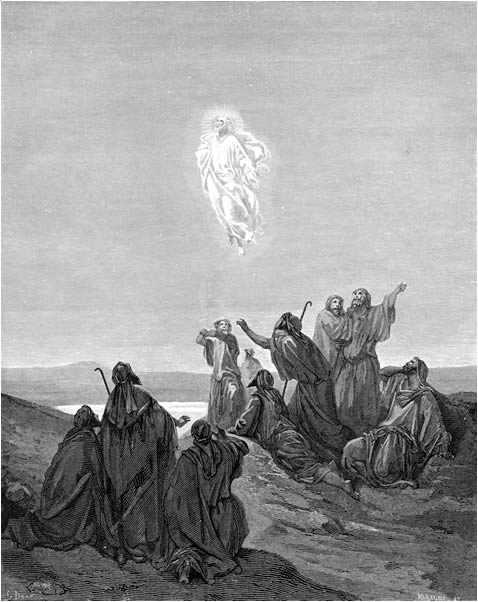
OUR blessed Lord and Master has gone from us. From the mount of Olives, the place where in dread conflict his garments were rolled in blood, he has mounted in triumph to his throne. After having shown himself for forty days amongst his beloved disciples, giving them abundant evidence that he had really risen from the dead, and enriching them by his divine counsels, he was taken up. Slowly rising before them all, he gave them his blessing as he disappeared.
OUR blessed Lord and Master has gone from us. From the mount of Olives, the place where in dread conflict his garments were rolled in blood, he has mounted in triumph to his throne. After having shown himself for forty days amongst his beloved disciples, giving them abundant evidence that he had really risen from the dead, and enriching them by his divine counsels, he was taken up. Slowly rising before them all, he gave them his blessing as he disappeared. Like good old Jacob, whose departing act was to bestow a benediction on his twelve sons and their descendants, so ere the cloud received our Lord out of our sight, he poured a blessing upon the apostles, who were looking upward, and who were the representatives of his church. He is gone! His voice of wisdom is silent for us, his seat at the table is empty, the congregation on the mountain hears him no more. It would be very easy to have found reasons why he should not have gone. Had it been a matter of choice to us, we should have entreated him to tarry with us till the dispensation closed. Unless, peradventure, grace had enabled us to say: “Not as we will! but as thou wilt,” we should have constrained him, saying, “Abide with us.” What a comfort to disciples to have their own beloved teacher visibly with them! What a consolation to a persecuted band to see their leader at their head; difficulties would disappear, problems would be solved, perplexities removed, trials made easy, temptations averted! Let Jesus himself, their own dear Shepherd be near, and the sheep will lie down in security. Had he been here we could have gone to him in every affliction, like those of whom it is said, “they went and told Jesus.” It seemed expedient for him to stay, to accomplish the conversion of the world.
A commentator
Albert Barnes1798–1870
Notes, Explanatory and Practical, on the Old and New Testaments (1832-1869)
proposed
For the perfecting of the saints - On the meaning of the word rendered here as “perfecting” - καταρτισμὸν katartismon - see the notes on 2Co 13:9. It properly refers to “the restoring of anything to its place;” then putting in order, making complete, etc. Here it means that these various officers were appointed in order that everything in the church might be well arranged, or put into its proper place; or that the church might be “complete.” It is that Christians may have every possible advantage for becoming complete in love, and knowledge, and order. For the work of the ministry - All these are engaged in the work of the ministry, though in different departments. Together they constituted the “ministry” by which Christ meant to establish and edify the church. All these offices had an existence at that time, and all were proper; though it is clear that they were not all designed to be permanent. The apostolic office was of course to cease with the death of those who were “the witnesses” of the life and doctrines of Jesus (compare notes on 1Co 9:1); the office of “prophets” was to cease with the cessation of inspiration; and in like manner it is possible that the office of teacher or evangelist might be suspended, as circumstances might demand. But is it not clear from this that Christ did not appoint “merely” three orders of clergy to be permanent in the church? Here are “five” orders enumerated, and in 1Co 12:28, there are “eight” mentioned; and how can it be demonstrated that the Saviour intended that there should be “three” only, and that they should be permanent? The presumption is rather that he meant that there should be but one permanent order of ministers, though the departments of their labor might be varied according to circumstances, and though there might be helpers, as occasion should demand. […]
The words behind it
14 Greek wordsEvery Greek word of this verse in the order it stands, with what it means and the door to its own study. The last column counts the times a word stands in the whole Bible: the rarer the word, the more the places it appears belong together.
| Greek | Sound | Meaning | Word study | In the Bible |
|---|---|---|---|---|
| πρὸς | pros | toward | G4314 → | 700 times |
| τὸν | ton | the | G3588 → | 19766 times |
| καταρτισμὸν | katartismon | perfecting | G2677 → | |
| τῶν | ton | of the | G3588 → | 19766 times |
| ἁγίων | hagion | saints | G40 → | 220 times |
| εἰς | eis | for | G1519 → | 1755 times |
| ἔργον | ergon | [the] work | G2041 → | 168 times |
| διακονίας, | diakonias | of ministry, | G1248 → | |
| εἰς | eis | for | G1519 → | 1755 times |
| οἰκοδομὴν | oikodomen | [the] building up | G3619 → | 18 times |
| τοῦ | tou | of the | G3588 → | 19766 times |
| σώματος | somatos | body | G4983 → | 142 times |
| τοῦ | tou | <the> | G3588 → | 19766 times |
| Χριστοῦ· | christou | of Christ; | G5547 → | 523 times |
πρὸςtoward
prosG4314 →700 times
τὸνthe
tonG3588 →19766 times
καταρτισμὸνperfecting
katartismonG2677 →
τῶνof the
tonG3588 →19766 times
ἁγίωνsaints
hagionG40 →220 times
εἰςfor
eisG1519 →1755 times
ἔργον[the] work
ergonG2041 →168 times
διακονίας,of ministry,
diakoniasG1248 →
εἰςfor
eisG1519 →1755 times
οἰκοδομὴν[the] building up
oikodomenG3619 →18 times
τοῦof the
touG3588 →19766 times
σώματοςbody
somatosG4983 →142 times
τοῦ<the>
touG3588 →19766 times
Χριστοῦ·of Christ;
christouG5547 →523 times
A shaded row is a word that stands 400 times or fewer in the Bible.
The walk
8 stopsEach card is a verse this one points to, and under it the verses that one points to in turn. Where several paths arrive at the same place, that place is listed first: the text keeps returning to it.
Through
Ephesians 4:16From Him the whole body, fitted and held together by every supporting ligament, grows and builds itself up in love through the work of each individual part.
it leads to
- Colossians 2:19
He has lost connection to the head, from whom the whole body, supported and knit together by its joints and ligaments, grows as God causes it to grow.
- John 15:5
I am the vine and you are the branches. The one who remains in Me, and I in him, will bear much fruit. For apart from Me you can do nothing.
- Colossians 2:2
that they may be encouraged in heart, knit together in love, and filled with the full riches of complete understanding, so that they may know the mystery of God, namely Christ,
- 1 Corinthians 13:13
And now these three remain: faith, hope, and love; but the greatest of these is love.
- Ephesians 4:15
Instead, speaking the truth in love, we will in all things grow up into Christ Himself, who is the head.
- Colossians 2:19
Through
1 Corinthians 12:27Now you are the body of Christ, and each of you is a member of it.
it leads to
- Ephesians 5:30
For we are members of His body.
- Romans 12:5
so in Christ we who are many are one body, and each member belongs to one another.
- Colossians 1:24
Now I rejoice in my sufferings for you, and I fill up in my flesh what is lacking in regard to Christ’s afflictions for the sake of His body, which is the church.
- Ephesians 5:30
Where this verse is studied
About Ephesians
This page draws on 11 works. Open the list of works
This page draws on Adam Clarke, Commentary on the Bible; Albert Barnes, Notes on the New Testament; Albert Barnes, Notes, Explanatory and Practical, on the Old and New Testaments (1832-1869); Ambrosiaster, EPISTLE TO THE EPHESIANS 4.12.6; Charles Spurgeon, The Metropolitan Tabernacle Pulpit, Sermon No. 982: “The Ascension of Christ” (lightly modernized text, CCEL edition); Jamieson, Fausset & Brown, Commentary Critical and Explanatory on the Whole Bible; John Chrysostom, Homily on Ephesians 11; John Gill, Exposition of the New Testament (1746-1748); Matthew Henry, Commentary on the Whole Bible; Theophylact of Ohrid, Commentary on Ephesians and Thomas Aquinas, Commentary on Ephesians.