
1 Samuel 17:5
in 1 Samuel 17and he had a bronze helmet on his head. He wore a bronze coat of mail weighing five thousand shekels,
BSB
The same verse in ASV and KJV ▾
ASV
And he had a helmet of brass upon his head, and he was clad with a coat of mail; and the weight of the coat was five thousand shekels of brass.
KJV
And he had an helmet of brass upon his head, and he was armed with a coat of mail; and the weight of the coat was five thousand shekels of brass.
⋯
This verse in 1 Samuel 17
Commentary
10 notes on this verseAnd a bronze helmet on his head, etc. If you inquire what a chain mail is, read in Virgil, a coat linked with hooks, and triple with gold.
This site's exposition
whose height was six cubits and a span
on 1 Samuel 17:4-5
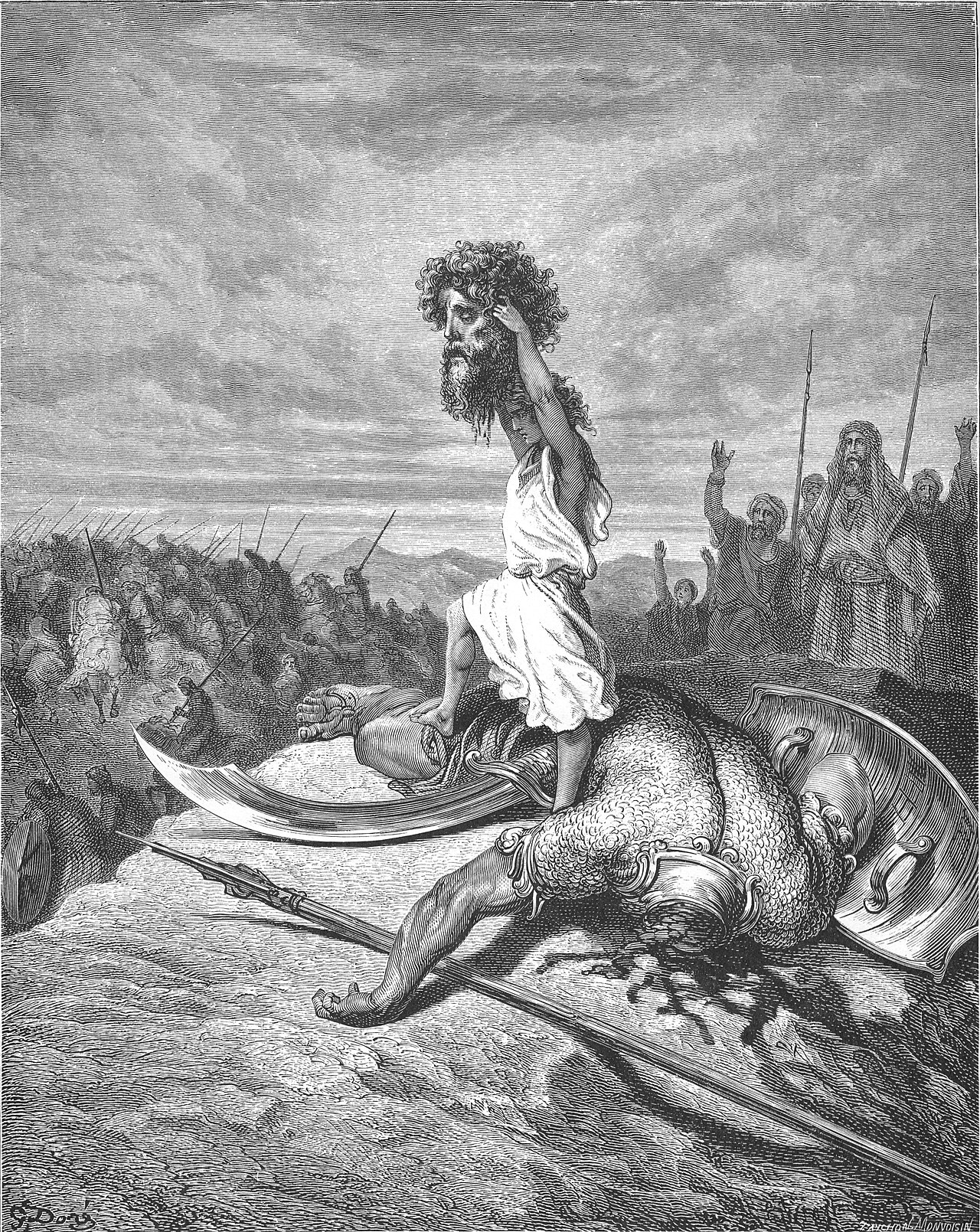
Goliath comes from Gath, one of the three towns where Joshua left a remnant of the Anakim, and the founder's thread runs through him from Genesis 6:4 and Numbers 13:33 to the four more giants of 2 Samuel 21. His height is given two ways in the witnesses: the Hebrew text reads six cubits and a span, about nine feet nine inches, while the Septuagint, a Samuel scroll from Qumran and Josephus read four cubits and a span, about six feet nine. Either way the coat of mail alone weighs five thousand shekels, near a hundred and twenty-five pounds, and the man wearing it has ruled this valley for forty days.
The record, by era
The Church Fathers2 voices
Yet there stands Goliath, monstrous in his pride, swollen with his earthly power, confident that he can do everything by himself, with his head, hands and entire body clad in much bronze, having his own armor bearer behind him who, though he does not himself …
In my discourse I showed that Goliath was protected by the power of his weapons and the strength of a full set of armor, whereas David had none of that panoply. But he was fortified by his faith.Goliath had the external protection of his glittering breastplate and shield; David shone from within with the grace of the Spirit. This is why a boy prevailed over a man, this is why the one wearing no armor conquered the one fully armed, this is why the shepherd's hand crushed and destroyed the bronze weapons of war.
The Puritans and the Awakening3 voices
Coat of mail - Made of brass plates laid over one another, like the scales of a fish. The weight, &c. - The common shekel contained a fourth part of an ounce; and so five thousand shekels made one thousand two hundred and fifty ounces, or seventy- eight pounds: which weight is not unsuitable to a man of such vast strength as his height speaks him to be.
The coat is said to weigh 5000 shekels, and a shekel was half an ounce avoirdupois, a vast weight for a man to carry, all the other parts of his armour being proportionable. But some think it should be translated, not the weight of the coat, but the value of it, was 5000 shekels; so much it cost.
And he had an helmet of brass upon his head,....
3 more voices on this verse
The Nineteenth Century3 voices
A commentator
Albert Barnes1798–1870
Notes, Explanatory and Practical, on the Old and New Testaments (1832-1869)
Coat of mail - Or “breastplate of scales.” A kind of metal shirt, protecting the back as well as the breast, and made of scales like those of a fish; as was the corselet of Rameses III, now in the British Museum. The terms, helmet, coat, and clothed (armed the King James Version) are the same as those used in Isa 59:17. Five thousand shekels - Probably about 157 pounds avoirdupois (see Exo 38:12).
A commentator
Jamieson, Fausset & Brown1802–1910
Commentary Critical and Explanatory on the Whole Bible (1871)
proposed
a champion--Hebrew, a "man between two"; that is, a person who, on the part of his own people, undertook to determine the national quarrel by engaging in single combat with a chosen warrior in the hostile army.
quarantine:debris (2026-07-29) — starts-lowercase
He was armed with a coat of mail - The words in the original, שרון קשקשים shiryon kaskassim, mean a coat of mail formed of plates of brass overlapping each other, like the scales of a fish, or tiles of a house. This is the true notion of the original terms. With thin plates of brass or iron, overlapping each other, were the ancient coats of mail formed in different countries; many formed in this way may be now seen in the tower of London. The weight - five thousand shekels - Following Bishop Cumberland’s tables, and rating the shekel at two hundred and nineteen grains, and the Roman ounce at four hundred and thirty-eight grains, we find that Goliath’s coat of mail, weighing five thousand shekels, was exactly one hundred and fifty-six pounds four ounces avoirdupois. A vast weight for a coat of mail, but not all out of proportion to the man.
The words behind it
14 Hebrew wordsEvery Hebrew word of this verse in the order it stands, with what it means and the door to its own study. The last column counts the times a word stands in the whole Bible: the rarer the word, the more the places it appears belong together.
| Hebrew | Sound | Meaning | Word study | In the Bible |
|---|---|---|---|---|
| וְכ֤וֹבַע | vekhoa' | and a helmet of | H3553 → | |
| נְחֹ֙שֶׁת֙ | nechoshet | bronze | H5178 → | 140 times |
| עַל־ | ʾal- | [was] on | H5921 → | 5755 times |
| רֹאשׁ֔וֹ | rosho | head his | H7218 → | 599 times |
| וְשִׁרְי֥וֹן | veshiryon | and body armor of | H8302 → | 9 times |
| קַשְׂקַשִּׂ֖ים | kaskasim | scales | H7193 → | |
| ה֣וּא | hu' | he | H1931 → | 1879 times |
| לָב֑וּשׁ | lavush | [was] clothed | H3847 → | 110 times |
| וּמִשְׁקַל֙ | umishkal | and [the] weight of | H4948 → | |
| הַשִּׁרְי֔וֹן | hashiryon | the body armor | H8302 → | 9 times |
| חֲמֵשֶׁת־ | chameshet- | [was] five | H2568 → | 343 times |
| אֲלָפִ֥ים | ʾalafim | thousand<s> | H505 → | 505 times |
| שְׁקָלִ֖ים | shekalim | shekels | H8255 → | 88 times |
| נְחֹֽשֶֽׁת׃ | nechoshet | bronze | H5178 → | 140 times |
וְכ֤וֹבַעand a helmet of
vekhoa'H3553 →
נְחֹ֙שֶׁת֙bronze
nechoshetH5178 →140 times
עַל־[was] on
ʾal-H5921 →5755 times
רֹאשׁ֔וֹhead his
roshoH7218 →599 times
וְשִׁרְי֥וֹןand body armor of
veshiryonH8302 →9 times
קַשְׂקַשִּׂ֖יםscales
kaskasimH7193 →
ה֣וּאhe
hu'H1931 →1879 times
לָב֑וּשׁ[was] clothed
lavushH3847 →110 times
וּמִשְׁקַל֙and [the] weight of
umishkalH4948 →
הַשִּׁרְי֔וֹןthe body armor
hashiryonH8302 →9 times
חֲמֵשֶׁת־[was] five
chameshet-H2568 →343 times
אֲלָפִ֥יםthousand<s>
ʾalafimH505 →505 times
שְׁקָלִ֖יםshekels
shekalimH8255 →88 times
נְחֹֽשֶֽׁת׃bronze
nechoshetH5178 →140 times
A shaded row is a word that stands 400 times or fewer in the Bible.
Where this verse is studied
About 1 Samuel
This page draws on 10 works. Open the list of works
This page draws on Adam Clarke, Commentary on the Bible; Albert Barnes, Notes, Explanatory and Practical, on the Old and New Testaments (1832-1869); Bede, Commentary on Samuel; Jamieson, Fausset & Brown, Commentary Critical and Explanatory on the Whole Bible; John Chrysostom, AGAINST THE ANOMOEANS 11.4-5; John Gill, Exposition of the Old Testament (1748-1763); John Wesley, Explanatory Notes upon the Old Testament; Keil and Delitzsch, Biblical Commentary on the Books of Samuel; Matthew Henry, Commentary on the Whole Bible and Paulus Orosius, DEFENSE AGAINST THE PELAGIANS 2.