
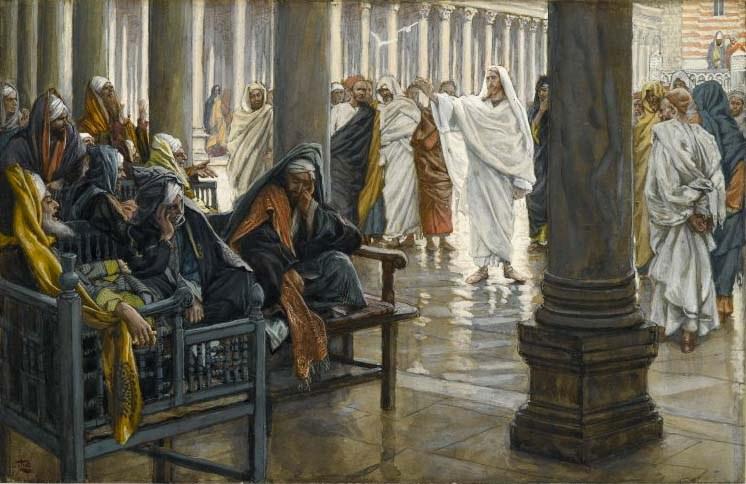
James Tissot, Woe unto You, Scribes and Pharisees, 1886 to 1894. Public domain.
Isaiah 5, Habakkuk 2 and Matthew 23 · Subject · Featured Study
The Woe Oracles of the Prophets
Woe sayings stand in Isaiah, Amos, Micah, Nahum and Habakkuk, and in Matthew and Luke.
Will not all of these take up a taunt against him, speaking with mockery and derision: ‘Woe to him who amasses what is not his and makes himself rich with many loans! How long will this go on?’
- Books
- Habakkuk, Isaiah, Matthew
- Hold in memory
- Habakkuk 2:6
Israel raised the same cry over its dead.
Summary
A woe saying names a sin and those who commit it, and warns of the ruin to come. Jesus used the same form against the teachers of the law.
- Isaiah 5 sets six woes against greed, drunkenness and bribes in Judah.
- The nations Babylon conquered sing Habakkuk's five woes over it.
- Teachers of the church have read the word as a sentence, as grief and as misery.
Two Runs of Woes
Isaiah 5 and Habakkuk 2 each set their woes one after another.
Woe to you who add house to house and join field to field until no place is left and you live alone in the land.Isaiah moves from the vineyard song to this woe with no break, so the woe names the fruit the vineyard bore.
The Woes Counted
Each series is counted as the Berean prints it.
Matthew 23 holds the most woes, and Micah 2, Nahum 3 and each chapter of Amos hold one.
The eight counts as a table
| The series | Woes | Verse |
|---|---|---|
| Isaiah 5, against greed and drunkenness in Judah | 6 | Isaiah 5:8 to 22 |
| Amos 5, on those eager for the LORD's day | 1 | Amos 5:18 |
| Amos 6, on those at ease in Zion | 1 | Amos 6:1 |
| Micah 2, against those who plot to seize fields | 1 | Micah 2:1 |
| Nahum 3, against Nineveh, the city of blood | 1 | Nahum 3:1 |
| Habakkuk 2, the nations against Babylon | 5 | Habakkuk 2:6 to 19 |
| Matthew 23, against the scribes and Pharisees | 7 | Matthew 23:13 to 29 |
| Luke 6, against the rich and the well fed | 4 | Luke 6:24 to 26 |
The two woes of Luke 6:25 are counted apart, so the series in Luke holds four.
How a Woe Is Built
Habakkuk 2 shows the two parts of a woe, the deed and its reason.
Each woe of Habakkuk 2 names a deed. The five are wealth gained by plunder, a house built by unjust gain, a city built with bloodshed, a neighbor made drunk, and an idol of wood. A reason or a sentence follows each one.
Because you have plundered many nations, the remnant of the people will plunder you—because of your bloodshed against man and your violence against the land, the city, and all their dwellers.The first woe gives its reason here, and the plunderer is plundered in return.
Isaiah's first woe works the same way, since Isaiah 5:9 answers the joining of house to house with great houses left empty.
The Taunt Sung Over a Conqueror
Habakkuk calls the woes a taunt, a mocking song.
you will sing this song of contempt against the king of Babylon: How the oppressor has ceased, and how his fury has ended!Isaiah gives Israel a song to sing over the king of Babylon, the same kind of song Habakkuk names.
The word for this taunt is mashal, the word for a proverb. Adam Clarke, in his Commentary on the Bible, took mashal as the general name of the Hebrews' poetic style. Its sayings are short and pointed, and often drawn from a comparison.
Micah 2:4 names the same kind of song, a proverb and a bitter lament taken up against those who seized fields.
The Cry Over the Dead
Three words of Scripture carry the cry of woe.
הוֹי hoy
51 uses in the canon
Hoy is a cry of woe or grief, the word that opens every woe of Isaiah 5 and Habakkuk 2.
אוֹי oy
24 uses in the canon
Oy is a second cry of woe, the word of Isaiah's woe is me.
οὐαί ouai
46 uses in the canon
Ouai is the Greek cry of woe, the word of every woe Jesus spoke.
The lexicon in full1 verse, 2 paragraphs
Then he laid the body in his own tomb, and they lamented over him, “Oh, my brother!”This verse is the first in the order of the canon where hoy stands.
Jeremiah 22:18 gives the same cry four times for King Jehoiakim, the king no one would mourn. John Gill, in his Exposition of the Old Testament, called alas, my brother a usual form of lament at funerals.
Isaiah 55:1 uses the same cry to call the thirsty to the waters, where the Berean renders it come.
The Woes of Jesus
Jesus spoke woes in the Sermon on the Plain and in the temple courts.
But woe to you who are rich, for you have already received your comfort.Luke sets this woe against the blessing on the poor that opens the sermon.
Woe to you, scribes and Pharisees, you hypocrites! You shut the kingdom of heaven in men’s faces. You yourselves do not enter, nor will you let in those who wish to enter.Jesus speaks this first woe to the crowds and His disciples, about their own teachers.
Albert Barnes on Habakkuk and Zephaniah
Barnes read the rhythm of Habakkuk's woes and the turn of Zephaniah's.
Albert Barnes (1798 to 1870)
Albert Barnes, in his Notes on Habakkuk 2:6, called the five woes a dirge. He found its rhythm more measured than any other in Scripture, each woe in three verses.
Barnes, on Zephaniah 3:1, saw the woe that had gone round the nations of Zephaniah 2 turn at last on Jerusalem.
What the Word Woe Carries
Chrysostom, Hilary and Wesley read the word in three ways.
A sentence of punishment to comeJohn Chrysostom
John Chrysostom, in words gathered by Aquinas in the Catena Aurea, said that Scripture always speaks woe to those who cannot escape the punishment to come.
A voice of sorrowHilary of Poitiers
Hilary of Poitiers, in his Commentary on Matthew, called woe a voice of sorrowing, as Jesus spoke it over the teachers who shut the kingdom.
A statement of the hearers' miseryJohn Wesley
John Wesley, in his Explanatory Notes upon the New Testament, rendered the woes of Luke 11 as miserable are you. He read every woe of that chapter the same way.
The Lament Over Jerusalem
The woes of Matthew 23 end in a lament for the city.
O Jerusalem, Jerusalem, who kills the prophets and stones those sent to her, how often I have longed to gather your children together, as a hen gathers her chicks under her wings, but you were unwilling!After the seventh woe Jesus grieves over the city He has warned.
In Revelation 18:10 those who stand far off in fear of her torment cry woe twice over Babylon the great.
Sources
Scripture is the Berean Standard Bible.
- The Hebrew and Greek words with Strong's numbers, h1945, h188, g3759 and h4912 and the verses they tag.
- Gill, Clarke, Barnes, Chrysostom, Hilary and Wesley on the woes of Isaiah, Amos, Micah, Habakkuk, Zephaniah, Matthew 23 and Luke.
- John Gill, Exposition of the Old Testament (1748 to 1763), on 1 Kings 13:30.
- Adam Clarke, Commentary on the Bible (1832), on Isaiah 14:4.
- Albert Barnes, Notes, Explanatory and Practical, on Habakkuk 2:6 and Zephaniah 3:1.
- John Chrysostom, in Thomas Aquinas, Catena Aurea, on Luke 6:24.
- Hilary of Poitiers, Commentary on Matthew 24.3, on Matthew 23:13.
- John Wesley, Explanatory Notes upon the New Testament (1755), on Luke 11:42.
Keep Studying
Read it3
People and groups6
Places1
Go further1