
1 Kingschapter 13
34 verses · Jeremiah, by tradition · 6th century BC · History
The section titles are this site's own.
A.A cry against the altar, and a king's hand dried upvv. 1-10
Suddenly, as Jeroboam was standing beside the altar to burn incense, there came a man of God from Judah to Bethel by the word of the LORD. And he cried out against the altar by the word of the LORD, “O altar, O altar, this is what the LORD says: ‘A son named Josiah will be born to the house of David, and upon you he will sacrifice the priests of the high places who burn incense upon you, and human bones will be burned upon you.’” That day the man of God gave a sign, saying, “The LORD has spoken this sign: ‘Surely the altar will be split apart, and the ashes upon it will be poured out.’” Now when King Jeroboam, who was at the altar in Bethel, heard the word that the man of God had cried out against it, he stretched out his hand and said, “Seize him!” But the hand he stretched out toward him withered, so that he could not pull it back. And the altar was split apart, and the ashes poured out, according to the sign that the man of God had given by the word of the LORD. Then the king responded to the man of God, “Intercede with the LORD your God and pray that my hand may be restored.” So the man of God interceded with the LORD, and the king’s hand was restored to him as it was before. Then the king said to the man of God, “Come home with me and refresh yourself, and I will give you a reward.” But the man of God replied, “If you were to give me half your possessions, I still would not go with you, nor would I eat bread or drink water in this place. For this is what I was commanded by the word of the LORD: ‘You must not eat bread or drink water or return by the way you came.’” So the man of God went another way and did not return by the way he had come to Bethel.
B.An old prophet's lie: an angel spake unto mevv. 11-19
Now a certain old prophet was living in Bethel, and his sons came and told him all the deeds that the man of God had done that day in Bethel. They also told their father the words that the man had spoken to the king. “Which way did he go?” their father asked. And his sons showed him the way taken by the man of God, who had come from Judah. So the prophet said to his sons, “Saddle the donkey for me.” Then they saddled the donkey for him, and he mounted it and went after the man of God. He found him sitting under an oak tree and asked, “Are you the man of God who came from Judah?” “I am,” he replied. So the prophet said to the man of God, “Come home with me and eat some bread.” But the man replied, “I cannot return with you or eat bread or drink water with you in this place. For I have been told by the word of the LORD: ‘You must not eat bread or drink water there or return by the way you came.’” Then the prophet replied, “I too am a prophet like you, and an angel spoke to me by the word of the LORD, saying, ‘Bring him back with you to your house, so that he may eat bread and drink water.’” The old prophet was lying to him, but the man of God went back with him, ate bread in his house, and drank water.
C.A lion that kills but will not eatvv. 20-32
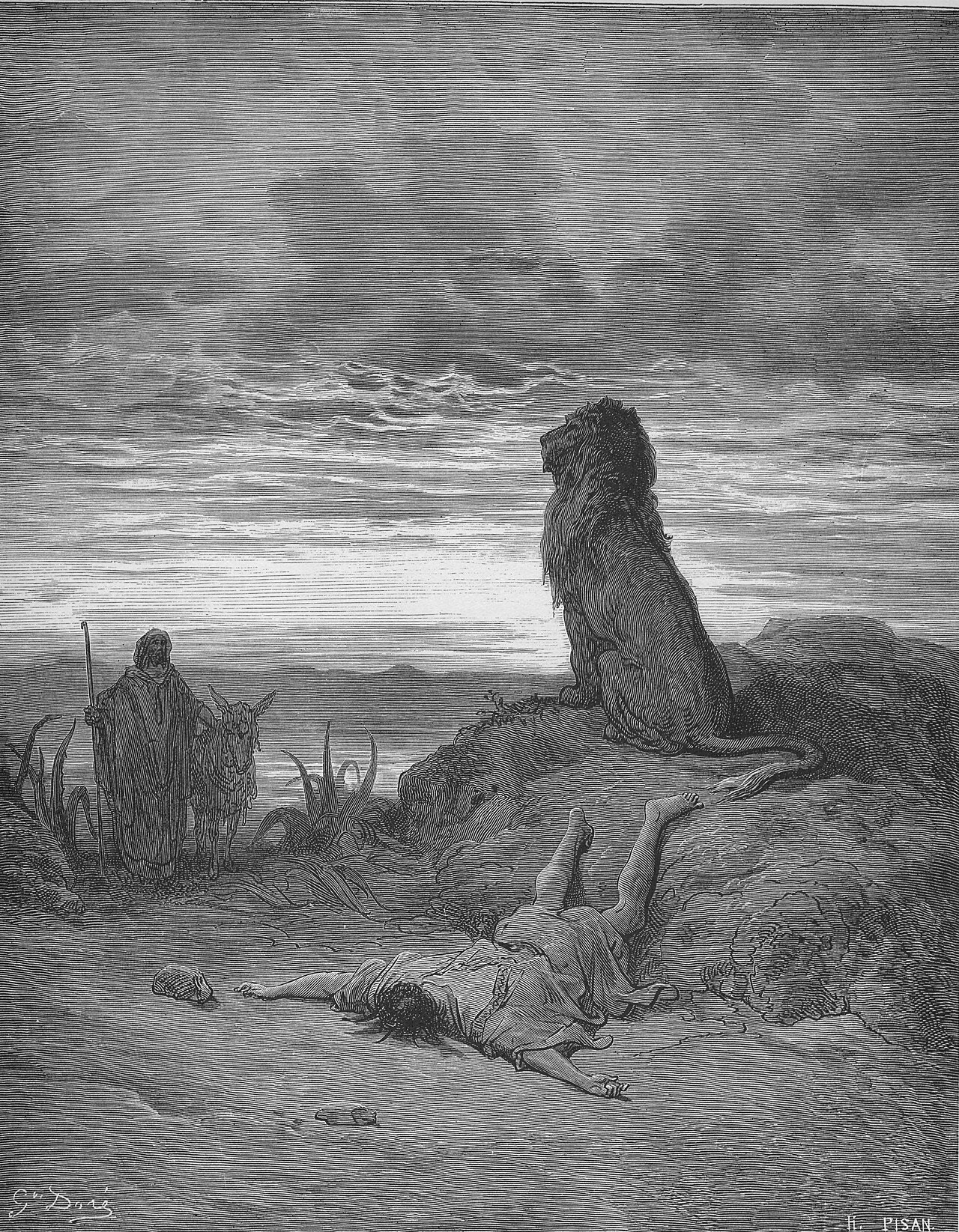
While they were sitting at the table, the word of the LORD came to the prophet who had brought him back, and the prophet cried out to the man of God who had come from Judah, “This is what the LORD says: ‘Because you have defied the word of the LORD and have not kept the commandment that the LORD your God gave you, but you went back and ate bread and drank water in the place where He told you not to do so, your body shall never reach the tomb of your fathers.’” And after the man of God had finished eating and drinking, the old prophet who had brought him back saddled the donkey for him. As he went on his way, a lion met him on the road and killed him, and his body was left lying in the road, with the donkey and the lion standing beside it. And there were men passing by who saw the body lying in the road with the lion standing beside it, and they went and reported this in the city where the old prophet lived. When the prophet who had brought him back from his journey heard this, he said, “It is the man of God who disobeyed the command of the LORD. Therefore the LORD has delivered him to the lion, and it has mauled him and killed him, according to the word that the LORD had spoken to him.” Then the old prophet instructed his sons, “Saddle the donkey for me.” So they saddled it, and he went and found the body lying in the road, with the donkey and the lion standing beside it. The lion had not eaten the body or mauled the donkey. So the old prophet lifted up the body of the man of God, laid it on the donkey, and brought it back to his own city to mourn for him and bury him. Then he laid the body in his own tomb, and they lamented over him, “Oh, my brother!” After he had buried him, the prophet said to his sons, “When I die, you must bury me in the tomb where the man of God is buried. Lay my bones beside his bones, for the message that he cried out by the word of the LORD against the altar in Bethel and against all the shrines on the high places in the cities of Samaria will surely come to pass.”
D.Jeroboam turned not from his evil wayvv. 33-34
Even after these events, Jeroboam did not repent of his evil ways, but again he appointed priests for the high places from every class of people. He ordained anyone who desired to be a priest of the high places. And this was the sin of the house of Jeroboam that led to its extermination and destruction from the face of the earth.