
On this page, 6 sections
The one drawing
Across the canon
11 passages
Where Scripture speaks
The passages this subject stands on, in canon order.
“My lord,” said Abraham, “if I have found favor in your sight, please do not pass your servant by.and said, “My lords, please turn aside into the house of your servant; wash your feet and spend the night. Then you can rise early and go on your way.” “No,” they answered, “we will spend the night in the square.”“Please stay here,” Manoah said to the angel of the LORD, “and we will prepare a young goat for you.”One day Elisha went to Shunem, and a prominent woman who lived there persuaded him to have a meal. So whenever he would pass by, he would stop there to eat.but no stranger had to lodge on the street, for my door has been open to the traveler—As they traveled along, Jesus entered a village where a woman named Martha welcomed Him into her home.But they pleaded with Him, “Stay with us, for it is nearly evening and the day is almost over.” So He went in to stay with them.Share with the saints who are in need. Practice hospitality.Do not neglect to show hospitality to strangers, for by so doing some people have entertained angels without knowing it.Show hospitality to one another without complaining.Beloved, you are faithful in what you are doing for the brothers, and especially since they are strangers to you.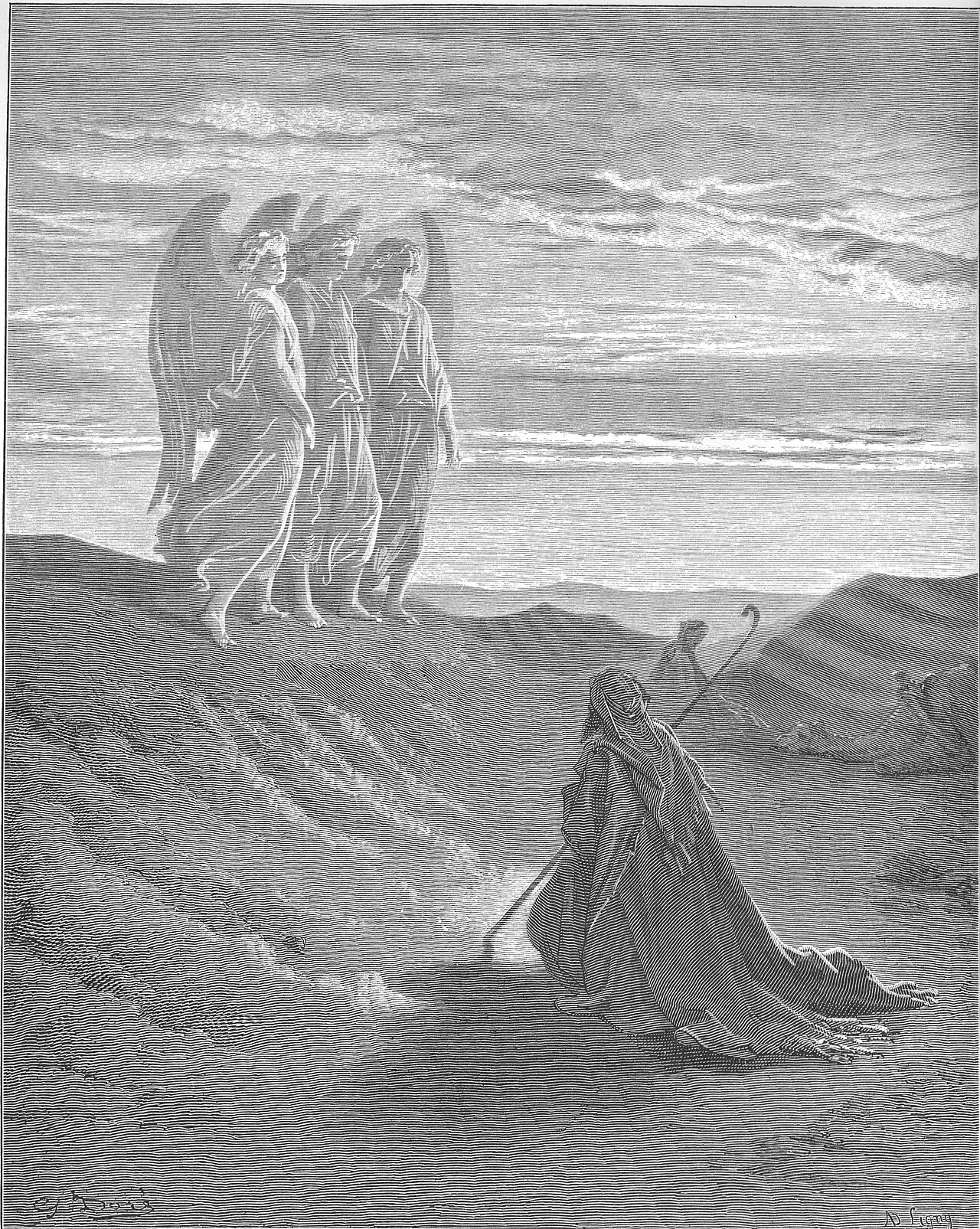
Hospitality in Scripture, in full
Hospitality is not modern politeness. In the Bible it is survival, safety, and sometimes worship, offered to a person who has nowhere else to turn.
Abraham gives us the picture everything else is measured against. Three strangers appear at his tent in the heat of the day, and he runs to meet them, bows to the ground, and prepares a feast fit for a king (Genesis 18). He does not know yet that he is entertaining the LORD himself. That is the whole point of biblical hospitality: you rarely know in advance who is standing at your door.
Lot repeats the pattern the very next chapter, pulling two visitors off the street of Sodom and into his house before the mob can reach them (Genesis 19). In a dangerous world, opening your door was an act of protection, not just courtesy.
The law built hospitality into Israel's identity. Israel had been the stranger in Egypt, so Israel was commanded never to oppress the stranger, the widow, or the fatherless (Exodus 22:21-22). Memory was supposed to produce mercy. A nation that remembered being unwelcome would learn to welcome others.
The Old Testament keeps circling back to this. Job defends himself by saying the stranger never had to sleep in the street, because his door was always open (Job 31:32). The widow of Zarephath shares her last handful of meal with a hungry prophet and finds it never runs out (1 Kings 17). A Shunammite woman builds a room onto her house just so Elisha always has somewhere to stay (2 Kings 4:8). Hospitality, again and again, turns out to be the door through which God's provision walks in.
Jesus steps into this tradition and complicates it in the best way. He receives hospitality from Martha, who welcomes him into her home even while she is distracted by all the serving (Luke 10:38). He gives hospitality too, feeding thousands with a boy's lunch and washing his own disciples' feet like a servant before supper (John 13). And on the Emmaus road, two grieving disciples press a stranger to stay the night with them: only to recognize, once he breaks the bread, that they had been hosting the risen Christ the whole time (Luke 24:29-31). The pattern from Abraham's tent repeats: the guest you welcome may be more than he appears.
The early church treats hospitality as ordinary Christian practice, not an occasional kindness. Paul tells the Roman believers to be "given to hospitality"; the phrase means actively pursuing it, not waiting for it to come to you (Romans 12:13). Peter tells scattered, suffering Christians to host one another without grumbling (1 Peter 4:9). The writer of Hebrews gives the reason that has echoed ever since: some have entertained angels without knowing it (Hebrews 13:2). John commends a man named Gaius by name for how well he cared for traveling believers he had never met before (3 John 1:5-8).
Underneath all of it sits a simple claim: welcoming another person is never just about them. Jesus said that whatever is done for "the least of these" is done for him (Matthew 25:40). Hospitality is one more place where love for a stranger becomes, without any change of address, love for God.
That is why the open door matters so much in Scripture. It is small, ordinary, and repeatable. Anyone can set another plate at the table. And every time someone does, the possibility stands open that they have done far more than feed a stranger; they have entertained someone sent by God, maybe even God himself.
4 voices
What teachers have said
And this was done designedly, in order that he, receiving them as men, might give proof of his charity. For angels do not need those services of ours, which are the true evidences of charity. Moreover, hospitality holds the chief place among these services; because it is no common virtue to assist strangers, from whom there is no hope of reward.
John Calvin · Commentaries, 1554
And he did not say, "Be not forgetful" of the entertaining of strangers, but "of hospitality": that is, do not merely entertain strangers, but do it with love for the strangers.
John Chrysostom · Homily on Hebrews 33
Written before 407.
Behold, the Lord was not recognized while He was speaking, and He deigned to be recognized while He was being fed. Therefore, dearest brothers, love hospitality, love the works of charity.
Gregory the Dialogist · Forty Gospel Homilies, Homily 23
Written before 604.
given to hospitality--that is, the entertainment of strangers. In times of persecution, and before the general institution of houses of entertainment, the importance of this precept would be at once felt.
Jamieson, Fausset & Brown · Commentary Critical and Explanatory on the Whole Bible, 1871
The words underneath
Each card is one Hebrew or Greek word behind hospitality. It gives the sense, the count across the canon, and the number in Strong's 1890 concordance.
xenia: lodging
Greek · G3578Strong's entry: hospitality, i.e. (by implication) a place of entertainment
used of Paul's rented room in Rome
2 times in the New Testament · xenia, in full →
xenizo: to host
Greek · G3579Strong's entry: to be a host (passively, a guest); by implication, be (make, appear) strange
root of "entertained angels unawares"
10 times in the New Testament · xenizo, in full →
philoxenos: hospitable
Greek · G5382Strong's entry: fond of guests, i.e. hospitable
the NT word for hospitable, love of strangers
3 times in the New Testament · philoxenos, in full →
ger: sojourner
Hebrew · H1616Strong's entry: properly, a guest; by implication, a foreigner
the "stranger" Israel was told to welcome
92 times in the Old Testament · ger, in full →
Character
The subjects beside it
On this page
Subjects28