
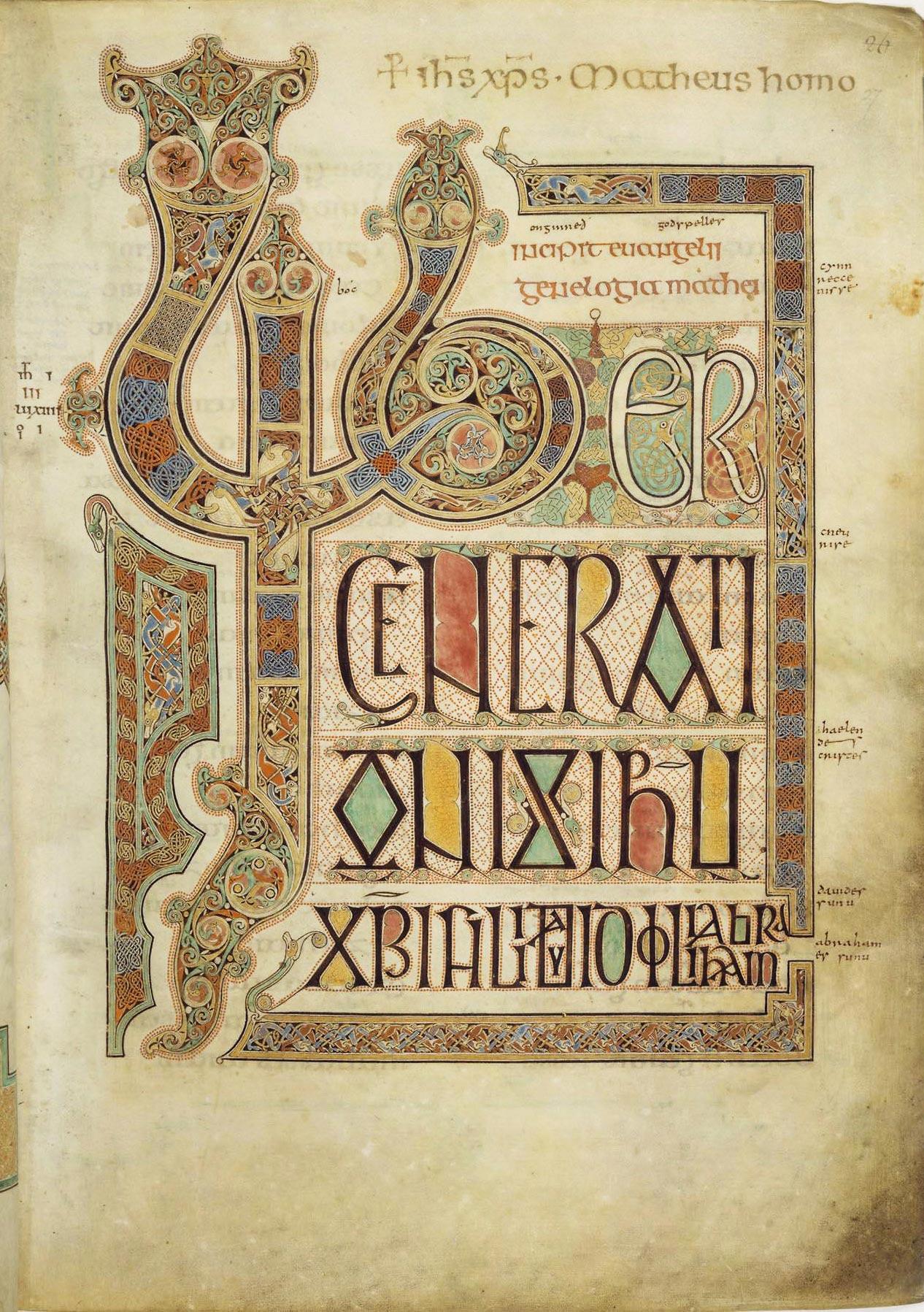
The Lindisfarne Gospels, folio 27r, 8th century. Public domain.
Lindisfarne, Northumbria, 635 to 793 · Place · Featured Study
Aidan and Lindisfarne
Bede set the island's first bishops before the clergy of his own day as a pattern of plain living.
Aidan preached in a language the English could not follow, so the king stood beside him and translated.
I gave you milk, not solid food, for you were not yet ready for solid food. In fact, you are still not ready,
I gave you milk, not solid food, for you were not yet ready for solid food. In fact, you are still not ready,
- Today
- Holy Island, Northumberland, England
- Region
- Northumbria
Summary
Lindisfarne is an island off the coast of Northumbria that the tide cuts off twice a day. In 635 King Oswald gave it to Aidan, a monk sent from Iona, as the seat of his bishopric, and Aidan's monks preached from it to the English of the north.
- Aidan travelled on foot and gave away to the poor whatever the rich gave him.
- Bede praised Aidan's life and faulted only the date on which he kept Easter.
- Cuthbert was bishop of the island in 685, and heathen raiders wrecked its church in 793.
Milk Before Meat
Aidan answered a failed mission with Paul's word about milk, and Bede described his zeal with Paul's word about Israel.
Although by this time you ought to be teachers, you need someone to reteach you the basic principles of God’s word. You need milk, not solid food!The same picture of milk for beginners and solid food for the mature stands here.
For I testify about them that they are zealous for God, but not on the basis of knowledge.Bede borrowed these words to say Aidan's zeal was not fully according to knowledge.
Lindisfarne from Iona to the Raid
Seven dates in the life of the island, from Columba's coming to the Picts to the Viking raid.
The mission from Iona held Lindisfarne for thirty years, and the island kept its church for a century more.
- 565Columba comes from Ireland to preach to the northern PictsBede 3.4
- 635Aidan, sent from Iona at Oswald's request, receives Lindisfarne as his seeBede 3.3
- 31 August 651Aidan dies in the seventeenth year of his bishopricBede 3.17
- 664After the debate at Whitby, Colman leaves with those who keep Iona's EasterBede 3.26
- 685Cuthbert is ordained bishop of LindisfarneBede 4.27
- 687Cuthbert dies on Farne and is buried on LindisfarneBede 4.29
- 793Heathen raiders plunder the church on Holy IslandAnglo-Saxon Chronicle, 793
Each row gives the year, what happened and where Bede or the Chronicle records it.
Aidan Comes to the Island
Bede tells how a failed mission led the elders of Iona to send Aidan.
Oswald had been baptized among the Scots of the north while he was an exile. When he became king of Northumbria, he sent to their elders and asked for a bishop to teach his people.
The first man they sent was of a harsher temper. He preached for a time, found no hearing, and went home to report that the English were stubborn and could not be taught.
Aidan, who sat in the council, told him he had been too severe with his hearers. The elders judged that Aidan had the gift of discretion the work needed, ordained him bishop and sent him.
Oswald gave him the island of Lindisfarne, as Aidan asked. Bede notes that the tide makes it an island twice a day and twice leaves the sands dry so that it joins the mainland.
Aidan did not yet speak English well, and Oswald, who had learned the Scots' language in exile, interpreted his sermons to his nobles. Monks followed from Iona, churches were built, and English boys were taught by the Scottish monks.
How Aidan Lived
Bede describes how Aidan travelled, gave away what he received and taught those with him.
Aidan went through town and country on foot so that he could stop and speak to anyone he met, rich or poor. Whatever kings and rich men gave him he passed at once to the poor or spent on buying back people wrongly sold as slaves, and he later trained many of them for the priesthood.
Everyone who travelled with him, monk or layman, had to read the Scriptures or learn the psalms as they went. When he ate at the king's table he took a little and left early to read or pray with his brothers.
King Oswin once gave him a fine horse for crossing rivers, and Aidan gave it with its royal trappings to a beggar on the road. When the king complained, Aidan asked whether the son of a mare was dearer to him than that son of God.
The Island After Aidan
Bede and the Chronicle follow Lindisfarne through its bishops to the raid.
The house the Scots left behindBede 3.26
Bede counts thirty years of the Scots' bishops among the English, Aidan seventeen, Finan ten and Colman three. When Colman left, the island had very few houses besides the church, and its monks kept cattle but no money.
Colman asked the king to set Eata over the brothers who stayed, and Eata had been one of the twelve English boys Aidan took to teach in his first years.
CuthbertBede 4.27 and 4.29
Cuthbert had lived for years as a hermit on Farne, an islet about nine miles from the church, when he was made bishop. He asked to be buried on Farne, and his brothers persuaded him to let them carry him back to Lindisfarne.
The Voices of Lindisfarne
Bede wrote of the island's teachers, and the Chronicle recorded its fall.
Bede (died 735)
Ecclesiastical History of England, book 3, chapter 5
Bede and the Chronicle on Lindisfarne
“it was the highest commendation of his doctrine with all men, that he taught nothing that he did not practise in his life among his brethren”
Patristic
About this saying1 paragraph
Bede gave the reason Aidan's teaching was received.
Bede
Ecclesiastical History of England, book 3, chapter 26
Bede and the Chronicle on Lindisfarne
“For the whole care of those teachers was to serve God, not the world”
Patristic
About this saying1 paragraph
Bede also described why the great men of the world came to the island only to pray.
The Anglo-Saxon Chronicle
The Anglo-Saxon Chronicle, the year 793
Bede and the Chronicle on Lindisfarne
“the harrowing inroads of heathen men made lamentable havoc in the church of God in Holy-island, by rapine and slaughter.”
Anglo-Saxon English annals
About this saying1 paragraph
The Anglo-Saxon Chronicle set down the raid of 793 among that year's signs and famine.
In Their Own Words
Bede records four sayings of Aidan, from the council that sent him in 635 to the year of his death in 651.
Aidan of Lindisfarne (died 651)
Bede, Ecclesiastical History of England, a revised translation by A. M. Sellar (1907), book 3, chapter 5
Aidan's answer at the council of 635
“Methinks, brother, that you were more severe to your unlearned hearers than you ought to have been, and did not at first, conformably to the Apostolic rule, give them the milk of more easy doctrine, till, being by degrees nourished with the Word of God, they should be capable of receiving that which is more perfect and of performing the higher precepts of God.”
Patristic
About this saying1 paragraph
In 635 the elders of the Scots met in council when their first preacher came home from Northumbria, and Aidan answered him there.
Aidan of Lindisfarne
Bede, Ecclesiastical History of England, a revised translation by A. M. Sellar (1907), book 3, chapter 6
A hand for the poor
“May this hand never decay.”
Patristic
About this saying1 paragraph
At an Easter feast between 635 and 642, King Oswald sent his food and his silver dish out to the poor in the street, and Aidan took him by the right hand.
Aidan of Lindisfarne
Bede, Ecclesiastical History of England, a revised translation by A. M. Sellar (1907), book 3, chapter 14
A humble king
“that the king will not live long; for I never before saw a humble king; whence I perceive that he will soon be snatched out of this life, because this nation is not worthy of such a ruler.”
Patristic
About this saying1 paragraph
Between 644 and 651, after King Oswin knelt to ask his pardon over the gift of the horse, Aidan wept and told his priest in their own tongue why he grieved.
Aidan of Lindisfarne
Bede, Ecclesiastical History of England, a revised translation by A. M. Sellar (1907), book 3, chapter 16
Smoke over the royal city
“Behold, Lord, how great evil is wrought by Penda!”
Patristic
About this saying1 paragraph
Before 651, when Penda's army set fire to the royal city, Aidan saw the smoke from the island of Farne, about two miles from the city, and Bede was told that he prayed aloud.
When Should Easter Be Kept?
Iona and Rome reckoned the day of Easter differently, and the island was caught between them.
Aidan kept Easter on the Sunday falling from the fourteenth to the twentieth day of the moon, as the northern Scots and the Picts did. The southern Irish had already taken up the reckoning of the Roman see.
The custom of IonaAidan; Colman
Aidan and his successors believed they followed the writings of Anatolius. Colman would not give up the custom after Whitby and went back to Scotland with those who agreed with him.
Bede answers that every instructed person can judge whether they truly followed Anatolius.
The Roman reckoningBede
Bede calls the Roman date the canonical custom and the Catholic Easter, and he praises Tuda, Colman's successor, for keeping it.
Bede's own account weighs against the charge, since he wrote that Aidan taught nothing he did not practise and faulted him only for the date of the feast.
Books to Read Next
Bede's Ecclesiastical History of England
Bede, revised translation by A. M. Sellar · 1907
Bede tells of Oswald, Aidan and Whitby in book 3 and of Cuthbert in book 4.
Read Bede free at Project GutenbergThe Anglo-Saxon Chronicle
translated by James Ingram · 1823
Ingram set out the English annals year by year in 1823, with readings from Giles.
Read the Chronicle free at Project GutenbergAn Island That Gave Away What It Received
The monks of Lindisfarne owned little and gave away the rest, and the English of the north learned the faith from men who lived what they preached.
Sources
Scripture is the Berean Standard Bible.
- The Holy Bible, Berean Standard Bible (read 2026)
- Bede, Ecclesiastical History of England, a revised translation by A. M. Sellar (George Bell and Sons, London, 1907), book 3, chapters 3, 4, 5, 14, 17 and 26, and book 4, chapters 27 and 29.
- Bede, Ecclesiastical History of England, a revised translation by A. M. Sellar (George Bell and Sons, London, 1907), book 3, chapters 5, 6, 14 and 16, the words of Aidan.
- The Anglo-Saxon Chronicle, translated by James Ingram (London, 1823), with readings from J. A. Giles (London, 1847), the year 793.
Keep Studying
Studies1
People and groups6