
Psalm 89
52 verses · Royal psalm
I will indeed appoint him as My firstborn, the highest of the kings of the earth.
Introduction
Ethan the Ezrahite, the Covenant with David, Book 3: The crisis of the throne, Poetry, Psalms Overview.
Ethan the Ezrahite, a singer of the sanctuary, is named at the head of this long psalm, which closes the third book of the Psalter. It was sung by a people who had watched the royal line of David fall, though God had sworn that line would stand. Most of the psalm recites that promise in full and with delight, and then it sets the ruin beside it. Listen for the oath, repeated again and again, and for the sharp turn where praise becomes complaint. Read it as faith that holds God to His word when the facts seem to stand against it.
Context
- Who
- A people whose central promise appeared to have failed
- What
- A royal psalm that recites God's covenant with David and then laments the fall of his throne.
- Where
- Judah after the fall of its king, with the strongholds in ruins.
- When
- Most likely after the fall of Jerusalem in 586 BC, though some readers place it at an earlier defeat.
- Why
- To hold God to His sworn promise when the royal line appeared to have failed.
Historical context
The heading names Ethan the Ezrahite, listed with Heman among the wise men Solomon surpassed and among the singers of the sanctuary. The closing scene of a crown thrown down, ruined strongholds and a king's splendour ended fits the fall of Jerusalem four centuries after Ethan's own lifetime, which points to the guild that carried his name, although some readers place the psalm at an earlier defeat and it names no invader. The promise it quotes at length is the one Nathan brought David, that God has made a covenant with His chosen one and sworn to establish his offspring forever. A first hearer knew two kinds of treaty: a vassal treaty, which put conditions on the servant and could be voided by his failure, and a royal grant, a gift secured by the giver's own oath. The promise to David is worded like a grant, which is why the psalm can hold together the rod for sons who forsake the law and a loving devotion that will never be withdrawn. It is sung from a kingdom without a king, and it leaves the gap between the oath and the ruin as wide as it is.
Significance
Israel sang most of a psalm about a promise that could not be broken, and then laid the broken thing on the floor before God and asked where the loving devotion of old was, which He had sworn to David. That question closes the whole third section of the songbook and is left unanswered there, and the next psalm reaches back past the monarchy altogether, to Moses.
This chapter in Jewish lifeWhat this chapter is in Jewish life and reading.
What is done
Rashi ties verse 16 to the New Year. Those who know the blast of the horn are those who know how to appease their Creator on Rosh Hashanah with the blasts. He names the three sets of blessings arranged upon them, malchuyot for God's kingship, zichronot for the remembrances, and shofarot for the horn itself (Rashi on Psalms 89:16:1). That order of blessings is the shape of the New Year service as the classical commentary describes it, and the verse is read in the synagogue as a description of the people who keep it.
How it is read
Psalm 89 closes Book III of the Psalter with a doxology at its last verse, and it closes the crisis of the throne that Book III carries. Rashi reads the psalm as a promise recited and then questioned. The covenant of verse 3 he takes as the word given to David through Nathan at 2 Samuel 7:13, that the throne would be established. He reads the psalm's opening as the singer saying that he had thought it would be built for ever (Rashi on Psalms 89:3:1). Verse 6 he reads in the same key, that the heavens would acknowledge the wonder "If You had kept Your promise" (Rashi on Psalms 89:6:1). On the heading he reports a second reading held by the Sages. Ethan the Ezrahite is one of the five musician brothers. At Bava Batra 15a the Sages take the name of Abraham, reading Isaiah 41:2 on the one roused from the east (Rashi on Psalms 89:1:1). The council of the holy ones in verse 8 he reads as the council of the angels (Rashi on Psalms 89:8:1). Rahab in verse 11 is Egypt (Rashi on Psalms 89:11:1). The pious ones of verse 20 he names as Nathan the prophet and Gad the seer (Rashi on Psalms 89:20:1). Ibn Ezra stands in the corpus on this psalm twelve times, cited by reference alone. Rashi is quoted here from the Judaica Press complete Tanach with Rashi, translated by A. J. Rosenberg, under CC-BY.
What the rabbis say
The corpus records forty places where the Midrash and the Talmud draw on this psalm, cited here by reference. Verse 3, on the covenant built for ever, stands in Avot DeRabbi Natan 4:5 and its Recension B 43:13. Verse 8 is drawn into the Babylonian Talmud at Bava Kamma 50a:22, verse 13 at Bava Batra 25b:6, verse 20 at Avodah Zarah 20b:10 and verse 21 at Bava Batra 91b:10. Verse 2 is read in the Jerusalem Talmud at Shabbat 1:3:11 and Shekalim 3:3:5. Midrash Tehillim cites the psalm's verses at 11:7, 13:1, 18:33, 19:8 and 104:1. The last verses, where the promise is set against the ruin, are read at Devarim Rabbah 9:4 and 11:10 and Midrash Shmuel 29:1.
Sources: Rashi, Rashi on Psalms 89:1 to 89:23, the Judaica Press complete Tanach with Rashi, translated by A. J. Rosenberg, CC-BY, 1040 to 1105; Babylonian Talmud, Bava Batra 15a, cited by Rashi, and Bava Kamma 50a:22, Bava Batra 25b:6 and 91b:10 and Avodah Zarah 20b:10, cited by reference; Jerusalem Talmud, Shabbat 1:3:11 and Shekalim 3:3:5, cited by reference; Avot DeRabbi Natan, 4:5 and Recension B 43:13, cited by reference; Midrash Tehillim, 11:7, 13:1, 18:33, 19:8 and 104:1, cited by reference; The Sefaria corpus, scripts/data/sources/sefaria/psalms/89.json, fetched 2026-09-19, 2026; MannaFest, the shape of the Psalter, src/components/book/dossier-content/psalms-structure.ts, on the doxology at 89:52, 2026.
Psalms 89:1-4
the loving devotion of the LORD: The psalm opens on two words, loving devotion and faithfulness, and keeps them together to the end. In verses 3 and 4 God speaks: a covenant with His chosen one, an oath to David, an offspring and a throne established forever. The oath stands at 2 Samuel 7:12 to 16.
Psalms 89:1
“Sing - He prefaces this, lest the following complainers of present miseries should argue ingratitude for former mercies. Faithfulness - Whatsoever hath befallen us, it proceeded not from thy unfaithfulness.”
John Wesley · Explanatory Notes upon the Old Testament (1765)evangelical
2 more voices on this verseWhat preachers and commentators have said about this verse, in their own words.
Psalms 89:1
“The eighty-eighth psalm is prefaced with this title: The Understanding of Ethan the Ezrahite. Wherever "understanding" is placed first, what follows is mystical and obscure. Ethan is interpreted as "strong," or "robust"; and Ezrahite as "one helped," or "one who has obtained help." I say this because we are dealing with the literal history. Rightly, therefore, is "understanding" placed first, so that this strong or robust man may obtain help from the Lord, and may be able to recognize the things that follow. But the Ezrahite either took his name from a place, or was of the tribe of Merari.”
Jerome · written before 420 · Homily 66, on Psalm 88 (Alternate Series)patristic
Psalms 89:1
“THIS Psalm is one of the very choicest songs in the night. Midst a stream of troubled thoughts there stands a fair island of rescue and redemption which supplies standing room for wonder and worship while the music of the words, like the murmuring of a river, sounds sweetly in our ears! Read the Psalm carefully and it will awaken your sympathy, for he who wrote it was bearing bitter reproach and was almost broken-hearted by the grievous calamities of his nation.”
Built up is a builder's word, and verse 4 uses it again for David's throne. Albert Barnes read the picture as a house carried up from its foundation to its completion. To Barnes, the heavens stood for stability.
Psalms 89:2
“For I have said, Mercy shall be built up for ever. His heart was persuaded of it, and he had affirmed it as an indisputable truth. He was certain that upon a sure foundation the Lord intended to pile up a glorious palace of goodness—a house of refuge for all people, wherein the Son of David should for ever be glorified as the dispenser of heavenly grace. Thy faithfulness shalt thou establish in the very heavens.”
Charles Spurgeon · The Treasury of David, Vol. 4 (1874)Particular Baptist
1 more voice on this verse
Psalms 89:2
For you have said, Mercy shall be built up forever. I myself, who then spoke in the Old Testament through the patriarchs and through the prophets, now myself speak through my own self; for I have not come to loose the commandments of mercy which the law had built up, but to build upon them. As he himself says in the Gospel: "I have not come to destroy the law, but to fulfill it." What then does Moses say? "Give heed, O heaven, and I will speak, and let the earth hear the words from my mouth."
Jerome · written before 420 · Homily 66, on Psalm 88 (Alternate Series)patristic
I have sworn to David: Here God's own words begin, and they run through verse 4. Charles Spurgeon set this I have sworn beside the psalmist's I have said in verse 2, so the singer's confidence rests on God's oath. Albert Barnes noted that chosen one is singular in the Hebrew.
Psalms 89:3
I have made a covenant with my chosen, I have sworn unto David my servant. This was the ground of the Psalmist's confidence in God's mercy and truth, for he knew that the Lord had made a covenant of grace with David and his seed, and confirmed it by an oath. Here he quotes the very words of God, which were revealed to him by the Holy Spirit, and are a condensation of the original covenant in 2Sa 7:1-29. Well might he write in the former verse, "I have said", when he knew that Jehovah had said, "I have sworn."
Charles Spurgeon · The Treasury of David, Vol. 4 (1874)Particular Baptist
Connections2 Samuel 7:12, Isaiah 7:14, Psalms 89:38
The promise has two parts, an offspring and a throne. Albert Barnes took it to mean that David's line would never lose its seat, and he found its fulfilment in the Messiah on the throne. Charles Spurgeon read Selah as a call to rest on the words.
Psalms 89:4
“Thy seed will I establish for ever. David must always have a seed, and truly in Jesus this is fulfilled beyond his hopes. What a seed David has in the multitude which have sprung from him who was both his Son and his Lord. The Son of David is the Great Progenitor, the second Adam, the Everlasting Father, he sees his seed, and in them beholds of the travail of his soul. And build up thy throne to all generations. David's dynasty never decays, but on the contrary, is evermore consolidated by the great Architect of heaven and earth.”
Charles Spurgeon · The Treasury of David, Vol. 4 (1874)Particular Baptist
2 more voices on this verse
Psalms 89:4
“And I will build up your throne from generation to generation. In two generations, as we have said, the throne of God is set, namely in the circumcision and among the Gentiles.”
Jerome · written before 420 · Homily 66, on Psalm 88 (Alternate Series)patristic
Psalms 89:4
“Build up - I will perpetuate the kingdom to thy posterity; which was promised upon condition, and was literally accomplished in Christ.”
John Wesley · Explanatory Notes upon the Old Testament (1765)evangelical
ConnectionsGenesis 22:18
Psalms 89:5-8
The heavens praise Your wonders: The praise here is in the heavens, and the assembly and the council are of the holy ones. Heavenly beings in verse 6 renders bene elim, sons of God, and none of them can be compared with the LORD. Verse 8 names Him God of Hosts, with faithfulness around Him.
Psalms 89:5
“And the heavens shall praise thy wonders, O Lord. Looking down upon what God had done, and was about to do, in connection with his covenant of grace, all heaven would be filled with adoring wonder. The sun and moon, which had been made tokens of the covenant, would praise God for such an extraordinary display of mercy, and the angels and redeemed spirits would sing, "as it were, a new song." Thy faithfulness also in the congregation of the saints. By which is probably intended the holy ones on earth.”
Charles Spurgeon · The Treasury of David, Vol. 4 (1874)Particular Baptist
2 more voices on this verse
Psalms 89:5
And the heavens shall confess your wonders, O Lord. This is what is said in the eighteenth psalm: "The heavens declare the glory of God." According to the mystical understanding, he calls the apostles "heavens." For if it is said to the sinner, "Earth you are, and to earth you shall go," why should it not be said to the holy or righteous man, "Heaven you are, and to heaven you shall go"? For of the saints, according to the apostle, "the conversation is in the heavens."
Jerome · written before 420 · Homily 66, on Psalm 88 (Alternate Series)patristic
Psalms 89:5
“The same council language found in Psalm 82 appears in Psalm 89 (as I noted in the book), and the latter psalm specifies that the council and its sons of God are "in the skies" (the spiritual realm; Psa 89:5-8, noting v. 6 in particular).”
Who among the heavenly beings: The question expects the answer no one. Albert Barnes read the heavenly beings as the angels, great in rank and still beyond comparison with God. Charles Spurgeon heard in the double question an echo of the song Israel sang after crossing the Red Sea.
Psalms 89:6
“For who among the clouds shall be equal to the Lord? The clouds are the prophets, the clouds are the apostles, who pour showers of teachings upon the dry hearts of men. Who shall be like the Lord among the sons of God? All the saints are named with the appellation and title "sons of God," because they are sons by adoption; but the Son of God, our Lord Jesus Christ, is alone the Son properly by nature. Of whom it is said, Who among the clouds or among the sons of God shall be like the Lord?”
Jerome · written before 420 · Homily 66, on Psalm 88 (Alternate Series)patristic
1 more voice on this verse
Psalms 89:6
“They are sons of the mighty, but which of them can be likened unto the Lord? Nobles are princes' peers; some parity there is between them. But there is none between God and the angels; they are not his peers.”
Matthew Henry · Commentary on the Whole Bible (1707-1721)puritan
In the council of the holy ones: Council renders sod, a gathering that sits to take counsel. Albert Barnes tied the verse to the one before it: since none compares with God, even those who stand nearest Him hold Him in awe. Charles Spurgeon drew the lesson that nearness to God deepens reverence.
Psalms 89:7
God is greatly to be feared in the assembly of the saints. The holiest tremble in the presence of the thrice Holy One: their familiarity is seasoned with the profoundest awe. Perfect love casts out the fear which hath torment, and works in lieu thereof that other fear which is akin to joy unutterable. How reverent should our worship be! Where angels veil their faces, men should surely bow in lowliest fashion. Sin is akin to presumptuous boldness, but holiness is sister to holy fear. "And to be had in reverence of all them that are about him."
Charles Spurgeon · The Treasury of David, Vol. 4 (1874)Particular Baptist
1 more voice on this verse
Psalms 89:7
“In religious assemblies God has promised the presence of his grace, but we must also, in them, have an eye to his glorious presence, that the familiarity we are admitted to may not breed the least contempt; for he is terrible in his holy places, and therefore greatly to be feared.”
Matthew Henry · Commentary on the Whole Bible (1707-1721)puritan
O mighty LORD: Albert Barnes noted that the name behind mighty LORD is Yah, a short form of the divine name found in only a few places. Adam Clarke pictured God's faithfulness standing round His throne like servants waiting on a king. The next verses prove it from creation.
Psalms 89:8
“O Lord God of hosts, who is a strong Lord like unto thee? Or Jehovah, God of Hosts, who is like thee, Mighty Jah. Alexander remarks, that the infinite superiority of God to men and angels is here expressed, or rather indicated, by an accumulation of descriptive titles. Here we have the name which displays his self existence, the title which denotes his dominion over all his creatures, and an adjective which sets forth the power with which he exercises his sovereignty. Yet this great and terrible God has entered into covenant with men!”
Charles Spurgeon · The Treasury of David, Vol. 4 (1874)Particular Baptist
1 more voice on this verse
Psalms 89:8
“To illustrate His power and faithfulness examples are cited from history. His control of the sea (the most mighty and unstable object in nature), and of Egypt (Ps 87:4), the first great foe of Israel (subjected to utter helplessness from pride and insolence), are specimens.”
Jamieson, Fausset & Brown · Commentary Critical and Explanatory on the Whole Bible (1871)reformed
Psalms 89:9-13
You rule the raging sea: God rules the raging sea and stills its waves, and verse 10 sets the crushing of Rahab beside it. Verses 11 to 13 hand Him the heavens and the earth. Tabor stands west of the Jordan and Hermon north of it, and both shout at His name.
Psalms 89:9
“Thou rulest the raging of the sea. Always, even in the hour of ocean's maddest fury, the Lord controls it. At the Red Sea the foaming billows saw their God and stood upright in awe. When the waves thereof arise, thou stillest them. None else can do this; to attempt it would be madness, but the Lord's "hush" silences the boisterous storm. So did the Lord's Anointed calm the storms of Galilee, for he is Lord of all; so also does the great Ruler of Providence evermore govern the fickle wills of men, and quiet the tumults of the people.”
Charles Spurgeon · The Treasury of David, Vol. 4 (1874)Particular Baptist
You crushed Rahab like a carcass: Rahab here is a name for Egypt, as in Psalm 87:4, and the crushing recalls the exodus. Adam Clarke weighed two senses of the Hebrew chalal, a slain man or a warrior, and kept the picture of Egypt trampled like a carcass. The arm stands for power.
Psalms 89:10
“Thou hast broken Rahab in pieces as one that is slain. Egypt was crushed like a corpse beneath the chariot wheels of the destroyer: its pomp and glory were broken like the limbs of the dead in battle. Egypt was Israel's ancient foe, and its overthrow wits a theme to which devout minds constantly reverted, as to a subject fit for their most exulting songs. We, too, have seen our Rahab broken, our sins overthrown, and we cannot but unite in the ascription of praise unto the Lord. Thou hast scattered thine enemies with thy strong arm.”
Charles Spurgeon · The Treasury of David, Vol. 4 (1874)Particular Baptist
The heavens are Yours: After the sea and Egypt, the claim widens to everything. Albert Barnes observed that the strongest right of ownership comes from making a thing, so the Maker may dispose of it. Charles Spurgeon added that the rebellious earth belongs to God as surely as the heavens that adore Him.
Psalms 89:11
“The heavens are thine, the earth also is thine. All things are alike God's—rebellious earth as well as adoring heaven. Let us not despair of the kingdom of truth; the Lord has not abdicated the throne of earth or handed it over to the sway of Satan. As for the world and the fulness thereof, thou hast founded them. The habitable and cultivated earth, with all its produce, owns the Lord to be both its Creator and Sustainer, builder and upholder.”
Charles Spurgeon · The Treasury of David, Vol. 4 (1874)Particular Baptist
North and south You created: The Hebrew for north, tsaphon, means hidden or dark, and the word for south, yamin, means the right hand. Albert Barnes explained that a man facing the sunrise has the south on his right. Charles Spurgeon took the mountains for west and east.
Psalms 89:12
“The north and the south thou hast created them. North and south, opposite poles, agree in this—that Jehovah fashioned them. Tabor and Hermon shall rejoice in thy name, that is to say, east and west are equally formed by thee, and therefore give thee praise. Turn to all points of the compass, and behold the Lord is there. The regions of snow and the gardens of the sun are his dominions: both the land of the dawning and the home of the setting sun rejoice to own his sway.”
Charles Spurgeon · The Treasury of David, Vol. 4 (1874)Particular Baptist
Mighty is Your arm: Arm, hand and right hand repeat one thought three times. Albert Barnes explained that a right hand is raised high just before it strikes with force. Charles Spurgeon noted that this power is best seen joined, as in verse 14, to loving devotion and faithfulness.
Psalms 89:13
“Thou hast a mighty arm, omnipotence is thine in smiting or uplifting; strong is thy hand, thy power to create and grasp is beyond conception great; and high is thy right hand—thy skill is incomparable, thy favour ennobling, thy working glorious. The power of God so impressed the Psalmist that in many ways he repeated the same thought: and indeed the truth of God's omnipotence is so full of refreshment to gracious hearts that it cannot be too much dwelt upon, especially when viewed in connection with his mercy and truth, as in the following verse.”
Charles Spurgeon · The Treasury of David, Vol. 4 (1874)Particular Baptist
Psalms 89:14-18
the foundation of Your throne: Righteousness and justice hold up the throne, and the loving devotion and faithfulness of verse 1 walk in front of it. The joyful sound in verse 15 is teruah, a shout that served both a festival and a battle. Verse 18 gives the king to the Holy One of Israel.
Psalms 89:14
“Justice and judgment are the habitation of thy throne. They are the basis of the divine government, the sphere within which his sovereignty moves. God as a sovereign is never unjust or unwise. He is too holy to be unrighteous, too wise to be mistaken; this is constant matter for joy to the upright in heart. Mercy and truth shall go before thy face.”
Charles Spurgeon · The Treasury of David, Vol. 4 (1874)Particular Baptist
who know the joyful sound: To know the sound is to answer its call to worship. Adam Clarke heard the trumpet of the jubilee, which proclaimed release to captives and returned lost land to its owners. Charles Spurgeon read walking in the light of God's presence as living each day under His favor.
Psalms 89:15
“Know - Who enjoy the presence of God and his ordinances, to which they are called by the sound of trumpets. Walk - Under the comfortable influences of thy favour.”
John Wesley · Explanatory Notes upon the Old Testament (1765)evangelical
1 more voice on this verse
Psalms 89:15
“Their relation to God is their honour and dignity. They are happy, for they are high. Surely in the Lord, in the Lord Christ, they have righteousness and strength, and so are recommended by him to the divine acceptance; and therefore in him shall all the seed of Israel glory, Isa. xlv.”
Matthew Henry · Commentary on the Whole Bible (1707-1721)puritan
They rejoice in Your name: All day long means without a break. Albert Barnes read Your righteousness as God's just rule, or the knowledge of His righteous character. Adam Clarke, still thinking of the jubilee trumpet of verse 15, read the day as the jubilee day itself.
Psalms 89:16
"Thou art the glory of their strength, " that is, "thou art their strength, and it is their glory that thou art so, and what they glory in." Thanks be to God who always causes us to triumph. "In thy favour, which through Christ we hope for, our horn shall be exalted. " The horn denotes beauty, plenty, and power; these those have who are made accepted in the beloved.
Matthew Henry · Commentary on the Whole Bible (1707-1721)puritan
our horn is exalted: Matthew Henry took the horn to stand for beauty, plenty and power. Charles Spurgeon noticed the change from their strength to our horn, as the psalmist counts himself among the blessed people. Their strength is glorious because it comes from God.
Psalms 89:17
“For thou art the glory of their strength. Surely in the Lord Jehovah have we both righteousness and strength. He is our beauty and glory when we are strong in him, as well as our comfort and sustenance when we tremble because of conscious weakness in ourselves. No man whom the Lord makes strong may dare to glory in himself, he must ascribe all honour to the Lord alone; we have neither strength nor beauty apart from him. And in thy favour our horn shall be exalted.”
Charles Spurgeon · The Treasury of David, Vol. 4 (1874)Particular Baptist
our shield belongs to the LORD: Shield and king stand side by side, and both belong to God. Albert Barnes read the verse as a statement of ownership: the shield of Israel belongs to the LORD, so its protectors are under His protection. Charles Spurgeon noted that kings are called the shields of nations.
Psalms 89:18
“For the Lord is our defence. Whoever else may defend us, he is our ultimate Defender and Shield. And the Holy one of Israel is our king. He who protects should govern, our defender should be acknowledged as our king. Kings are called the shields of nations, and the God of Israel is both our Ruler and our Defence. Another sense may be that Israel's defender and king was of the Lord, belonging to him and sent by him; even the protectors of the land being themselves protected by the Lord.”
Charles Spurgeon · The Treasury of David, Vol. 4 (1874)Particular Baptist
1 more voice on this verse
Psalms 89:18
“Christ is the Holy One of Israel, that holy thing; and in nothing was that peculiar people more blessed than in this, that he was born King of the Jews. Now this account of the blessedness of God's Israel comes in here as that to which it was hard to reconcile their present calamitous state. God's Covenant with David.”
Matthew Henry · Commentary on the Whole Bible (1707-1721)puritan
Psalms 89:19-23
You once spoke in a vision: The oracle is God's own speech: help laid on a warrior, and one man chosen from the people. Verse 20 names him, I have found My servant David, and Paul repeats the line at Acts 13:22. The hand and the arm that hold him are God's.
Psalms 89:19
“Then--when the covenant was established, of whose execution the exalted views of God now given furnish assurance. thou . . . to thy holy one--or godly saint, object of favor (Ps 4:3). Nathan is meant (2Sa 7:17; 1Ch 17:3-15). laid help--literally, "given help." David was chosen and then exalted.”
Jamieson, Fausset & Brown · Commentary Critical and Explanatory on the Whole Bible (1871)reformed
2 more voices on this verse
Psalms 89:19
“He is called Messiah, or Christ, the Anointed. In all this he designed him to be his own servant, for the accomplishing of his eternal purpose and the advancement of the interests of his kingdom among men. The promises made to this chosen one, to David in the type and the Son of David in the antitype, in which not only gracious, but glorious things are spoken of him.”
Matthew Henry · Commentary on the Whole Bible (1707-1721)puritan
Psalms 89:19
“Then thou spakest in vision to thy holy one. The Psalmist returns to a consideration of the covenant made with David. The holy one here meant may be either David or Nathan the prophet, but most probably the latter, for it was to him that the word of the Lord came by night. 2Sa 7:4-5. God condescends to employ his gracious ministers to be the means of communication between himself and his favoured ones, —even to King David the covenant was revealed by Nathan the prophet; thus the Lord puts honour upon his ministers.”
Charles Spurgeon · The Treasury of David, Vol. 4 (1874)Particular Baptist
with My sacred oil: God found David among the sheepfolds, and Samuel poured the oil at 1 Samuel 16:13. Charles Spurgeon observed that the anointing came long before David took the throne. Matthew Henry noted that Anointed means Messiah, or Christ.
Psalms 89:20
“I have found David my servant. David was discovered by the Lord among the sheepfolds and recognised as a man of gracious spirit, full of faith and courage, and therefore fit to be leader in Israel. With my holy oil have I anointed him. By the hand of Samuel, David was anointed to be king long before he ascended the throne.”
Charles Spurgeon · The Treasury of David, Vol. 4 (1874)Particular Baptist
Cross references
Psalms 89:20
- Quoted inActs 13:22“After removing Saul, He raised up David as their king and testified about him: ‘I have found David son of Jesse a man after My own heart; he will carry out My will in its entirety.’”
'I have found David... a man after mine own heart' (Paul at Antioch, w/ 1Sa 13:14)
ConnectionsActs 13:22
My hand will sustain him: The hand and arm of verse 13 now work for David. Albert Barnes read sustain as a hand that stays with him and helps him at all times. God's strength becomes David's to use, as if it were his own.
Psalms 89:21
“With whom my hand shall be established - Septuagint: “My hand shall aid him.” Luther; “My hand shall hold him.” DeWette; “With him my hand shall be continually.” Professor Alexander; “Shall ever be present.” The idea is, that God would always defend or protect him. He would not merely interpose at times, or at intervals, but he would be his constant protector. His hand would be permanently, or constantly, extended for his aid - as if it were a part of David’s own person, or were his own hand, to be used as he pleased.”
No enemy will exact tribute: Exact is a creditor's word for squeezing a debtor. Albert Barnes noted that the second line is taken almost word for word from 2 Samuel 7:10. Adam Clarke observed that David outlasted Saul's pursuit, Absalom's revolt and Sheba's conspiracy, and was never overthrown.
Psalms 89:22
“The enemy shall not exact upon him; he shall not be vexed and persecuted as a helpless debtor by an extortionate creditor. Nor the son of wickedness afflict him. Graceless men shall no longer make his life a burden. David had in his earlier history been hunted by Saul like a partridge on the mountains, and though he had striven in all things to act justly towards Saul, because he was the Lord's anointed, yet Saul was never content with his displays of loyalty, but persecuted him relentlessly.”
Charles Spurgeon · The Treasury of David, Vol. 4 (1874)Particular Baptist
1 more voice on this verse
Psalms 89:22
“Christ became a surety for our debt, and thereby Satan and death thought to gain advantage against him; but he satisfied the demands of God's justice, and then they could not exact upon him.”
Matthew Henry · Commentary on the Whole Bible (1707-1721)puritan
I will crush his foes: God is the subject of both verbs. Albert Barnes drew that the power to defeat David's enemies was God's, and linked strike down to the plagues on Egypt, blows from God's hand.
Psalms 89:23
“And I will beat down his foes before his face —crushing them and their plans. God himself thus fights the battles of his Son, and effectually overturns his foes. And plague them that hate him, or smite his haters. May none of us learn the terror of this threatening, which is surely being fulfilled upon all those unbelievers who have rejected the Son of God, and died in the hardness of their hearts. The prophecy is also having another fulfilment in the overthrow of systems of error, and the vexation caused to their promoters.”
Charles Spurgeon · The Treasury of David, Vol. 4 (1874)Particular Baptist
Psalms 89:24-29
his horn will be exalted: In verse 26 the son calls God Father, and in verse 27 God makes him the firstborn, highest of the earth's kings. Revelation 1:5 gives those titles to Jesus Christ, the firstborn from the dead and the ruler of the kings of the earth.
Psalms 89:24
“God continued merciful to him, and so approved himself faithful. God made good all his promises to him. God's mercy to us, and his faithfulness to us, are with Christ; he is not only pleased with him, but with us in him; and it is in him that all the promises of God are yea and amen.”
Matthew Henry · Commentary on the Whole Bible (1707-1721)puritan
his right hand upon the rivers: The sea is the Mediterranean on the west, and the rivers are the Euphrates and its streams on the east. Albert Barnes saw here the borders promised to Abraham in Genesis 15:18, which David's conquests reached. God shares His rule of the sea from verse 9.
Psalms 89:25
“I will set his hand also in the sea, and his right hand in the rivers. He shall reach far beyond the little rivers which stand for boundaries in Palestine; he shall by his power embrace all lands from sea to sea. He shall have his hand in the ocean and his right hand in earth's mightiest streams. As monarchs hold in their hands a globe to set forth their dominion over the earth, he shall grasp the far more unconquerable sea, and be Lord of all.”
Charles Spurgeon · The Treasury of David, Vol. 4 (1874)Particular Baptist
1 more voice on this verse
Psalms 89:25
“The sea - The mid- land sea. The rivers - Euphrates, called rivers, in regard of divers branches of it, and rivers which flow into it. So here is a description of the uttermost bounds of the promised land.”
John Wesley · Explanatory Notes upon the Old Testament (1765)evangelical
The king answers God's promise with a cry of trust. Albert Barnes read the three titles as the king's whole hope, and linked the Rock of salvation to Psalm 18:2. Matthew Henry heard the same cry from Christ in His agony, in Matthew 26, when He called God His Father.
Psalms 89:26
“He shall cry unto me, Thou art my Father - He shall appeal to me, or come to me as a Father, and as his only hope and defense. My God - He shall come to me as God, and shall recognize me as his God, his only trust and hope. And the rock of my salvation - See the notes at Psa 18:2. The meaning of all this is, that he would at all times recognize him as his only trust and hope, and that he would be faithful on his part to God.”
2 more voices on this verse
Psalms 89:26
“It is probable that Solomon did so; but we are sure Christ did so, in the days of his flesh, when he offered up strong cries to God, and called him holy Father, righteous Father, and taught us to address ourselves to him as our Father in heaven. Christ, in his agony, cried unto God, Thou art my Father ( Matt. xxvi.”
Matthew Henry · Commentary on the Whole Bible (1707-1721)puritan
Psalms 89:26
"He shall call me, You are My Father, and the lifter up of My salvation" [Psalm 89:26].
Augustine of Hippo · written before 430 · Exposition on Psalm 89patristic
appoint him as My firstborn: Firstborn here is a rank of honor. Adam Clarke showed the same use for Israel in Exodus 4:22 and for Ephraim in Jeremiah 31:9, where it marks a best-beloved son. John Gill and Clarke both noted that the firstborn received the double portion.
Psalms 89:27
“Also I will make him my firstborn. Among the kings the seed of David were to be most favoured and indulged with most love and paternal regard from God: but in Jesus we see this in the highest degree verified, for he has preeminence in all things, inasmuch as by inheritance he has a more glorious name than any other, and is higher than the kings of the earth. Who can rival heaven's Firstborn? The double portion and the government belong to him. Kings are honoured when they honour him, and those who honour him are kings!”
Charles Spurgeon · The Treasury of David, Vol. 4 (1874)Particular Baptist
2 more voices on this verse
Psalms 89:27
“Also I will make him my firstborn,.... Or, "make him the firstborn"; make him great, as Jarchi interprets it; give him the blessing, the double portion of inheritance: so Christ is made most blessed for ever, and has all spiritual blessings in his hands; and is heir of all things, and his people joint-heirs with him.”
Psalms 89:27
“My first-born - As he calls me father, ver. 26, so I will make him my son, yea my first-born; who had divers privileges above other sons. This and the following passage in some sort agree to David, but are properly accomplished in Christ. Higher - This also was in some sort accomplished in David, but more fully in the Messiah.”
John Wesley · Explanatory Notes upon the Old Testament (1765)evangelical
ConnectionsRevelation 1:5
My covenant with him will stand fast: The covenant stands because God keeps it. Charles Spurgeon observed that David's sons needed God's loving devotion, and it kept his house from perishing until the Son of Mary came. Albert Barnes pointed ahead to verses 33 to 36, where the same promise is sworn again.
Psalms 89:28
“My mercy will I keep for him for evermore. The kings of David's line needed mercy, and mercy prevented their house from utterly perishing until the Son of Mary came. He needs no mercy for himself, but he is a representative man, and the mercy of God is required for those who are in him: for such mercy is kept for ever. And my covenant shall stand fast with him.”
Charles Spurgeon · The Treasury of David, Vol. 4 (1874)Particular Baptist
2 more voices on this verse
Psalms 89:28
“And, as the mercy of God flows to us through him, so the promise of God is, through him, firm to us: My covenant shall stand fast with him, both the covenant of redemption made with him and the covenant of grace made with us in him. The new covenant is therefore always new, and firmly established, because it is lodged in the hands of a Mediator, Heb. viii.”
Matthew Henry · Commentary on the Whole Bible (1707-1721)puritan
Psalms 89:28
“This relation is perpetual with David's descendants, as a whole typical in official position of his last greatest descendant. Hence though in personal relations any of them might be faithless and so punished, their typical relation shall continue. His oath confirms His promise, and the most enduring objects of earth and heaven illustrate its perpetual force (Ps 72:5, 7, 17).”
Jamieson, Fausset & Brown · Commentary Critical and Explanatory on the Whole Bible (1871)reformed
I will establish his line forever: His line means his descendants, the offspring of verse 4. Albert Barnes read the promise two ways: of David's sons had they stayed faithful, and of the Messiah, citing Isaiah 9:6 and 7. Charles Spurgeon found no conditions here, and noted the next verses deal with the sons who fail.
Psalms 89:30-34
If his sons forsake My law: If the sons break the law, the sentence named is the rod and the stripes. The covenant holds through it, and verse 34 has God keeping the words of His own lips. 2 Samuel 7:14 gave David that rod already.
Psalms 89:30
“If his children forsake my law, and walk not in my judgments. It was possible, terribly possible, that David's posterity might wander from the Lord; indeed they did so, but what then? Was the mercy of God to pass away from David's seed?—far from it. So, too, the seed of the Son of David are apt to start aside, but are they therefore cast away? Not a single word gives liberty for such an idea, but the very reverse.”
Charles Spurgeon · The Treasury of David, Vol. 4 (1874)Particular Baptist
if they violate My statutes: Violate is a strong word. Albert Barnes explained it as to profane, treating God's statutes as soiled and worthless. Matthew Henry took the sons to be Solomon and the kings of Judah after him.
Psalms 89:31
“If they break my statutes, and keep not my commandments. The dreadful "if" is suggested again, and the sad case is stated in other forms. But if it should be so, what then? Death and rejection? Ah, no; Blessed be God, No! If their sin be negative or positive, if it be forsaking or profanation; if either judgments or commandments or both be violated, yet there is not a word as to final destruction, but the very reverse. Legalism will import its ifs, but the Lord slays the ifs as fast as they rise.”
Charles Spurgeon · The Treasury of David, Vol. 4 (1874)Particular Baptist
with the rod: Attend to means that God will call the sin to account. Albert Barnes saw two purposes in the rod: to show God's displeasure and to bring the offender back. Charles Spurgeon called it a father's rod, laid on because God loves His children too well to leave them in sin.
Psalms 89:32
“Then will I visit their transgressions with the rod. Not with the sword, not with death and destruction; but still with a smarting, tingling, painful rod. Saints must smart if they sin: God will see to that. He hates sin too much not to visit it, and he loves his saints too well not to chasten them. God never plays with his rod, he lays it well home to his children, he visits them with it in their houses, bodies, and hearts, and makes them know that he is grieved with their ways.”
Charles Spurgeon · The Treasury of David, Vol. 4 (1874)Particular Baptist
But I will not withdraw: But turns the passage from the sons' failure to God's constancy. Albert Barnes explained the Hebrew parar as to break or make void, so God promises never to annul His loving devotion. Matthew Henry put it that David's sons may be cast down, yet they are never cast off.
Psalms 89:33
“First, "Notwithstanding their provocations, yet my covenant shall not be broken." Note, Afflictions are not only consistent with covenant-love, but to the people of God they flow from it. Though David's seed be chastened, it does not follow that they are disinherited; they may be cast down, but they are not cast off.”
Matthew Henry · Commentary on the Whole Bible (1707-1721)puritan
alter the utterance of My lips: Albert Barnes noted that violate is the word used of the sons in verse 31. God refuses to do that to His covenant. Charles Spurgeon observed that people change their word when events surprise them, and God, who sees everything from the beginning, has no such reason.
Psalms 89:34
“My covenant will I not break. It is his own covenant. He devised it, drew up the draft of it, and voluntarily entered into it: he therefore thinks much of it. It is not a man's covenant, but the Lord claims it as his own. It is an evil thing among men for one to be a "covenant breaker", and such an opprobrious epithet shall never be applicable to the Most High. Nor alter the thing that is gone out of my lips.”
Charles Spurgeon · The Treasury of David, Vol. 4 (1874)Particular Baptist
Psalms 89:35-37
I have sworn by My holiness—: The oath is sworn on God's own holiness, and the words are that He will not lie to David. The throne is measured against the sun and the moon, the faithful witness in the sky. Jeremiah 33:20 and 21 argue the same from day and night.
Psalms 89:35
“Once have I sworn by my holiness that I will not lie unto David. Because he could swear by no greater he swore by himself, and by that peculiar attribute which is his highest glory, being the subject of threefold adoration by all the hosts of heaven. God here pledges the crown of his kingdom, the excellent beauty of his person, the essence of his nature. He does as good as say that if he ceases to be true to his covenant he will have forfeited his holy character. What more can he say?”
Charles Spurgeon · The Treasury of David, Vol. 4 (1874)Particular Baptist
1 more voice on this verse
Psalms 89:35
“For the covenant's sake: My faithfulness shall not fail, my covenant will I not break. It was supposed that they had broken God's statutes, profaned and polluted them (so the word signifies); "But," says God, "I will not break, I will not profane and pollute, my covenant;" it is the same word.”
Matthew Henry · Commentary on the Whole Bible (1707-1721)puritan
his throne before Me like the sun: Offspring and throne, the two promises of verse 4, are sworn again here. Charles Spurgeon called them the two great promises of the covenant. Adam Clarke read the sun as splendor as well as duration, a throne that gives light and life to all.
Psalms 89:36
“His seed shall endure for ever. David's line in the person of Jesus is an endless one, and the race of Jesus, as represented in successive generations of believers, shows no sign of failure. No power, human or Satanic, can break the Christian succession; as saints die others shall rise up to fill their places, so that till the last day, the day of doom, Jesus shall have a seed to serve him. And his throne as the sun before me. In our Lord Jesus the dynasty of David remains upon the throne.”
Charles Spurgeon · The Treasury of David, Vol. 4 (1874)Particular Baptist
1 more voice on this verse
Psalms 89:36
"Thou saidst thou wouldst not take away thy lovingkindness, but thou hast cast off. " Sometimes, it is no easy thing to reconcile God's providences with his promises, and yet we are sure they are reconcilable; for God's works fulfil his word and never contradict it.
Matthew Henry · Commentary on the Whole Bible (1707-1721)puritan
Readers have named the faithful witness in two ways. Albert Barnes took it to be the moon itself, steady in its course. John Wesley and Adam Clarke pointed to the rainbow, the token of God's covenant with every living creature in Genesis 9.
Psalms 89:37
“It shall be established for ever as the moon. The kingdom may wax and wane to mortal eyes, but it shall still abide as long as the moon walks in her silver beauty. And as a faithful witness in heavens. The most stable part of the universe is selected as a type of Messiah's kingdom, and both sun and moon are made to be symbols of its long endurance. Whatever else there is in the sky which faithfully witnesses to the unbending course of nature is also called upon to be a sign of the Lord's truth.”
Charles Spurgeon · The Treasury of David, Vol. 4 (1874)Particular Baptist
1 more voice on this verse
Psalms 89:37
“A witness - The rainbow, which is God's faithful witness, a token of God's everlasting covenant between God and every living creature for perpetual generations, Gen. ix, 12, 16.”
John Wesley · Explanatory Notes upon the Old Testament (1765)evangelical
Psalms 89:38-45
You have spurned and rejected him: The second half undoes the first: crown sullied after verse 20, throne on the ground after verse 4, enemies rejoicing after verse 23. Verse 39 says the covenant with the servant has been renounced. The psalm gives no reason for any of it.
Psalms 89:38
“Thus, when the Jews were rejected, the apostle shows that God's covenant with Abraham was not broken, because it was fulfilled in his spiritual seed, the heirs of the righteousness of faith, Rom. xi. (2.) If we apply it to Christ, by his seed we are to understand his subjects, all believers, his spiritual seed, the children which God has given him, Heb. ii.”
Matthew Henry · Commentary on the Whole Bible (1707-1721)puritan
1 more voice on this verse
Psalms 89:38
“But thou hast cast off and abhorred. The Lord had promised not to cast off the seed of David, and yet it looked as if he had done so, and that too in the most angry manner, as if he loathed the person of the king. God's actions may appear to us to be the reverse of his promises, and then our best course is to come before him in prayer and put the matter before him just as it strikes our apprehension.”
Charles Spurgeon · The Treasury of David, Vol. 4 (1874)Particular Baptist
sullied his crown in the dust: Albert Barnes rendered sullied as profaned, the same sense he gave violate in verses 31 and 34. God seems to break His own word. Matthew Henry answered from the cross, where God seemed to cast off His Anointed and yet kept the covenant.
Psalms 89:39
“Thou hast made void the covenant of thy servant. The dispensations of providence looked as if there had been a disannulling of the sacred compact, though indeed it was not so. Thou hast profaned his crown by casting it to the ground. The king had been subject to such sorrow and shame that his diadem had been as it were taken from his head, dashed on the earth, and rolled in the mire. He was a theocratic monarch, and the Lord, who gave him his crown, took it from him and treated it with contempt, —at least so it seemed.”
Charles Spurgeon · The Treasury of David, Vol. 4 (1874)Particular Baptist
1 more voice on this verse
Psalms 89:39
“We misconstrue the rebukes of Providence if we think they make void the covenant. When the great anointed one, Christ himself, was upon the cross, God seemed to have cast him off, and was wroth with him, and yet did not make void his covenant with him, for that was established for ever.”
Matthew Henry · Commentary on the Whole Bible (1707-1721)puritan
You have broken down all his walls: Charles Spurgeon pictured David's house as a vine whose enclosure has been laid low. Matthew Henry added that the people had counted God's covenant as their hedge of protection. Psalm 80 uses the same picture.
Psalms 89:40
“Thou hast broken down all his hedges. He was no longer sheltered from the slanderous assaults of contemptuous tongues; the awe which should guard the royal name had ceased to separate him from his fellows. The "divinity which doth hedge a king" had departed. Hitherto, the royal family had been like a vine within an enclosure, but the wall was now laid low, and the vine was unprotected.”
Charles Spurgeon · The Treasury of David, Vol. 4 (1874)Particular Baptist
1 more voice on this verse
Psalms 89:40
“The ruin is depicted under several figures--a vineyard whose broken "hedges," and "strongholds," whose ruins invite spoilers and invaders; a warrior, whose enemies are aided by God, and whose sword's "edge"--literally, "rock" or "strength" (Jos 5:2) is useless; and a youth prematurely old.”
Jamieson, Fausset & Brown · Commentary Critical and Explanatory on the Whole Bible (1871)reformed
All who pass by plunder him: With the walls of verse 40 gone, any passer-by can take what he wants. Albert Barnes pictured a field turned into an open common, and read reproach as ridicule of a man who seems forsaken by God. Adam Clarke named the Chaldeans and Assyrians as the first plunderers.
Psalms 89:41
“All that pass by the way spoil him. Idle passers by, who have nothing else to do, must needs have a pluck at this vine, and they do it without difficulty, since the hedges are gone. Woe is the day when every petty reasoner has an argument against religion, and men in their cups are fluent with objections against the gospel of Jesus.”
Charles Spurgeon · The Treasury of David, Vol. 4 (1874)Particular Baptist
the right hand of his foes: Exalted echoes verse 13, where God's own right hand is exalted, and verse 24, where David's horn was to be exalted. Now the foes' right hand is lifted instead. Adam Clarke read it as the strength God once gave His people handed to their enemies.
Psalms 89:42
“Thou hast set up the right hand of thy adversaries. Thou hast done it, thou, who hast sworn to give him help and victory, thou hast, instead thereof, sided with his enemies, and lent them thy strength, so that they have gained the supremacy. Thou hast made all his enemies to rejoice. They are boasting over him, and are glorying in his defeat, and this is done by thyself. O God, —how is this? Where is the covenant? Hast thou forgotten thine own pledges and promises?”
Charles Spurgeon · The Treasury of David, Vol. 4 (1874)Particular Baptist
the edge of his sword: Jamieson, Fausset and Brown noted that edge is literally rock or strength, so the blade has lost its hardness. Verse 21 promised a hand to sustain the king, and here he stands in battle without it. Charles Spurgeon observed that the heart fails with the sword.
Psalms 89:43
“Also turned the edge of his sword. When he goes to war he is as unsuccessful as though his sword refused to cut, and gave way like a sword of lead. His weapons fail him. And hast not made him to stand in the battle. His heart fails him as well as his sword—he wavers, he falls. This has happened even to naturally brave men—a terrible dread has unmanned them. At this present the church has few swords of true Jerusalem metal; her sons are pliable, her ministers yield to pressure.”
Charles Spurgeon · The Treasury of David, Vol. 4 (1874)Particular Baptist
2 more voices on this verse
Psalms 89:43
“Thou hast also turned the edge of his sword - The arms and military prowess of thy people are no longer of any use to them; Thou art against them, and therefore they are fallen. In what a perilous and hopeless situation must that soldier be who, while defending his life against his mortal foe, has his sword broken, or its edge turned; or, in modern warfare, whose gun misses fire!”
Adam Clarke · Commentary on the Bible (1810-1826)evangelical
Psalms 89:43
“Thou hast also turned the edge of his sword - That is, Thou hast turned it away, so that when it is raised to strike, it does not descend on the object aimed at by the blow. The meaning is, that he had not been successful in battle, or had been defeated. And hast not made him to stand in the battle - To stand firm; to hold his ground. He has been driven back; his forces have fled.”
You have ended his splendor: Albert Barnes explained splendor as brightness, the glory that belonged to David's house as royal. The throne promised in verse 29 now lies on the ground. Matthew Henry weighed two settings: the loss of most of the kingdom under Rehoboam, or the fall of the last king, Zedekiah.
Psalms 89:44
“Thou hast made his glory to cease. The brightness of his reign and the prosperity of his house are gone, his fame is tarnished, his honour disgraced. And cast his throne down to the ground. He has lost his power to govern at home or to conquer abroad. This happened to kings of David's line, and, more grievous to tell, it is happening in these days to the visible kingdom of the Lord Jesus. Where are the glories of Pentecost? Where is the majesty of the Reformation? Where does his kingdom come among the sons of men?”
Charles Spurgeon · The Treasury of David, Vol. 4 (1874)Particular Baptist
1 more voice on this verse
Psalms 89:44
“If it was penned in Rehoboam's time, it was true as to the greatest part of the kingdom, five parts of six; if in Zedekiah's time, it was more remarkably true of the poor remainder. Note, Thrones and crowns are tottering things, and are often laid in the dust; but there is a crown of glory reserved for Christ's spiritual seed which fadeth not away.”
Matthew Henry · Commentary on the Whole Bible (1707-1721)puritan
the days of his youth: Albert Barnes took the days of youth to mean the king's vigor and hope, so he has become old before his time. Adam Clarke pointed to Jehoahaz and Jehoiachin, who reigned about three months each before they were carried off. Selah pauses before the plea of verse 46.
Psalms 89:45
“The days of his youth hast thou shortened. The time of the king's energy was brief, he grew feeble before his time. Thou hast covered him with shame. Shame was heaped upon him because of his premature decay and his failure in arms. This was very grievous to the writer of this Psalm, who was evidently a most loyal adherent of the house of David. In this our day we have to bemoan the lack of vigour in religion—the heroic days of Christianity are over, her raven locks are sprinkled with untimely grey. Is this according to the covenant?”
Charles Spurgeon · The Treasury of David, Vol. 4 (1874)Particular Baptist
1 more voice on this verse
Psalms 89:45
“How apt we are to place the promised honour and happiness of the church in something external, and to think the promise fails, and the covenant is made void, if we be disappointed of that, a mistake which we now are inexcusable if we fall into, since our Master has so expressly told us that his kingdom is not of this world.”
Matthew Henry · Commentary on the Whole Bible (1707-1721)puritan
Psalms 89:46-48
Will You hide Yourself forever?: The complaint asks how long, and whether the wrath keeps burning. Then it sets the covenant's delay against the length of one life, which verse 47 calls brief. Verse 48 asks which man can live and never see death, and whether he can save his own soul from Sheol.
Psalms 89:46
“The shortness of life, and the certainty of death: "Lord, let thy anger cease, and return thou, in mercy to us, remembering how short my time is and how sure the period of my time. Lord, since my life is so transitory, and will, ere long, be at an end, let it not be always so miserable that I should rather choose no being at all than such a being." Job pleads thus, ch. x.”
Matthew Henry · Commentary on the Whole Bible (1707-1721)puritan
Remember the briefness of my lifespan!: Lifespan renders cheled, the length of a life. Albert Barnes drew out the plea: if God means to keep His promise to this man, He must do it soon. Jamieson, Fausset and Brown explained the second line: if the royal house fails, the hope of mankind seems made for nothing.
Psalms 89:47
“Remember how short my time is. If so brief, do not make it altogether bitter. If thine anger burn on it will outlast this mortal life, and then there will be no time for thy mercy to restore me. Some expositors ascribe these words, and all the preceding verses, to the state of the Lord Jesus in the days of his humiliation, and this gives an instructive meaning; but we prefer to continue our reference all through to the church, which is the seed of the Lord Jesus, even as the succeeding kings were the seed of David.”
Charles Spurgeon · The Treasury of David, Vol. 4 (1874)Particular Baptist
1 more voice on this verse
Psalms 89:47
“These expostulations are excited in view of the identity of the prosperity of this kingdom with the welfare of all mankind (Ge 22:18; 11:1-10); for if such is the fate of this chosen royal line.”
Jamieson, Fausset & Brown · Commentary Critical and Explanatory on the Whole Bible (1871)reformed
never see death?: To see death is an old way of saying to die. Albert Barnes noted that the rule holds for kings, so the one to whom the promises were made will soon be gone. Charles Spurgeon observed that the psalmist turns the certainty of death into a plea for mercy now.
Psalms 89:48
“What man is he that liveth, and shall not see death? All must die. None of our race can answer to the question here propounded except in the negative; there is none that can claim to elude the arrows of death. Shall he deliver his soul from the hand of the grave? Neither by strength, wisdom, nor virtue can any man escape the common doom, for to the dust return we must. Since then we must all die, do not make this life all wretchedness, by smiting us so long, O Lord.”
Charles Spurgeon · The Treasury of David, Vol. 4 (1874)Particular Baptist
Psalms 89:49-52
Your loving devotion of old: The last plea goes back to the oath, and asks God to keep what He swore to David. The reproach he carries is the mockery of the anointed one's every step. Verse 52 closes with a blessing, and the question stays open.
Psalms 89:49
“Lord, where are thy former loving kindnesses, which thou swarest unto David in thy truth? Here he comes to grand pleading, hand to hand work with the covenant angel. We may remind the Lord of his first deeds of love, his former love to his church, his former favour to ourselves. Then may we plead his oath, and beg him to remember that he has sworn to bless his chosen: and we may wrestle hard also, by urging upon him his own character, and laying hold upon his inviolable truth.”
Charles Spurgeon · The Treasury of David, Vol. 4 (1874)Particular Baptist
1 more voice on this verse
Psalms 89:49
“The terms of expostulation are used in view of the actual appearance that God had forsaken His people and forgotten His promise, and the plea for aid is urged in view of the reproaches of His and His people's enemies (compare Isa 37:17-35).”
Jamieson, Fausset & Brown · Commentary Critical and Explanatory on the Whole Bible (1871)reformed
the reproach of Your servants: Barnes noted the Hebrew of the second line speaks of carrying many peoples in the bosom, and compared the burden of Moses in Numbers 11. The psalmist feels the mockery aimed at the nation settle on himself. Remember asks God to take the insult as His own.
Psalms 89:50
“Remember, Lord, the reproach of thy servants. By reason of their great troubles they were made a mock of by ungodly men, and hence the Lord's pity is entreated. Will a father stand by and see his children insulted? The Psalmist entreats the Lord to compassionate the wretchedness brought upon his servants by the taunts of their adversaries, who jested at them on account of their sufferings. How I do bear in my bosom the reproach of all the mighty people. The Psalmist himself laid the scorn of the great and the proud to heart.”
Charles Spurgeon · The Treasury of David, Vol. 4 (1874)Particular Baptist
1 more voice on this verse
Psalms 89:50
“In singing this psalm we must have high thoughts of God, a lively faith in his covenant with the Redeemer, and a sympathy with the afflicted parts of the church.”
Matthew Henry · Commentary on the Whole Bible (1707-1721)puritan
every step of Your anointed one!: The enemies are God's, so the insult falls on Him. Albert Barnes pictured the mockers following at the king's heels wherever he set his foot. Adam Clarke reported that the ancient Chaldee paraphrase read the taunt against the slow steps of the Messiah, who seemed late in coming.
Psalms 89:51
“Wherewith thine enemies have reproached, O Lord. Here is another forcible point; the scoffers are the Lord's enemies as well as ours, and their reproach falls upon him as well as upon us; therefore we cry for the Lord's interposition. When Jehovah's own name is in the quarrel, surely he will arise. Wherewith they have reproached the footsteps of thine anointed. Tracking him and finding occasion to blaspheme at every turn; not only watching his words and actions, but even his harmless steps. Neither Christ nor his church can please the world, whichever way we turn scoffers will rail.”
Charles Spurgeon · The Treasury of David, Vol. 4 (1874)Particular Baptist
Blessed be the LORD forever!: This blessing closes the third book, and Adam Clarke took it for a line added to mark the division. Charles Spurgeon observed the psalm ends where it began, in praise, from a man who cannot understand God's ways and still refuses to distrust Him. Amen and amen seals it.
Psalms 89:52
“Blessed be the Lord for evermore. He ends where he began; he has sailed round the world and reached port again. Let us bless God before we pray, and while we pray, and when we have done praying, for he always deserves it of us. If we cannot understand him, we will not distrust him. When his ways are beyond our judgment we will not be so foolish as to judge; yet we shall do so if we consider his dealings to be unkind or unfaithful. He is, he must be, he shall be, for ever, our blessed God.”
Charles Spurgeon · The Treasury of David, Vol. 4 (1874)Particular Baptist
1 more voice on this verse
Psalms 89:52
“Blessed - Let thine enemies reproach thee and thy promises concerning the sending of the Messiah, I will heartily bless and praise thee for them, and encourage myself with them.”
John Wesley · Explanatory Notes upon the Old Testament (1765)evangelical
How this psalm is built
The form: A psalm of the covenant with David, sung of a mercy built up forever and then of a crown sullied in the dust, as Hippo classes it.
The patterns in this chapter
| Device | What it does | Where to see it |
|---|---|---|
| Loving devotion and faithfulness, paired through the whole psalm | The two words stand together at verses 1 and 2, at verse 14 as what goes before God's throne, at verse 24 as what will be with David, at verse 33 as what God will never withdraw or betray, and at verse 49 as the question that ends the psalm. The pair is the thread the argument is strung on. | Psalm 89:1, Psalm 89:14, Psalm 89:33, Psalm 89:49 |
| The oath quoted at length | Verses 19 to 37 are God's own speech, introduced at verse 19 as a vision spoken to His godly ones. Nineteen verses of the psalm are the covenant in the first person, and the psalm's complaint at verse 38 gains its whole force from being set immediately after it. | Psalm 89:19, Psalm 89:37, Psalm 89:38 |
| The hinge at the word now | Verse 38 opens with a turn that reverses everything said since verse 19. God has spurned and rejected, is enraged with His anointed, has renounced the covenant and sullied the crown. The psalm changes nothing in its vocabulary and only changes the tense and the direction, so the same words that built the throne now describe its fall. | Psalm 89:37, Psalm 89:38, Psalm 89:39 |
| The ruin counted item by item | Verses 39 to 45 list the losses in order: the covenant renounced, the crown sullied, the walls broken, the strongholds in rubble, the plunder taken, the neighbours' reproach, the foes exalted, the sword blunted, the splendour ended, the throne cast down, the days cut short, the shame. Twelve losses stand between the oath and the questions. | Psalm 89:39, Psalm 89:44, Psalm 89:45 |
Psalm 89 closes the third book of the Psalter, and verse 52 is one of the five doxologies that mark the book divisions. Its placement matters to how the whole is read: the book that opened with Asaph's question about the prosperity of the wicked closes with the throne of David in the dust, and the fourth book opens at Psalm 90 with Moses and with God as the dwelling place before there were mountains.
10 more paragraphs on the patterns
The covenant the psalm quotes is the one given at 2 Samuel 7, where God promises David a house and an offspring whose throne will be established forever, with the same provision about sons who go wrong and the same refusal to remove His loving devotion. Psalm 89 is the Psalter's longest treatment of that promise, and it treats it as a text to be cited rather than as a memory.
Inside the psalm the pattern is a set of terms that survive the reversal unchanged. Loving devotion and faithfulness stand at verse 1 as the thing to be sung, at verse 14 as the foundation of the throne, at verse 24 as what accompanies David, at verse 33 as what God swears never to withdraw, and at verse 49 as the question the psalm ends on. Nothing in the vocabulary changes between the oath and the ruin. Only the tense changes, which is why the psalm's problem is sharp.
The New Testament's use
Verse 20 stands behind Acts 13:22. Paul, preaching at Antioch, says that God raised up David as king and testified about him, and the testimony he gives begins, I have found David son of Jesse. The psalm's line is, I have found My servant David, with My sacred oil I have anointed him. Paul's sermon goes on at Acts 13:23 to bring a Saviour from this man's descendants, which is the psalm's covenant carried forward.
The psalm's language of the firstborn at verse 27 and of the throne established as long as the heavens endure at verse 29 runs through the New Testament's treatment of Christ as David's heir, and the fathers read verses 19 to 37 of Him without hesitation. Those are readings rather than citations, and the psalm is quoted with a citation formula only in the Acts sermon.
The debated point
The psalm's central dispute is how verses 38 to 45 stand with verses 33 to 37. God swears that He will not violate His covenant or alter the utterance of His lips, and fourteen verses later the psalm says He has renounced the covenant and cast the throne to the ground. One position holds that verses 30 to 32 govern the reversal, so that what fell on the house is the rod promised for the sons' disobedience rather than the covenant's failure, and the throne stands although its occupant is chastened. The other holds that the psalm states a real contradiction it cannot resolve, and that resolving it is the work of the rest of Scripture rather than of this chapter. Both positions are held by teachers the site cites, and the psalm's own last question at verse 49 is left open.
The second dispute is the heading, which names Ethan the Ezrahite. Jerome reads the name as meaning strong, and Ezrahite as one helped, and treats the whole title as a signal that what follows is obscure. Whether the heading records authorship or the collection it came from is the standing question over the psalm titles as a class.
Where to go deeper
The covenant the psalm quotes is set out at the Davidic covenant, and the king it concerns at the king and David as a type of Christ. The firstborn of verse 27 is set out at the firstborn, and the horn of verses 17 and 24 at the horn. Rahab at verse 10 stands with Egypt.
Keep studying
Studies13
People and groups1
Words12
Sources for this chapter
The summary
Jamieson, Fausset & Brown, Commentary Critical and Explanatory; John Calvin, Commentaries; John Wesley, Notes on the Old Testament and Matthew Henry, Complete Commentary.
The form and classifications
Augustine of Hippo, Exposition on Psalm 89, 430, on Psalm 89:2; Charles Spurgeon, The Treasury of David, Vol. 4, 1874, on Psalm 89:51 and Jerome, Homily on Psalm 88, 420.
The exposition
Adam Clarke, Commentary on the Bible; Albert Barnes, Notes on the Book of Psalms; Augustine, Expositions on the Psalms; Charles Spurgeon, The Treasury of David; Franz Delitzsch, Biblical Commentary on the Psalms; Jamieson, Fausset & Brown, Commentary Critical and Explanatory on the Whole Bible; John Gill, Exposition of the Old Testament; John Wesley, Explanatory Notes upon the Old Testament and Matthew Henry, Commentary on the Whole Bible.
The painting
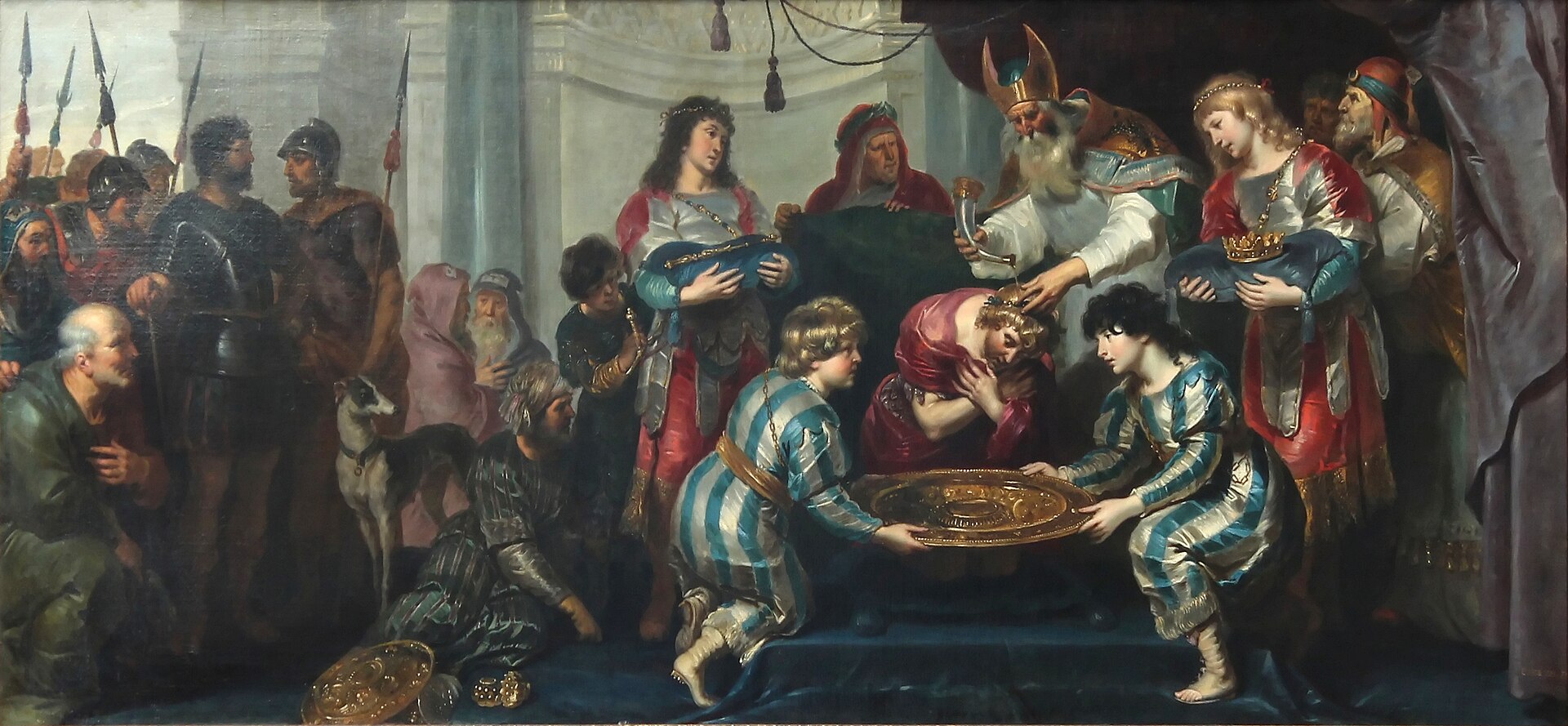
The anointing of Solomon. Cornelis de Vos, 17th century. Wikimedia Commons. Public domain.