
Psalms 89:3
in Psalms 89You said, “I have made a covenant with My chosen one, I have sworn to David My servant:
BSB
The same verse in ASV and KJV ▾
ASV
I have made a covenant with my chosen, I have sworn unto David my servant:
KJV
I have made a covenant with my chosen, I have sworn unto David my servant,
⋯
This verse in Psalms 89
Commentary
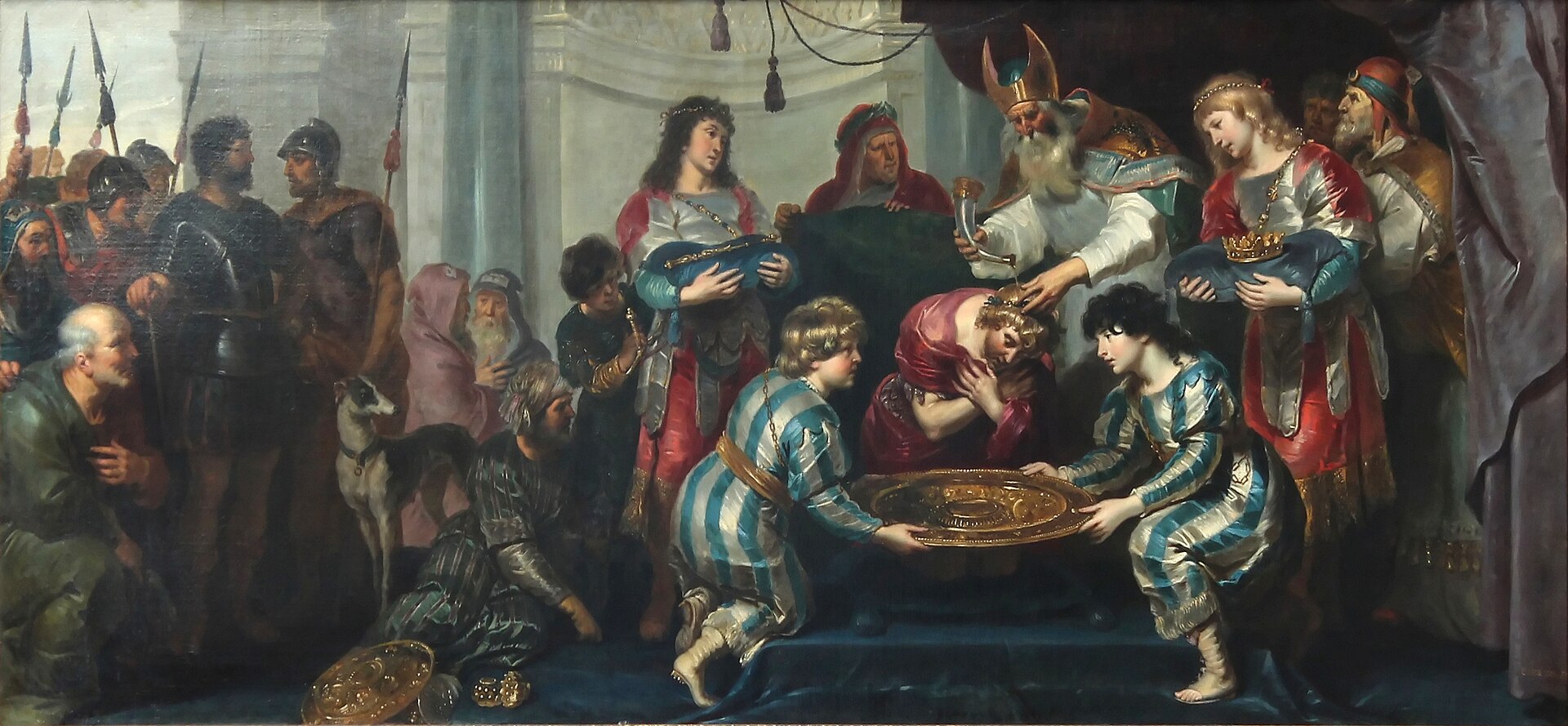
13 notes on this verseI have made a covenant with my chosen, I have sworn unto David my servant. This was the ground of the Psalmist's confidence in God's mercy and truth, for he knew that the Lord had made a covenant of grace with David and his seed, and confirmed it by an oath. Here he quotes the very words of God, which were revealed to him by the Holy Spirit, and are a condensation of the original covenant in 2Sa 7:1-29. Well might he write in the former verse, "I have said", when he knew that Jehovah had said, "I have sworn."
This site's exposition
the loving devotion of the LORD
on Psalms 89:1-4
The psalm opens on two words, loving devotion and faithfulness, and keeps them together to the end. In verses 3 and 4 God speaks: a covenant with His chosen one, an oath to David, an offspring and a throne established forever. The oath stands at 2 Samuel 7:12 to 16.
This site's exposition
I have sworn to David
Here God's own words begin, and they run through verse 4. Charles Spurgeon set this I have sworn beside the psalmist's I have said in verse 2, so the singer's confidence rests on God's oath. Albert Barnes noted that chosen one is singular in the Hebrew.
The record, by era
The Church Fathers3 voices
Orthodoxos: Listen now how the prophet praises God at the very beginning of the psalm. He saw with his prophetic eyes the future iniquity of his people and the captivity that was in consequence foredoomed; yet he praised his own Lord for unfailing promises. "I …
I have appointed a covenant to my chosen ones. Do you wish to know how to this day the Lord appoints his covenant? Let us act well, and we shall deserve to be sharers in the Lord's appointment of the chosen ones. I have sworn to David my servant. Let us see what it is that the Lord swore. This surely, which follows. Unto eternity I will prepare your seed. Come to our aid, O apostle, and interpret this little verse. For what does the apostle say?
"You have said, I have made a covenant with My chosen" [Psalm 89:3]. What covenant, but the new, by which we are renewed to a fresh inheritance, in our longing desire and love of which we sing a new song. "I have made a covenant with My chosen," says the Psalmist: "I have sworn unto David My servant." How confidently does he speak, who understands, whose mouth serves truth! I speak without fear; since "You have said." If You make me fearless, because You have said, how much more so dost Thou make me, when You have sworn! For the oath of God is the assurance of a promise. Man is justly forbidden to swear: [Matthew 5:34] lest by the habit of swearing, since a man may be deceived, he fall into perjury. God alone swears securely, because He alone is infallible.
The Puritans and the Awakening2 voices
), owning, to the comfort of his people, " I have made a covenant, and therefore will make it good." The covenant is made with David; the covenant of royalty is made with him, as the father of his family, and with his seed through him and for his sake, representing the covenant of grace made with Christ as head of the church and with all believers as his spiritual seed.
quarantine:debris (2026-07-29) — leading-punctuation+unbalanced-parens
5 ), and very great and precious promises they are which are here made to the Redeemer, which are strong foundations for the faith and hope of the redeemed to build upon. The comforts of our redemption flow from the covenant of redemption; all our springs are in that, Isa. lv.
quarantine:debris (2026-07-29) — leading-citation-number+unbalanced-parens
5 more voices on this verse
The Puritans and the Awakening2 voices
Here we have, (1.) The psalmist's faith and hope: "Things now look black, and threaten the utter extirpation of the house of David; but I have said, and I have warrant from the word of God to say it, that mercy shall be built up for ever. " As the goodness of God's nature is to be the matter of our song (
quarantine:debris (2026-07-29) — unbalanced-parens
I have made a covenant with my chosen,....
The Nineteenth Century3 voices
I have made a covenant with my chosen, I have sworn unto David my servant. This was the ground of the Psalmist's confidence in God's mercy and truth, for he knew that the Lord had made a covenant of grace with David and his seed, and confirmed it by an oath. Here he quotes the very words of God, which were revealed to him by the Holy Spirit, and are a condensation of the original covenant in 2Sa 7:1-29. Well might he write in the former verse, "I have said", when he knew that Jehovah had said, "I have sworn." David was the Lord's elect, and with him a covenant was made, which ran along in the line of his seed until it received a final and never ending fulfilment in "the Son of David." David's house must be royal: as long as there was a sceptre in Judah, David's seed must be the only rightful dynasty; the great "King of the Jews" died with that title above his head in the three current languages of the then known world, and at this day he is owned as king by men of every tongue. The oath sworn to David has not been broken, though the temporal crown is no longer worn, for in the covenant itself his kingdom was spoken of as enduring for ever. In Christ Jesus there is a covenant established with all the Lord's chosen, and they are by grace led to be the Lord's servants, and then are ordained kings and priests by Christ Jesus. How sweet it is to see the Lord, not only making a covenant, but owning to it in after days, and bearing witness to his own oath; this ought to be solid ground for faith, and Ethan, the Ezrahite, evidently thought it so. Let the reader and writer both pause over such glorious lines, and sing of the mercies of the Lord, who thus avows the bonds of the covenant, and, in so doing, gives a renewed pledge of his faithfulness to it. "I have", says the Lord, and yet again "I have", as though he himself was nothing loath to dwell upon the theme.
I have made a covenant with my chosen - I have made a covenant with Abraham, Isaac, and Jacob; and renewed it with Moses and Joshua in reference to the Israelites in general: but I have made one with David in especial relation to himself and posterity, of whom, according to the flesh, the Christ is to come. And this is the covenant with David: -
A commentator
Albert Barnes1798–1870
Notes, Explanatory and Practical, on the Old and New Testaments (1832-1869)
proposed
I have made a covenant with my chosen - With my chosen one; that is, with David. The original is in the singular number, though by the Septuagint, and the Vulgate, and by Luther, it is rendered in the plural - chosen ones - elect. This is undoubtedly the language of God himself, though it is not expressly ascribed to him. The design is to describe the solemn promise which God had made to David and to his posterity. Compare Psa 78:70-71. See also, on the use of the phrase “made a covenant,” see Psa 50:5, note; Psa 83:5, note. I have sworn unto David my servant - I have taken a solemn oath in regard to him. The substance of the oath is stated in the next verse. The promise referred to is found in 2Sa 7:11-16.
The words behind it
6 Hebrew wordsEvery Hebrew word of this verse in the order it stands, with what it means and the door to its own study. The last column counts the times a word stands in the whole Bible: the rarer the word, the more the places it appears belong together.
| Hebrew | Sound | Meaning | Word study | In the Bible |
|---|---|---|---|---|
| כָּרַ֣תִּֽי | karati | I have made | H3772 → | 288 times |
| בְ֭רִית | verit | a covenant | H1285 → | 284 times |
| לִבְחִירִ֑י | livchiri | to chosen one my | H972 → | 13 times |
| נִ֝שְׁבַּ֗עְתִּי | nishba'ti | I have sworn an oath | H7650 → | 186 times |
| לְדָוִ֥ד | ledavid | to David | H1732 → | 999 times |
| עַבְדִּֽי׃ | ʾavdi | servant my | H5650 → | 799 times |
כָּרַ֣תִּֽיI have made
karatiH3772 →288 times
בְ֭רִיתa covenant
veritH1285 →284 times
לִבְחִירִ֑יto chosen one my
livchiriH972 →13 times
נִ֝שְׁבַּ֗עְתִּיI have sworn an oath
nishba'tiH7650 →186 times
לְדָוִ֥דto David
ledavidH1732 →999 times
עַבְדִּֽי׃servant my
ʾavdiH5650 →799 times
A shaded row is a word that stands 400 times or fewer in the Bible.
The walk
8 stopsEach card is a verse this one points to, and under it the verses that one points to in turn. Where several paths arrive at the same place, that place is listed first: the text keeps returning to it.
Through
Hebrews 7:21but Jesus became a priest with an oath by the One who said to Him: “The Lord has sworn and will not change His mind: ‘You are a priest forever.’”
it leads to
- Psalms 110:4
The LORD has sworn and will not change His mind: “You are a priest forever in the order of Melchizedek.”
Reached by 2 separate paths from here.
- Hebrews 7:17
For it is testified: “You are a priest forever in the order of Melchizedek.”
- Psalms 110:4
Through
Psalms 132:11The LORD swore an oath to David, a promise He will not revoke: “One of your descendants I will place on your throne.
it leads to
- 2 Samuel 7:12
And when your days are fulfilled and you rest with your fathers, I will raise up your descendant after you, who will come from your own body, and I will establish his kingdom.
- Psalms 89:3–4
You said, “I have made a covenant with My chosen one, I have sworn to David My servant:
- Acts 2:30
But he was a prophet and knew that God had promised him on oath that He would place one of his descendants on his throne.
- 2 Chronicles 6:16
Therefore now, O LORD, God of Israel, keep for Your servant, my father David, what You promised when You said: ‘You will never fail to have a man to sit before Me on the…
- 2 Samuel 7:12
Through
1 Kings 8:16‘Since the day I brought My people Israel out of Egypt, I have not chosen a city from any tribe of Israel in which to build a house so that My Name would be…
it leads to
- 1 Samuel 16:1
Now the LORD said to Samuel, “How long are you going to mourn for Saul, since I have rejected him as king over Israel? Fill your horn with oil and go. I am sending…
- 1 Samuel 16:1
Through
Psalms 89:28I will forever preserve My loving devotion for him, and My covenant with him will stand fast.
it leads to
- Isaiah 55:3
Incline your ear and come to Me; listen, so that your soul may live. I will make with you an everlasting covenant—My loving devotion promised to David.
- Isaiah 55:3
Where this verse is studied
On this page
Studies12
On this verse
About Psalms
Who and where
1 name in this verse with a page on the site.
This page draws on 11 works. Open the list of works
This page draws on Adam Clarke, Commentary on the Bible; Albert Barnes, Notes on the Book of Psalms; Albert Barnes, Notes, Explanatory and Practical, on the Old and New Testaments (1832-1869); Augustine of Hippo, Exposition on Psalm 89; Charles Spurgeon, The Treasury of David, Vol. 4; Charles Spurgeon, The Treasury of David; Franz Delitzsch, Biblical Commentary on the Psalms; Jerome, Homily 66, on Psalm 88 (Alternate Series); John Gill, Exposition of the Old Testament (1748-1763); Matthew Henry, Commentary on the Whole Bible and Theodoret of Cyrus, DIALOGUE 1.