
Psalms 89:20
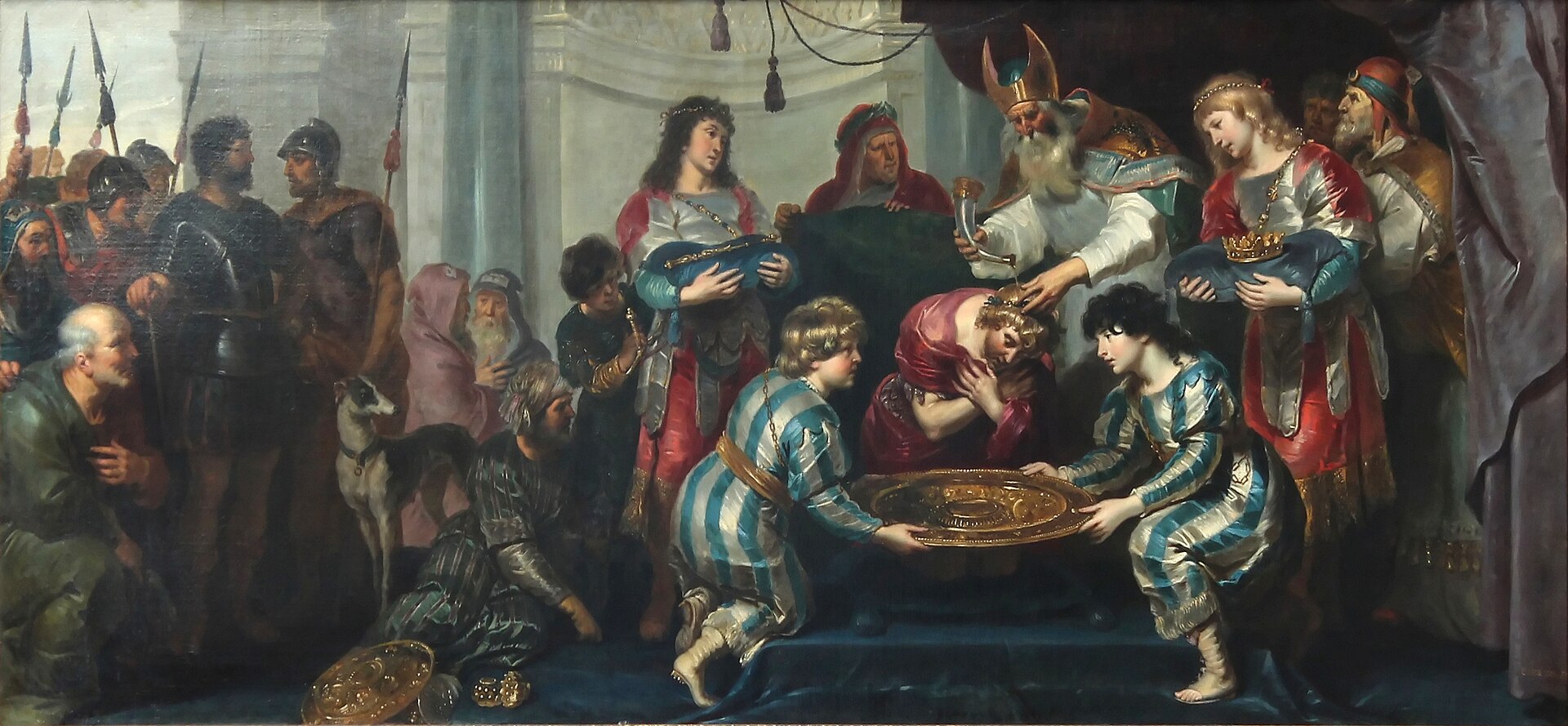
in Psalms 89I have found My servant David; with My sacred oil I have anointed him.
BSB
The same verse in ASV and KJV ▾
ASV
I have found David my servant; With my holy oil have I anointed him:
KJV
I have found David my servant; with my holy oil have I anointed him:
⋯
This verse in Psalms 89
Commentary
11 notes on this verseI have found David my servant. David was discovered by the Lord among the sheepfolds and recognised as a man of gracious spirit, full of faith and courage, and therefore fit to be leader in Israel. With my holy oil have I anointed him. By the hand of Samuel, David was anointed to be king long before he ascended the throne.
This site's exposition
You once spoke in a vision
on Psalms 89:19-23
The oracle is God's own speech: help laid on a warrior, and one man chosen from the people. Verse 20 names him, I have found My servant David, and Paul repeats the line at Acts 13:22. The hand and the arm that hold him are God's.
This site's exposition
with My sacred oil
God found David among the sheepfolds, and Samuel poured the oil at 1 Samuel 16:13. Charles Spurgeon observed that the anointing came long before David took the throne. Matthew Henry noted that Anointed means Messiah, or Christ.
The record, by era
The Church Fathers2 voices
"I have found David My servant:" that David from David's seed: "with My holy oil have I anointed Him" (ver. 20): for it is said of Him, "God, even Thy God, hath anointed Thee with the oil of gladness above Thy fellows."
"I have found David My servant:" that David from David's seed: "with My holy oil have I anointed Him" (ver. 20): for it is said of Him, "God, even Thy God, hath anointed Thee with the oil of gladness above Thy fellows."
The Puritans and the Awakening2 voices
He is called Messiah, or Christ, the Anointed. In all this he designed him to be his own servant, for the accomplishing of his eternal purpose and the advancement of the interests of his kingdom among men. The promises made to this chosen one, to David in the type and the Son of David in the antitype, in which not only gracious, but glorious things are spoken of him.
I have found David my servant,....
The Nineteenth Century1 voice
A commentator
Jamieson, Fausset & Brown1802–1910
Commentary Critical and Explanatory on the Whole Bible (1871)
Then--when the covenant was established, of whose execution the exalted views of God now given furnish assurance. thou . . . to thy holy one--or godly saint, object of favor (Ps 4:3). Nathan is meant (2Sa 7:17; 1Ch 17:3-15). laid help--literally, "given help." David was chosen and then exalted.
3 more voices on this verse
The Nineteenth Century3 voices
I have found David my servant. David was discovered by the Lord among the sheepfolds and recognised as a man of gracious spirit, full of faith and courage, and therefore fit to be leader in Israel. With my holy oil have I anointed him. By the hand of Samuel, David was anointed to be king long before he ascended the throne. The verse must also be expounded of the Prince Emmanuel; he became the servant of the Lord for our sakes, the Father having found for us in his person a mighty deliverer, therefore upon him rested the Spirit without measure, to qualify him for all the offices of love to which he was set apart. We have not a Saviour self appointed and unqualified, but one sent of God and divinely endowed for his work. Our Saviour Jesus is also the Lord's Christ, or anointed. The oil with which he is anointed is God's own oil, and holy oil; he is divinely endowed with the Spirit of holiness.
I have found David my servant - This is the sum of what God had said in prophetic visions to his saints or holy persons, Samuel, Nathan, and Gad; see 1Sa 16:1, 1Sa 16:12. Here the psalmist begins to reason with God relative to David, his posterity, and the perpetuity of his kingdom; which promises appear now to have utterly failed, as the throne had been overturned, and all the people carried into captivity. But all these things may have reference to Christ and his kingdom; for we are assured that David was a type of the Messiah.
A commentator
Albert Barnes1798–1870
Notes, Explanatory and Practical, on the Old and New Testaments (1832-1869)
proposed
I have found David my servant - That is, I found him among the sheepfolds; in humble life. I saw there one who was qualified for the high office of being the ruler of the nation, and I designated, or set him apart, for that office. The idea is, that there was in him a precious qualification for this work, and that God had seen this, and, in accordance with this, had summoned him to his service. With my holy oil have I anointed him - By the hand of Samuel. 1Sa 16:13. Oil was used in setting apart prophets, priests, and kings. It was poured upon the person - emblematic of the pouring out upon him of wisdom and grace from on high to qualify him for his office.
The words behind it
6 Hebrew wordsEvery Hebrew word of this verse in the order it stands, with what it means and the door to its own study. The last column counts the times a word stands in the whole Bible: the rarer the word, the more the places it appears belong together.
| Hebrew | Sound | Meaning | Word study | In the Bible |
|---|---|---|---|---|
| מָ֭צָאתִי | matzati | I have found | H4672 → | 455 times |
| דָּוִ֣ד | david | David | H1732 → | 999 times |
| עַבְדִּ֑י | ʾavdi | servant my | H5650 → | 799 times |
| בְּשֶׁ֖מֶן | beshemen | with [the] oil of | H8081 → | 193 times |
| קָדְשִׁ֣י | kodshi | holiness my | H6944 → | 469 times |
| מְשַׁחְתִּֽיו׃ | meshachtiv | I have anointed him | H4886 → |
מָ֭צָאתִיI have found
matzatiH4672 →455 times
דָּוִ֣דDavid
davidH1732 →999 times
עַבְדִּ֑יservant my
ʾavdiH5650 →799 times
בְּשֶׁ֖מֶןwith [the] oil of
beshemenH8081 →193 times
קָדְשִׁ֣יholiness my
kodshiH6944 →469 times
מְשַׁחְתִּֽיו׃I have anointed him
meshachtivH4886 →
A shaded row is a word that stands 400 times or fewer in the Bible.
The walk
8 stopsEach card is a verse this one points to, and under it the verses that one points to in turn. Where several paths arrive at the same place, that place is listed first: the text keeps returning to it.
Through
Acts 13:22After removing Saul, He raised up David as their king and testified about him: ‘I have found David son of Jesse a man after My own heart; he will carry out My will in…
it leads to
- 1 Samuel 13:13–14
“You have acted foolishly,” Samuel declared. “You have not kept the command that the LORD your God gave you; if you had, the LORD would have established your kingdom over Israel for all time.
- 1 Kings 15:5
For David had done what was right in the eyes of the LORD and had not turned aside from anything the LORD commanded all the days of his life, except in the matter of…
- 1 Samuel 16:13
So Samuel took the horn of oil and anointed him in the presence of his brothers, and the Spirit of the LORD rushed upon David from that day forward. Then Samuel set out and…
- Psalms 78:70–72
He chose David His servant and took him from the sheepfolds;
- 1 Samuel 16:1
Now the LORD said to Samuel, “How long are you going to mourn for Saul, since I have rejected him as king over Israel? Fill your horn with oil and go. I am sending…
- 1 Samuel 13:13–14
Through
John 3:34For the One whom God has sent speaks the words of God, for God gives the Spirit without limit.
it leads to
- Acts 10:38
how God anointed Jesus of Nazareth with the Holy Spirit and with power, and how Jesus went around doing good and healing all who were oppressed by the devil, because God was with Him.
- Matthew 12:18
“Here is My Servant, whom I have chosen, My beloved, in whom My soul delights. I will put My Spirit on Him, and He will proclaim justice to the nations.
- John 15:26
When the Advocate comes, whom I will send to you from the Father—the Spirit of truth who proceeds from the Father—He will testify about Me.
- Acts 10:38
Where this verse is studied
On this page
Studies12
On this verse
About Psalms
Who and where
1 name in this verse with a page on the site.
This page draws on 10 works. Open the list of works
This page draws on Adam Clarke, Commentary on the Bible; Albert Barnes, Notes on the Book of Psalms; Albert Barnes, Notes, Explanatory and Practical, on the Old and New Testaments (1832-1869); Augustine of Hippo, Exposition on Psalm 89; Charles Spurgeon, The Treasury of David, Vol. 4; Charles Spurgeon, The Treasury of David; Franz Delitzsch, Biblical Commentary on the Psalms; Jamieson, Fausset & Brown, Commentary Critical and Explanatory on the Whole Bible; John Gill, Exposition of the Old Testament (1748-1763) and Matthew Henry, Commentary on the Whole Bible.