
Psalm 22
31 verses · Lament
My God, my God, why have You forsaken me? Why are You so far from saving me, so far from my words of groaning?
Introduction
David, the Forsaken Sufferer, Book 1: The book of David, Poetry, Psalms Overview.
David's name heads this psalm, and it is the darkest prayer in the first book of the Psalter. A man surrounded by enemies prays to a God who seems absent, and he describes his body failing in the open while a crowd looks on. Christians have read it beside the Gospels from the first, because Jesus prayed its opening words on the cross. Listen for the sudden turn two thirds of the way through, where the cry for help becomes a vow of praise in the assembly, and for how far that praise travels before the psalm ends, out to the nations and to people not yet born.
Context
- Who
- Israelites singing a sufferer's prayer whose details outran anything in their own history
- What
- A lament in which a dying man cries to God, is answered, and turns to praise before the whole world.
- Where
- An open place of execution, with a crowd standing around the dying man.
- When
- The reign of David, about 1010 to 970 BC by the superscription.
- Why
- To give a sufferer words for abandonment that end in praise, words the Gospels hear again at the cross.
Historical context
The bulls of Bashan in verse 12 name a real place, the high well-watered plateau east of the Sea of Galilee, known for cattle so large that the prophets used them as a byword. Dogs in that world ran in scavenging packs at the edges of towns and around refuse and corpses, so the two pictures together say the crowd is powerful and filthy at once. The physical detail is that of slow death in the open: bones out of joint, strength dried like a potsherd, the tongue stuck to the roof of the mouth with thirst, and the hands and feet pierced. That last phrase is the most argued line in the psalm. The traditional Hebrew wording reads like a lion, while the ancient Greek translation, some Hebrew manuscripts and a fragment found at the Dead Sea support they pierced. Dividing a condemned man's clothes among the executioners was ordinary practice, and casting lots was how the ancient world split anything that could not be divided.
Significance
The psalm opens with an abandoned cry and closes with all the ends of the earth remembering and turning to the LORD, a scope far past one man's rescue. That gap sat in Israel's songbook for a thousand years. Jesus quoted its first line from the cross, and the Gospel writers report the mockery, the thirst and the divided garments as things that happened. First hearers sang a lament, and later readers found they had been singing a description.
This chapter in Jewish lifeWhat this chapter is in Jewish life and reading.
How it is read
No chapter of the first thirty stands further from the Christian reading than this one, and the corpus is clear about where the Jewish reading goes. Rashi is quoted here from the Judaica Press Tanach with Rashi. He reads the psalm of the nation rather than of a man. At the second verse he says the speakers "are destined to go into exile, and David recited this prayer for the future" (Rashi on Psalms 22:2:1). At the seventh verse, where the psalm says I am a worm, Rashi gives the rule that governs the whole chapter. The psalmist "refers to all Israel as one man" (Rashi on Psalms 22:7:1). From there every image in the psalm becomes a picture of a people under empires.
The animals of the middle verses are read as kingdoms on that plan. The great bulls of the thirteenth verse are "mighty kingdoms" (Rashi on Psalms 22:13:1). The tearing lion of the fourteenth is Nebuchadnezzar (Rashi on Psalms 22:14:1). The crushed hands and feet of the seventeenth Rashi reads from the Hebrew word for a lion. He glosses them "as though they are crushed in a lion's mouth", and sets Hezekiah's words about a lion breaking his bones beside them (Rashi on Psalms 22:17:1). The casting of lots for the clothing in the nineteenth verse he reads as plunder: "They plunder our property" (Rashi on Psalms 22:19:1). Radak, quoted from the Finch translation of 1919, which is public domain, reads the same chapter as exile throughout. At the twelfth verse he prays "now also in exile be not far from me" (Radak on Psalms 22:12:1). At the twenty-first he asks deliverance "from the sword of exile, lest I be exterminated in exile" (Radak on Psalms 22:21:1).
The parting is total, and it should be stated without heat on either side. The Gospels put the psalm's opening words in the mouth of Jesus on the cross. The evangelists read the casting of lots for the clothing, and the piercing of the hands and feet, as things that happened at the crucifixion. The classical Jewish reading in this corpus takes the same verses of Israel in exile, with the lion for an empire and the plundered clothing for plundered property. The clause about the hands and feet turns on a disputed Hebrew word, and the two readings of it rest on different witnesses. That argument is set out in full, with the evidence on each side, in the chapter study of Psalm 22. It is also carried by the pierced hands and feet row of docs/lanes/FEATURE-PAGES-OWED.md, and this card points there rather than repeating it.
Rashi's other notes on the chapter are worth having in their own right. On the heading he offers a musical instrument first, then reads the phrase of Israel as a beloved hind who looks out like the dawn. He also reports that the Sages referred it to Esther (Rashi on Psalms 22:1:1). At the ninth verse he turns the taunt into a rule of prayer. A man "should roll his burden and his load upon His Creator so that He rescue him" (Rashi on Psalms 22:9:1). At the eleventh he reads the casting upon God from birth as God carrying the tribes from the time they were born (Rashi on Psalms 22:11:1). At the twenty-third he reads the brothers whom the psalmist will teach as the assembly. He takes the God-fearers of that verse as the proselytes, standing beside all the seed of Jacob (Rashi on Psalms 22:23:1). Radak grounds the fifth and sixth verses in the fathers who trusted and cried and escaped, "not to other gods" (Radak on Psalms 22:6:1).
What the rabbis say
The corpus carries forty locators on this psalm and the text of none, so each is cited and linked here rather than quoted. Five are Talmudic. Three stand in Avot DeRabbi Natan, at 25:1 later in the chapter and at 27:10 and 44:16 of Recension B on the fourth verse. Two more stand at Jerusalem Talmud Yoma 8:4:2 on the heading and Chullin 89a:6 on the seventh verse.
Midrash Tehillim carries ten and follows the psalm through. They stand at 22:17 on the fifth verse, 22:14 on the sixth, 22:18 on the ninth, 22:19 on the tenth, 22:20 on the thirteenth and 119:24 on the fifteenth. Four more stand at 22:21 and 42:1 on the twentieth verse, 22:23 on the twenty-fourth, and 22:27 on the thirty-second.
Five entries of Ein Yaakov stand in the Glick Edition. They are Megillah 1:33 and 1:5 on the second and third verses, Chullin 6:4 on the seventh, Bava Batra 5:32 on the thirteenth, and Sanhedrin 11:132 on the thirty-first. Beside them stand Yoma 3:6, Megillah 1:40 and Megillah 1:5. Four entries of Bereshit Rabbati stand on the tenth, fourteenth, seventeenth and twenty-seventh verses, on Vayechi 9, Vayetze 52, Vayechi 30 and Vayechi 32.
The rest are scattered. Two entries of Pesikta Rabbati stand on the sixteenth verse, at 36:1 and 37:1. Two entries of Midrash Sekhel Tov stand on the eighth and fifteenth, on Exodus 13:1:2 and 1:11:4. On the twelfth verse the corpus carries Midrash Lekach Tov on Genesis 2:6:2 and Sifrei Devarim 342:2. On the twenty-first it carries Bamidbar Rabbah 17:2 and Bereshit Rabbah 14:9. The last five stand at Tanna DeBei Eliyahu Rabbah 18:2 on the fifth verse, Aggadat Bereshit 13:3 on the eighth, and Mekhilta DeRabbi Yishmael, Shirah 8:22 on the eighteenth. Two close the chapter, at Eikhah Rabbah 2:6 on the twenty-second verse and Esther Rabbah 1:13 on the twenty-ninth. What each of them teaches is a saying of the rabbis, and is reported as theirs wherever this site quotes one. The quotations wait on a fetch that carries the text.
Sources: Rashi, Rashi on Psalms 22:1:1 to 22:24:1, the Judaica Press complete Tanach with Rashi, translated by A. J. Rosenberg; Radak, Radak on Psalms 22:5:1 to 22:21:1, R. David Kimhi on the first book of Psalms, translated by R. G. Finch, London, 1919; MannaFest, the pierced hands and feet row of docs/lanes/FEATURE-PAGES-OWED.md, and the chapter study of Psalm 22; The Sefaria corpus, scripts/data/sources/sefaria/psalms/22.json, the 5 Talmud and 35 Midrash locators of this chapter.
why have You forsaken me?: is the cry Jesus prayed from the cross, kept in Aramaic at Matthew 27:46. The sufferer calls God his own God and asks why He is far from saving him. He cries by day and night and gets no rest.
Psalms 22:1
"My God, my God, why hast thou forsaken me?" This was the startling cry of Golgotha: Eloi, Eloi, lama sabacthani. The Jews mocked, but the angels adored when Jesus cried this exceeding bitter cry. Nailed to the tree we behold our great Redeemer in extremities, and what see we? Having ears to hear let us hear, and having eyes to see let us see! Let us gaze with holy wonder, and mark the flashes of light amid the awful darkness of that midday-midnight.
Charles Spurgeon · The Treasury of David, Vol. 1 (1869)Particular Baptist
2 more voices on this verseWhat preachers and commentators have said about this verse, in their own words.
Psalms 22:1
“Seeing, then, that he took on himself a soul he also took the affections of a soul, for God could not have been distressed or have died in respect of his being God.… As being man, therefore, he speaks, bearing with him my terrors, for when we are in the midst of dangers we think ourself abandoned by God. As man, therefore, he is distressed, as man he weeps, as man he is crucified.”
Ambrose of Milan · written before 397 · Exposition of the Christian Faith 2.7.56patristic
Psalms 22:1
“Psalm 22 reads as if it was dictated, first person singular, as He hung on the cross, even though it was written 700 years earlier.”
Chuck Missler · How Can We Be Sure? (article) (2021)Calvary Chapel-influenced Independent
Cross references
Psalms 22:1
- Quoted inMark 15:34At the ninth hour, Jesus cried out in a loud voice, “Eloi, Eloi, lema sabachthani?” which means, “My God, My God, why have You forsaken Me?”
'Eloi, Eloi, lama sabachthani', cry of dereliction
- Quoted inMatthew 27:46About the ninth hour Jesus cried out in a loud voice, “Eli, Eli, lema sabachthani?” which means, “My God, My God, why have You forsaken Me?”
'My God, my God, why hast thou forsaken me?', cry of dereliction (invokes whole Psalm 22)
ConnectionsMatthew 27:46, Psalms 69:1
Psalms 22:2
"O my God, I cry in the daytime, but thou hearest not." For our prayers to appear to be unheard is no new trial, Jesus felt it before us, and it is observable that he still held fast his believing hold on God, and cried still, "My God." On the other hand his faith did not render him less importunate, for amid the hurry and horror of that dismal day he ceased not his cry, even as in Gethsemane he had agonized all through the gloomy night.
Charles Spurgeon · The Treasury of David, Vol. 1 (1869)Particular Baptist
2 more voices on this verse
Psalms 22:2
He is surely showing his surprise here that the Father does not hear him; he regards it as something strange and unusual. But the Father reserved his hearing until the fit time that he should be heard. That time was the hour of dawn, of the resurrection from the dead, when to him it could be more justly said than to any, "In a time accepted I heard you, and in a day of salvation I succored you. Behold, now is the accepted time; behold, now is the day of salvation."
Eusebius of Caesarea · written before 339 · Proof of the Gospel 10:8.496patristic
Psalms 22:2
“The long distress is evinced by-- am not silent--literally, "not silence to me," either meaning, I continually cry; or, corresponding with "thou hearest not," or answerest not, it may mean, there is no rest or quiet to me.”
Jamieson, Fausset & Brown · Commentary Critical and Explanatory on the Whole Bible (1871)reformed
Yet You are holy: God is holy, enthroned on the praises of Israel. Verses 4 and 5 name the record, the fathers who trusted, cried out, and were delivered, set free and not disappointed. Henry sets the cry of verse 1 against that record, a silence from the God who had always answered.
Psalms 22:3
"But thou art holy, O thou that inhabitest the praises of Israel." However ill things may look, there is no ill in thee, O God! We are very apt to think and speak hardly of God when we are under his afflicting hand, but not so the obedient Son. He knows too well his Father's goodness to let outward circumstances libel his character. There in no unrighteousness with the God of Jacob, he deserves no censure; let him do what he will, he is to be praised, and to reign enthroned amid the songs of his chosen people.
Charles Spurgeon · The Treasury of David, Vol. 1 (1869)Particular Baptist
1 more voice on this verse
Psalms 22:3
“Past experience of God's people is a ground of trust. The mention of "our fathers" does not destroy the applicability of the words as the language of our Saviour's human nature.”
Jamieson, Fausset & Brown · Commentary Critical and Explanatory on the Whole Bible (1871)reformed
Psalms 22:4
"Our fathers trusted in thee: they trusted, and thou didst deliver them." This is the rule of life with all the chosen family. Three times over is it mentioned, they trusted, and trusted, and trusted, and never left off trusting, for it was their very life; and they fared well too, for thou didst deliver them.
Charles Spurgeon · The Treasury of David, Vol. 1 (1869)Particular Baptist
Psalms 22:5
"They cried unto thee, and were delivered: they trusted in thee, and were not confounded." As if he had said, "How is it that I am now left without succour in my overwhelming griefs, while all others have been helped? We may remind the Lord of his former lovingkindnesses to his people, and beseech him to be still the same. This is true wrestling; let us learn the art.
Charles Spurgeon · The Treasury of David, Vol. 1 (1869)Particular Baptist
I am a worm: The sufferer calls himself a worm, in Hebrew tolaath, a grub men tread on. The mockers in verse 8 dare God to rescue the man who trusts Him. The chief priests say the same thing at the cross in Matthew 27:43.
Psalms 22:6
"But I am a worm, and no man." This verse is a miracle in language. How could the Lord of glory be brought to such abasement as to be not only lower than the angels, but even lower than men. What a contrast between "I AM" and "I am a worm"! yet such a double nature was found in the person of our Lord Jesus when bleeding upon the tree. He felt himself to be comparable to a helpless, powerless, down-trodden worm, passive while crushed, and unnoticed and despised by those who trod upon him.
Charles Spurgeon · The Treasury of David, Vol. 1 (1869)Particular Baptist
2 more voices on this verse
Psalms 22:6
“He became all these things so that he might dull the sting of our death, that he might take away our state of slavery, that he might wipe away our curses, sins and reproaches.”
Ambrose of Milan · written before 397 · Letter 46: To Sabinuspatristic
Psalms 22:6
“They make mouths at him, make merry over him, and make a jest of his sufferings: They shoot out the lip, they shake their head, saying, This was he that said he trusted God would deliver him; now let him deliver him. David was sometimes taunted for his confidence in God; but in the sufferings of Christ this was literally and exactly fulfilled.”
Matthew Henry · Commentary on the Whole Bible (1707-1721)puritan
ConnectionsStrong's H8438
Psalms 22:7
"All they that see me laugh me to scorn." Read the evangelistic narrative of the ridicule endured by the Crucified One, and then consider, in the light of this expression, how it grieved him. The iron entered into his soul. Mockery has for its distinctive description "cruel mockings;" those endured by our Lord were of the most cruel kind. The scornful ridicule of our Lord was universal; all sorts of men were unanimous in the derisive laughter, and vied with each other in insulting him.
Charles Spurgeon · The Treasury of David, Vol. 1 (1869)Particular Baptist
1 more voice on this verse
Psalms 22:7
“Just as we say that the flesh became [the Word's] very own, in the same way the weakness of that flesh became his very own in an economic appropriation according to the terms of the unification. So, he is "made like his brothers in all things except sin alone." Do not be astonished if we say that he has made the weakness of the flesh his own along with the flesh itself.”
Cyril of Alexandria · written before 444 · On the Unity of Christpatristic
Psalms 22:8
"Saying, He trusted on the Lord that he would deliver him: let him deliver him, seeing he delighted in him." Here the taunt is cruelly aimed at the sufferer's faith in God, which is the tenderest point in a good man's soul, the very apple of his eye. They must have learned the diabolical art from Satan himself, for they made rare proficiency in it.
Charles Spurgeon · The Treasury of David, Vol. 1 (1869)Particular Baptist
1 more voice on this verse
Psalms 22:8
This is the language of enemies sporting with his faith in the hour of his desertion. Though ironically spoken, the exhortation to trust was well founded on his previous experience of divine aid, the special illustration of which is drawn from the period of helpless infancy. didst make me hope--literally, "made me secure."
Jamieson, Fausset & Brown · Commentary Critical and Explanatory on the Whole Bible (1871)reformed
You brought me forth from the womb: Answering the taunt, the sufferer goes back to the womb, where God brought him out and held him safe at the breast. God has been his God from birth, before he could trust anyone. Verse 11 asks one thing, that God not stay far off.
Psalms 22:9
"But thou art he that took me out of the womb." Kindly providence attends with the surgery of tenderness at every human birth; but the Son of Man, who was marvelously begotten of the Holy Ghost, was in an especial manner watched over by the Lord when brought forth by Mary.
Charles Spurgeon · The Treasury of David, Vol. 1 (1869)Particular Baptist
Psalms 22:10
"I was cast upon thee from the womb." Into the Almighty arms he was first received, as into those of a loving parent. This is a sweet thought. God begins his care over us from the earliest hour. We are dandled upon the knee of mercy, and cherished in the lap of goodness; our cradle is canopied by divine love, and our first totterings are guided by his care. "Thou art my God from my mother's belly." The psalm begins with "My God, my God," and here, not only is the claim repeated, but its early date is urged.
Charles Spurgeon · The Treasury of David, Vol. 1 (1869)Particular Baptist
1 more voice on this verse
Psalms 22:10
He and the Father are One, and the Father is his Father by possession of the same nature.… Speaking as the Son, he called God his father, and afterward, speaking as man, named him as God. Everywhere, indeed, we have witness in the Scriptures to show that Christ, in naming God as his God, does so as man. "My God, my God, why have you forsaken me? And again: "From my mother's womb you are my God."
Ambrose of Milan · written before 397 · Exposition of the Christian Faith 1.14.91-92patristic
Psalms 22:11
"Be not far from me." This is the petition for which he has been using such varied and powerful pleas. His great woe was that God had forsaken him, his great prayer is that he would be near him. A lively sense of the divine presence is a mighty stay to the heart in times of distress. "For trouble is near; for there is none to help." There are two "fors," as though faith gave a double knock at mercy's gate; that is a powerful prayer which is full of holy reasons and thoughtful arguments.
Charles Spurgeon · The Treasury of David, Vol. 1 (1869)Particular Baptist
2 more voices on this verse
Psalms 22:11
“It is surely the very climax of affliction to have no helper. For Christ went for the salvation of the souls in hades that had so long awaited his arrival. He went down to shatter the gates of brass, and to break the iron bonds and to let them go free that before were prisoners in hades, which was indeed done, when many bodies of the saints that slept arose and entered with him into the true holy city of God.”
Eusebius of Caesarea · written before 339 · Proof of the Gospel 10:8.501patristic
Psalms 22:11
“From this statement of reasons for the appeal, he renews it, pleading his double extremity, the nearness of trouble, and the absence of a helper. His enemies, with the vigor of bulls and rapacity of lions, surround him, eagerly seeking his ruin. The force of both figures is greater without the use of any particle denoting comparison.”
Jamieson, Fausset & Brown · Commentary Critical and Explanatory on the Whole Bible (1871)reformed
strong bulls of Bashan: The attackers come as animals, bulls from the rich pasture of Bashan east of the Jordan and lions with open jaws. Inside, the body gives way, water poured out and a heart of melting wax. Verse 15 lays the dust of death at God's own hand.
Psalms 22:12
"Many bulls have compassed me: strong bulls of Bashan have beset me round." The mighty ones in the crowd are here marked by the tearful eye of their victim. The priests, elders, scribes, Pharisees, rulers, and captains bellowed round the cross like wild cattle, fed in the fat and solitary pastures of Bashan, full of strength and fury; they stamped and foamed around the innocent One, and longed to gore him to death with their cruelties. Conceive of the Lord Jesus as a helpless, unarmed, naked man, cast into the midst of a herd of infuriated wild bulls.
Charles Spurgeon · The Treasury of David, Vol. 1 (1869)Particular Baptist
1 more voice on this verse
Psalms 22:12
“Bulls - Wicked and violent, and potent enemies; for such are so called, Ezek xxxix, 18 Amos iv, 1. Of Bashan - As the cattle there bred were, and therefore fierce and furious.”
John Wesley · Explanatory Notes upon the Old Testament (1765)evangelical
Psalms 22:13
"They gaped upon me with their mouths, as a ravening and a roaring lion." Like hungry cannibals they opened their blasphemous mouths as if they were about to swallow the man whom they abhorred. They could not vomit forth their anger fast enough through the ordinary aperture of their mouths, and therefore set the doors of their lips wide open like those who gape. Like roaring lions they howled out their fury, and longed to tear the Saviour in pieces, as wild beasts raven over their prey.
Charles Spurgeon · The Treasury of David, Vol. 1 (1869)Particular Baptist
Psalms 22:14
“Turning from his enemies, our Lord describes his own personal condition in language which should bring the tears into every loving eye. "I am poured out like water." He was utterly spent, like water poured upon the earth; his heart failed him, and had no more firmness in it than running water, and his whole being was made a sacrifice, like a libation poured out before the Lord.”
Charles Spurgeon · The Treasury of David, Vol. 1 (1869)Particular Baptist
Psalms 22:15
“And so fire cooked the meats of our Lamb, because the very power of His passion rendered Him stronger for resurrection and strengthened Him for incorruption. For He who recovered from death—clearly His flesh was hardened by fire. Hence also through the Psalmist He says: "My strength has dried up like a potsherd." For what is a potsherd before fire except soft clay? But it is subjected to fire so that it may become solid. Therefore the strength of His humanity dried up like a potsherd, because from the fire of passion it grew into the power of incorruption.”
Gregory the Dialogist · written before 604 · Forty Gospel Homilies, Homily 22patristic
2 more voices on this verse
Psalms 22:15
"My strength is dried up like a potsherd." Most complete debility is here portrayed; Jesus likens himself to a broken piece of earthenware, or an earthen pot, baked in the fire till the last particle of moisture is driven out of the clay. No doubt a high degree of feverish burning afflicted the body of our Lord. All his strength was dried up in the tremendous flames of avenging justice, even as the paschal lamb was roasted in the fire. "My tongue cleaveth to my jaws;" thirst and fever fastened his tongue to his jaws.
Charles Spurgeon · The Treasury of David, Vol. 1 (1869)Particular Baptist
Psalms 22:15
“The life of the sinner was forfeited, and therefore the life of the sacrifice must be the ransom for it. The sentence of death passed upon Adam was thus expressed: Unto dust thou shalt return. And therefore Christ, having an eye to that sentence in his obedience to death, here uses a similar expression: Thou hast brought me to the dust of death.”
Matthew Henry · Commentary on the Whole Bible (1707-1721)puritan
Note on the text · Psalm 22:16
One Hebrew letter separates "they pierced" from "like a lion." The Greek Old Testament read "pierced" centuries before the crucifixion, and a scroll fragment supports it, but the medieval Hebrew reads "lion," and the case deserves to be heard at full strength.
The witnesses, and what each reads here
- The Greek Old Testament (Septuagint) · translated in the last centuries BCA verb, "they dug my hands and my feet".
- A Psalms fragment from Nahal Hever · about the early 2nd century ADA form of the word ending in the letter that gives the verbal reading rather than "lion", the earliest Hebrew evidence we have at this point.
- The Syriac and Latin versions · 2nd century AD onward"Pierced", ancient translations agreeing with the Greek.
- The Masoretic Hebrew text · the Leningrad Codex, AD 1008*ka'ari*, "like a lion", giving "like a lion, my hands and my feet", a phrase with no verb in it.
they have pierced my hands and feet: The Berean reads they have pierced my hands and feet with the Septuagint, the Greek Old Testament. The received Hebrew text has one letter different and reads like a lion. A Psalms scroll from the Judean desert carries the pierced reading.
Psalms 22:16
The dogs that surrounded him and the council of the wicked were the rulers of the Jews, the scribes and high priests and the Pharisees, who spurred on the whole multitude to demand his blood against themselves and against their own children. Isaiah clearly calls them dogs when he says, "You are all foolish dogs, unable to bark."
Eusebius of Caesarea · written before 339 · Proof of the Gospel 10:8.505-6patristic
2 more voices on this verse
Psalms 22:16
“Dogs - So he calls his enemies for their insatiable greediness, and implacable fierceness against him. Pierced - These words cannot with any probability be applied to David, but were properly and literally verified in Christ.”
John Wesley · Explanatory Notes upon the Old Testament (1765)evangelical
Psalms 22:16
“Evildoers are well described as dogs, which, in the East, herding together, wild and rapacious, are justly objects of great abhorrence. The last clause has been a subject of much discussion (involving questions as to the genuineness of the Hebrew word translated "pierce)" which cannot be made intelligible to the English reader.”
Jamieson, Fausset & Brown · Commentary Critical and Explanatory on the Whole Bible (1871)reformed
Psalms 22:17
“So emaciated was Jesus by his fastings and sufferings that he says, "I may tell all my bones." He could count and recount them. The posture of the body on the cross, Bishop Horne thinks, would so distend the flesh and skin as to make the bones visible, so that they might be numbered. The zeal of his Father's house had eaten him up; like a good soldier he had endured hardness. Oh that we cared less for the body's enjoyment and ease and more for our Father's business!”
Charles Spurgeon · The Treasury of David, Vol. 1 (1869)Particular Baptist
1 more voice on this verse
Psalms 22:17
“His blessed body was lean and emaciated with labour, grief, and fasting, during the whole course of his ministry, which made him look as if he was nearly 50 years old when he was yet but 33, as we find, John viii.”
Matthew Henry · Commentary on the Whole Bible (1707-1721)puritan
Psalms 22:18
“They part my garments among them,.... Such as died the death of the cross were crucified naked (h), and their clothes were the perquisites of the executioners; there were four soldiers concerned in the crucifixion of Christ, and these parted his garments into four parts, and everyone took his part; and cast lots on my vesture; which was a seamless coat, wove from the top to the bottom; and therefore, not willing to rend it, they cast lots upon it who should have it; all this was exactly fulfilled in Christ, Joh 19:23. (h) Vid Lipsium de Cruce, l.”
2 more voices on this verse
Psalms 22:18
"They part my garments among them, and cast lots upon my vesture." The garments of the executed were the perquisites of the executioners in most cases, but it was not often that they cast lots at the division of the spoil; this incident shows how clearly David in vision saw the day of Christ, and how surely the Man of Nazareth is he of whom the prophets spake: "these things, therefore, the soldiers did." He who gave his blood to cleanse us gave his garments to clothe us.
Charles Spurgeon · The Treasury of David, Vol. 1 (1869)Particular Baptist
Psalms 22:18
“They part - This also cannot be applied to David, but was literally fulfilled in Christ, Matt. xxvii, 35 John xix, 24.”
John Wesley · Explanatory Notes upon the Old Testament (1765)evangelical
Cross references
Psalms 22:18
- Quoted inJohn 19:24“So they said to one another, “Let us not tear it. Instead, let us cast lots to see who will get it.” This was to fulfill the Scripture: “They divided My garments among them, and cast lots for My clothing.” So that is what the soldiers did.”
'They parted my raiment among them' (soldiers cast lots; 'that the scripture might be fulfilled')
ConnectionsJohn 19:24
come quickly to help me: The prayer names the beasts again in reverse, the wild dogs, the lion's mouth, the horns of the wild oxen. The precious life of verse 20 is the Hebrew word for an only one, the single life a man has. Verse 21 ends with You have answered me.
Psalms 22:19
"But be thou not far from me, O Lord." Invincible faith returns to the charge, and uses the same means, viz., importunate prayer. He repeats the petition so piteously offered before. He wants nothing but his God, even in his lowest state. He does not ask for the most comfortable or nearest presence of God, he will be content if he is not far from him; humble requests speed at the throne. "O my strength, haste thee to help me."
Charles Spurgeon · The Treasury of David, Vol. 1 (1869)Particular Baptist
1 more voice on this verse
Psalms 22:19
"Whoever stands aloof from my sore, Lord, do not thou." The nearness of trouble should quicken us to draw near to God and then we may hope that he will draw near to us. That he would help him and make haste to help him, help him to bear up under his troubles, that he might not fail nor be discouraged, that he might neither shrink from his undertaking no sink under it.
Matthew Henry · Commentary on the Whole Bible (1707-1721)puritan
Psalms 22:20
"Deliver my soul from the sword." By the sword is probably meant entire destruction, which as a man he dreaded; or perhaps he sought deliverance from the enemies around him, who were like a sharp and deadly sword to him. The Lord had said, "Awake, O sword, " and now from the terror of that sword the Shepherd would fain be delivered as soon as justice should see fit. "My darling from the power of the dog." Meaning his soul, his life, which is most dear to every man.
Charles Spurgeon · The Treasury of David, Vol. 1 (1869)Particular Baptist
Psalms 22:21
"Save me from the lion's mouth: for thou hast heard me from the horns of the unicorns." Having experienced deliverance in the past from great enemies, who were strong as the unicorns, the Redeemer utters his last cry for rescue from death, which is fierce and mighty as the lion. This prayer was heard, and the gloom of the cross departed. Thus faith, though sorely beaten, and even cast beneath the feet of her enemy, ultimately wins the victory. It was so in our Head, it shall be so in all the members.
Charles Spurgeon · The Treasury of David, Vol. 1 (1869)Particular Baptist
1 more voice on this verse
Psalms 22:21
“Deliverance pleaded in view of former help, when in the most imminent danger, from the most powerful enemy, represented by the unicorn or wild buffalo. the lion's mouth--(Compare Ps 22:13). The lion often used as a figure representing violent enemies; the connecting of the mouth intimates their rapacity.”
Jamieson, Fausset & Brown · Commentary Critical and Explanatory on the Whole Bible (1871)reformed
proclaim Your name to my brothers: The psalm turns here from the cry to the assembly. Hebrews 2:12 puts this verse in the mouth of Christ, who calls the people He saves His brothers. The first thing the sufferer does with the answer is proclaim God's name.
Psalms 22:22
"I will declare thy name unto my brethren." The delights of Jesus are always with his church, and hence his thoughts, after much distraction, return at the first moment of relief to their usual channel; he forms fresh designs for the benefit of his beloved ones. He is not ashamed to call them brethren, "Saying, I will declare thy name unto my brethren, in the midst of the church will I sing praise unto thee." Among his first resurrection words were these, "Go to my brethren."
Charles Spurgeon · The Treasury of David, Vol. 1 (1869)Particular Baptist
2 more voices on this verse
Psalms 22:22
“He is the Lord by nature but a brother by grace.”
Ambrose of Milan · written before 397 · On the Blessings of the Patriarchspatristic
Psalms 22:22
“Congregations - The same whom he calls the congregation, and the seed of Jacob and Israel: which also does not so fitly agree to David, who never gives this title to any, but such as were near a-kin to him, as it does to Christ, who extends this name to all his disciples, Matt. xii, 48, 49, and to whom this very text is applied, Heb. ii, 11, 12.”
John Wesley · Explanatory Notes upon the Old Testament (1765)evangelical
Cross references
Psalms 22:22
- Quoted inHebrews 2:12He says: “I will proclaim Your name to My brothers; I will sing Your praises in the assembly.”
'I will declare thy name unto my brethren' (Christ not ashamed to call us brethren)
ConnectionsHebrews 2:12
You who fear the LORD: The praise answers the complaint line by line: God has not hidden His face and has attended to the cry. The vows of verse 25 belong to the thank offering, whose meal fed the poor at the sanctuary. The poor eat and are satisfied at that meal.
Psalms 22:23
"Ye that fear the Lord praise him." The reader must imagine the Saviour as addressing the congregation of the saints. He exhorts the faithful to unite with him in thanksgiving. The description of "fearing the Lord" is very frequent and very instructive; it is the beginning of wisdom, and is an essential sign of grace. "I am a Hebrew and I fear God" was Jonah's confession of faith.
Charles Spurgeon · The Treasury of David, Vol. 1 (1869)Particular Baptist
1 more voice on this verse
Psalms 22:23
“That God would be glorified in the Redeemer and in his undertaking. Therefore Christ is said to praise God in the church, not only because he is the Master of the assemblies in which God is praised, and the Mediator of all the praises that are offered up to God, but because he is the matter of the church's praise.”
Matthew Henry · Commentary on the Whole Bible (1707-1721)puritan
Psalms 22:24
"For he hath not despised nor abhorred the affliction of the afflicted." Here is good matter and motive for praise. The experience of our covenant Head and Representative should encourage all of us to bless the God of grace. Never was man so afflicted as our Saviour in body and soul from friends and foes, by heaven and hell, in life and death; he was the foremost in the ranks of the afflicted, but all those afflictions were sent in love, and not because his Father despised and abhorred him.
Charles Spurgeon · The Treasury of David, Vol. 1 (1869)Particular Baptist
1 more voice on this verse
Psalms 22:24
“Though it was offered for us poor sinners, he did not despise nor abhor him that offered it for our sakes; no did he turn his face from him that offered it, as Saul was angry with his own son because he interceded for David, whom he looked upon as his enemy. But when he cried unto him, when his blood cried for peace and pardon for us, he heard him.”
Matthew Henry · Commentary on the Whole Bible (1707-1721)puritan
Psalms 22:25
"My praise shall be of thee in the great congregation." The one subject of our Master's song is the Lord alone. The Lord and the Lord only is the theme which the believer handleth when he gives himself to imitate Jesus in praise. The word in the original is "from thee, "—true praise is of celestial origin. The rarest harmonies of music are nothing unless they are sincerely consecrated to God by hearts sanctified by the Spirit.
Charles Spurgeon · The Treasury of David, Vol. 1 (1869)Particular Baptist
Psalms 22:26
“To inquire, respecting God, if it tends not to strife but to discovery, is salutary. For it is written in David, "The poor eat and shall be filled; and they shall praise the Lord that seek him. Your heart shall live forever." For they who seek him after the true search, praising the Lord, shall be filled with the gift that comes from God, that is, knowledge. And their soul shall live; for the soul is figuratively termed the heart, which ministers life: for by the Son is the Father known.”
Clement of Alexandria · written before 215 · The Stromata Book 5patristic
2 more voices on this verse
Psalms 22:26
"The meek shall eat and be satisfied." Mark how the dying Lover of our souls solaces himself with the result of his death. The spiritually poor find a feast in Jesus, they feed upon him to the satisfaction of their hearts, they were famished until he gave himself for them, but now they are filled with royal dainties. The thought of the joy of his people gave comfort to our expiring Lord. Note the characters who partake of the benefit of his passion; "the meek," the humble and lowly. Lord, make us so.
Charles Spurgeon · The Treasury of David, Vol. 1 (1869)Particular Baptist
Psalms 22:26
“Christ's sacrifice being accepted, the saints shall feast upon the sacrifice, as, under the law, upon the peace-offerings, and so partake of the altar: The meek shall eat and be satisfied, eat of the bread of life, feed with an appetite upon the doctrine of Christ's mediation, which is meat and drink to the soul that knows its own nature and case.”
Matthew Henry · Commentary on the Whole Bible (1707-1721)puritan
All the ends of the earth: The psalm widens past Israel to every nation, the rich who feast and those who go down to the dust alike. Verses 30 and 31 carry it to a people yet unborn, who will hear of His righteousness. The psalm ends on one Hebrew word, He has done it.
Psalms 22:27
“In reading this verse one is struck with the Messiah's missionary spirit. It is evidently his grand consolation that Jehovah will be known throughout all places of his dominion. "All the ends of the world shall remember and turn unto the Lord." Out from the inner circle of the present church the blessing is to spread in growing power until the remotest parts of the earth shall be ashamed of their idols, mindful of the true God, penitent for their offences, and unanimously earnest for reconciliation with Jehovah.”
Charles Spurgeon · The Treasury of David, Vol. 1 (1869)Particular Baptist
1 more voice on this verse
Psalms 22:27
“So this is an evident prophecy of the calling of the Gentiles, and a clear proof, that this psalm immediately speaks of Christ; to whom alone, this and divers other passages of it, belong. Remember - They shall remember their former wickedness with grief and shame, and fear; particularly in worshiping dead and impotent idols.”
John Wesley · Explanatory Notes upon the Old Testament (1765)evangelical
Psalms 22:28
"For the kingdom is the Lord's." As an obedient Son the dying Redeemer rejoiced to know that his Father's interests would prosper through his pains. "The Lord reigneth" was his song as it is ours. He who by his own power reigns supreme in the domains of creation and providence, has set up a kingdom of grace, and by the conquering power of the cross that kingdom will grow until all people shall own its sway and proclaim that "he is the governor among the nations."
Charles Spurgeon · The Treasury of David, Vol. 1 (1869)Particular Baptist
2 more voices on this verse
Psalms 22:28
“For - This is added as a reason, why the Gentiles should be converted, because God is not only God and the Lord of the Jews, but also of the Gentiles, and of all nations.”
John Wesley · Explanatory Notes upon the Old Testament (1765)evangelical
Psalms 22:28
“In these words he very aptly proclaims the glorious works after his resurrection, which are fulfilled in the calling of people from all nations and by the election of people from the ends of the earth, the results of which being visible to all eyes afford evidence of the truth of the words of the psalm. And we, too, are the poor, who like beggars in the things of God, the word of salvation nourishes with spiritual bread, the life-giving food of the soul, and affords eternal life.”
Eusebius of Caesarea · written before 339 · Proof of the Gospel 10:8.510patristic
Psalms 22:29
"All they that be fat upon earth," the rich and great are not shut out. Grace now finds the most of its jewels among the poor, but in the latter days the mighty of the earth "shall eat," shall taste of redeeming grace and dying love, and shall "worship" with all their hearts the God who deals so bountifully with us in Christ Jesus. Those who are spiritually fat with inward prosperity shall be filled with the marrow of communion, and shall worship the Lord with peculiar fervour.
Charles Spurgeon · The Treasury of David, Vol. 1 (1869)Particular Baptist
2 more voices on this verse
Psalms 22:29
“Shall eat - Shall feed upon the bread of life, Christ and all his benefits. Worship - This is added to shew what kind of eating he spoke of. Go down - That is, all mankind, for none can escape death.”
John Wesley · Explanatory Notes upon the Old Testament (1765)evangelical
Psalms 22:29
“Seeing we cannot keep alive our own souls, it is our wisdom, by an obedient faith, to commit our souls to Jesus Christ, who is able to save them and keep them alive for ever. That the church of Christ, and with it the kingdom of God among men, should continue to the end, through all the ages of time.”
Matthew Henry · Commentary on the Whole Bible (1707-1721)puritan
Psalms 22:30
"A seed shall serve him." Posterity shall perpetuate the worship of the Most High. The kingdom of truth on earth shall never fail. As one generation is called to its rest, another will arise in its stead. We need have no fear for the true apostolic succession; that is safe enough. "It shall be accounted to the Lord for a generation." He will reckon the ages by the succession of the saints, and set his accounts according to the families of the faithful. Generations of sinners come not into the genealogy of the skies.
Charles Spurgeon · The Treasury of David, Vol. 1 (1869)Particular Baptist
1 more voice on this verse
Psalms 22:30
“Their application to Christ: A seed shall serve him, shall keep up the solemn worship of him and profess and practice obedience to him as their Master and Lord. Note, God will have a church in the world to the end of time; and, in order to that, there shall be a succession of professing Christians and gospel ministers from generation to generation.”
Matthew Henry · Commentary on the Whole Bible (1707-1721)puritan
Psalms 22:31
“They - The seed last mentioned. Come - From Judea and Jerusalem (from whence the gospel was first to go forth) to the Gentile world, to the several parts whereof the apostles went upon this errand. His - God's righteousness: his wonderful grace and mercy unto mankind, in giving them Christ and the gospel; for righteousness is often put for mercy or kindness.”
John Wesley · Explanatory Notes upon the Old Testament (1765)evangelical
How this psalm is built
The form: A psalm of Christ suffering and Christ praying, whose particulars were never true of David and belong to the depth of Christ's humiliation, as Henry classes it.
The patterns in this chapter
| Device | What it does | Where to see it |
|---|---|---|
| Be not far from me, asked three times | The first verse asks why God is so far from saving, verse 11 asks Him to be not far off because trouble is near, and verse 19 asks the same thing again and adds a plea for haste. Barnes calls this the burden of the prayer in the whole psalm and sends the reader from verse 19 back to verse 1. Spurgeon reads verse 19 as faith returning to the same charge with the same weapon, asking for nothing more than that God should not be far away.Albert Barnes, Notes, Explanatory and Practical, on the Old and New Testaments, 1832 to 1869, on Psalm 22:19. | Psalm 22:1, Psalm 22:11, Psalm 22:19 |
| The crowd named as animals, kind by kind | The enemies are given in a sequence of creatures rather than in one figure: bulls of Bashan at verse 12, lions that roar and maul at verse 13, dogs at verse 16, wild dogs at verse 20, and the lion's mouth and the horns of the wild oxen at verse 21. Spurgeon reads the bulls as the mighty men in the crowd and the dogs as the more ignoble crowd, less strong and no less fierce. Augustine divides the same way, taking the calves as the wanton populace and the fat bulls as their leaders.Charles Spurgeon, The Treasury of David, Vol. 1, 1869, on Psalm 22:16. | Psalm 22:12, Psalm 22:13, Psalm 22:16, Psalm 22:20, Psalm 22:21 |
| They trusted, set against I am a worm | Verses 4 and 5 say trusted three times over of the fathers, and each time the result is deliverance. Verse 6 answers with one man who is scorned and despised. Spurgeon counts the repetitions and says the fathers trusted and trusted and never left off trusting, and that they fared well by it. Adam Clarke reads verse 5 as an argument the sufferer makes from the same ground: they cried, so do I, they were delivered, so may I.Charles Spurgeon, The Treasury of David, Vol. 1, 1869, on Psalm 22:4. | Psalm 22:4, Psalm 22:5, Psalm 22:6 |
| The turn at verse 22 | Everything up to verse 21 is spoken to God about trouble. From verse 22 the speaker turns and addresses his brothers, then the assembly, then all the offspring of Israel, and the psalm never goes back. Spurgeon calls the transition very marked and says that from a horrible tempest all is changed into calm. Augustine reads the same verse as the point where the sufferer begins to preach God in the middle of the church.Charles Spurgeon, The Treasury of David, Vol. 1, 1869, on Psalm 22:22 to 31. | Psalm 22:21, Psalm 22:22, Psalm 22:23, Psalm 22:25 |
The structure
13 more paragraphs on the patterns
The psalm is held by a plea repeated three times, be not far from me at verses 1, 11 and 19, which Barnes calls the burden of the prayer in the whole psalm. The enemies arrive as a sequence of creatures rather than one figure, bulls, lions and dogs, which Spurgeon reads as the mighty men of the crowd and then the more ignoble crowd behind them. The fathers trusted three times over in verses 4 and 5, and verse 6 answers with one man scorned. Spurgeon calls the change at verse 22 very marked, from a horrible tempest into calm.
The debate
Verse 16 carries the sharpest textual question in this group of psalms. Jamieson, Fausset and Brown record that the last clause has been the subject of much discussion, and that the discussion turns on the genuineness of the Hebrew word rendered pierce. This site's published summary of Psalm 22 states both readings: the traditional Hebrew wording reads like a lion, while the ancient Greek translation and some Hebrew manuscripts, including a fragment found at Nahal Hever by the Dead Sea, support they pierced. A reader is owed both readings with their witnesses before he is asked to choose.
How far the psalm is David's own is the second debate, and it runs through the same verses. Adam Clarke reads the images of verses 14 and 15 as the language of a man in the deepest distress and says he cannot find a sound theological sense in which those things are spoken of Christ. John Wesley takes the other side at verses 16 and 18, holding that the piercing and the division of the garments were properly and literally verified in Christ. Augustine reads verse 16 as pierced with nails, and Matthew Henry holds that many particulars here belong to Christ alone.
The prophecy and the New Testament
John Wesley reads the dividing of the garments in verse 18 as fulfilled at Matthew 27:35 and John 19:24. Adam Clarke says Matthew applies the shot out lip and the shaken head of verse 7 to the crowd at the cross, and sends his reader to Matthew 27:46 for the cry of verse 1. Wesley notes that verse 22 is applied in Hebrews 2:11 and 12, where the sufferer calls the people his brothers. John Chrysostom adds from John 19 that the soldiers divided the outer clothes and cast lots for the coat, which is what the psalm says in two clauses.
The insight ahead of its time
Verses 14 to 18 state what a death by exposure on a cross does to a body: poured out like water, bones disjointed, strength dried up like a potsherd, the tongue stuck to the roof of the mouth, hands and feet pierced, the bones countable, the garments divided and the clothing decided by lot. What is confirmed is the report of the Gospels at the places Wesley and Clarke name, Matthew 27:35 and 46 and John 19:24. What is contested is the wording of verse 16, set out above, and whether verses 14 and 15 may be read of Christ, which Clarke disputes.
Chuck Missler, in How Can We Be Sure?, 2021, writes that the psalm reads as if it was dictated, first person singular, as He hung on the cross, and the agreement between the psalm's detail and the Gospel reports is what that judgment rests on. The claim a reader can check is the agreement itself, verse by verse against the four accounts.
Where it stands in the Psalter
Arnobius the Younger, in his Commentary on the Psalms at Psalm 23, takes this psalm as the tribulation of the passion and Psalm 23 as the joy of the resurrection, so that the shepherd comes straight after the sufferer. Matthew Henry, reading the generation of those who seek God at Psalm 24:6, sends his reader back to this psalm for the seed that is accounted to the Lord for a generation. The three psalms read in order run from the dust of death to the green pasture to the gate of the holy hill.
Where to go deeper
The two readings of verse 16 are carried in full above, and a row for their own page stands in docs/lanes/FEATURE-PAGES-OWED.md. The passion narrative the psalm is read against has pages at /featured/john-passion and /featured/the-trial-of-jesus.
This site records the readings below for this chapter. Spelling and word-order differences that change no meaning are passed over.
- "They pierced my hands and my feet", or "like a lion"? Psalm 22:16, at the verse ↑
Keep studying
Studies11
People and groups1
Places1
Words12
Subjects1
Sources for this chapter
The summary
Jamieson, Fausset & Brown, Commentary Critical and Explanatory; John Calvin, Commentaries; John Wesley, Notes on the Old Testament and Matthew Henry, Complete Commentary.
The form and classifications
Adam Clarke, Commentary on the Bible, 1832, on Psalm 22:4; Charles Spurgeon, The Metropolitan Tabernacle Pulpit, Sermon No. 1047, "The Triumph Of Christianity" (lightly modernized text, CCEL edition), 1872 and Matthew Henry, Commentary on the Whole Bible, 1710, on Psalm 22:4.
The exposition
Albert Barnes, Notes on the Book of Psalms; Augustine, Expositions on the Psalms; Charles Spurgeon, The Treasury of David; Franz Delitzsch, Biblical Commentary on the Psalms; John Gill, Exposition of the Old Testament and Matthew Henry, Commentary on the Whole Bible.
The painting
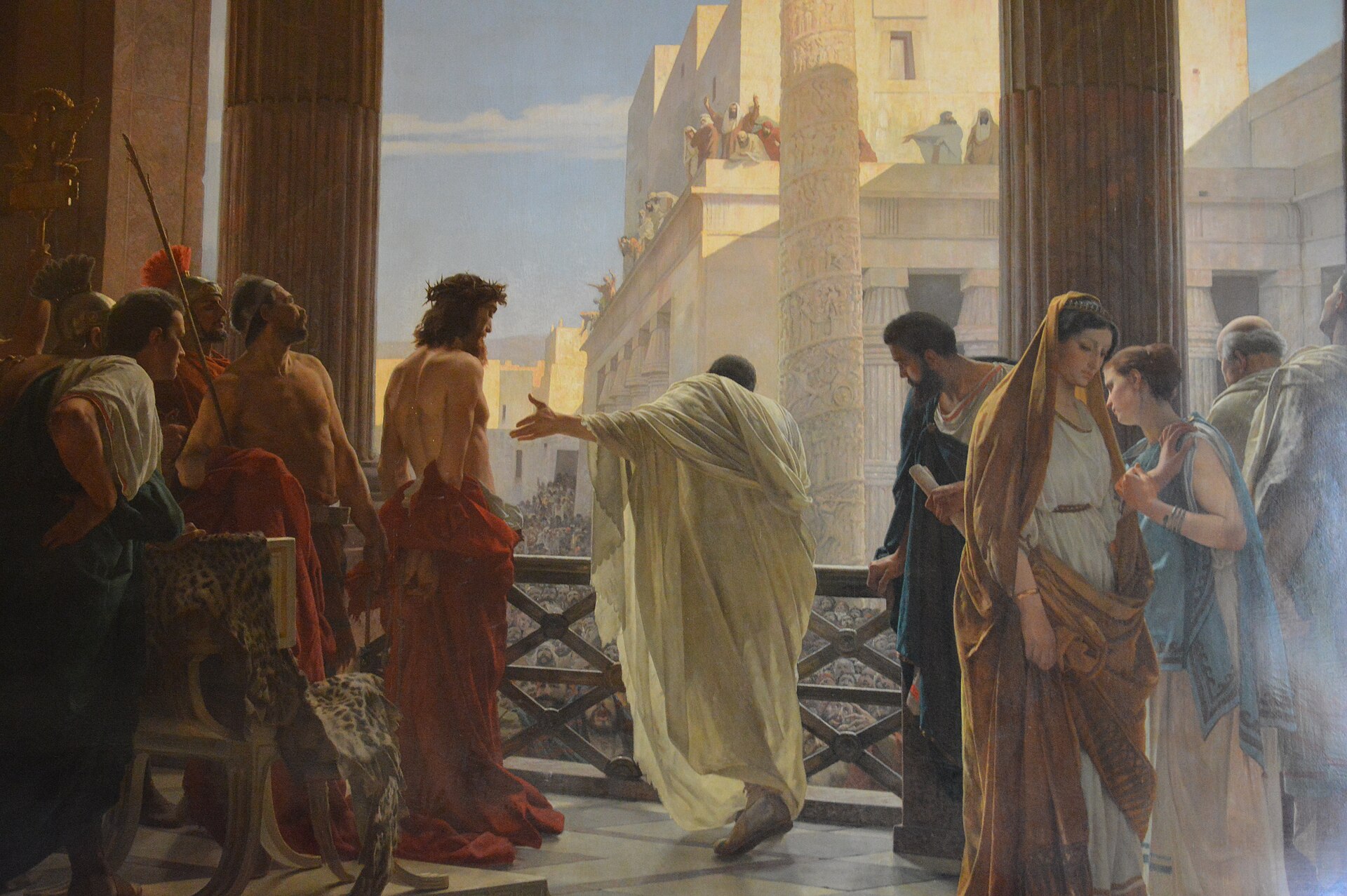
Ecce Homo (Behold the Man!). Antonio Ciseri, from 1871 until 1888. Wikimedia Commons. Public domain.