
Psalms 22:8
in Psalms 22“He trusts in the LORD, let the LORD deliver him; let the LORD rescue him, since He delights in him.”
BSB
The same verse in ASV and KJV ▾
ASV
Commit thyself unto Jehovah; let him deliver him: Let him rescue him, seeing he delighteth in him.
KJV
He trusted on the Lord that he would deliver him: let him deliver him, seeing he delighted in him.
⋯
This verse in Psalms 22
Commentary
16 notes on this versePsalm 22 reads as if it was dictated, first person singular, as He hung on the cross, even though it was written 700 years earlier.
This site's exposition
I am a worm
on Psalms 22:6-8
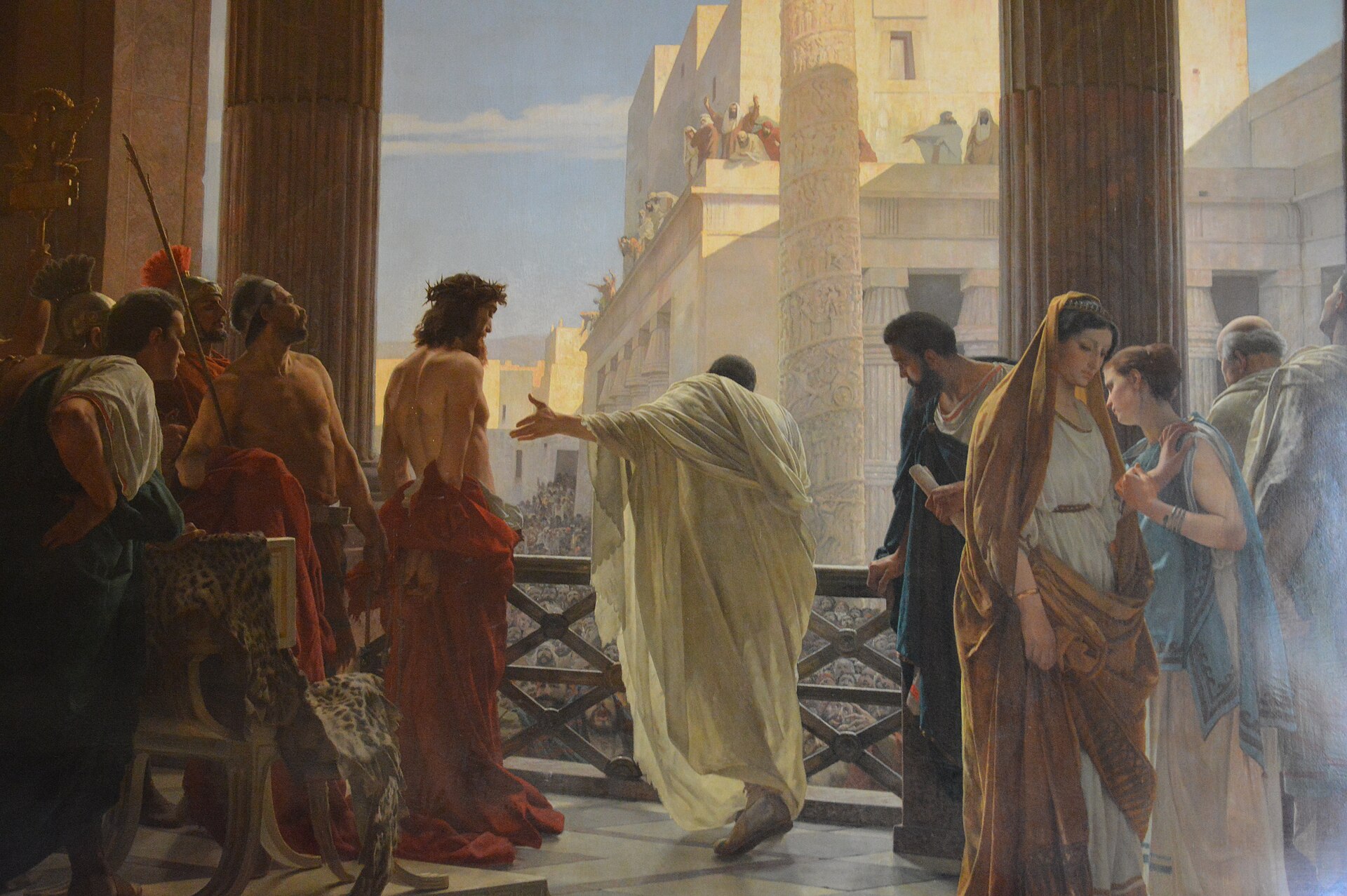
The sufferer calls himself a worm, in Hebrew tolaath, a grub men tread on. The mockers in verse 8 dare God to rescue the man who trusts Him. The chief priests say the same thing at the cross in Matthew 27:43.
The record, by era
The Church Fathers4 voices
For they shook their head in derision, saying, "He trusted in the Lord let Him deliver Him: let Him save Him, since He desireth Him" (ver. 8). These were their words; but they were spoken "with the lips."
For they shook their head in derision, saying, "He trusted in the Lord let Him deliver Him: let Him save Him, since He desireth Him" (ver. 8). These were their words; but they were spoken "with the lips."
These words are in fact specifically found in the Gospel, for when Christ was hanging on the cross, the Jews were saying: "He hoped in the Lord: let him deliver him now, if he wants him." O heavenly wholeness! Do we not here seem to …
A commentator
Clement of RomeClement's First Letter to the Corinthians, Chapter 16 · Written before 99.
proposed
For Christ is of those who are humble-minded, and not of those who exalt themselves over His flock. Our Lord Jesus Christ, the Sceptre of the majesty of God, did not come in the pomp of pride or arrogance, although He might have done so, but in a lowly condition, as the Holy Spirit had declared regarding Him. For He says, "Lord, who has believed our report, and to whom is the arm of the Lord revealed? We have declared [our message] in His presence: He is, as it were, a child, and like a root in thirsty ground; He has no form nor glory, yea, we saw Him, and He had no form nor comeliness; but His form was without eminence, yea, deficient in comparison with the [ordinary] form of men. He is a man exposed to stripes and suffering, and acquainted with the endurance of grief: for His countenance was turned away; He was despised, and not esteemed. He bears our iniquities, and is in sorrow for our sakes; yet we supposed that [on His own account] He was exposed to labour, and stripes, and affliction. But He was wounded for our transgressions, and bruised for our iniquities. The chastisement of our peace was upon Him, and by His stripes we were healed. All we, like sheep, have gone astray; [every] man has wandered in his own way; and the Lord has delivered Him up for our sins, while He in the midst of His sufferings opens not His mouth. He was brought as a sheep to the slaughter, and as a lamb before her shearer is dumb, so He opens not His mouth. In His humiliation His judgment was taken away; who shall declare His generation? For His life is taken from the earth. For the transgressions of my people was He brought down to death. And I will give the wicked for His sepulchre, and the rich for His death, because He did no iniquity, neither was guile found in His mouth. And the Lord is pleased to purify him by stripes. […]
The Medieval Church1 voice
"He hoped." He shows what those words were that they spoke to his confusion: because first they reproached him for the hope he had in God; hence he says, "He hoped in the Lord; let him deliver him." Mt. 27: "He trusts in God; let …
9 more voices on this verse
The Puritans and the Awakening3 voices
They make mouths at him, make merry over him, and make a jest of his sufferings: They shoot out the lip, they shake their head, saying, This was he that said he trusted God would deliver him; now let him deliver him. David was sometimes taunted for his confidence in God; but in the sufferings of Christ this was literally and exactly fulfilled.
), where David, as a type of Christ, complains of the very calamitous condition he was in upon many accounts. He complains, and mixes comforts with his complaints; he complains (
quarantine:debris (2026-07-29) — leading-punctuation
He trusted on the Lord, that he would deliver him,....
The Nineteenth Century6 voices
"Saying, He trusted on the Lord that he would deliver him: let him deliver him, seeing he delighted in him." Here the taunt is cruelly aimed at the sufferer's faith in God, which is the tenderest point in a good man's soul, the very apple of his eye. They must have learned the diabolical art from Satan himself, for they made rare proficiency in it.
A commentator
Jamieson, Fausset & Brown1802–1910
Commentary Critical and Explanatory on the Whole Bible (1871)
This is the language of enemies sporting with his faith in the hour of his desertion. Though ironically spoken, the exhortation to trust was well founded on his previous experience of divine aid, the special illustration of which is drawn from the period of helpless infancy. didst make me hope--literally, "made me secure."
"Saying, He trusted on the Lord that he would deliver him: let him deliver him, seeing he delighted in him." Here the taunt is cruelly aimed at the sufferer's faith in God, which is the tenderest point in a good man's soul, the very apple of his eye. They must have learned the diabolical art from Satan himself, for they made rare proficiency in it. According to Matthew 27:39-44, there were five forms of taunt hurled at the Lord Jesus; this special piece of mockery is probably mentioned in this psalm because it is the most bitter of the whole; it has a biting, sarcastic irony in it, which gives it a peculiar venom; it must have stung the Man of Sorrows to the quick. When we are tormented in the same manner, let us remember him who endured such contradiction of sinners against himself, and we shall be comforted. On reading these verses one is ready, with Trapp, to ask, Is this a prophecy or a history? for the description is so accurate. We must not lose sight of the truth which was unwittingly uttered by the Jewish scoffers. They themselves are witnesses that Jesus of Nazareth trusted in God: why then was he permitted to perish? Jehovah had aforetime delivered those who rolled their burdens upon him: why was this man deserted? Oh that they had understood the answer! Note further, that their ironical jest, "seeing he delighted in him," was true. The Lord did delight in his dear Son, and when he was found in fashion as a man, and became obedient unto death, he still was well pleased with him. Strange mixture! Jehovah delights in him, and yet bruises him; is well pleased, and yet slays him.
DAVID experienced what Paul afterwards so aptly described as "cruel mockings." Note the adjective, cruel—it is well chosen. Mockings may not cut the flesh, but they tear the heart. They may shed no blood, but they cause the mind to bleed internally. Fetters gall the wrists, but the iron of scorn enters into the soul. Ridicule is a poisoned bullet which goes deeper than the flesh and strikes the center of the heart. David in the wilderness, hunted by Saul and on the throne abused by Shimei, knew what it was to be the butt of scorn, the football of contempt. Many a time and often he was the song of the drunk and the byword of the scoffer. But what have I to do with the son of Jesse? My heart remembers the Son of Man. What if David suffered despising and scorn? He knew it but in small measure compared with our blessed Lord! Well is it said, "The disciple is not above his master, nor the servant above his Lord." It is not amazing that such an one as David should have to cry, "My soul is among lions," when the Lord of All, the perfectly pure and Holy One, was driven to utter the same cry, saying, "All they that see Me laugh Me to scorn: they shoot out the lip, they shake the head, saying, He trusted on the Lord that He would deliver Him: let Him deliver Him, seeing He delighted in Him." My Brothers and Sisters in Christ, if you have to pass through a like painful experience, count it no strange thing, for a strange thing it is not! Reproach is the common heritage of the godly. Do not think that this fire which you suffer is the first that ever burned a saint.
DAVID experienced what Paul afterwards so aptly described as "cruel mockings." Note the adjective, cruel—it is well chosen. Mockings may not cut the flesh, but they tear the heart. They may shed no blood, but they cause the mind to bleed internally. Fetters gall the wrists, but the iron of scorn enters into the soul. Ridicule is a poisoned bullet which goes deeper than the flesh and strikes the center of the heart.
A commentator
Albert Barnes1798–1870
Notes, Explanatory and Practical, on the Old and New Testaments (1832-1869)
proposed
He trusted on the Lord that he would deliver him - Margin, “He rolled himself on the Lord.” The margin expresses the true sense of the Hebrew word. The idea is that of being under the pressure of a heavy burden, and of rolling it off, or casting it on another. Hence, the word is often used in the sense of committing to another; entrusting anything to another; confiding in another. Psa 37:5, “commit thy way unto the Lord;” Margin, as in Hebrew: “Roll thy way upon the Lord.” Pro 16:3, “commit thy works unto the Lord,” Margin, as in Hebrew: “Roll.” The language here is the taunting language of his enemies, and the meaning is that he had professed to commit himself to the Lord as if he were his friend; he had expressed confidence in God, and he believed that his cause was sate in His hand. This, too, was actually fulfilled in the ease of the Saviour. Mat 27:43, “he trusted in God; let him deliver him now, if he will have him.” It is one of the most remarkable instances of blindness and infatuation that has ever occurred in the world, that the Jews should have used this language in taunting the dying Redeemer, without even suspecting that they were fulfilling the prophecies, and demonstrating at the very time when they were reviling him that he was the true Messiah. Let him deliver him - Let him come and save him. Since he professes to belong to God; since he claims that God loves him and regards him as his friend, let him come now and rescue one so dear to him. He is hopelessly abandoned by men. If God chooses to have one so abject, so despised, so forsaken, so helpless, let him come now and take him as his own. We will not rescue him; we will do nothing to save him, for we do not need him. If God wants him, let him come and save him. What blasphemy! […]
The words behind it
8 Hebrew wordsEvery Hebrew word of this verse in the order it stands, with what it means and the door to its own study. The last column counts the times a word stands in the whole Bible: the rarer the word, the more the places it appears belong together.
| Hebrew | Sound | Meaning | Word study | In the Bible |
|---|---|---|---|---|
| גֹּ֣ל | gol | roll | H1556 → | 18 times |
| אֶל־ | ʾel- | to | H413 → | 5510 times |
| יְהוָ֣ה | yahweh | Yahweh | H3068 → | 6520 times |
| יְפַלְּטֵ֑הוּ | yefaletehu | let him rescue him | H6403 → | 26 times |
| יַ֝צִּילֵ֗הוּ | yatzilehu | let him deliver him | H5337 → | 212 times |
| כִּ֘י | ki | for | H3588 → | 4482 times |
| חָ֥פֵֽץ | chafetz | he delights | H2654 → | 74 times |
| בּֽוֹ׃ | bo | in him |
גֹּ֣לroll
golH1556 →18 times
אֶל־to
ʾel-H413 →5510 times
יְהוָ֣הYahweh
yahwehH3068 →6520 times
יְפַלְּטֵ֑הוּlet him rescue him
yefaletehuH6403 →26 times
יַ֝צִּילֵ֗הוּlet him deliver him
yatzilehuH5337 →212 times
כִּ֘יfor
kiH3588 →4482 times
חָ֥פֵֽץhe delights
chafetzH2654 →74 times
בּֽוֹ׃in him
bo
A shaded row is a word that stands 400 times or fewer in the Bible.
The walk
8 stopsEach card is a verse this one points to, and under it the verses that one points to in turn. Where several paths arrive at the same place, that place is listed first: the text keeps returning to it.
Through
Psalms 91:14“Because he loves Me, I will deliver him; because he knows My name, I will protect him.
it leads to
- Psalms 9:10
Those who know Your name trust in You, for You, O LORD, have not forsaken those who seek You.
- John 14:23
Jesus replied, “If anyone loves Me, he will keep My word. My Father will love him, and We will come to him and make Our home with him.
- James 1:12
Blessed is the man who perseveres under trial, because when he has stood the test, he will receive the crown of life that God has promised to those who love Him.
- John 16:27
For the Father Himself loves you, because you have loved Me and have believed that I came from God.
- Romans 8:28
And we know that God works all things together for the good of those who love Him, who are called according to His purpose.
- Psalms 9:10
Through
Matthew 3:17And a voice from heaven said, “This is My beloved Son, in whom I am well pleased!”
it leads to
- Isaiah 42:1
“Here is My Servant, whom I uphold, My Chosen One, in whom My soul delights. I will put My Spirit on Him, and He will bring justice to the nations.
- Matthew 17:5
While Peter was still speaking, a bright cloud enveloped them, and a voice from the cloud said, “This is My beloved Son, in whom I am well pleased. Listen to Him!”
- Psalms 2:7
I will proclaim the decree spoken to Me by the LORD: “You are My Son; today I have become Your Father.
- Isaiah 42:1
Where this verse is studied
On this page
Studies10
About Psalms
This page draws on 13 works. Open the list of works
This page draws on Albert Barnes, Notes on the Book of Psalms; Albert Barnes, Notes, Explanatory and Practical, on the Old and New Testaments (1832-1869); Augustine of Hippo, Exposition on Psalm 22; Cassiodorus, EXPLANATION OF THE PSALMS 22:9; Charles Spurgeon, The Treasury of David, Vol. 1; Charles Spurgeon, The Metropolitan Tabernacle Pulpit, Sermon No. 1767: “Faith Among Mockers” (lightly modernized text, CCEL edition); Chuck Missler, How Can We Be Sure? (article); Clement of Rome, Clement's First Letter to the Corinthians, Chapter 16; Jamieson, Fausset & Brown, Commentary Critical and Explanatory on the Whole Bible; John Gill, Exposition of the Old Testament; John Gill, Exposition of the Old Testament (1748-1763); Matthew Henry, Commentary on the Whole Bible and Thomas Aquinas, Exposition on the Psalms of David.