
Psalms 22:6
in Psalms 22But I am a worm and not a man, scorned by men and despised by the people.
BSB
The same verse in ASV and KJV ▾
ASV
But I am a worm, and no man; A reproach of men, and despised of the people.
KJV
But I am a worm, and no man; a reproach of men, and despised of the people.
⋯
This verse in Psalms 22
Commentary
19 notes on this verseHe became all these things so that he might dull the sting of our death, that he might take away our state of slavery, that he might wipe away our curses, sins and reproaches.
This site's exposition
I am a worm
on Psalms 22:6-8
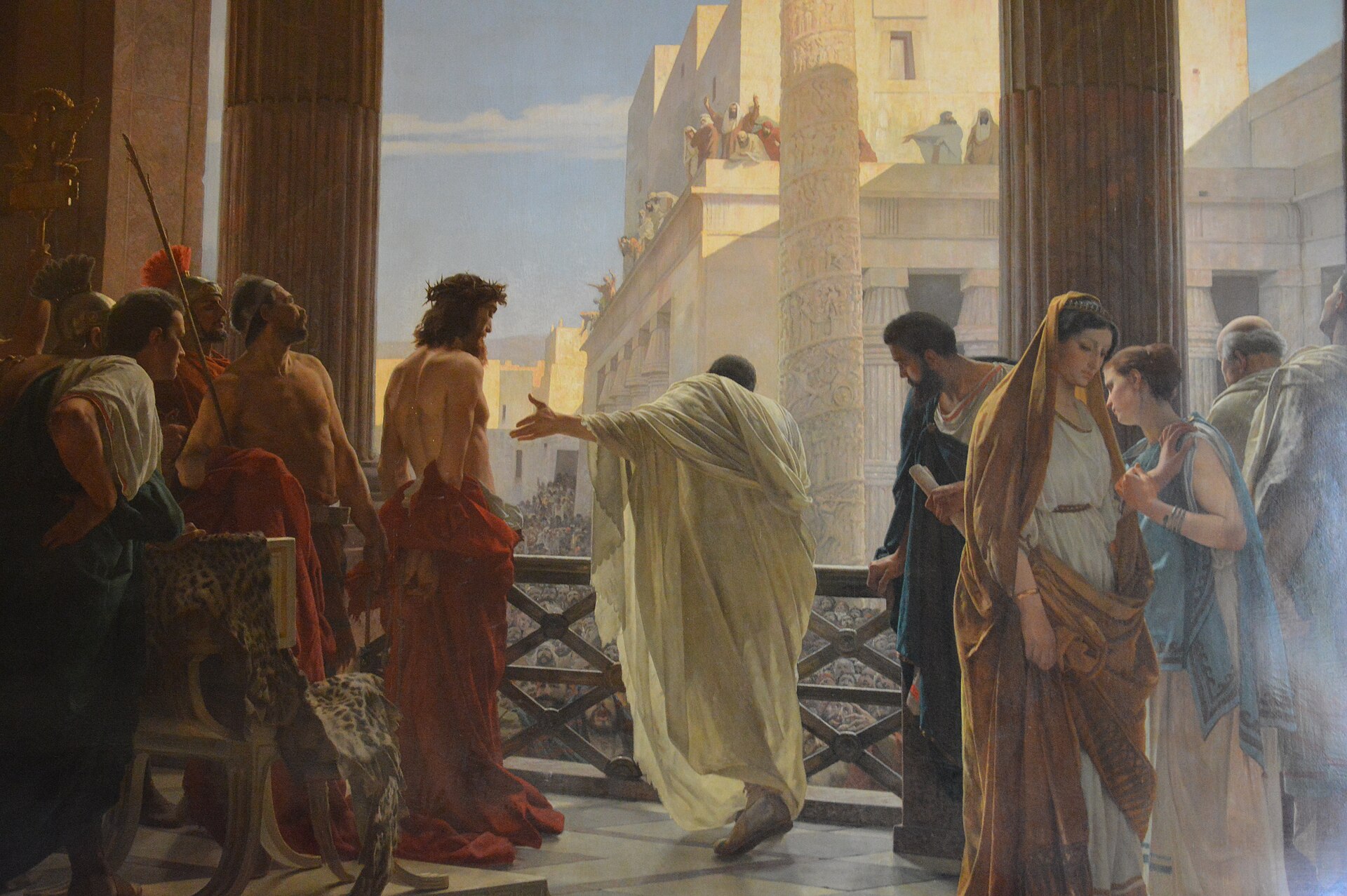
The sufferer calls himself a worm, in Hebrew tolaath, a grub men tread on. The mockers in verse 8 dare God to rescue the man who trusts Him. The chief priests say the same thing at the cross in Matthew 27:43.
The record, by era
The Church Fathers5 voices
"But I am a worm, and no man" [Psalm 22:6]. But I, speaking now not in the person of Adam, but I in My own person, Jesus Christ, was born without human generation in the flesh, that I might be as man beyond men; that so at least human pride might deign to imitate My humility. "The scorn of men, and outcast of the people." In which humility I was made the scorn of men, so as that it should be said, as a reproachful railing, "Be His disciple:" [John 9:28] and that the people despise Me.
Understand your God. That is what he is, this one so great and so small, "a worm and no man," and yet through him humankind was made.
Wonder not if this was said of and fulfilled by the passion of the Savior, for even now he is a reproach among all people who have not yet received faith in him!
By the word worm did the Spirit foreshow him in a parable, because his generation was without marriage.
I am like a worm, he is saying, seen to be worthless and become a laughingstock. Now, some claimed that by "worm" is suggested also the birth from a virgin, as it is not by intercourse that it comes into existence; but I believe only …
12 more voices on this verse
The Church Fathers1 voice
A commentator
Clement of RomeClement's First Letter to the Corinthians, Chapter 16 · Written before 99.
proposed
For Christ is of those who are humble-minded, and not of those who exalt themselves over His flock. Our Lord Jesus Christ, the Sceptre of the majesty of God, did not come in the pomp of pride or arrogance, although He might have done so, but in a lowly condition, as the Holy Spirit had declared regarding Him. For He says, "Lord, who has believed our report, and to whom is the arm of the Lord revealed? We have declared [our message] in His presence: He is, as it were, a child, and like a root in thirsty ground; He has no form nor glory, yea, we saw Him, and He had no form nor comeliness; but His form was without eminence, yea, deficient in comparison with the [ordinary] form of men. He is a man exposed to stripes and suffering, and acquainted with the endurance of grief: for His countenance was turned away; He was despised, and not esteemed. He bears our iniquities, and is in sorrow for our sakes; yet we supposed that [on His own account] He was exposed to labour, and stripes, and affliction. But He was wounded for our transgressions, and bruised for our iniquities. The chastisement of our peace was upon Him, and by His stripes we were healed. All we, like sheep, have gone astray; [every] man has wandered in his own way; and the Lord has delivered Him up for our sins, while He in the midst of His sufferings opens not His mouth. He was brought as a sheep to the slaughter, and as a lamb before her shearer is dumb, so He opens not His mouth. In His humiliation His judgment was taken away; who shall declare His generation? For His life is taken from the earth. For the transgressions of my people was He brought down to death. And I will give the wicked for His sepulchre, and the rich for His death, because He did no iniquity, neither was guile found in His mouth. And the Lord is pleased to purify him by stripes. […]
The Medieval Church1 voice
"But I." Here he sets forth his passion. And first he proposes the confusion that he suffered. Second, he expounds it, at "All who see me." Third, he assigns its cause, at "For you are." The first part can be read in two ways. In …
The Puritans and the Awakening4 voices
They make mouths at him, make merry over him, and make a jest of his sufferings: They shoot out the lip, they shake their head, saying, This was he that said he trusted God would deliver him; now let him deliver him. David was sometimes taunted for his confidence in God; but in the sufferings of Christ this was literally and exactly fulfilled.
), where David, as a type of Christ, complains of the very calamitous condition he was in upon many accounts. He complains, and mixes comforts with his complaints; he complains (
quarantine:debris (2026-07-29) — leading-punctuation
A worm - Neglected and despised. People - Not only of the great men, but also of the common people. Which doth not so truly agree to David as to Christ.
But I am a worm, and no man,....
The Nineteenth Century5 voices
"But I am a worm, and no man." This verse is a miracle in language. How could the Lord of glory be brought to such abasement as to be not only lower than the angels, but even lower than men. What a contrast between "I AM" and "I am a worm"! yet such a double nature was found in the person of our Lord Jesus when bleeding upon the tree. He felt himself to be comparable to a helpless, powerless, down-trodden worm, passive while crushed, and unnoticed and despised by those who trod upon him.
A commentator
Jamieson, Fausset & Brown1802–1910
Commentary Critical and Explanatory on the Whole Bible (1871)
proposed
He who was despised and rejected of His own people, as a disgrace to the nation, might well use these words of deep abasement, which express not His real, but esteemed, value.
"But I am a worm, and no man." This verse is a miracle in language. How could the Lord of glory be brought to such abasement as to be not only lower than the angels, but even lower than men. What a contrast between "I AM" and "I am a worm"! yet such a double nature was found in the person of our Lord Jesus when bleeding upon the tree. He felt himself to be comparable to a helpless, powerless, down-trodden worm, passive while crushed, and unnoticed and despised by those who trod upon him. He selects the weakest of creatures, which is all flesh; and becomes, when trodden upon, writhing, quivering flesh, utterly devoid of any might except strength to suffer. This was a true likeness of himself when his body and soul had become a mass of misery—the very essence of agony—in the dying pangs of crucifixion. Man by nature is but a worm; but our Lord puts himself even beneath man, on account of the scorn that was heaped upon him and the weakness which he felt, and therefore he adds, "and no man." The privileges and blessings which belonged to the fathers he could not obtain while deserted by God, and common acts of humanity were not allowed him, for he was rejected of men; he was outlawed from the society of earth, and shut out from the smile of heaven. How utterly did the Saviour empty himself of all glory, and become of no reputation for our sakes! "A reproach of men" —their common butt and jest; a byword and a proverb unto them: the sport of the rabble, and the scorn of the rulers. Oh the caustic power of reproach, to those who endure it with patience, yet smart under it most painfully! "And despised of the people." The vox populi was against him. The very people who would once have crowned him then contemned him, and they who were benefited by his cures sneered at him in his woes.
But I am a worm, and no man - I can see no sense in which our Lord could use these terms. David might well use them to express his vileness and worthlessness. The old Psalter gives this a remarkable turn: I am a worme, that es, I am borne of the mayden with outen manseede; and nout man anely, bot god als so: and nevir the latter, I am reprove of men. In spitting, buffetyng, and punging with the thornes and outkasting of folk; for thai chesed Barraban the thefe, and nought me.
A commentator
Albert Barnes1798–1870
Notes, Explanatory and Practical, on the Old and New Testaments (1832-1869)
proposed
But I am a worm, and no man - In contrast with the fathers who trusted in thee. They prayed, and were heard; they confided in God, and were treated as men. I am left and forsaken, as if I were not worth regarding; as if I were a grovelling worm beneath the notice of the great God. In other words, I am treated as if I were the most insignificant, the most despicable, of all objects - alike unworthy the attention of God or man. By the one my prayers are unheard; by the other I am cast out and despised. Compare Job 25:6. As applicable to the Redeemer, this means that he was forsaken alike by God and men, as if he had no claims to the treatment due to a “man.” A reproach of men - Reproached by men. Compare Isa 53:3, and the notes at that verse. Despised of the people - That is, of the people who witnessed his sufferings. It is not necessary to say how completely this had a fulfillment in the sufferings of the Saviour.
Modern Voices1 voice
Psalm 22 reads as if it was dictated, first person singular, as He hung on the cross, even though it was written 700 years earlier.
The words behind it
8 Hebrew wordsEvery Hebrew word of this verse in the order it stands, with what it means and the door to its own study. The last column counts the times a word stands in the whole Bible: the rarer the word, the more the places it appears belong together.
| Hebrew | Sound | Meaning | Word study | In the Bible |
|---|---|---|---|---|
| וְאָנֹכִ֣י | veanokhi | and I | H595 → | 359 times |
| תוֹלַ֣עַת | tolaat | [am] a worm | H8438 → | |
| וְלֹא־ | velo'- | and not | H3808 → | 5168 times |
| אִ֑ישׁ | ʾish | a man | H376 → | 1663 times |
| חֶרְפַּ֥ת | cherpat | a reproach of | H2781 → | 73 times |
| אָ֝דָ֗ם | ʾadam | humankind | H120 → | 551 times |
| וּבְז֥וּי | uvezui | and despised of | H959 → | 44 times |
| עָֽם׃ | ʾam | a people | H5971 → | 1873 times |
וְאָנֹכִ֣יand I
veanokhiH595 →359 times
תוֹלַ֣עַת[am] a worm
tolaatH8438 →
וְלֹא־and not
velo'-H3808 →5168 times
אִ֑ישׁa man
ʾishH376 →1663 times
חֶרְפַּ֥תa reproach of
cherpatH2781 →73 times
אָ֝דָ֗םhumankind
ʾadamH120 →551 times
וּבְז֥וּיand despised of
uvezuiH959 →44 times
עָֽם׃a people
ʾamH5971 →1873 times
A shaded row is a word that stands 400 times or fewer in the Bible.
The walk
8 stopsEach card is a verse this one points to, and under it the verses that one points to in turn. Where several paths arrive at the same place, that place is listed first: the text keeps returning to it.
Through
Isaiah 53:3He was despised and rejected by men, a man of sorrows, acquainted with grief. Like one from whom men hide their faces, He was despised, and we esteemed Him not.
it leads to
- Matthew 26:67
Then they spit in His face and struck Him. Others slapped Him
Reached by 2 separate paths from here.
- John 1:10–11
He was in the world, and though the world was made through Him, the world did not recognize Him.
- Isaiah 53:10
Yet it was the LORD’s will to crush Him and to cause Him to suffer; and when His soul is made a guilt offering, He will see His offspring, He will prolong His days,…
- Hebrews 12:2–3
Let us fix our eyes on Jesus, the author and perfecter of our faith, who for the joy set before Him endured the cross, scorning its shame, and sat down at the right hand…
- Isaiah 49:7
Thus says the LORD, the Redeemer and Holy One of Israel, to Him who was despised and abhorred by the nation, to the Servant of rulers: “Kings will see You and rise, and princes…
- Matthew 26:67
Through
Isaiah 49:7Thus says the LORD, the Redeemer and Holy One of Israel, to Him who was despised and abhorred by the nation, to the Servant of rulers: “Kings will see You and rise, and princes…
it leads to
- 1 Peter 2:4
As you come to Him, the living stone, rejected by men but chosen and precious in God’s sight,
- Isaiah 53:3
He was despised and rejected by men, a man of sorrows, acquainted with grief. Like one from whom men hide their faces, He was despised, and we esteemed Him not.
- Isaiah 48:17
Thus says the LORD your Redeemer, the Holy One of Israel: “I am the LORD your God, who teaches you for your benefit, who directs you in the way you should go.
- 1 Peter 2:4
Where this verse is studied
On this page
Studies10
About Psalms
This page draws on 18 works. Open the list of works
This page draws on Adam Clarke, Commentary on the Bible; Albert Barnes, Notes on the Book of Psalms; Albert Barnes, Notes, Explanatory and Practical, on the Old and New Testaments (1832-1869); Ambrose of Milan, Letter 46: To Sabinus; Augustine of Hippo, Exposition on Psalm 22; Augustine of Hippo, SERMON 380:2; Charles Spurgeon, The Treasury of David, Vol. 1; Chuck Missler, How Can We Be Sure? (article); Clement of Rome, Clement's First Letter to the Corinthians, Chapter 16; Ephrem the Syrian, HYMNS ON THE NATIVITY 1; Eusebius of Caesarea, PROOF OF THE GOSPEL 10:8.499; Jamieson, Fausset & Brown, Commentary Critical and Explanatory on the Whole Bible; John Gill, Exposition of the Old Testament; John Gill, Exposition of the Old Testament (1748-1763); John Wesley, Explanatory Notes upon the Old Testament; Matthew Henry, Commentary on the Whole Bible; Theodoret of Cyrus, COMMENTARY ON THE PSALMS 22:6 and Thomas Aquinas, Exposition on the Psalms of David.