
Psalms 22:20
in Psalms 22Deliver my soul from the sword, my precious life from the power of wild dogs.
BSB
The same verse in ASV and KJV ▾
ASV
Deliver my soul from the sword, My darling from the power of the dog.
KJV
Deliver my soul from the sword; my darling from the power of the dog.
⋯
This verse in Psalms 22
Commentary
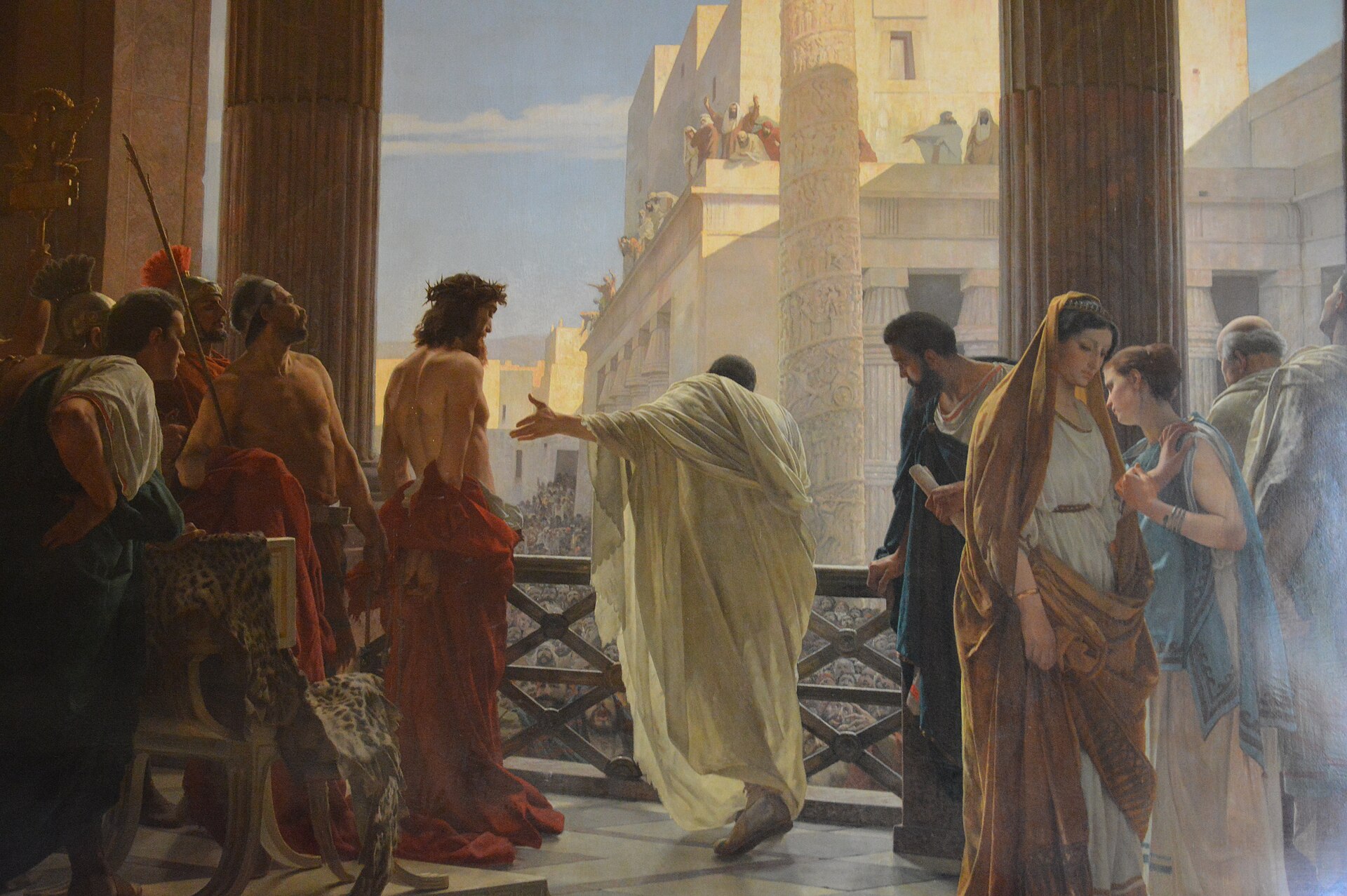
15 notes on this versePsalm 22 reads as if it was dictated, first person singular, as He hung on the cross, even though it was written 700 years earlier.
This site's exposition
come quickly to help me
on Psalms 22:19-21
The prayer names the beasts again in reverse, the wild dogs, the lion's mouth, the horns of the wild oxen. The precious life of verse 20 is the Hebrew word for an only one, the single life a man has. Verse 21 ends with You have answered me.
The record, by era
The Church Fathers3 voices
"Deliver My soul from the sword." "Deliver My soul" from the tongue of dissension. "And My only One from the hand of the dog" [Psalm 22:20]. And from the power of the people, barking after their custom, deliver My Church.
"Deliver My soul from the sword." "Deliver My soul" from the tongue of dissension. "And My only One from the hand of the dog" [Psalm 22:20]. And from the power of the people, barking after their custom, deliver My Church.
Let each one also think this about his own life, that he may hate in it that private affection that is undoubtedly transitory and may love in it that union and sense of sharing of which it was said, "They had one soul and heart toward God." Thus, your soul is not your own but is shared by all the brothers whose souls are also yours, or, rather, whose souls form with yours not souls but one soul, the single soul of Christ, of which the psalm says that it is delivered from the hand of the dog. From this it is an easy step to contempt of death.
The Medieval Church1 voice
"Deliver." Here he explains specifically from what he asks to be defended. And first, against death. Second, against the temptation of death, at "From the hand of the dog." He says therefore, "Look to my defense," and "O God, deliver my soul," which they seek, …
The Puritans and the Awakening1 voice
Darling - Hebrew. my only one; his soul, which he so calls, because it was left alone and destitute of friends and helpers.
8 more voices on this verse
The Puritans and the Awakening3 voices
27 All the ends of the world shall remember and turn unto the L ORD : and all the kindreds of the nations shall worship before thee. 28 For the kingdom is the L ORD 's: and he is the governor among the nations. 29 All they that be fat upon earth shall eat and worship: all they that go down to the dust shall bow before him: and none can keep alive his own soul.
quarantine:scripture (2026-07-29) — scripture-overlap:94%@v27-29
), where David, as a type of Christ, complains of the very calamitous condition he was in upon many accounts. He complains, and mixes comforts with his complaints; he complains (
quarantine:debris (2026-07-29) — leading-punctuation
Deliver my soul from the sword,....
The Nineteenth Century5 voices
"Deliver my soul from the sword." By the sword is probably meant entire destruction, which as a man he dreaded; or perhaps he sought deliverance from the enemies around him, who were like a sharp and deadly sword to him. The Lord had said, "Awake, O sword, " and now from the terror of that sword the Shepherd would fain be delivered as soon as justice should see fit. "My darling from the power of the dog." Meaning his soul, his life, which is most dear to every man.
"Deliver my soul from the sword." By the sword is probably meant entire destruction, which as a man he dreaded; or perhaps he sought deliverance from the enemies around him, who were like a sharp and deadly sword to him. The Lord had said, "Awake, O sword, " and now from the terror of that sword the Shepherd would fain be delivered as soon as justice should see fit. "My darling from the power of the dog." Meaning his soul, his life, which is most dear to every man. The original is, "my only one, " and therefore is our soul dear, because it is our only soul. Would that all men made their souls their darlings, but many treat them as if they were not worth so much as the mire of the streets. The dog may mean Satan, that infernal Cerberus, that cursed and cursing cur; or else the whole company of Christ's foes, who though many in number were as unanimous as if there were but one, and with one consent sought to rend him in pieces. If Jesus cried for help against the dog of hell, much more may we. Cave canem, beware of the dog, for his power is great, and only God can deliver us from him. When he fawns upon us, we must not put ourselves in his power; and when he howls at us, we may remember that God holds him with a chain.
The crucified Son of David continues to pour out his complaint and prayer. We need much grace that while reading we may have fellowship with his sufferings. May the blessed Spirit conduct us into a most clear and affecting sight of our Redeemer's woes.
Deliver my soul from the sword - Deliver נפשי naphshi, my life; save me alive, or raise me again. My darling - יחידתי yechidathi, my only one. The only human being that was ever produced since the creation, even by the power of God himself, without the agency of man. Adam the first was created out of the dust of the earth; that was his mother; God was the framer. Adam the second was produced in the womb of the virgin; that was his mother. But that which was conceived in her was by the power of the Holy Ghost; hence the man Christ Jesus is the Only Son of God; God is his Father, and he is his Only One.
A commentator
Albert Barnes1798–1870
Notes, Explanatory and Practical, on the Old and New Testaments (1832-1869)
proposed
Deliver my soul from the sword - The word soul here means life, and denotes a living person. It is equivalent to “deliver me.” “The sword” is used to denote an instrument of death, or anything that pierces like a sword. Compare 2Sa 11:24-25. As applied to the Saviour here, it may mean those extreme mental sufferings that were like the piercing of a sword. My darling - Margin, “my only one.” Prof. Alexander, “my lonely one.” DeWette, my life. The Hebrew word - יחיד yâchı̂yd - means “one alone, only,” as of an only child; then one alone, as forsaken, solitary, wretched, Psa 25:16; Psa 68:6; then it means one only, the only one, in the sense of “most dear, darling.” Here, according to Gesenius (Lexicon), it is used poetically for life, as being something most dear, or as denoting all that we have, and, therefore, most precious. Compare Job 2:4. This is the most probable interpretation here, as it would thus correspond with the expression in the first part of the verse, “deliver my soul.” From the power of the dog - Margin, as in Hebrew, from the hand. The enemy is represented, as in Psa 22:16, as a “dog” (see the notes on that verse); and then that enemy is spoken of as inflicting death by his hand. There is a little incongruity in speaking of a “dog” as having hands, but the image before the mind is that of the enemy with the character of a dog, and thus there is no impropriety in using in reference to him the language which is commonly applied to a man.
The words behind it
6 Hebrew wordsEvery Hebrew word of this verse in the order it stands, with what it means and the door to its own study. The last column counts the times a word stands in the whole Bible: the rarer the word, the more the places it appears belong together.
| Hebrew | Sound | Meaning | Word study | In the Bible |
|---|---|---|---|---|
| הַצִּ֣ילָה | hatzilah | deliver ! | H5337 → | 212 times |
| מֵחֶ֣רֶב | mecherev | from [the] sword | H2719 → | 413 times |
| נַפְשִׁ֑י | nafshi | life my | H5315 → | 754 times |
| מִיַּד־ | miyad- | from [the] hand of | H3027 → | 1618 times |
| כֶּ֝֗לֶב | kelev | a dog | H3611 → | 32 times |
| יְחִידָתִֽי׃ | yechidati | only [life] my | H3173 → | 12 times |
הַצִּ֣ילָהdeliver !
hatzilahH5337 →212 times
מֵחֶ֣רֶבfrom [the] sword
mecherevH2719 →413 times
נַפְשִׁ֑יlife my
nafshiH5315 →754 times
מִיַּד־from [the] hand of
miyad-H3027 →1618 times
כֶּ֝֗לֶבa dog
kelevH3611 →32 times
יְחִידָתִֽי׃only [life] my
yechidatiH3173 →12 times
A shaded row is a word that stands 400 times or fewer in the Bible.
The walk
8 stopsEach card is a verse this one points to, and under it the verses that one points to in turn. Where several paths arrive at the same place, that place is listed first: the text keeps returning to it.
Through
Zechariah 13:7Awake, O sword, against My Shepherd, against the man who is My Companion, declares the LORD of Hosts. Strike the Shepherd, and the sheep will be scattered, and I will turn My hand against…
it leads to
- Mark 14:27
Then Jesus said to them, “You will all fall away, for it is written: ‘I will strike the Shepherd, and the sheep will be scattered.’
- Matthew 26:31
Then Jesus said to them, “This very night you will all fall away on account of Me. For it is written: ‘I will strike the Shepherd, and the sheep of the flock will be…
- John 16:32
“Look, an hour is coming and has already come when you will be scattered, each to his own home, and you will leave Me all alone. Yet I am not alone, because the Father…
- Isaiah 40:11
He tends His flock like a shepherd; He gathers the lambs in His arms and carries them close to His heart. He gently leads the nursing ewes.
- Mark 14:50
Then everyone deserted Him and fled.
- Mark 14:27
Through
Psalms 35:17How long, O Lord, will You look on? Rescue my soul from their ravages, my precious life from these lions.
it leads to
- Habakkuk 1:13
Your eyes are too pure to look upon evil, and You cannot tolerate wrongdoing. So why do You tolerate the faithless? Why are You silent while the wicked swallow up those more righteous than…
- Psalms 57:4
My soul is among the lions; I lie down with ravenous beasts— with men whose teeth are spears and arrows, whose tongues are sharp swords.
- Psalms 22:20–21
Deliver my soul from the sword, my precious life from the power of wild dogs.
- Habakkuk 1:13
Where this verse is studied
On this page
Studies10
About Psalms
This page draws on 12 works. Open the list of works
This page draws on Adam Clarke, Commentary on the Bible; Albert Barnes, Notes, Explanatory and Practical, on the Old and New Testaments (1832-1869); Augustine of Hippo, Exposition on Psalm 22; Augustine of Hippo, LETTER 243; Charles Spurgeon, The Treasury of David, Vol. 1; Chuck Missler, How Can We Be Sure? (article); Franz Delitzsch, Biblical Commentary on the Psalms; John Gill, Exposition of the Old Testament; John Gill, Exposition of the Old Testament (1748-1763); John Wesley, Explanatory Notes upon the Old Testament; Matthew Henry, Commentary on the Whole Bible and Thomas Aquinas, Exposition on the Psalms of David.