
Obadiahchapter 1
21 verses · Obadiah · about 586 BC · The Twelve
For the Day of the LORD is near for all the nations. As you have done, it will be done to you; your recompense will return upon your own head.
Introduction
Obadiah, The Twelve, Obadiah Overview.
This is the shortest book of the Old Testament, and its prophet gives nothing of himself beyond his name, which means servant of the LORD. It was spoken for the people of Judah after a disaster, most likely the fall of Jerusalem to Babylon, when their nearest kin across the Dead Sea joined the looters. Those kin were Edom, the nation descended from Esau, the twin brother of Jacob. They lived in a mountain country that seemed out of any army's reach. Listen for the word brother, for the day that keeps returning, and for the two mountains the book sets side by side at its close.
Context
- Who
- Judeans who had watched their cousins help the looters
- What
- A prophecy against Edom for its violence against Judah, which widens into the Day of the LORD on every nation and closes on the rule of the LORD from Mount Zion.
- Where
- Spoken in Judah against Edom, the highland country south-east of the Dead Sea, with Jerusalem and Mount Zion at the centre of its promise.
- When
- Most place it soon after Babylon took Jerusalem in 586 BC and some place it near 845 BC under King Jehoram, since the book itself carries no date.
- Why
- To assure a ruined Judah that God had seen what its own kin did on the day of its fall and would return the same measure to them.
Historical context
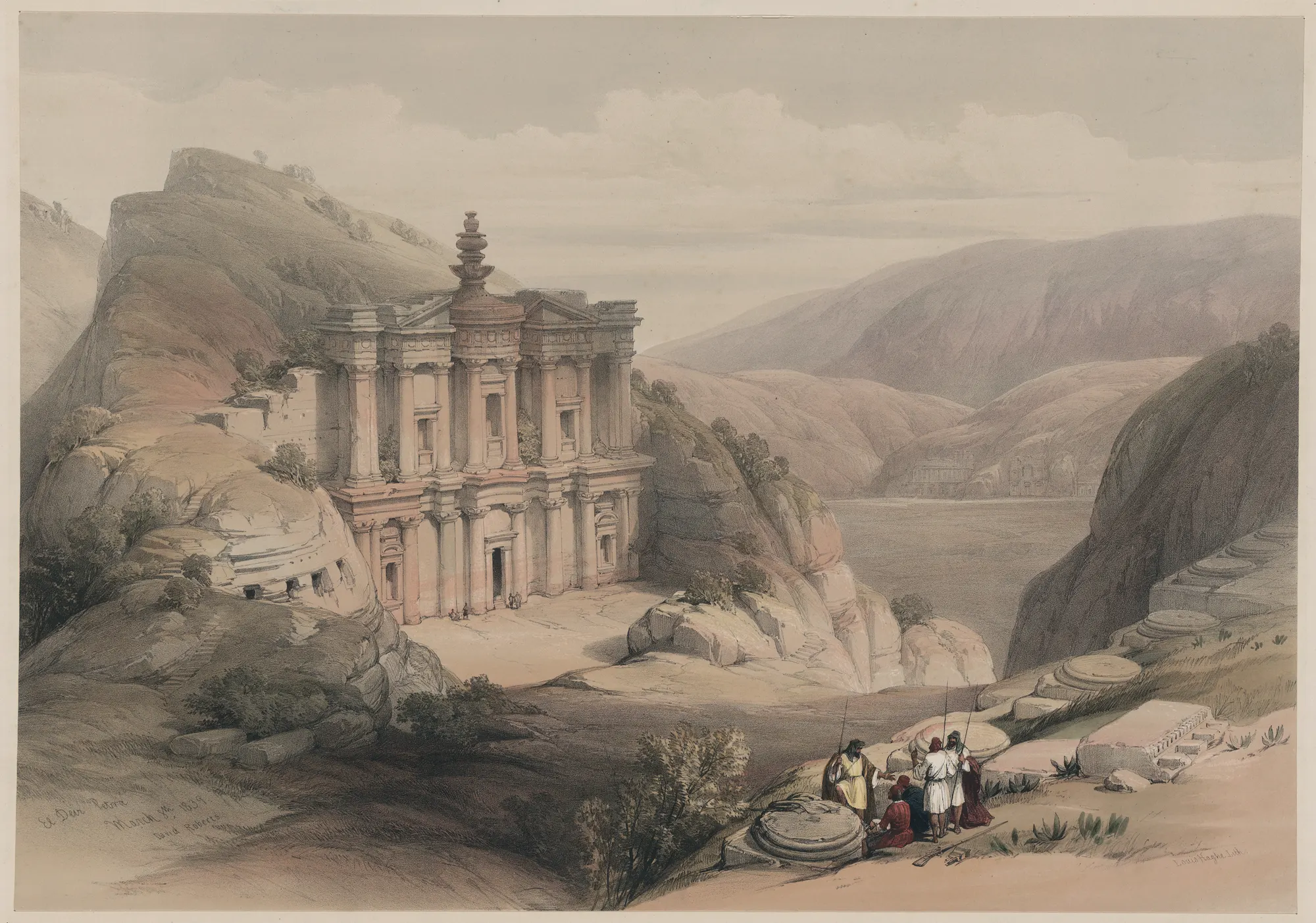
Edom's country was a natural fortress and the book keeps saying so. The highlands south-east of the Dead Sea rise steeply from the rift valley, cut by narrow gorges, with settlements perched on sandstone crags reached by a single defensible path. The line about dwelling in the clefts of the rock and saying who will bring me down is a description of the terrain, not an insult invented for the occasion.
Show the rest of the historical context, 3 more paragraphs
The wealth came from position. The King's Highway, the main north-south caravan route between Arabia and Damascus, ran through Edomite territory, and controlling it meant taxing spices, incense, and metals. Edom also had copper, the mines and smelting sites in the Wadi Arabah were worked for centuries.
Teman, named for its wisdom, was a district of Edom, and the region's reputation for wise men shows up elsewhere in Scripture; Job's friend Eliphaz is called a Temanite. The taunt that God will destroy the wise men out of Edom is aimed at a genuine local point of pride.
The relationship is the wound. Edom descended from Esau, Jacob's twin brother, which makes every line about your brother Jacob literal family language. Standing aside on the day strangers carried off his wealth, cutting down the fugitives at the crossroads, and handing over survivors were the acts of a relative, not an enemy.
Significance
For the first hearers this was a case brought on their behalf against people they could not touch. The verdict is that the treatment will be returned exactly: as you have done, it shall be done to you, and your deeds shall return on your own head.
Show the rest of the significance, 1 more paragraph
History bore it out. Edom was pushed out of its highlands, and by the New Testament era the Nabateans held Petra while the displaced Edomites were living in southern Judea as Idumeans. The book widens at the end to the day of the LORD on all nations, when deliverance comes on Mount Zion and the kingdom shall be the LORD's, a promise the earth has not seen fulfilled yet.
This chapter in Jewish lifeWhat this chapter is in Jewish life and reading.
What is done
The whole of this chapter is read aloud in the synagogue once a year. The site's table in src/lib/hebraic/readings.ts records Obadiah 1:1 to 1:21 as the Haftarah of Vayishlach, the eighth portion of Genesis (Genesis 32:4 to 36:43). The probe printed that reading for both the Ashkenazi and the Sephardi rite. A congregation hears Jacob meet Esau and the list of Esau's descendants from the Torah scroll, and then hears the prophet's word against Edom, the nation that came from Esau.
The corpus shows the join between the two readings. Rashi's first note says why this prophet was given this message, and it rests on the house of Esau the portion has just read (Rashi on Obadiah 1:1:1). Under the seventh verse the corpus carries Bereshit Rabbati, Parashat Vayishlach 7, and under the twelfth Midrash Sekhel Tov, Bereshit 32:21:6, both of them midrash on the portion itself.
One rule of prayer is drawn from this chapter. At the fourteenth verse Rashi reads the word for the gap as a rule for the Shema. No break may be made between one paragraph and the next in reading it, a teaching he takes from the Haggadah of Rabbi Akiva (Rashi on Obadiah 1:14:1).
How it is read
Rashi is the main commentator on this chapter in the corpus, quoted here from The Judaica Press complete Tanach with Rashi, translated by A. J. Rosenberg, which Sefaria reports as CC-BY. He opens with a question. "Why is Obadiah different that he was chosen to prophesy concerning Edom and did not prophesy any other prophecy? Our Sages of blessed memory stated: Obadiah was an Edomite proselyte." He gives the reason as a contrast. Obadiah lived beside Ahab and Jezebel and did not learn from their deeds. Esau "dwelt between two righteous people, Isaac and Rebecca, and did not learn from their deeds." So the one is sent to judge the other. The note marks its source as Sanhedrin 39b (Rashi on Obadiah 1:1:1).
The second verse he reads against Genesis. Esau's father called him his big son and his mother called him the same, and God answers, "In My eyes, he is small." Rashi names the Pesikta and Genesis Rabbah 65:11 for the reading. He adds the Sages' reading from Avodah Zarah 10a, "small for they have neither script nor language" (Rashi on Obadiah 1:2:1). Edom is despised because "they did not crown a king the son of a king" (Rashi on Obadiah 1:2:2).
The pride of the third verse is read two ways in the corpus, and the two sit together. Rashi reads the clefts of the rock as the merit of the fathers. Edom is one "Who relies on the support of his ancestors, Abraham and Isaac, but they shall not avail him" (Rashi on Obadiah 1:3:1). Metzudat David is quoted from the Sefaria Community Translation, which Sefaria reports as CC0. He reads it as the pride of a ruler come into Mount Seir, so that "the arrogance in your heart has turned you to become too prideful" (Metzudat David on Obadiah 1:3:1).
The charge of the middle verses Rashi reads as the charge of a brother who stood by. The violence against Jacob is "the violence you inflicted upon Jacob" (Rashi on Obadiah 1:10:1). Standing afar off means "that you did not come to aid him" (Rashi on Obadiah 1:11:1). The drinking on the holy mountain is joy over its ruin, "Just as you rejoiced concerning the destruction of My Holy Mount," a reading Rashi takes from Targum Jonathan (Rashi on Obadiah 1:16:1). At the eighteenth verse he asks where the Lord had spoken this, and answers from Balaam's oracle in Numbers 24:19, naming Mechilta Bo 12:16 and Pirké d’Rabbi Eliezer ch. 37 (Rashi on Obadiah 1:18:1).
Several of his notes turn on the Aramaic of Targum Jonathan, which he cites by name at the sixth, ninth, thirteenth, sixteenth, seventeenth and twentieth verses. At the ninth verse he reads the dismay of Edom's mighty men as flight to the land of Israel. The translation sets beside it in brackets the reading of Malbim, flight to the land of Edom (Rashi on Obadiah 1:9:1). At the twentieth he gives two readings of the one word and leaves both standing. The first is Jonathan's, the exiled host as this people. The second is his own, "the exile of this valley" (Rashi on Obadiah 1:20:1). The closing verse he reads as "Princes of Israel as saviors on Mt. Zion" (Rashi on Obadiah 1:21:1).
The corpus carries four notes of Ibn Ezra on this chapter without an English text, each marked linked because Sefaria holds no English version of the ref. They stand cited and unquoted at Ibn Ezra on Obadiah 1:1:1, 1:4:1, 1:8:1 and 1:15:1.
What the rabbis say
The corpus carries forty rabbinic locators on this chapter and the text of none, so each is cited and linked here rather than quoted. On the first verse it holds Aggadat Bereshit 14:4, 56:1 and 59:2. On the second, Edom made small, it holds Aggadat Bereshit 40:3, Avodah Zarah 10a:10 and Bereshit Rabbah 65:11. On the third, the pride of the heart, it holds Ein Yaakov (Glick Edition), Sanhedrin 10:3, Ein Yaakov, Sanhedrin 10:6 and Kohelet Rabbah 1:16:1. On the fourth, the nest among the stars, it holds Aggadat Bereshit 57:1, Bamidbar Rabbah 15:17 and Jerusalem Talmud Nedarim 3:8:2.
The searching of Esau draws the next run. On the fifth verse the corpus holds Bereshit Rabbah 63:12, Midrash Aggadah, Genesis 25:29:2 and Midrash Lekach Tov, Genesis 25:29:2. On the sixth it holds Bava Kamma 3b:15, Bereshit Rabbah 82:12 and Ein Yaakov, Bava Kamma 1:3. On the seventh it holds Bereshit Rabbati, Parashat Vayishlach 7 and Ein Yaakov (Glick Edition), Sanhedrin 11:14. On the eighth it holds Bereshit Rabbah 75:12 and 75:13, and on the ninth Bamidbar Rabbah 14:10 and Otzar Midrashim, Chapter of Rabbi Yoshiahu 1:5.
The charge against the brother carries the middle of the list. On the tenth verse the corpus holds Bamidbar Rabbah 10:3 and 11:1. On the eleventh it holds Yalkut Shimoni on Torah 764:13, on the twelfth Midrash Sekhel Tov, Bereshit 32:21:6, and on the fourteenth Midrash Lekach Tov, Numbers 24:18:1. On the fifteenth, the day of the Lord, it holds Bava Metzia 101b:13 and Gittin 40a:16.
The deliverance on Mount Zion carries the rest. On the seventeenth verse the corpus holds Midrash Lekach Tov, Numbers 24:17:1 and Otzar Midrashim, Midrashim on The Messiah, Aggadah on The Messiah 3. On the eighteenth it holds Aggadat Bereshit 29:1 and 46:3. On the nineteenth it holds Midrash Tanchuma Buber, Appendix to Devarim 6:1 and Midrash Tanchuma Buber, Devarim 3:1. On the twentieth it holds Otzar Midrashim, The Ten Exiles 1:14, and on the twenty-first Aggadat Bereshit 59:4 and Bereshit Rabbah 78:14. What each of them teaches is a saying of the rabbis, and is reported as theirs wherever this site quotes one. The quotations wait on a fetch that carries the text.
Sources: Rashi, Rashi on Obadiah 1:1:1 to 1:21:1, The Judaica Press complete Tanach with Rashi, translated by A. J. Rosenberg, reported CC-BY; Metzudat David, Metzudat David on Obadiah 1:3:1, Sefaria Community Translation, reported CC0; Ibn Ezra, Ibn Ezra on Obadiah 1:1:1, 1:4:1, 1:8:1 and 1:15:1, cited by ref because the corpus carries no English text; The Sefaria corpus, scripts/data/sources/sefaria/obadiah/1.json, the 40 Talmud and Midrash locators of this chapter; The site's own files, src/lib/hebraic/readings.ts, probed for this chapter and printing one Haftarah use, Vayishlach, rite both, Obadiah 1:1 to 1:21.
The heads below are this chapter's scenes. The numbered points under each are its verses.
Though you nest among the stars, I will bring you down
Obadiah 1:1-2
the vision of Obadiah: The shortest book in the Old Testament opens on a war council in motion: "Rise up, and let us go to battle against her!" Obadiah's date rests on verses 11 to 14. "I will make you small among the nations" answers Edom's self-estimate before any deed is named.
Obadiah 1:1
“The vision of Obadiah,.... Or the prophecy, as the Targum; which was delivered unto him by the Lord in a vision; it was not what he fancied or dreamed of, but what he saw, what he had a clear discovery and revelation of made unto his mind; hence prophets are sometimes called "seers".”
1 more voice on this verseWhat preachers and commentators have said about this verse, in their own words.
Obadiah 1:1
“The vision of Obadiah - , i. e., of “the worshiper of God.” The prophet would be known only by that which his name imports, that he worshiped God. He tells us in this double title, through whom the prophecy came, and from whom it came. His name authenticated the prophecy to the Jewish Church. Thenceforth, he chose to remain wholly hidden. He entitles it “a vision,” as the prophets were called “seers” 1Sa 9:9, although he relates, not the vision which he saw, but its substance and meaning.”
I will make you small among the nations: The LORD speaks in the Hebrew past tense, as if Edom were already made small among the nations and deeply despised. Jamieson, Fausset and Brown read the tense as certainty. Edom was always a small nation, Adam Clarke adds.
Obadiah 1:2
“I have made thee small among the heathen - God ever attributes to himself the rise and fall of nations. If they be great and prosperous, it is by God’s providence; if they be tow and depressed, it is by his justice. Compared with the Assyrians, Chaldeans, Egyptians, Syrians, Arabs, and other neighboring nations, the Idumeans were a small people.”
Adam Clarke · Commentary on the Bible (1810-1826)evangelical
1 more voice on this verse
Obadiah 1:2
“I have made thee small--Thy reduction to insignificance is as sure as if it were already accomplished; therefore the past tense is used [MAURER]. Edom then extended from Dedan of Arabia to Bozrah in the north (Jer 49:8, 13). CALVIN explains it, "Whereas thou wast made by Me an insignificant people, why art thou so proud" (Ob 3)?”
Jamieson, Fausset & Brown · Commentary Critical and Explanatory on the Whole Bible (1871)reformed
Obadiah 1:3-4
The pride of your heart: t has deceived you", a pride housed in "the clefts of the rocks", widely identified with Sela, later called Petra. The boast "Who can bring me down to the ground?" is answered in verse 4, "even from there I will bring you down."
Obadiah 1:3
“The pride of thy heart hath deceived thee - Not the strength of its mountain-fastnesses, strong though they were, deceived Edom, but “the pride of his heart.” That strength was but the occasion which called forth the “pride.” Yet, it was strong in its abode.”
2 more voices on this verse
Obadiah 1:3
“The pride - The Edomites were, as most mountaineers are, a rough hardy, and daring people. Deceived thee - Magnifying thy strength above what really it is.”
John Wesley · Explanatory Notes upon the Old Testament (1765)evangelical
Obadiah 1:3
“Many forfeit their privileges, and yet boast of them. Because Edom is high and lifted up, he imagines none can bring him down. Note, Carnal security is a sin that most easily besets men in the day of their pomp, power, and prosperity, and does, as much as any thing, both ripen men for ruin and aggravate it when it comes.”
Matthew Henry · Commentary on the Whole Bible (1707-1721)puritan
Though you soar like the eagle: The eagle nests on ledges no climber reaches, and Edom built its towns on ledges like them. Albert Barnes calls the Edomites a race of eagles and hears in the stars the old boast of kings who claimed to touch heaven. God answers the height in one clause.
Obadiah 1:4
“Though thou exalt thyself as the eagle - Though like this bird thou get into the highest cliff of the highest rock, it will not avail thee. To defend thee, when Jehovah has determined thy destruction, thy deepest caves and highest rocks will be equally useless. See Jer 49:16.”
Adam Clarke · Commentary on the Bible (1810-1826)evangelical
1 more voice on this verse
Obadiah 1:4
“Note, Sinners will certainly be made ashamed of their pride and security of their pride when it has a fall and of their security when their confidences fail their expectation. Do they depend upon their wealth and treasure, the abundance of which is looked upon as the sinews of war? Is their money their defence?”
Matthew Henry · Commentary on the Whole Bible (1707-1721)puritan
Thieves leave something behind; Esau will be ransacked bare
Obadiah 1:5-7
If grape gatherers came to you: The judgment is measured against thieves and grape gatherers, who take only what they want, so Edom's ruin will be worse than any raid. In verse 7 "the men at peace with you will deceive and overpower you". So the nation that betrayed its brother is betrayed in turn.
Obadiah 1:5
“If thieves came to thee - The prophet describes their future punishment, by contrast with that which, as a marauding people, they well knew. Thieves and robbers spoil only for their petty end. They take what comes to hand; what they can, they carry off shortness of time, difficulty of transport, necessity of providing for a retreat, limit their plunder. When they have gorged themselves, they depart. “Their” plunder is limited. The “grape-gatherer” leaves gleanings.”
1 more voice on this verse
Obadiah 1:5
“How art thou fallen, and how great is thy fall! How art thou stupefied! so the Chaldee words it. How senseless art thou under these desolating judgments, as if they were but common strokes!”
Matthew Henry · Commentary on the Whole Bible (1707-1721)puritan
how Esau will be pillaged: Esau stands for the nation, the people called by their father's name, as John Wesley notes. The Hebrew sets the one name beside a plural verb, Albert Barnes observes, so the search reaches every man of Esau and every hidden treasure. Edom's rocks hid its wealth.
Obadiah 1:6
“How are the things of Esau searched out! - literally, “How are Esau, out searched!” i. e., Esau, as a whole and in all its parts and in all its belongings, all its people and all its property, one and all. The name “Esau” speaks of them as a whole; the plural verb, “are outsearched,” represents all its parts.”
Those who eat your bread: Eating a man's bread made you his friend. Albert Barnes names Edom's likely allies as Moab, Ammon, Tyre and Sidon, and Psalm 41:9 grieves over the same kind of friend. The men allied with Edom drive it to the border, as Edom stood aloof when strangers entered his brother's gate.
Obadiah 1:7
“All the men of thy confederacy have brought thee even to the border - Destruction is more bitter, when friends aid in it. Edom had all along with unnatural hatred persecuted his brother, Jacob. So, in God’s just judgment, its friends should be among its destroyers. Those confederates were probably Moab and Ammon, Tyre and Zidon, with whom they united to resist Nebuchadnezzar Jer 27:3, and seduced Zedekiah to rebel, although Moab, Ammon, and Edom turned against him Zep 2:8; Ezek.”
Obadiah 1:8-9
destroy the wise men of Edom: Edom was known for wisdom: Jeremiah 49:7 asks whether wisdom is gone from Teman. The threat to "destroy the wise men of Edom and the men of understanding in the mountains of Esau" strikes the nation's proudest claim. Teman stands for the whole in verse 9, its "mighty men" terrified.
Obadiah 1:8
“Shall I not - destroy the wise men - It appears, from Jer 49:7, that the Edomites were remarkable for wisdom, counsel, and prudence. See on the above place.”
Adam Clarke · Commentary on the Bible (1810-1826)evangelical
your mighty men, O Teman: Teman was a district of Edom named for a grandson of Esau at Genesis 36:11, and here it stands for the whole country. John Gill notes that it was known for brave soldiers. The terror falls on the men Edom counted on.
Obadiah 1:9
“And thy mighty men, O Teman, shall be dismayed,.... Teman was one part of the country of Edom, so called from Teman, a son of Eliphaz, and grandson of Esau, Gen 36:11; and which it seems had been famous for men of might and courage: it abounded with brave officers, and courageous soldiers, who should now be quite dispirited, and have no heart to go out against the enemy; and, instead of defending their country, should throw away their arms, and run away in a fright.”
2 more voices on this verse
Obadiah 1:9
“And thy mighty, O Teman, shall be dismayed - The pagan, more religiously than we, ascribed panic to the immediate action of one of their gods, or to Nature deified, Pan, i. e., the Universe: wrong as to the being whom they “ignorantly worshiped;” right, in ascribing it to what they thought a divine agency. Holy Scripture at times discovers the hidden agency, that we may acknowledge God’s Hand in those terrors which we cannot account for.”
Obadiah 1:9
“The Septuagint, Syriac, and Vulgate connect these words with Ob 10, "for the slaughter, for the violence (of which thou art guilty) against thy brother Jacob." English Version, "cut off by slaughter" (that is, an utter cutting off), answers well to "cut off for ever" (Ob 10). However, the arrangement of the Septuagint gives a better parallelism in Ob 10.”
Jamieson, Fausset & Brown · Commentary Critical and Explanatory on the Whole Bible (1871)reformed
You stood aside the day your brother was carried off
Obadiah 1:10-11
the violence against your brother Jacob: The charge turns from pride to crime, "the violence against your brother Jacob", the kinship word the book presses. Foreigners "cast lots for Jerusalem", most naturally read against the Babylonian conquest. The sharpest words are "you were just like one of them", a brother no different from the enemy.
Obadiah 1:10
“Against any of our own people; it is violence against thy brother, thy near relation, to whom thou shouldst be a goël--a redeemer, whom it is thy duty to right if others wronged him; how wicked is it then for thee thyself to wrong him! Thou slanderest and abusest thy own mother's son; this makes the sin exceedingly sinful, Ps. l.”
Matthew Henry · Commentary on the Whole Bible (1707-1721)puritan
cast lots for Jerusalem: Victors cast lots to divide captives and spoil, and Joel 3:3 records the same act against Jerusalem. Adam Clarke reads the charge as Edom taking a share of the booty, so standing aloof ended in joining the plunder. The verse counts Edom among the enemy.
Obadiah 1:11
“In the day that thou stoodest on the other side - The time when they so stood, is not defined in itself, as a past or future. It is literally; “In the day of thy standing over against,” i. e., to gaze on the calamities of God’s people; “in the day of strangers carrying away his strength,” i. e., “the strength of thy brother Jacob,” of whom he had just spoken, “and foreigners entered into his gates, and cast lots on Jerusalem, thou too as one of them. One of them” they were not.”
Obadiah 1:12-14
your brother’s day of misfortune: Verses 12 to 14 build the fullest list of a nation's guilt in the Twelve, clause after clause in the negative: "you should not gloat". Lamentations 4:21-22 addresses the same Daughter of Edom who rejoices. The wrongs grow from watching to gloating to plundering to handing over survivors.
Obadiah 1:12
“So the antitypes, Messiah's foes (Ps 22:17). MAURER translates, as the Margin, "thou shouldest not look" any more. English Version agrees with the context better. the day of thy brother--his day of calamity. became a stranger--that is, was banished as an alien from his own land.”
Jamieson, Fausset & Brown · Commentary Critical and Explanatory on the Whole Bible (1871)reformed
1 more voice on this verse
Obadiah 1:12
“Those have a great deal to answer for that are idle spectators of the troubles and afflictions of their neighbours, when they are capable of being their active helpers. But this was not all; they looked upon it with a scornful eye, with an eye of complacency and satisfaction; they looked and laughed to see Israel in distress, saying, Aha! so we would have it.”
Matthew Henry · Commentary on the Whole Bible (1707-1721)puritan
enter the gate of My people: The verse says in the day of their disaster three times, and the wrong grows, from the gate to gloat to loot their wealth. Matthew Henry notes that the plunderers excused the theft as saving goods that would be lost anyway. The wealth still belonged to the people of Judah.
Obadiah 1:13
“Jerusalem was thrown open, and then they entered in; its wealth was thrown about, and they seized it for themselves, excusing it with this, that they might as well take it as let it be lost; whereas it was taking what was not their own.”
Matthew Henry · Commentary on the Whole Bible (1707-1721)puritan
stand at the crossroads: Edom stood at the crossroads, the narrow passes out of the hill country where fugitives from Jerusalem would run. Adam Clarke describes the Edomites holding those passes and driving the survivors back to the Babylonians. Some who fled to Edom for refuge were delivered up.
Obadiah 1:14
“Neither shouldest thou have stood in the crossway - They are represented here as having stood in the passes and defiles to prevent the poor Jews from escaping from the Chaldeans. By stopping these passes, they threw the poor fugitives back into the teeth of their enemies. They had gone so far in this systematic cruelty as to deliver up the few that had taken refuge among them.”
Adam Clarke · Commentary on the Bible (1810-1826)evangelical
As you have done, it shall be done to you
Obadiah 1:15-16
As you have done: "For the Day of the LORD is near for all the nations" widens the verdict to every nation. The law of measure for measure follows: "As you have done, it will be done to you; your recompense will return upon your own head." Verse 16 turns to the cup.
Obadiah 1:15
“For the day of the Lord is near upon all the pagan - The prophet once more enforces his warning by preaching judgment to come. “The day of the Lord” was already known Joe 1:15; Joe 2:1, Joe 2:31, as a day of judgment upon “all nations,” in which God would “judge all the pagan,” especially for their outrages against His people. Edom might hope to escape, were it alone threatened.”
1 more voice on this verse
Obadiah 1:15
“The righteous God will render both to nations and to particular persons according to their works; and the punishment is often made exactly to answer to the sin, and those that have abused others come to be themselves abused in like manner.”
Matthew Henry · Commentary on the Whole Bible (1707-1721)puritan
as you drank on My holy mountain: Readers differ on who drank on the holy mountain. Jamieson, Fausset and Brown hear the prophet turn to Judah, who drank God's judgment in Jerusalem, while Cyril of Alexandria sees Edom drinking in revelry. Either way all the nations drink next.
Obadiah 1:16
“For as ye have drunk - This address is to the Jews. As ye have been visited and punished upon my holy mountain in Jerusalem, so shall other nations be punished in their respective countries. See Jer 49:12.”
Adam Clarke · Commentary on the Bible (1810-1826)evangelical
2 more voices on this verse
Obadiah 1:16
“These words "as you have drunk" indicate, I think, that the victors insolently gloried in victory. They had a festive celebration where they got drunk with their friends, boasting in praise of their part in the victory while they got drunk. And while they were drinking and singing songs and causing all manner of damage at this party, they got drunk and began to insult the other nations. "And they will descend against you," that is, the neighboring regions will attack these parties.”
Cyril of Alexandria · written before 444 · Commentary on Obadiahpatristic
Obadiah 1:16
“And it is part of the burden of Edom ( Jer. xlix. 12 ), Those whose judgment was not to drink of the cup (who had reason to promise themselves an exemption from it) have assuredly drunken, and shall Edom that is the generation of God's wrath go unpunished?”
Matthew Henry · Commentary on the Whole Bible (1707-1721)puritan
Obadiah 1:17-18
Mount Zion there will be deliverance: Against Edom's ruin the oracle sets Zion's deliverance and holiness, while "the house of Jacob will reclaim their possession". Verse 18 names Judah and the Joseph tribes "a blazing fire" against Esau as "stubble". The end is stated without remainder, "no survivor will remain from the house of Esau".
Obadiah 1:17
“In mount Zion, there will be salvation, and it will be holy and possess the house of Jacob, those who possess it. And the house of Jacob will be a fire, and the house of Joseph a flame, and the house of Esau straw. They will set them on fire and consume them, and there will be no survivors in the house of Esau, for the Lord has spoken. The Septuagint version: In mount Zion there will be salvation, and it will be holy, and possess the house of Jacob, those who possess it.”
Jerome · written before 420 · Commentary on Obadiahpatristic
3 more voices on this verse
Obadiah 1:17
“But (And) upon (in) Mount Zion, shall be deliverance, or, an escaped remnant, and there (and it) shall be holiness - The sifting times of the Church are the triumph of the world; the judgment of the world is the restoration of the Church. In the triumph of the world, the lot was cast on Jerusalem, her sons were carried captive and slain, her holy places were desecrated.”
Obadiah 1:17
“Zion - Literally this refers to the Jews: typically to the gospel- church. Deliverance - A remnant that shall be delivered by Cyrus, a type of Israel's redemption by Christ.”
John Wesley · Explanatory Notes upon the Old Testament (1765)evangelical
Obadiah 1:17
“THIS is a remarkable passage. Its wording is singular. It begins with a, "but," because the previous verses have been denouncing judgments upon Edom. When God comes forth to punish His enemies He also comes forth to bless His friends. When Pharaoh is overthrown in the Red Sea, it is that Israel may pass onward to Canaan. When Amalek is overcome, it is that Israel may be at peace. There is a black cloud as well as the silvery rain. The acceptable year of the Lord is the day of vengeance of our God.”
the house of Jacob will be a blazing fire: Jacob and Joseph together name the southern and northern kingdoms, so the two halves of Israel stand as one again. Adam Clarke and John Wesley point to the wars of John Hyrcanus and the Maccabees against Edom, in 1 Maccabees 5:3, as a first fulfilment. Stubble leaves nothing behind.
Obadiah 1:18
“The house of Jacob shall be a fire - After their return from captivity, the Jews, called here the house of Jacob and the house of Joseph, did break out as a flame upon the Idumeans; they reduced them into slavery; and obliged them to receive circumcision, and practise the rites of the Jewish religion. See 1 Maccabees 5:3, etc.; 2 Maccabees 10:15-23; and Josephus Antiq., lib. 13 c. 17. There shall not be any remaining - As a people and a nation they shall be totally destroyed.”
Adam Clarke · Commentary on the Bible (1810-1826)evangelical
2 more voices on this verse
Obadiah 1:18
“Shall kindle - This was fulfilled in part by Hyrcanus and the Maccabees, 1Macc v, 3, but will be more fully accomplished, when the Lord shall make his church as a fire to all its enemies.”
John Wesley · Explanatory Notes upon the Old Testament (1765)evangelical
Obadiah 1:18
“The word of God in the mouth of his ministers is said to be like fire, and the people as wood to be devoured by it, Jer. v. 14 . And the man of sin is to be consumed by the breath of Christ's mouth, 2 Thess. ii. Those that are not refined as gold by fire of the gospel shall be consumed as dross by it; for it will be a savour either of life or of death.”
Matthew Henry · Commentary on the Whole Bible (1707-1721)puritan
Saviors on Mount Zion, and the kingdom shall be the LORD's
Obadiah 1:19-21
possess the mountains of Esau: The book closes on a map of Israel's own restored possession: the Negev takes "the mountains of Esau". "The deliverers will ascend Mount Zion to rule over the mountains of Esau". "And the kingdom will belong to the LORD" answers Edom's boast that no one could bring it down.
Those from the Negev will possess the mountains of Esau: The land of Judah spreads south to the mountains of Esau, west to the land of the Philistines, north to Ephraim and east to Gilead. Jamieson, Fausset and Brown note that Gilead lay beyond the Jordan. Each people possesses the land beside it.
Obadiah 1:19
“Benjamin shall possess Gilead--that is, the region east of Jordan, occupied formerly by Reuben, Gad, and half Manasseh. Benjamin shall possess besides its own territory the adjoining territory eastward, while the two and a half tribes shall in the redistribution occupy the adjoining territory of Moab and Ammon.”
Jamieson, Fausset & Brown · Commentary Critical and Explanatory on the Whole Bible (1871)reformed
2 more voices on this verse
Obadiah 1:19
“And if this were the time of fulfilling the one, doubtless it was the time of fulfilling the other also. And all the land which the ten tribes possessed, shall again be possessed by the Jews. Gilead - Here is promised a larger possession than ever they had before the captivity; and it does, no doubt, point out the enlargement of the church of Christ in the times of the gospel.”
John Wesley · Explanatory Notes upon the Old Testament (1765)evangelical
Obadiah 1:19
“And they of the South shall possess the mount of Esau - The Church was now hemmed in within Judah and Benjamin. They too were to go into captivity. The prophet looks beyond the captivity and the return, and tells how that original promise to Jacob Gen 28:14 should be fulfilled; “Thy seed shall be as the dust of the earth, and thou shalt break North to the West, and to the East, and to the North, and to the South; and in thee and in thy seed shall all the families of the earth be blessed.”
who are in Sepharad: Sepharad has never been placed with certainty. Adam Clarke lists the Bosphorus, Spain and a district of Chaldea among the guesses for where those exiles lived, and Jerome reads the Bosphorus. Zarephath, a Canaanite town on the coast by Sidon, marks the northern edge of the land the exiles possess.
Obadiah 1:20
“Zarephath - Sarepta, a city of the Sidonians, 1Ki 17:9. That is, they should possess the whole city of Phoenicia, called here that of the Canaanites. Which is in Sepharad - This is a difficult word. Some think the Bosphorus is meant; others, Spain; others, France; others, the Euphrates; others, some district in Chaldea; for there was a city called Siphora, in Mesopotamia, above the division of the Euphrates. Dr. Lightfoot says it was a part of Edom.”
Adam Clarke · Commentary on the Bible (1810-1826)evangelical
The deliverers will ascend Mount Zion: The deliverers who ascend Mount Zion bear the title Judges gives to the leaders God raised up, as at Judges 3:9. John Wesley and Matthew Henry read them as the apostles and preachers of the gospel. The book opened on Esau's heights and closes on Zion.
Obadiah 1:21
“And people will ascend, gathered on top of Zion, which sums up the goal of the prophecy. For the inhabitants of Zion, he says, are saved by God, who will burst through their chains of servitude. At that time he will ascend and take vengeance against Mount Esau. For they will fight, as I have said, against Edom after the time of captivity, and God will rule over all, although God rejected Esau long ago and withdrew from Judah because of apostasy. For they served Baal and the golden calf.”
Cyril of Alexandria · written before 444 · Commentary on Obadiahpatristic
2 more voices on this verse
Obadiah 1:21
“And saviors shall ascend on Mount Zion - The body should not be without its head; saviours there should be, and those, successively. The title was familiar to them of old Jdg 3:9, Jdg 3:15. “The children of Israel cried unto the Lord, Who raised them up a savior, and he saved them. And the Lord gave unto Israel a savior” 2Ki 13:5, in the time of Jehoahaz. Nehemiah says to God, Neh 9:27. “According to Thy manifold mercies, Thou gavest them saviours, who should save them from the hands of their enemies.” So there should be thereafter.”
Obadiah 1:21
“Mystically, Christ and his apostles, and other preachers of the gospel. To judge - To avenge Israel upon Edom. The Lord's - The God of Israel, Jehovah, shall be honoured, obeyed, and worshipped by all.”
John Wesley · Explanatory Notes upon the Old Testament (1765)evangelical
How this psalm is built
The form: A prophecy against Edom, the nation of Esau, in which Edom stands for the nations, as Hippo classes it.
The patterns in this chapter
| Device | What it does | Where to see it |
|---|---|---|
| The day, said nine times in four verses | Verses 11 to 14 name the day nine times in the Berean text: once in verse 11, four times in verse 12, three times in verse 13 and once in verse 14. Each time it is Judah's day, of misfortune, destruction, distress or disaster, and each time Edom is told what it should never have done in it. Verse 15 then names a different day, the Day of the LORD on all the nations, and the repeated word turns from Judah's loss to Edom's account.Albert Barnes, Notes, Explanatory and Practical, on the Old and New Testaments, on Obadiah 11 and 15. | Obadiah 1:11, Obadiah 1:12, Obadiah 1:13, Obadiah 1:14, Obadiah 1:15 |
| As you have done, it will be done to you | Verse 15 states the rule the whole book applies. Matthew Henry reads it as the punishment made exactly to answer the sin, so that those who have abused others come to be abused in the same way. Edom looted, and its own hidden treasures are sought out. Its allies betray it as it betrayed its brother, and the nations will drink as it drank on the holy mountain.Matthew Henry, Commentary on the Whole Bible, 1710, on Obadiah 15. | Obadiah 1:6, Obadiah 1:7, Obadiah 1:15, Obadiah 1:16 |
| The two mountains | The mountains of Esau are named four times, in verses 8, 9, 19 and 21, and Mount Zion twice, in verses 17 and 21. The last verse sets both in one line, with deliverers going up Mount Zion to rule the mountains of Esau. The height Edom trusted in verses 3 and 4 is answered by the hill God calls holy in verse 16.Augustine of Hippo, City of God, Book 18, Chapter 31, on Obadiah 21. | Obadiah 1:3, Obadiah 1:8, Obadiah 1:17, Obadiah 1:21 |
The structure
9 more paragraphs on the patterns
The book runs in two movements. Verses 1 to 14 speak to Edom alone: the summons of the nations against it, the pride that trusted its height, the stripping of its treasures and its allies, and then the charge itself, set out as what it did on Judah's day. Verses 15 to 21 widen to the Day of the LORD on every nation, and the book ends on Mount Zion, with Jacob's house holding its land again and the kingdom belonging to the LORD.
The debate over the date
The book names no king, and its date is read from the disaster of verses 11 to 14. Ephrem the Syrian makes Obadiah a contemporary of Hosea, Joel, Amos and Isaiah (Commentary on Obadiah, on verse 1). Jamieson, Fausset and Brown list the sacks of Jerusalem the verse could fit, by the Philistines and Arabians under Jehoram, by the Syrians under Joash and by the Chaldeans, which is the later date most readers hold (Commentary Critical and Explanatory, on verse 11). Albert Barnes holds that the Hebrew of verse 11 leaves the time undefined as past or future, so the verse alone cannot settle it (Notes, Explanatory and Practical, on verse 11). The objection to the early date is that Psalm 137, Lamentations 4 and Ezekiel 35 all charge Edom with the fall of 586 BC in the same terms.
The saviours of verse 21
Adam Clarke reads the saviours first as deliverers God raised after the exile, Zerubbabel, Ezra, Nehemiah and the Maccabees, and records that several manuscripts read the preserved in place of saviours. He holds the Gospel reading is the secondary sense (Commentary on the Bible, 1832, on verse 21). John Wesley reads verse 18 as fulfilled in part by Hyrcanus and the Maccabees and more fully when the church is a fire to its enemies (Explanatory Notes upon the Old Testament, 1765, on verse 18). Augustine reads the saviours as the apostles going up from Judea and Mount Esau as the church of the Gentiles, defended by the preaching of the gospel (City of God, Book 18, Chapter 31). The objection to Augustine is that the verse speaks of ruling Esau's mountains, which Clarke's historical reading takes at its plain sense.
Where it stands in the Twelve
Obadiah stands fourth among the Twelve, after Amos, whose last chapter promises that Israel will possess the remnant of Edom, and before Jonah, whose prophet is sent to another nation. Its central oracle runs close to Jeremiah 49:7 to 22, and Adam Clarke sends the reader of verse 1 to Jeremiah 49:14, where the same expressions are found. Albert Barnes reads the Day of the LORD of verse 15 as already known from Joel 1:15 and 2:31, and verse 17 takes up the deliverance on Mount Zion that Joel 2:32 names.
Where to go deeper
The day of verse 15 has its own page at /featured/the-day-of-the-lord. The hill of verses 16, 17 and 21 has its page at /featured/zion-and-jerusalem, the two brothers behind the book are at /featured/jacob-have-i-loved, and the fall and return the book looks across are at /featured/the-exile-and-return.
Keep studying
Studies7
Words12
Subjects1
Sources for this chapter
The summary
Jamieson, Fausset & Brown, Commentary Critical and Explanatory; John Calvin, Commentaries; John Wesley, Notes on the Old Testament and Matthew Henry, Complete Commentary.
The form and classifications
Albert Barnes, Notes, Explanatory and Practical, on the Old and New Testaments, on Obadiah 15; Augustine of Hippo, City of God, Book 18, Chapter 31, on Obadiah 21 and Charles Spurgeon, The Metropolitan Tabernacle Pulpit, Sermon No. 2136, "Possessing Possessions" (lightly modernized text, CCEL edition), on Obadiah 17.
The exposition
Adam Clarke, Commentary on the Bible; Albert Barnes; Carl Friedrich Keil, The Twelve Minor Prophets; Cyril of Alexandria, Commentary on Obadiah; Edward Bouverie Pusey, The Minor Prophets: A Commentary; Jamieson, Fausset & Brown, Commentary Critical and Explanatory on the Whole Bible; Jerome, Commentary on Obadiah; John Gill, Exposition of the Old Testament; John Wesley, Explanatory Notes upon the Old Testament and Matthew Henry, Commentary on the Whole Bible.