
Jeremiahchapter 36
32 verses · KJVJeremiah book hub →
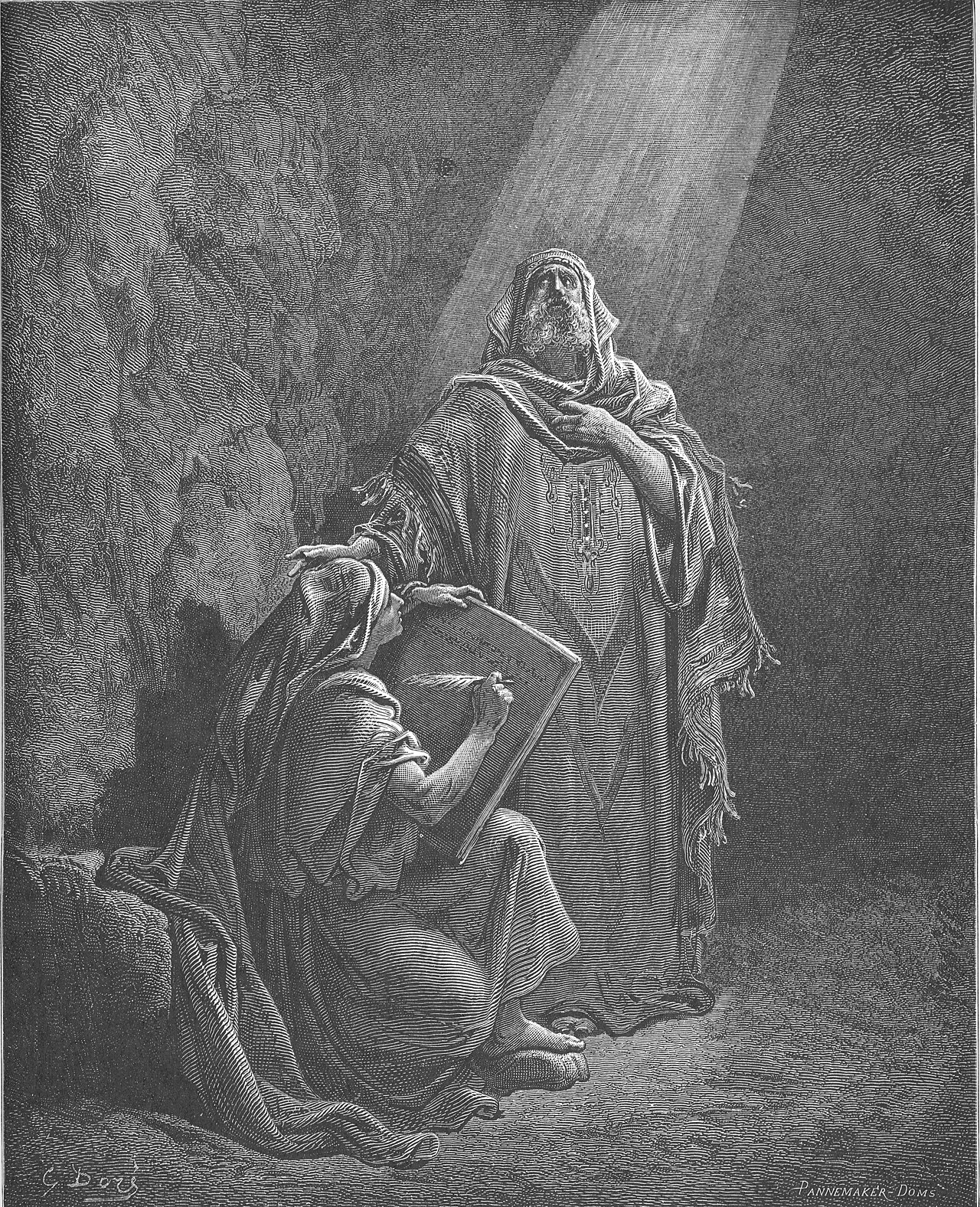
Baruch Writes Jeremiah's Prophecies, Gustave Doré, Doré's English Bible (1866), public domain
Key verse
And it came to pass in the fourth year of Jehoiakim the son of Josiah king of Judah, that this word came unto Jeremiah from the Lord, saying,
It stands in scene A of the chapter, verses 1 to 10.
The chapter
Chapter summary
The scroll. Jeremiah, barred from the temple, dictates to Baruch every word spoken since Josiah's days, hoping Judah will hear and repent. Baruch reads it publicly on a fast day; Micaiah reports it; the princes hear it, grow afraid, and tell the two men to hide. Jehoiakim sits in the winter house with a brazier burning before him, and as Jehudi reads three or four leaves the king cuts them with a penknife and casts them into the fire until the whole roll is consumed: 'and they were not afraid, nor rent their garments.' Elnathan, Delaiah, and Gemariah plead in vain. So another roll is written with all the former words, and many like words added.
Context
Prophecy · Jeremiah · Jeremiah overview
Where the chapter sits
Jeremiah 36 falls in Jerusalem's fall narrated (chapters 34–45). Zedekiah's vacillation; Jehoiakim burns the scroll (36); siege and fall (39); assassination of Gedaliah; flight to Egypt with the remnant.
Jehoiakim burns the scroll. The king cuts the scroll with a penknife and casts it into the fire; Jeremiah dictates it again.
Before it: Book of consolation, chapters 30–33. After it: Oracles against the nations, chapters 46–51.
The whole shape of Jeremiah→The world behind this chapter
Jeremiah 36The history
This chapter shows the machinery of Scripture being made. Jeremiah, barred from the temple, dictates twenty-three years of preaching to Baruch son of Neriah. Baruch writes with a reed pen cut to a chisel point and ink made of soot and gum, on a roll made of papyrus sheets or prepared skin, in narrow columns read from right to left.
The rest of the history, and what it meant to them
A clay seal impression reading belonging to Berekhyahu son of Neriyahu the scribe is well known and matches this man's full name exactly, though it surfaced through the antiquities trade rather than a controlled dig, so its authenticity is argued over and it cannot carry weight on its own. A seal impression of Gemariah son of Shaphan, the official whose temple chamber Baruch reads from in this chapter, was found in place in the burnt debris of the City of David, and that one is not in doubt.
The reading happens on a proclaimed fast day, when country people had come into the city, the largest possible audience. Baruch reads, an official reports it, the scroll is read again to the officials, who go pale and tell the two men to hide.
Then the king. It is the ninth month, winter, and Jehoiakim is in the winter house with a brazier burning in front of him. As each three or four columns are read, he cuts them off with a scribe's knife and drops them in the fire until the whole roll is burned, and nobody tears their clothes. A second scroll is written with many similar words added.
What it meant to them
For the first hearers the contrast between two kings would have been unmissable. Josiah heard a scroll and tore his clothes. His son heard a scroll and took a knife to it.
And the scroll came back longer. That is the durable point: the words survived the man who burned them, and the fire is the reason we know their author's name and his scribe's.
Sources cited
- Walton, Matthews and Chavalas, The IVP Bible Background Commentary: Old Testament
- Kenneth A. Kitchen, On the Reliability of the Old Testament
A. Baruch Writes the Scroll and Reads It in the Temple
1. (vv. 1-4)
a.the fourth year of Jehoiakim the son of Josiah king of Judah: The command comes in Jehoiakim's fourth year and covers everything Jeremiah has preached since the days of Josiah, all the words against Israel, Judah, and the nations gathered onto one roll, more than twenty years of oracles compiled at once. The purpose is stated before a word is written, it may be that the house of Judah will hear... that I may forgive their iniquity and their sin, mercy still the goal of a book about to be condemned. Jeremiah dictates and Baruch the son of Neriah writes it down, the first appearance of the scribe whose name will carry through the rest of the chapter and into 43 and 45.
Jeremiah 36:1, 1 voiceWhat preachers and commentators have said about these verses, in their own words.
Jeremiah 36:1
“In the fourth year of Jehoiakim - See Jer 25:1 note. The present chapter belongs to the very end of that year. The capture of Jerusalem by Nebuchadnezzar took place early in Jehoiakim’s fourth year, long before the writing of Jehoiakim’s scroll. The humiliation seems to have sunk deeply into the heart of Jehoiakim, and when Jeremiah prophesied extended dominion to the Chaldaeans Jer 36:29, his anger knew no bounds.”
Jeremiah 36:2, 1 voice
Jeremiah 36:2
“Take thee a roll of a book - Take a sufficient quantity of parchment; cut and stitch it together, that it may make a roll on which to write the words that I have already spoken, that they may serve for a testimony to future generations. The Jewish rolls, several of which now lie before me, were made of vellum, or of sheep-skins dressed in the half-tanned or Basil manner. These were cut into certain lengths, and those parts were all stitched together, and rolled upon a roller. The matter was written on these skins in columns or pages.”
Adam Clarke· Commentary on the Bible (1810-1826)evangelical
Jeremiah 36:4, 1 voice
Jeremiah 36:4
“Then Jeremiah called Baruch - This man, so useful to the prophet, and so faithfully attached to him, was by office a scribe; which signifies, not only a writer, but also a man in office; a chancellor, secretary, etc., a learned man; one acquainted with laws and customs.”
Adam Clarke· Commentary on the Bible (1810-1826)evangelical
2. (vv. 5-8)
a.I am shut up; I cannot go into the house of the Lord: Jeremiah cannot go himself, I am shut up; I cannot go into the house of the Lord, most commentators reading this as the lingering effect of the ban that followed his trial for his life in chapter 26, and so the reading falls to Baruch. The instruction repeats the hope already voiced, it may be they will present their supplication before the Lord, and Baruch is told to read on the fasting day when the crowd from every town would be gathered to hear it at once. Verse 8 closes the unit with plain obedience, Baruch did according to all that Jeremiah the prophet commanded him, the servant's fidelity that will hold through everything the rest of the chapter throws at him.
Jeremiah 36:5, 1 voice
Jeremiah 36:5
“I am shut up--not in prison, for there is no account of his imprisonment under Jehoiakim, and Jer 36:19, 26 are inconsistent with it: but, "I am prevented," namely, by some hindrance; or, through fear of the king, to whose anger Baruch was less exposed, as not being the author of the prophecy.”
Jamieson, Fausset & Brown· Commentary Critical and Explanatory on the Whole Bible (1871)reformed
Jeremiah 36:6, 1 voice
Jeremiah 36:6
“Upon the fasting day - A day when multitudes of people would be gathered together from all parts to implore the mercy of God. This was a favorable time to read these tremendous prophecies.”
Adam Clarke· Commentary on the Bible (1810-1826)evangelical
3. (vv. 9-10)
a.the fifth year of Jehoiakim the son of Josiah king of Judah: A full year passes before the occasion comes, the fast finally proclaimed in the fifth year, ninth month, drawing people from every city of Judah into Jerusalem at once. Baruch reads from a position of real visibility, the chamber of Gemariah the son of Shaphan, in the higher court at the entry of the new gate, a scribe's room chosen because Gemariah's family had already shown Jeremiah some sympathy. Henry notes the timing as providence rather than accident, a national fast assembling the very audience the roll needed and a friendly official's chamber giving Baruch a platform to reach it from.
Jeremiah 36:9, 2 voices
Jeremiah 36:9
“The ninth month answers to our December, and the fast was probably in commemoration of the capture of Jerusalem by the Chaldaeans in the previous year.”
Jeremiah 36:9
“But some think that the writing of the book fairly over took up so much time that it was another year ere it was perfected; and yet perhaps it might not be past a month or two; he might begin in the latter end of the fourth year and finish it in the beginning of the fifth, for thee ninth month refers to the computation of the year in general, not to the year of that reign.”
Matthew Henry· Commentary on the Whole Bible (1707-1721)puritan
Jeremiah 36:10, 1 voice
Jeremiah 36:10
“Gemariah seems to have inherited his father’s office of public scribe or secretary of state (see 2Ki 22:3). As brother of Ahikam, he would be favorable to Jeremiah. The higher court - The inner court; into which it was not lawful for the people to enter, but the chamber probably itself formed one of its sides, and could be approached from the outer court.”
B. The Princes Hear It and Tell Them to Hide
1. (vv. 11-13)
a.Michaiah the son of Gemariah, the son of Shaphan: Michaiah, grandson of the Shaphan whose family ran through Josiah's reform, hears the reading and moves at once, going down to the scribe's chamber in the king's house where the princes are already sitting. He reports the whole content rather than a summary, all the words that he had heard, and the princes' response is immediate concern rather than dismissal. Gill notes the Shaphan family's recurring role across the book, three generations of one household turning up at every hinge point of Jeremiah's story, Ahikam protecting him in chapter 26, Gemariah lending his chamber here, Gedaliah governing after the fall in chapter 40.
Jeremiah 36:12, 1 voice
Jeremiah 36:12
“The scribe’s chamber - The chancery in which the king’s business was conducted. Probably Elishama was one of the “principal scribes of the host” Jer 52:25, i. e., the secretary of state for war. The business which had brought together “all the princes” would have reference to the Chaldaean war.”
2. (vv. 14-16)
a.Jehudi the son of Nethaniah, the son of Shelemiah, the son of Cushi: The princes send a five-generation-deep summons, Jehudi the son of Nethaniah, the son of Shelemiah, the son of Cushi, for a roll they have only heard about secondhand, and Baruch comes and reads it to them directly. Their reaction is fear rather than anger, they were afraid both one and other, the words landing on men close enough to power to know exactly what they meant. Their decision, we will surely tell the king, is stated without any sign yet of what the king will do with it, the princes still acting as though the normal channels of government might still matter.
Jeremiah 36:14, 1 voice
Jeremiah 36:14
“Jehudi signifies a Jew and Cushi an Ethiopian, but it seems reasonable to conclude that they are genuine, proper names.”
Jeremiah 36:16, 3 voices
Jeremiah 36:16
“They were afraid both one and other - literally, “they trembled each to his neighbor,” i. e., they showed their alarm by their looks and gestures one to another. They felt that what he had so consistently prophesied for a period of 23 years would in all probability be fulfilled. We will surely tell - Rather, We must tell the king. It was their official duty.”
Jeremiah 36:16
“They showed some concern till they saw how light the king made of it, and then they shook off all that concern. They rent not their garments, as Josiah, this Jehoiakim's own father, did when he had the book of the law read to him, though it was not so particular as the contents of this roll were, nor so immediately adapted to the present posture of affairs.”
Matthew Henry· Commentary on the Whole Bible (1707-1721)puritan
Jeremiah 36:16
“They were all convinced that it was worthy to be regarded, but none of them had courage to second it, only they agreed to tell the king of all these words; and, if he think fit to give credit to them, they will, otherwise not, no, though it were to prevent the ruin of the nation.”
Matthew Henry· Commentary on the Whole Bible (1707-1721)puritan
3. (vv. 17-19)
a.How didst thou write all these words at his mouth?: Before taking the matter further the princes want the process confirmed, how didst thou write all these words at his mouth, and Baruch answers plainly, he pronounced them with his mouth and I wrote them with ink in the book, dictation and transcription named as exactly what happened. The princes' next move sets them apart from the king who is about to hear the same words, go, hide thee, thou and Jeremiah, and let no man know where ye be, a warning rather than an arrest. Clarke reads this as the chapter's one moment of official conscience, men who feared the message enough to protect its bearers even while they carried it toward a king who would not.
Jeremiah 36:17, 1 voice
Jeremiah 36:17
“What they wished to know was, whether what Baruch had read to them was written by him from memory after hearing Jeremiah repeating his prophecies continuously, or accurately from the prophet's own dictation.”
Jamieson, Fausset & Brown· Commentary Critical and Explanatory on the Whole Bible (1871)reformed
Jeremiah 36:18, 1 voice
Jeremiah 36:18
“He pronounced - He used to say aloud, he dictated. Baruch’s office was merely mechanical. He contributed nothing but hand, pen, and ink.”
C. Jehoiakim Cuts the Scroll with a Penknife
1. (vv. 20-21)
a.they laid up the roll in the chamber of Elishama the scribe: The princes go to the king but leave the roll behind in Elishama the scribe's chamber, telling him the content before he has heard a word of it himself, and the king responds by sending Jehudi to fetch what they had just secured. Jehudi reads it in the king's own hearing with all the princes standing by, the same words that had already frightened the men who first heard them now placed in front of the one man with the power to act on the warning or ignore it. The scene's arrangement, roll stored safely, then summoned, then read aloud again, gives the king every chance to receive it seriously.
2. (vv. 22-23)
a.the king sat in the winterhouse in the ninth month: The setting is deliberately comfortable, the king sitting in his winterhouse with a fire burning on the hearth before him in the ninth month's cold, a scene of ease chosen against the fast day's solemnity that opened the chapter. Jehudi reads three or four leaves at a time, and the king does not wait for the whole roll, he cuts it with the penknife and casts it into the fire, then repeats the act column by column until all the roll was consumed. Henry reads the deliberateness as the point, not one furious gesture but a methodical destruction, leaf after leaf fed to the fire as if patience could out-argue the word.
Jeremiah 36:22, 1 voice
Jeremiah 36:22
“Winterhouse - A warm apartment suited to the season of the year, (December), when in Palestine there is often snow upon the ground, though it does not last long. A fire on the hearth - a pan or brazier of burning coals. This is the case to the present day. In cold weather the rich burn wood in brass or earthen pans, placed in any part of the room; the indigent burn sticks on the floor.”
Adam Clarke· Commentary on the Bible (1810-1826)evangelical
Jeremiah 36:23, 3 voices
Jeremiah 36:23
“The God of all orders Jeremiah to write the former words in another book. The sheet of paper was burned, but the divine law remained unharmed. So also when the body assumed by the Word suffered, the Word remained free from suffering.”
Theodoret of Cyrus· written before 458· ON JEREMIAH 7:36patristic
Jeremiah 36:23
“Leaves - Columns: literally folding-doors; the word exactly describes the shape of the columns of writing upon the scroll. Penknife - “Scribe’s knife;” used to shape the reed for writing, and to make erasures in the parchment. On the hearth - Or, in the fire-pan. The conduct of the king shows how violent was his temper.”
Jeremiah 36:23
"He" refers to the king (Jer 36:22). As often as Jehudi read three or four columns, the king cut asunder the part of the roll read; and so he treated the whole, until all the parts read consecutively were cut and burnt; Jer 36:24, "all these words," implies that the whole volume was read through, not merely the first three or four columns (1Ki 22:8).
Jamieson, Fausset & Brown· Commentary Critical and Explanatory on the Whole Bible (1871)reformed
3. (vv. 24-26)
a.Yet they were not afraid, nor rent their garments: The court's response is stated as a double failure, they were not afraid, nor rent their garments, neither the king nor any of his servants, the standard signs of conviction entirely absent even after the roll had already frightened the princes who first heard it. Three men do try to stop him, Elnathan and Delaiah and Gemariah had made intercession that he would not burn the roll, but he would not hear them, the king's refusal naming him against his own officials rather than merely against the prophet. He orders Baruch and Jeremiah taken, but the Lord hid them, the chapter's only miracle stated in five plain words with no description of how it happened.
Jeremiah 36:24, 1 voice
Jeremiah 36:24
“Yet they were not afraid, nor rent their garments,.... They were not struck with horror at such an impious action as the burning of the roll; nor afraid of the judgments and wrath of God threatened in it; nor did they rend their garments in token of sorrow and mourning on account of either, as used to be when anything blasphemous was said or done, or any bad news were brought. The Jews from hence conclude, that whenever a man sees the book of the law torn of cut to pieces, he should rend his garments (t).”
Jeremiah 36:25, 1 voice
Jeremiah 36:25
“The "nevertheless" aggravates the king's sin; though God would have drawn him back through their intercession, he persisted: judicial blindness and reprobation!”
Jamieson, Fausset & Brown· Commentary Critical and Explanatory on the Whole Bible (1871)reformed
D. A Second Scroll, with Many Like Words Added
1. (vv. 27-31)
a.after that the king had burned the roll: The word of the Lord returns after the king had burned the roll, and Jeremiah is told to write it all again, the divine answer to fire proving to be more words rather than silence. The sentence on Jehoiakim by name is specific and personal, he shall have none to sit upon the throne of David, and his dead body shall be cast out in the day to the heat, and in the night to the frost, an unburied end for a king who had just watched a book burned with proper ceremony. Verse 31 widens the judgment to his line and his officials and the whole city, the same evil already pronounced now confirmed rather than softened by his attempt to erase it.
Jeremiah 36:27, 1 voice
Jeremiah 36:27-32
“8 And Baruch the son of Neriah did according to all that Jeremiah the prophet commanded him, reading in the book the words of the L ORD in the L ORD 's house. In the beginning of Ezekiel's prophecy we meet with a roll written in vision, for discovery of the things therein contained to the prophet himself, who was to receive and digest them, Ezek. ii.”
Matthew Henry· Commentary on the Whole Bible (1707-1721)puritan
Jeremiah 36:29, 2 voices
Jeremiah 36:29
“The king of Babylon ... - These words do not prove that Nebuchadnezzar had not already come, and compelled Jehoiakim to become his vassal. The force lies in the last words, which predict such a coming as would make the land utterly desolate: and this would be the result of the king throwing off the Chaldaean yoke.”
Jeremiah 36:29
“He did so ( 2 Chron. xxxvi. 6, 7 ) in his third year, Dan. i. So that God and his prophets had therefore become his enemies because they told him the truth, told him of the desolation that was coming, but at the same time putting him into a fair way to prevent it.”
Matthew Henry· Commentary on the Whole Bible (1707-1721)puritan
Jeremiah 36:30, 1 voice
Jeremiah 36:30
“Zedekiah was not the son, but the uncle of Jeconiah, and was raised to the throne in contempt of him and his father Jehoiakim (Jer 22:30). dead body . . . cast out-- (Jer 22:18, 19). day . . . heat . . . night . . . frost--There are often these variations of temperature in the East between night and day (Ge 31:40).”
Jamieson, Fausset & Brown· Commentary Critical and Explanatory on the Whole Bible (1871)reformed
Jeremiah 36:31, 1 voice
Jeremiah 36:31
“That all the evil pronounced against Judah and Jerusalem in that roll shall be brought upon them. Though the copy be burnt, the original remains in the divine counsel, which shall again be copied out after another manner in bloody characters. Note, There is no escaping God's judgments by struggling with them.”
Matthew Henry· Commentary on the Whole Bible (1707-1721)puritan
2. (v. 32)
a.and there were added besides unto them many like words: Jeremiah takes another roll and gives it to Baruch, and the whole book is written again, all the former words the king had burned now restored word for word. The chapter adds one detail beyond simple replacement, there were added besides unto them many like words, the book coming back not merely intact but larger than the fire left it. Henry and Gill both read this last line as Scripture's own comment on itself, a king with a penknife and a hearth proving unable to reduce a single word of what God had spoken, and the record growing instead of shrinking under his hand.
Jeremiah 36:32, 1 voice
Jeremiah 36:32
“There were added - many like words - All the first roll, with many other threatening and perhaps more minute declarations which were merely of a temporary importance and local application; and the Holy Spirit did not think proper to record them here.”
Adam Clarke· Commentary on the Bible (1810-1826)evangelical
The text of this chapter
This page carries no textual note on Jeremiah 36. Where this site has examined a place the manuscripts differ, the examination is in the manuscripts room. Every place this site examines →
This page draws on Adam Clarke; Albert Barnes; Carl Friedrich Keil, The Prophecies of Jeremiah; Jamieson, Fausset & Brown; John Gill; Matthew Henry and Theodoret of Cyrus, ON JEREMIAH 7:36.
Keep studying
On this page
Studies4
On this chapter
On this book