
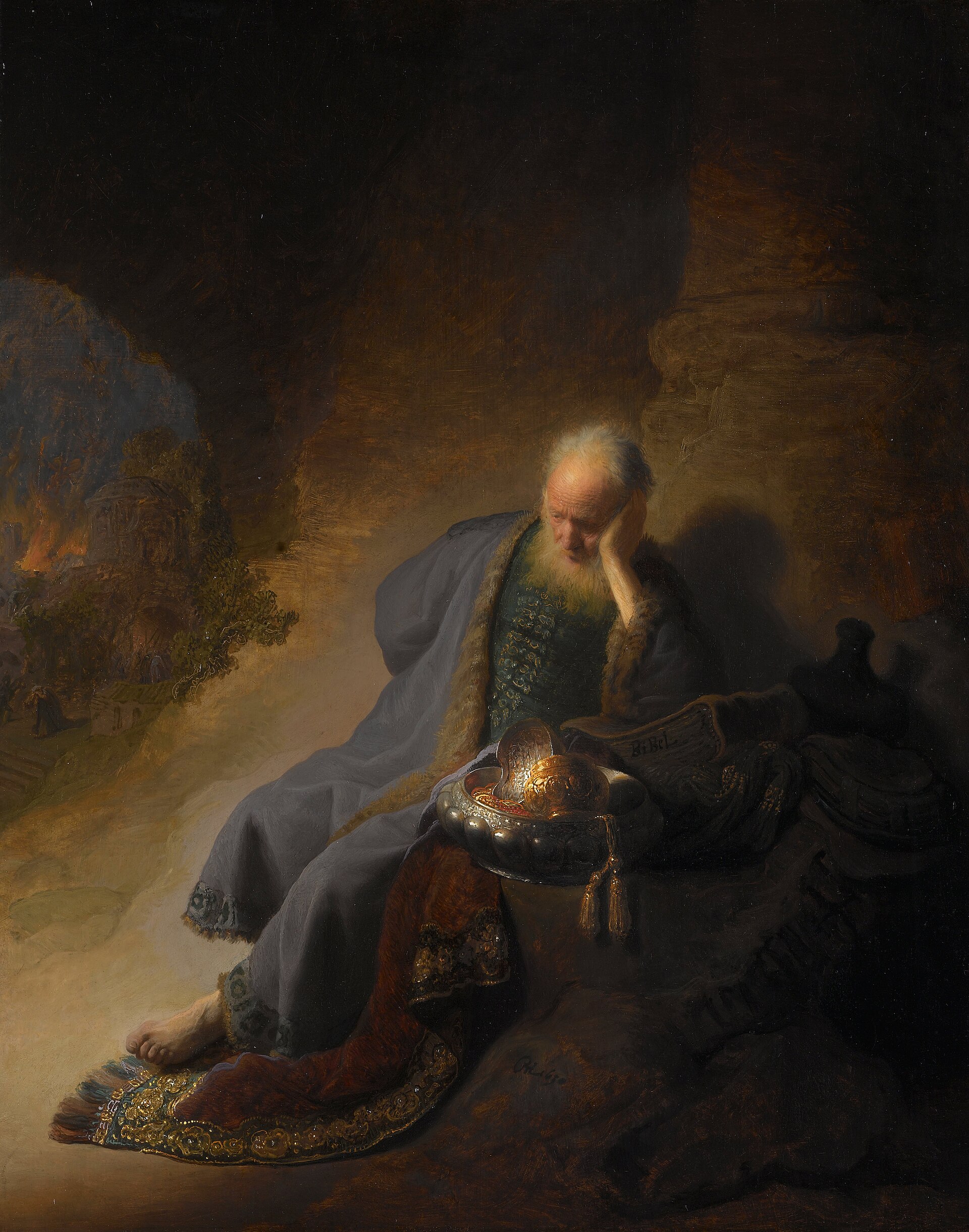
Jeremiahchapter 22
30 verses · Jeremiah, written by Baruch · 7th to 6th century BC · The Prophets
“As surely as I live,” declares the LORD, “even if you, Coniah son of Jehoiakim king of Judah, were a signet ring on My right hand, I would pull you off.
Introduction
Jeremiah, written by Baruch, The Prophets, Jeremiah Overview.
This chapter gathers words Jeremiah spoke to the kings of Judah over about twelve years, from the death of Josiah to the first deportation. Judah changed kings four times in that span, and two of them reigned only three months. Its first hearers were the court itself, addressed at the palace gate. The chapter measures each king against the work the throne was given. Listen for the names, since each king is called by a name the court would know, and for the pictures of cedar, burial and a ring. Read it as a verdict on a royal house in its last years.
Context
- Who
- The court itself, king, servants and household, addressed to their faces
- What
- A set of oracles delivered at the palace on the kings who followed Josiah, each judged by how he ruled.
- Where
- The gate of the royal palace in Jerusalem.
- When
- Oracles from about 609 to 597 BC, from the reign of Jehoahaz to the exile of Jehoiachin.
- Why
- To show the house of David that the throne stood on justice for the poor and that kings who abandoned it would lose it.
Historical context
This chapter is a file on the last kings, and each one is named by a fate that history confirms. Shallum is Jehoahaz, who reigned three months in 609 BC before Pharaoh Neco removed him and took him to Egypt, where he died. The oracle says exactly that: he shall never return.
Show the rest of the historical context, 3 more paragraphs
Jehoiakim's charge is a building project. He is accused of building his house by unrighteousness, making his neighbour serve for nothing and not paying him his wages, panelling with cedar and painting with vermilion, a red ochre pigment used on beams and window frames. Forced labour on a royal palace, during a period when Judah was paying heavy tribute, is a fair description of squeezing a small country to build big.
The burial threatened for him is a donkey's burial: dragged out and thrown beyond the gates of Jerusalem. Livestock were dumped, not buried. For a king of David's line that is the deepest insult available.
Coniah is Jehoiachin, who reigned three months in 597 BC and was deported to Babylon with his mother. The picture used is a signet ring, the king's personal seal, worn on the hand, pressed into clay to authorise documents, and never let out of a man's sight. God says even if he were the signet ring on my right hand, I would tear him off.
Significance
First hearers were watching kings come and go in months. This chapter told them why: the throne had a job description, do justice, rescue the robbed, do not shed innocent blood, and the men on it were doing something else.
Show the rest of the significance, 1 more paragraph
The line about Coniah having no offspring who would sit on David's throne is precise rather than absolute. He did have sons, as the family records show, but none of them ruled. The dynasty went into the ground, and the promise of a righteous branch in the next chapter has to grow from a stump.
This chapter in Jewish lifeWhat this chapter is in Jewish life and reading.
What is done
No part of this chapter is read in the synagogue. Probed for this lane, the site's own table in src/lib/hebraic/readings.ts printed parashot 0 and haftarah uses 0 for Jeremiah 22, and no festival reading for the book. Across chapters 1 to 26 of Jeremiah the same probe found a Haftarah only in chapters 1, 2, 3, 4, 7, 8, 9, 16 and 17.
How it is read
Rashi is the one commentator on this chapter whose English the corpus carries, quoted here from The Judaica Press complete Tanach with Rashi, translated by A. J. Rosenberg, which Sefaria reports as CC-BY.
Rashi reads the dead not to be wept for as Jehoiakim, and Shallum as Zedekiah, the fourth of Josiah's sons to take the kingdom (Rashi on Jeremiah 22:10:1 and 22:11:1). The woe to the man who builds his house by unrighteousness is spoken of Jehoiakim, "who was a wicked man" (Rashi on Jeremiah 22:13:1). The burial of a donkey is a carcass dragged away (Rashi on Jeremiah 22:19:1).
Lebanon he reads as the Temple: "Go up to the Temple and cry" (Rashi on Jeremiah 22:20:1). The shepherds are the kings (Rashi on Jeremiah 22:22:1). The signet ring on God's hand he reads as "Engraved and sealed in the flesh of My arm" (Rashi on Jeremiah 22:24:1).
The corpus carries eight further notes on this chapter without an English text, each marked linked because Sefaria holds no English version of the ref. They stand cited and unquoted at Radak on Jeremiah 22:1:1, 22:2:1, 22:4:1, 22:5:1, 22:8:1 and 22:16:1. The same holds for Metzudat David on Jeremiah 22:9:1. The same holds for Malbim on Jeremiah 22:12:1.
What the rabbis say
The corpus carries 40 rabbinic locators on the verses of this chapter, 4 in the Talmud and 36 in the Midrash. It carries the text of none, so each is cited by ref here and never quoted or paraphrased. The verse numbers are the Hebrew ones the corpus prints.
On verse 2 it holds Ein Yaakov (Glick Edition), Ketubot 13:12. On verse 5 it holds Aggadat Bereshit 74:1. On verse 6 it holds Mekhilta DeRabbi Yishmael, Tractate Amalek 2:18, Midrash Lekach Tov, Deuteronomy 1:7:1, Midrash Lekach Tov, Deuteronomy 3:25:1, Midrash Lekach Tov, Deuteronomy 34:1:1 and Midrash Tannaim on Deuteronomy 1:7:10. On verse 7 it holds Sifrei Bamidbar 94:1 and Yalkut Shimoni on Torah 736:8. On verse 8 it holds Midrash Tehillim 48:4. On verse 9 it holds Sanhedrin 38b:12.
On verse 10 it holds Bava Batra 116a:8, Bereshit Rabbah 63:11, Bereshit Rabbati, Parashat Lech Lecha 5 and Ein Yaakov (Glick Edition), Bava Batra 8:4. On verse 12 it holds Ein Yaakov (Glick Edition), Shabbat 2:22. On verse 13 it holds Otzar Midrashim, Perek Shirah ('Chapter of Song') 1:87. On verse 14 it holds Midrash Lekach Tov, Numbers 13:32:1, Midrash Sekhel Tov, Bereshit 32:17:4, Midrash Tannaim on Deuteronomy 3:26:8 and Sifrei Zuta; Midrashah shel Lod, Extant Remnants 9. On verse 15 it holds Mekhilta DeRabbi Shimon Ben Yochai 18:22.
On verse 17 it holds Kohelet Rabbah 1:16:1. On verse 19 it holds Ein Yaakov (Glick Edition), Sanhedrin 11:84, Ein Yaakov, Sanhedrin 9:9, Midrash Sekhel Tov, Bereshit 19:9:1 and Otzar Midrashim, The Ten Exiles 2:8. On verse 21 it holds Bereshit Rabbah 92:7. On verse 24 it holds Bamidbar Rabbah 20:20, Bereshit Rabbah 85:9, Midrash Aggadah, Genesis 38:18:1 and Midrash Lekach Tov, Genesis 38:18:2. On verse 29 it holds Chullin 127a:14, Ein Yaakov, Khullin 9:2, Midrash Tehillim 19:2 and Pesikta Rabbati 21:1.
On verse 30 it holds Ein Yaakov (Glick Edition), Sanhedrin 4:10, Ein Yaakov, Sanhedrin 4:17, Midrash Lekach Tov, Leviticus 20:20:1 and Sanhedrin 37b:14.
Sources: Rashi, Rashi on Jeremiah 22:3:1 to 22:24:1, The Judaica Press complete Tanach with Rashi, translated by A. J. Rosenberg, reported CC-BY; Malbim, Malbim on Jeremiah 22:12:1, cited by ref because the corpus carries no English text; Metzudat David, Metzudat David on Jeremiah 22:9:1, cited by ref because the corpus carries no English text; Radak, Radak on Jeremiah 22:1:1, 22:2:1, 22:4:1, 22:5:1, 22:8:1 and 22:16:1, cited by ref because the corpus carries no English text; The Sefaria corpus, scripts/data/sources/sefaria/jeremiah/22.json, the 40 Talmud and Midrash locators on the verses of this chapter; The site's own files, src/lib/hebraic/readings.ts, probed for Jeremiah 22: parashot 0, haftarah uses 0, and no festival reading for the book.
The heads below are this chapter's scenes. The numbered points under each are its verses.
Go Down to the House of the King of Judah
Jeremiah 22:1-5
This is what the LORD says: Jeremiah is sent to “the palace of the king of Judah” with a word for the king “who sits on the throne of David.” He is to “Administer justice and righteousness,” and to do no wrong “to the foreigner, the fatherless, or the widow.”
Jeremiah 22:1
“Thus saith the Lord, go down to the house of the king of Judah,.... To the palace of Jehoiakim, who was now the reigning king; the prophet is bid to go down to it, because, as Kimchi thinks, he was now upon the mountain of the house, or in the temple, from whence to the king's house there was a descent: and speak there this word; of prophecy, relating to the several kings hereafter mentioned. This prophecy was delivered some years before that in the preceding chapter, though it stands here.”
1 more voice on this verseWhat preachers and commentators have said about this verse, in their own words.
Jeremiah 22:1
“Go down to the house of the king of Judah, and speak there this word - This is supposed by Dahler to have been published in the first year of the reign of Zedekiah.”
Adam Clarke · Commentary on the Bible (1810-1826)evangelical
The king is addressed as heir of David, with his officials and the people who pass through the gates. Henry notes that the throne was held under the covenant God made with David, so the king should follow David's example. Clarke blames the officials who urged Zedekiah to rebel.
Jeremiah 22:2
“The king of Judah is here spoken to as sitting upon the throne of David, who was a man after God's own heart, as holding his dignity and power by the covenant made with David; let him therefore conform to his example, that he may have the benefit of the promises made to him.”
Matthew Henry · Commentary on the Whole Bible (1707-1721)puritan
1 more voice on this verse
Jeremiah 22:2
“O king of Judah - thou, and thy servants - His ministers are here addressed, as chiefly governing the nation; and who had counselled Zedekiah to rebel.”
Adam Clarke · Commentary on the Bible (1810-1826)evangelical
Administer justice and righteousness: Each king in the chapter is judged by these commands. The foreigner, the fatherless and the widow are the people with no one to defend them. Barnes, on verse 17, says Jehoiakim broke the last command, putting innocent people to death to take their property.
Jeremiah 22:3
“Herein they must be ministers of God for good. (2.) That they do no hurt with it, no wrong, no violence. That is the greatest wrong and violence which is done under colour of law and justice, and by those whose business it is to punish and protect from wrong and violence.”
Matthew Henry · Commentary on the Whole Bible (1707-1721)puritan
Obedience would keep David's line on the throne, with kings still riding through these gates in state. Gill reads the kings as David's sons ruling in his place. The promise repeats the one made in 17:25, where obedience would keep the city inhabited forever.
Jeremiah 22:4
“For if ye do this thing indeed,.... Or, "in doing do this word" (y); diligently and carefully attend to this word of exhortation, and constantly perform the duties required: then shall there enter in by the gates of this house kings sitting upon the throne of David; or, upon the throne for David: in his room and stead, as successors of his; or of his lineage and descent, as the Vulgate Latin version.”
I swear by Myself: The LORD swears by Himself, having no one greater to swear by (Hebrews 6:13). Gill notes that an oath makes a threat certain. The palace that could have held David's sons would become a pile of rubble.
Jeremiah 22:5
“But if ye will not hear these words,.... Will give no attention, and yield no obedience to them: I swear by myself, saith the Lord; and by a greater he cannot swear; and that is the reason why he swears by himself, Heb 6:13; and as, when he swears to a promise, it shows the immutability of it, the certainty of its performance, and that it is irreversible, and never repented of, nor revoked; so it is when he swears to a threatening.”
Jeremiah 22:6-9
For this is what the LORD: The LORD tells the royal house, “You are like Gilead to Me, like the summit of Lebanon,” and He will “turn you into a desert.” The answer names covenant breach: “Because they have forsaken the covenant of the LORD their God and have worshiped and served other gods.”
Jeremiah 22:6
“Thou art Gilead unto me, and the head of Lebanon - Perhaps in allusion, says Dahler, to the oaks of Gilead, and the cedars of Mount Lebanon, of which the palace was constructed. Lebanon was the highest mountain in Israel, and Gilead the richest and most fertile part of the country; and were, therefore, proper emblems of the reigning family. Though thou art the richest and most powerful, I, who raised thee up, can bring thee down and make thee a wilderness.”
Adam Clarke · Commentary on the Bible (1810-1826)evangelical
1 more voice on this verse
Jeremiah 22:6
“Gilead - Gilead was a country fertile for pastures; upon which account the Reubenites and Gadites, being men whose estate lay in cattle, begged it of Moses for their portion. Lebanon also was a very pleasant place: they were both in the lot of Gad and Manasseh.”
John Wesley · Explanatory Notes upon the Old Testament (1765)evangelical
I will appoint destroyers against you: Gill names the destroyers as the Chaldeans. Barnes notes that the word for appoint means to consecrate, as at 6:4, so the army comes set apart for this work. He reads the choicest cedars as the leading men of the royal house and the chief officers.
Jeremiah 22:7
“And I will prepare destroyers against thee,.... The Chaldeans, men of savage dispositions, bent upon the destruction of their neighbours; and who had already destroyed many nations, and so fit instruments for such service, as after mentioned; and who yet did not come merely of themselves, but were moved and directed to it by the powerful and all wise providence of God, in consequence of a previous preparation and appointment of them by the Lord in his counsels and purposes.”
many nations will pass by this city: Foreign travelers stop at the fallen city and ask what happened. Jamieson, Fausset and Brown, following Calvin, note that the nations will grasp what Judah refused to see. The great city becomes a public sign of the LORD's judgment.
Jeremiah 22:8
“The Gentile nations, more intelligent than you, shall understand that which ye do not, namely, that this city is a spectacle of God's vengeance [CALVIN].”
Jamieson, Fausset & Brown · Commentary Critical and Explanatory on the Whole Bible (1871)reformed
they have forsaken the covenant: The people give the same answer Moses foresaw when nations ask about the land (Deuteronomy 29:24-26). Henry calls the sin a revolt from their own God. Having forsaken His covenant, they served other gods, and the great city fell.
Jeremiah 22:9
“They forsook the covenant of Jehovah their own God, revolted from their allegiance to him and from the duty which their covenant with him bound them to, and they worshipped other gods and served them, in contempt of him; and therefore he gave them up to this destruction.”
Matthew Henry · Commentary on the Whole Bible (1707-1721)puritan
Shallum Shall Not Return; Jehoiakim Buried as an Ass
Jeremiah 22:10-12
Do not weep for the dead: The dead king is Josiah, and the command “Do not weep for the dead king” sets his grave beside a worse fate. Shallum, identified as Jehoahaz, was deposed by Pharaoh Necho after three months, and “he will die in the place to which he was exiled.”
Jeremiah 22:10
“Weep ye not for the dead - Josiah, dead in consequence of the wound he had received at Megiddo, in a battle with Pharaoh-necho, king of Egypt; but he died in peace with God. But weep sore for him that goeth away - Namely, Jehoahaz, the son of Josiah, called below Shallum, whom Pharaoh-necho had carried captive into Egypt from which it was prophesied he should never return, 2Ki 23:30-34. He was called Shallum before he ascended the throne, and Jehoahaz afterwards; so his brother Eliakim changed his name to Jehoiakim, and Mattaniah to Zedekiah.”
Adam Clarke · Commentary on the Bible (1810-1826)evangelical
concerning Shallum son of Josiah: Shallum reigned only three months before he was taken away. Wesley traces his path from Jerusalem to prison at Riblah and then to death in Egypt. Henry notes that Josiah went to his grave in peace, while his son lived on in shame as a captive.
Jeremiah 22:11
“Shallum - Most think that this Shallum was Jehoahaz. Went forth - He was carried away from Jerusalem presently after he was set up, imprisoned at Riblah, and died in Egypt.”
John Wesley · Explanatory Notes upon the Old Testament (1765)evangelical
1 more voice on this verse
Jeremiah 22:11
“Josiah went to the grave in peace and honour, was prevented from seeing the evil to come in this world and removed to see the good to come in the other world; and therefore, Weep not for him, but for his unhappy son, who is likely to live and die in disgrace and misery, a wretched captive. Note, Dying saints may be justly envied, while living sinners are justly pitied.”
Matthew Henry · Commentary on the Whole Bible (1707-1721)puritan
he will die in the place: Shallum died in Egypt, where Pharaoh Necho had taken him (2 Kings 23:30-34). Clarke notes that he never returned, as the word said. Henry turns to the next king, Jehoiakim, who ruled no better and fared no better at the end.
Jeremiah 22:12
“Whether he had any better right to the crown than Shallum we know not; for, though he was older than his predecessor, there seems to be another son of Josiah, older than he, called Johanan, 1 Chron. iii. But this we know he ruled no better, and fared no better at last. His sins faithfully reproved.”
Matthew Henry · Commentary on the Whole Bible (1707-1721)puritan
Jeremiah 22:13-17
The woe falls on the one “who builds his palace by unrighteousness”. The LORD asks Jehoiakim, “Does it make you a king to excel in cedar?” and sets beside him his father, who “administered justice and righteousness, and so it went well with him.”
Jeremiah 22:13
“Far worse is the second example. Shallum was no heartless tyrant like Jehoiakim, who lived in splendor amid the misery of the nation, and perished so little cared for that his body was cast aside without burial. His chambers - Really, his upper chambers. From the absence of machinery the raising of materials for the upper stories was a difficult task, especially when massive stones were used. His work - Giveth him not his wages.”
1 more voice on this verse
Jeremiah 22:13
“But such a house as this sensual persons, they who dwell in cieled houses and delight in chased silver, do not build. For as they despise pure silver, so also they despise simple dwellings. They enlarge the site of their houses, they add more and more, joining house to house and farm to farm, they dig up the ground; so that the very earth itself gives way to their habitations, and like sons of the earth they are laid up within her womb, and hidden in her bowels.”
Ambrose of Milan · written before 397 · Letter 30.4patristic
paints it with vermilion: Vermilion was a deep red paint, and Barnes notes it still shows bright on many old buildings. Henry grants that a king may build a great palace. The sin lay in the pride behind the cedar and in the wages left unpaid (verse 13).
Jeremiah 22:14
“Large chambers - spacious upper chambers. It is cieled - Or, roofing it. Vermilion - The pigment which gives the deep red color still bright and untarnished on many ancient buildings.”
2 more voices on this verse
Jeremiah 22:14
“No doubt it is lawful for princes and great men to build, and beautify, and furnish their houses so as is agreeable to their dignity; but he that knows what is in man knew that Jehoiakim did this in the pride of his heart, which makes that to be sinful, exceedingly sinful, which is in itself lawful.”
Matthew Henry · Commentary on the Whole Bible (1707-1721)puritan
Jeremiah 22:14
“Retaining English Version, there must be understood something remarkable about the windows, since they are deemed worthy of notice. GESENIUS thinks the word dual, "double windows," the blinds being two-leaved. vermilion--Hebrew, shashar, called so from a people of India beyond the Ganges, by whom it is exported [PLINY, 6.19].”
Jamieson, Fausset & Brown · Commentary Critical and Explanatory on the Whole Bible (1871)reformed
Does it make you a king: The question mocks the idea that cedar makes a king. Barnes reads it as a king trying to match Solomon's building and hoping it would keep him on the throne. Jamieson, Fausset and Brown note that Josiah secured his throne by justice, while his son sat on a shaky one.
Jeremiah 22:15
“Did he need to build costly palaces to secure his throne? Nay, he did secure it by "judgment and justice"; whereas thou, with all thy luxurious building, sittest on a tottering throne. then--on that account, therefore.”
Jamieson, Fausset & Brown · Commentary Critical and Explanatory on the Whole Bible (1871)reformed
1 more voice on this verse
Jeremiah 22:15
“Thus when Christ spoke of the destruction of the temple his disciples came to him, to show him what a magnificent structure it was, Matt. xxiii. Note, Those wretchedly deceive themselves who think their present prosperity is a lasting security, and dream of reigning because they are enclosed in cedar.”
Matthew Henry · Commentary on the Whole Bible (1707-1721)puritan
He took up the cause: Josiah defended the poor and needy, and the LORD calls this knowing Him. Henry reads knowing God here as doing the duty of one's place. For a king, that meant justice for the weak.
Jeremiah 22:16
“First, God accepted him: " Was not this to know me, saith the Lord? Did he not hereby make it to appear that he rightly knew his God, and worshipped him, and consequently was known and owned of him?" Note, The right knowledge of God consists in doing our duty, particularly that which is the duty of our place and station in the world.”
Matthew Henry · Commentary on the Whole Bible (1707-1721)puritan
your own dishonest gain: Jehoiakim's eyes and heart are set on gain, the opposite of his father's care for the poor. Barnes notes that he put innocent people to death on false charges and took their property. The book names one victim, the prophet Uriah (26:20-23).
Jeremiah 22:17
“Covetousness - literally, gain. Besides exacting forced labor Jehoiakim, to procure the necessary means for the vast expenses he incurred, put innocent people to death on various pretexts, and escheated their property.”
Jeremiah 22:18-19
Therefore this is what the LORD: In place of the funeral, “He will be buried like a donkey, dragged away and thrown outside the gates of Jerusalem.” The account in 2 Kings 24:6 records only his death. The sentence here stands as written: no lament and no honored grave for the builder of the cedar palace.
Jeremiah 22:18
“They shall not lament for him, saying, Ah my brother! - These words were no doubt the burden of some funeral dirge. Alas! a brother, who was our lord or governor, is gone. Alas, our sister! his Queen, who has lost her glory in losing her husband. הדה hodah is feminine, and must refer to the glory of the queen. The mournings in the east, and lamentations for the dead, are loud, vehement, and distressing.”
Adam Clarke · Commentary on the Bible (1810-1826)evangelical
1 more voice on this verse
Jeremiah 22:18
The boldness of the Hebrew prophets proves their divine mission; were it not so, their reproofs to the Hebrew kings, who held the throne by divine authority, would have been treason. Ah his glory!--"Alas! his majesty."
Jamieson, Fausset & Brown · Commentary Critical and Explanatory on the Whole Bible (1871)reformed
He will be buried like a donkey: A dead donkey was dragged out and left to rot with no grave at all. Barnes says nothing is known of how this was fulfilled. Jamieson, Fausset and Brown set it beside 2 Chronicles 36:6, where Nebuchadnezzar bound him, and beside Jeremiah 36:30, where his body is thrown out.
Jeremiah 22:19
“The burial of an ass - i. e., he shall merely be dragged out of the way, and left to decay unheeded. Nothing is known of the fulfillment of this prophecy.”
1 more voice on this verse
Jeremiah 22:19
“This is not formally narrated. But 2Ch 36:6 states that "Nebuchadnezzar bound him in fetters to carry him to Babylon"; his treatment there is nowhere mentioned. The prophecy here, and in Jer 36:30, harmonizes these two facts.”
Jamieson, Fausset & Brown · Commentary Critical and Explanatory on the Whole Bible (1871)reformed
Write This Man Coniah Childless
Jeremiah 22:20-23
Go up to Lebanon and cry: The city is told to “Go up to Lebanon and cry out,” “for all your lovers have been crushed,” the allies Judah trusted. The one “nestled in the cedars” answers the cedar palace of verse 14, and its comfort turns to “agony like a woman in labor.”
Jeremiah 22:20
“Go up to Lebanon, and cry,.... These words are directed to Jerusalem and its inhabitants, and to the people of the Jews; not to go up to the temple, as the Targum interprets it, so called, because made of the wood of Lebanon, as in Zec 11:1; or, as the Rabbins say, because it made white the sins of Israel; but the mountain of Lebanon, and from thence call to their neighbours for help in their present distress, as the Assyrians and Egyptians; and lift up thy voice in Bashan; another high hill in the land of Israel.”
2 more voices on this verse
Jeremiah 22:20
“Go up to Lebanon - Probably Anti-Libanus, which, together with Bashan and Abarim, which we here translate passages, were on the way by which the captives should be led out of their own country.”
Adam Clarke · Commentary on the Bible (1810-1826)evangelical
Jeremiah 22:20
“Lebanon - Jerusalem was the place to which this speech is directed: the inhabitants of which the prophet calls to go up to Lebanon. Both Lebanon and Bashan were hills that looked towards Assyria, from whence the Jews looked for help. Abarim - Abarim is the name of a mountain, as well as Lebanon and Bashan.”
John Wesley · Explanatory Notes upon the Old Testament (1765)evangelical
I warned you when you were secure: The LORD spoke while Judah was at ease and felt safe. The refusal was a habit from the nation's youth, as the people confess at 3:25. Clarke notes that shame would come only when all that ease was stripped away, as verse 22 says.
Jeremiah 22:21
“I spake unto thee in thy prosperity - In all states and circumstances I warned thee by my prophets; and thou wilt only be ashamed of thy conduct when thou shalt be stripped of all thy excellencies, and reduced to poverty and disgrace, Jer 22:22.”
Adam Clarke · Commentary on the Bible (1810-1826)evangelical
The wind will drive away all your shepherds: The shepherds are the rulers, and Gill lists the king, nobles, priests and prophets among them. The wind blows them off like chaff, a picture of the Babylonian army. Wesley names the lovers as Syria and Egypt.
Jeremiah 22:22
“Pastors - Thy rulers and governors, they shall be blasted by my judgments, as plants are blasted by winds. Thy lovers - And those that have been thy friends, Syria and Egypt.”
John Wesley · Explanatory Notes upon the Old Testament (1765)evangelical
O inhabitant of Lebanon: The inhabitant of Lebanon is Jerusalem, living in houses built of cedar from Lebanon. Barnes and Gill link it to the kings who took pride in cedar palaces, as in verse 14. The safe nest turns to labor pains when the siege comes.
Jeremiah 22:23
“Lebanon is the usual metaphor for anything splendid. and is here put for Jerusalem, but with special reference to the kings whose pride it was to dwell in palaces roofed with cedar Jer 22:14. How gracious shalt thou be - Or, How wilt thou groan!”
2 more voices on this verse
Jeremiah 22:23
“O inhabitant of Lebanon,.... Jerusalem is meant, and the inhabitants of it, so called, because they lived near Lebanon, or in that land in which Lebanon was; or rather because they dwelt in houses made of the wood of Lebanon; and which stood as thick as the trees in the forest of Lebanon; and where they thought themselves safe and secure, according to the next clause; not but that there were inhabitants of the mountain of Lebanon, called Druses; and there were towns and villages on it, inhabited by people, as there are to this day.”
Jeremiah 22:23
“Note, Those that are proud of their worldly advantages would do well to consider how they will look when pangs come upon them, and how they will then have lost all their beauty. Here is a prophecy of the disgrace of the king; his name was Jeconiah, but he is here once and again called Coniah, in contempt.”
Matthew Henry · Commentary on the Whole Bible (1707-1721)puritan
Jeremiah 22:24-27
Coniah is King Jehoiachin, and a signet ring was worn on a king’s hand to seal decrees in his name. The LORD will hand him “to those you dread,” Nebuchadnezzar and the Chaldeans. “You will never return to the land for which you long.”
Jeremiah 22:24
“Coniah - By Coniah he means Jehoiakim, whose name was Jeconiah, 1 Chron. iii, 13, (for all Josiah's sons had two names, and so had his grandchild Jeconiah) here in contempt called Coniah.”
John Wesley · Explanatory Notes upon the Old Testament (1765)evangelical
1 more voice on this verse
Jeremiah 22:24
“Jehoiachin's popularity is probably here referred to. right hand--the hand most valued. I would pluck thee thence--(Compare Ob 4); on account of thy father's sins, as well as thine own (2Ch 36:9). There is a change here, as often in Hebrew poetry, from the third to the second person, to bring the threat more directly home to him.”
Jamieson, Fausset & Brown · Commentary Critical and Explanatory on the Whole Bible (1871)reformed
Connections2 Kings 24:6, Haggai 2:23
I will hand you over to those: The enemy's hand takes the place of the LORD's own hand, where the signet ring was worn. Jerome notes that the Greek lacks the name Nebuchadnezzar here. Coniah gave himself up to that king after a reign of three months (2 Kings 24:8-12).
Jeremiah 22:25
“The Chaldeans are here said to be such as had a spite to Coniah; they sought his life; no less than that, they thought, would satisfy their rage; they were such as he had a dread of (they are those whose face thou fearest ) which would make it the more terrible to him to fall into their hands, especially when it was God himself that gave him into their hands.”
Matthew Henry · Commentary on the Whole Bible (1707-1721)puritan
I will hurl you and the mother: The king's mother goes with him, as 13:18 had already warned. Clarke points to 2 Kings 24:12, where both were taken to Babylon together. Henry notes that a man knows where he was born, yet only God knows where he will die.
Jeremiah 22:26
“As there is a time to be born and a time to die, so there is a place to be born in and a place to die in. We know where we were born, but where we shall die we know not; it is enough that our God knows. Let it be our care that we die in Christ, and then it will be well with us, wherever we die, though it should be in a far country.”
Matthew Henry · Commentary on the Whole Bible (1707-1721)puritan
1 more voice on this verse
Jeremiah 22:26
“I will cast thee out, and thy mother - See all this fulfilled, 2Ki 24:12, 2Ki 24:13. All were carried by Nebuchadnezzar into captivity together.”
Adam Clarke · Commentary on the Bible (1810-1826)evangelical
Coniah would long for home and never see it. Jeremiah 52:31-34 records his release from prison in Babylon, where he ate at the king's table for the rest of his life. Henry, on verse 26, speaks of a death in a far country.
Jeremiah 22:27
“He passes from the second person (Jer 22:26) to the third person here, to express alienation. The king is as it were put out of sight, as if unworthy of being spoken with directly. desire--literally, "lift up their soul" (Jer 44:14; Judea was the land which they in Babylon should pine after in vain.”
Jamieson, Fausset & Brown · Commentary Critical and Explanatory on the Whole Bible (1871)reformed
1 more voice on this verse
Jeremiah 22:27
“Those that had abused the dominion they had over others were justly brought thus under the dominion of others. Those that had indulged and gratified their sinful desires, by their oppression, luxury, and cruelty, were justly denied the gratification of their innocent desire to see their own native country again.”
Matthew Henry · Commentary on the Whole Bible (1707-1721)puritan
Jeremiah 22:28-30
Is this man Coniah a despised: Coniah is called “a despised and shattered pot, a jar that no one wants,” and the land is summoned: “Enroll this man as childless.” He had descendants, and the verse defines the loss: “None of his descendants will prosper to sit on the throne of David.”
Jeremiah 22:28
“Luke the real pedigree, from Mary, the real parent, through Nathan, brother of Solomon, upwards (Lu 3:31). no man of his seed . . . upon the throne--This explains the sense in which "childless" is used. Though the succession to the throne failed in his line, still the promise to David (Ps 89:30-37) was revived in Zerubbabel and consummated in Christ.”
Jamieson, Fausset & Brown · Commentary Critical and Explanatory on the Whole Bible (1871)reformed
O land, land, land: The land is called three times to hear the word of the LORD against Coniah. Gill reads the call as a rebuke to a dull people, the earth itself standing as witness. The sentence that follows is enrolled for all to hear.
Jeremiah 22:29
“O earth, earth, earth,.... Not Coniah himself, an earthly man; but either the inhabitants of the whole earth, or of the land of Israel; or rather the earth, on which men dwell, is here called upon as a witness to what is after said; to rebuke the stupidity of the people, and to quicken their attention to somewhat very remarkable and worthy of notice, and therefore the word is repeated three times. Some think reference is had to the land from which, and that to which, the Jews removed, and the land of Israel, through which they passed.”
Enroll pictures a man's name written into the list of families. Clarke notes that Coniah had seven sons (1 Chronicles 3:17-18), yet he is enrolled as childless, for none of his descendants sat on David's throne. Gill adds that the writing made the sentence sure.
Jeremiah 22:30
“Write ye this man childless - Though he had seven sons, 1Ch 3:17, yet having no successor, he is to be entered on the genealogical tables as one without children for none of his posterity ever sat on the throne of David.”
Adam Clarke · Commentary on the Bible (1810-1826)evangelical
1 more voice on this verse
Jeremiah 22:30
“Thus saith the Lord, write ye this man childless,.... That is, Coniah, or Jeconiah; who though he had children in the captivity, yet they died in it, or however never succeeded him in the throne. This, to show the certainty of the thing, the Lord would have written.”
Connections1 Chronicles 3:17, Matthew 1:12
Keep studying
Studies6
Words12
Subjects1
Sources for this chapter
The summary
Jamieson, Fausset & Brown, Commentary Critical and Explanatory; John Calvin, Commentaries; John Wesley, Notes on the Old Testament and Matthew Henry, Complete Commentary.
The exposition
Adam Clarke, Commentary on the Bible; Albert Barnes, Notes on the Old Testament; Carl Friedrich Keil, The Prophecies of Jeremiah; Jamieson, Fausset & Brown, Commentary Critical and Explanatory on the Whole Bible; Jerome, Commentary on Jeremiah; John Gill, Exposition of the Old Testament; John Wesley, Explanatory Notes upon the Old Testament and Matthew Henry, Commentary on the Whole Bible.