
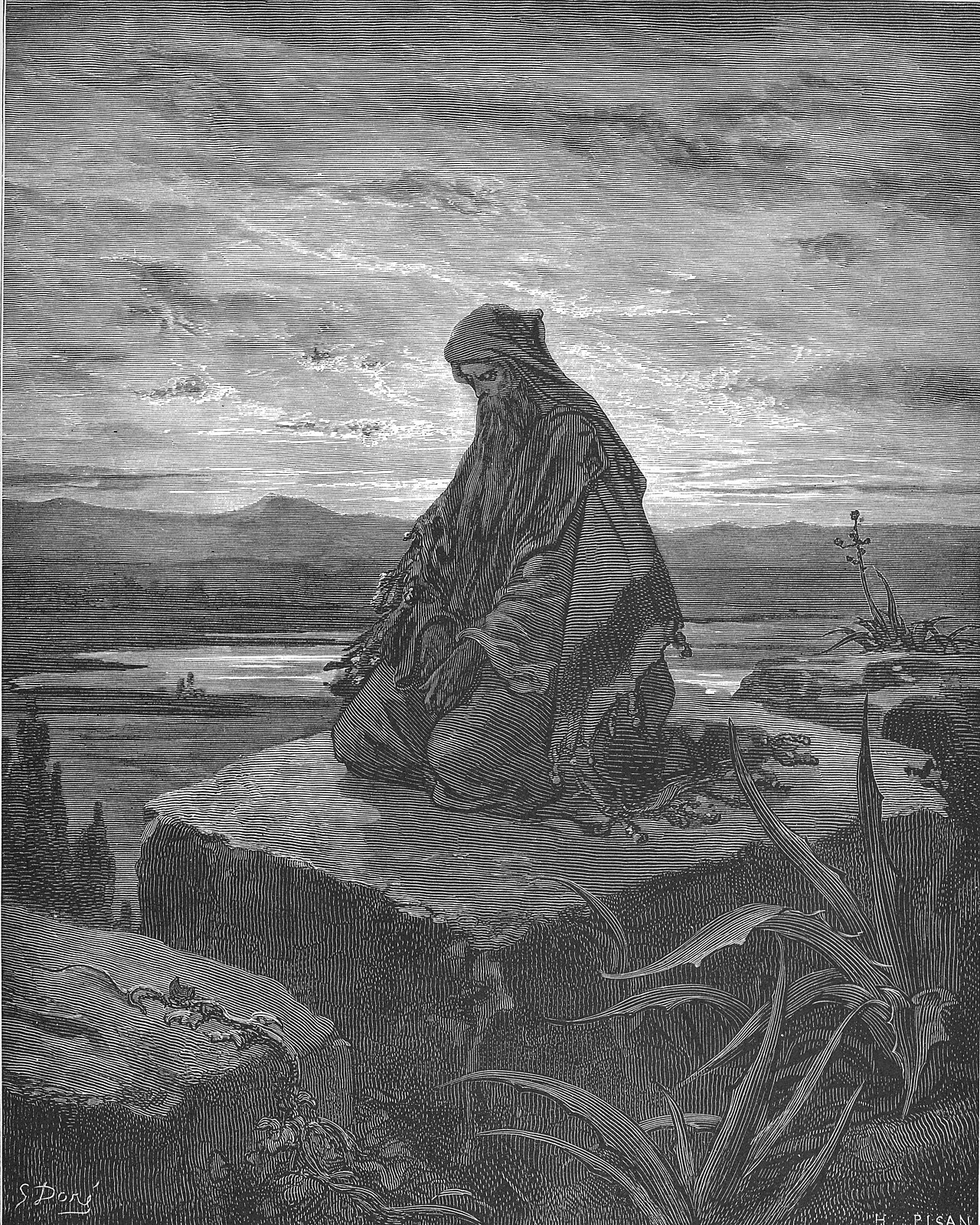
Isaiahchapter 42
25 verses · Isaiah · 8th century BC · The Prophets
“Here is My Servant, whom I uphold, My Chosen One, in whom My soul delights. I will put My Spirit on Him, and He will bring justice to the nations.
Introduction
Isaiah, The Prophets, Isaiah Overview.
Isaiah wrote this for exiles who expected their rescue to arrive with noise and horses. The chapter opens with the first of four songs about a figure the LORD calls His servant, and it describes a quiet and patient deliverer. The song is followed by a hymn that calls the far edges of the earth to sing, and then by a hard word to Israel about its own blindness. Listen for the two servants in the chapter, the one who brings justice and the one who cannot see. The New Testament reads the first of them as Jesus.
Context
- Who
- Exiles who expected rescue to arrive loud, on horseback
- What
- The first Servant Song, a new song for the whole earth, and a rebuke of Israel as a blind and deaf servant.
- Where
- Spoken to the exiles, with the song reaching the coastlands, the desert settlements of Kedar and the town of Sela.
- When
- Spoken about 700 to 690 BC by the book's own reading.
- Why
- To show how God will bring justice to the nations through His chosen servant, and why Israel needed him.
Historical context
Two objects in the opening lines are everyday trash. A bruised reed is a river cane that has been cracked, used for shepherds' pipes, for measuring rods, and for pens, and once it is bent it whistles wrong and gets thrown away. Smoking flax is a lamp wick that has burned down and is guttering in the oil, filling the room with smoke; you pinch it out and put in a new one. The servant does neither. He does not break the cracked one or snuff the smoking one.
Show the rest of the historical context, 4 more paragraphs
His method is described mostly by what he does not do. He does not cry out or lift up his voice or make it heard in the street, the street being where public announcements, court cases, and religious arguments actually happened. He does not fail or get discouraged until he has set justice in the earth, and the coastlands wait for his instruction.
The commission is release from prison. Opening blind eyes, bringing out prisoners from the dungeon, and those who sit in darkness out of the prison house, an ancient jail was frequently a pit or a windowless cell under a house, and being brought out of it was literally coming into the light.
There is a real question about who the servant is, and the book itself supplies both readings. In several places it plainly calls the nation Israel my servant, and later in this same chapter it describes a servant who is blind and deaf, which fits the nation and cannot fit the Messiah. In others, including these opening verses, the servant has a mission to Israel and cannot be Israel. The reading held here, and the reading the New Testament takes when Matthew quotes these very lines about Jesus, is that the individual Servant does what the servant nation failed to do.
The new song at the end is sung from the ends of the earth, the coastlands, the desert villages of Kedar, and the rock town of Sela, that is, from every edge of the known map inward.
Significance
A generation whose national life had been cracked and was barely smoking heard a description of someone who does not discard the damaged.
Show the rest of the significance, 1 more paragraph
And the honest self-portrait at the end of the chapter is the reason they needed him: who is blind but my servant, or deaf as my messenger? They were the people who had a book they would not read, in a fire they did not understand.
This chapter in Jewish lifeWhat this chapter is in Jewish life and reading.
What is done
This chapter is read aloud in the synagogue as the Haftarah of Bereshit, the first portion of the Torah, which reads Genesis 1:1 to 6:8. The site's table in src/lib/hebraic/readings.ts records the Ashkenazi reading as Isaiah 42:5 to 43:10 and the Sephardi reading as Isaiah 42:5 to 42:21. The two rites begin at the same verse, and the Sephardi reading ends at the twenty-first verse of this chapter.
How it is read
Rashi is quoted here from The Judaica Press complete Tanach with Rashi, translated by A. J. Rosenberg, which Sefaria reports as CC-BY, and Ibn Ezra from the Commentary of Ibn Ezra on Isaiah translated by M. Friedlander in 1873, which Sefaria reports as public domain. The servant of the first verse is the question a Christian reader brings to this chapter. Rashi answers it in his first words: "Behold My servant Jacob is not like you, for I will support him" (Rashi on Isaiah 42:1:1). The servant is the people. The nations will come to learn from Israel of their own accord, so the servant need not raise his voice, and Rashi cites Zechariah 8:23 (Rashi on Isaiah 42:2:1). The bruised reed and the dim wick are the meek and the poor, through the Aramaic of Jonathan (Rashi on Isaiah 42:3:1). A Christian reader who takes the servant as the Messiah should hear that this classical reading names the nation.
At the sixth verse Rashi names a second addressee. "I called you" is spoken "To Isaiah" (Rashi on Isaiah 42:6:1). The Haftarah of Bereshit begins at the fifth verse, and Rashi reads the two names of God there as "The Master of justice and the Master of clemency" (Rashi on Isaiah 42:5:1). Ibn Ezra reads the Lord going forth as the revealing of decrees that were hidden until then (Ibn Ezra on Isaiah 42:13:1).
The last verses turn the title of servant against the people. "Who is blind among you? There is no one but My servant" (Rashi on Isaiah 42:19:1). God magnifies the Torah for them so that they will return (Rashi on Isaiah 42:21:1). The plunder of Jacob is explained by the people's own confession at the twenty-fourth verse, that they sinned against Him (Rashi on Isaiah 42:24:1).
What the rabbis say
The corpus carries forty rabbinic locators on this chapter and the text of none, so each is cited by ref here and none is quoted or paraphrased. On the first verse it holds Aggadat Bereshit 67:3 and Avot DeRabbi Natan, Recension B 43:18. On the second verse it holds Jerusalem Talmud Kilayim 9:3:11. On the third verse it holds Berakhot 56b:13 and Ein Yaakov, Yevamot 10:3. On the fourth verse it holds Bereshit Rabbati, Parashat Vayechi 18. On the fifth verse it holds Berakhot 52b:29 and Bereshit Rabbah 12:12.
On the seventh verse it holds Pesikta Rabbati 21:1 and Tanna DeBei Eliyahu Rabbah 16:1. On the eighth verse it holds Bamidbar Rabbah 19:3 and Bereshit Rabbah 17:4. On the ninth verse it holds Shemot Rabbah 15:17 and Shemot Rabbah 15:21. On the tenth verse it holds Kohelet Rabbah 1:9:1 and Mekhilta DeRabbi Shimon Ben Yochai 15:1. On the eleventh verse it holds Bamidbar Rabbah 1:2 and Bereshit Rabbah 13:6.
On the twelfth verse it holds Midrash Sekhel Tov, Bereshit 31:1:4 and Tanna DeBei Eliyahu Rabbah 2:1. On the thirteenth verse it holds Arakhin 15b:15 and Avot DeRabbi Natan 2:6. On the fourteenth verse it holds Avodah Zarah 3b:10 and Ein Yaakov (Glick Edition), Avodah Zarah 1:5. On the fifteenth verse it holds Otzar Midrashim, Chapter of Rabbi Yoshiahu 1:6. On the sixteenth verse it holds Bamidbar Rabbah 19:6 and Midrash Lekach Tov on Lamentations 3:56:1.
On the eighteenth verse it holds Aggadat Bereshit 70:2 and Tanna DeBei Eliyahu Rabbah 14:1. On the nineteenth verse it holds Bereshit Rabbati, Parashat Chayei Sarah 12 and Midrash Tehillim 29:1. On the twenty-first verse it holds Avot DeRabbi Natan 41:17 and Bamidbar Rabbah 14:10. On the twenty-second verse it holds Jerusalem Talmud Kilayim 5:3:6. On the twenty-third verse it holds Midrash Tehillim 83:1.
On the twenty-fourth verse it holds Aggadat Bereshit 11:1 and Aggadat Bereshit 8:4. On the twenty-fifth verse it holds Eikhah Rabbah 2:8 and Eikhah Rabbah 4:14.
The corpus files one further locator under a verse number this chapter does not reach. The site's table in src/data/bible/chapter-verse-counts.json counts the chapter at 25 verses in the Berean Standard Bible. The corpus files Pesikta Rabbati 33:1 at the number 38. It is cited as the corpus files it, and the anchor is left for a check against the source. What each of them teaches is a saying of the rabbis, and it is reported as theirs wherever this site quotes one. The quotations wait on a fetch that carries the text.
Sources: Rashi, Rashi on Isaiah 42:1:1 to 42:24:1, The Judaica Press complete Tanach with Rashi, translated by A. J. Rosenberg, reported CC-BY; Ibn Ezra, Ibn Ezra on Isaiah 42:12:1 to 42:17:1, Commentary of Ibn Ezra on Isaiah, translated by M. Friedlander, 1873, reported public domain; The Sefaria corpus, scripts/data/sources/sefaria/isaiah/42.json, the 40 Talmud and Midrash locators of this chapter; The site's own files, src/lib/hebraic/readings.ts, the Haftarah of Bereshit (both rites, Isaiah 42:5 to 43:10), and src/data/bible/chapter-verse-counts.json for the verse count.
The heads below are this chapter's scenes. The numbered points under each are its verses.
Behold My Servant: a Bruised Reed He Will Not Break
Isaiah 42:1-2
The first servant song opens, Here is My Servant, whom I uphold, and the Spirit is put on him before his work is described. Matthew quotes verses 1 to 4 at Matthew 12:18-21 of Jesus. His manner is quiet, He will not cry out or raise His voice.
Isaiah 42:1
“Behold - This word is designed to call attention to the person that is immediately referred to. It is an intimation that the subject is of importance, and should command their regard. My servant - This phrase denotes properly anyone who acknowledges or worships God; anyone who is regarded as serving or obeying him.”
Cross references
Isaiah 42:1
- Quoted inMatthew 12:18“Here is My Servant, whom I have chosen, My beloved, in whom My soul delights. I will put My Spirit on Him, and He will proclaim justice to the nations.
'Behold my servant, whom I have chosen', Servant fulfillment formula
ConnectionsMatthew 12:18
He will not cry out: Barnes sets the quiet Servant against men of strife, who raise their voice in the streets with loud and angry words. The herald of 40:9 was told to cry out. Jerome adds that Symmachus heard the verb as meaning the Servant will never be deceived.
Isaiah 42:2
“He shall not cry - He will not make a clamor or noise; he will not be boisterous, in the manner of a man of strife and contention. Nor lift up - That is, his voice. Nor cause his voice to be heard in the street - He shall not t use loud and angry words, as they do who are engaged in conflict, but all his teaching shall be gentle, humble, and mild. How well this agrees with the character of the Lord Jesus it is not necessary to pause to show. He was uniformly unostentatious, modest, and retiring.”
Isaiah 42:3-4
A bruised reed He will not break: The gentleness is given two pictures, A bruised reed He will not break and a smoldering wick, which Matthew 12:20 quotes of Jesus. The first movement closes on endurance, He will not grow weak or discouraged before He has established justice. In His law the islands will put their hope.
Isaiah 42:3
“A bruised reed - The word ‘reed’ means the cane or calamus which grows up in marshy or wet places (Isa 36:6; see the note at Isa 43:24). The word, therefore, literally denotes that which is fragile, weak, easily waved by the wind, or broken down; and stands in contrast with a lofty and firm tree (compare Mat 11:7): ‘What went ye out into the wilderness to see?”
1 more voice on this verse
Isaiah 42:3
“Isa 42:13, 14, here, and Mt 12:32, 36, 41, 42, show that there is reference to the judicial aspect of the Gospel, especially finally: besides the mild triumph of Jesus coming in mercy to the penitent now (Isa 42:2), there shall be finally the judgment on His enemies, when the "truth" shall be perfectly developed.”
Jamieson, Fausset & Brown · Commentary Critical and Explanatory on the Whole Bible (1871)reformed
He will not grow weak or discouraged: Grow weak shares its root with the smoldering wick, and discouraged, which Clarke gives as yaruts, with the bruised reed. So the Servant will Himself never burn low or be crushed. Where the Hebrew has His law, the Septuagint that Jerome cites and Matthew 12:21 have His name.
Isaiah 42:4
“4 He shall not fail nor be discouraged, till he have set judgment in the earth: and the isles shall wait for his law. We are sure that these verses are to be understood of Christ, for the evangelist tells us expressly that in him this prophecy was fulfilled, Matt. xii.”
Matthew Henry · Commentary on the Whole Bible (1707-1721)puritan
1 more voice on this verse
Isaiah 42:4
“ROSENMULLER not so well translates, "He shall not be too slow on the one hand, nor run too hastily on the other." judgment--His true religion, the canon of His judgments and righteous reign. isles . . . wait, &c.--The distant lands beyond sea shall put their trust in His gospel way of salvation.”
Jamieson, Fausset & Brown · Commentary Critical and Explanatory on the Whole Bible (1871)reformed
Isaiah 42:5-7
The second movement names the speaker as God the LORD, who created the heavens. The servant is called for a righteous purpose and made a light to the nations, a light Simeon sees in Jesus at Luke 2:32. His work is to open the eyes of the blind.
Isaiah 42:5
“For the breath of life, which also rendered man an animated being, is one thing, and the vivifying Spirit another, which also caused him to become spiritual. And for this reason Isaiah said, "Thus saith the Lord, who made heaven and established it, who founded the earth and the things therein, and gave breath to the people upon it, and Spirit to those walking upon it;" thus telling us that breath is indeed given in common to all people upon earth, but that the Spirit is theirs alone who tread down earthly desires.”
Irenaeus · written before 202 · Against Heresies 5:12.2patristic
3 more voices on this verse
Isaiah 42:5
“Thus saith God the Lord,.... The God of the world, as the Targum.”
Isaiah 42:5
“Thus saith God the Lord - This verse commences a new form of discourse. It is still Yahweh who speaks; but in the previous verses he had spoken of the Messiah in the third person; here he is introduced as speaking to him directly. He introduces the discourse by showing that he is the Creator and Lord of all things.”
Isaiah 42:5
“Now this is prefixed to God's covenant with the Messiah, and the commission given him, not only to show that he has authority to make such a covenant and give such a commission, and had power sufficient to bear him out, but that the design of the work of redemption was to maintain the honour of the Creator, and to restore man to the allegiance he owes to God as his Maker.”
Matthew Henry · Commentary on the Whole Bible (1707-1721)puritan
a covenant for the people: The Servant is Himself the covenant for the people and the light to the nations. Matthew Henry calls Him its mediator and guarantee. Clarke renders berith as covenant sacrifice, and Jamieson, Fausset and Brown join the line to Isaiah 49:8, where God appoints Him, and to Hebrews 8:6.
Isaiah 42:6
“Note, Those whom God calls he will own and help, and will hold their hands. The great intentions of this commission speak abundance of comfort to the children of men. He was given for a covenant of the people, for a mediator, or guarantee, of the covenant of grace, which is all summed up in him.”
Matthew Henry · Commentary on the Whole Bible (1707-1721)puritan
1 more voice on this verse
Isaiah 42:6
“A covenant of the people “A covenant to the people” - For עם am, two MSS. of Dr. Kennicott’s, and of my own, read עולם olam, the covenant of the age to come, or the everlasting covenant; which seems to give a clearer and better sense. But I think the word ברית berith, here, should not be translated covenant, but covenant sacrifice, which meaning it often has; and undoubtedly in this place. This gives a still stronger and clearer sense.”
Adam Clarke · Commentary on the Bible (1810-1826)evangelical
to open the eyes of the blind: Barnes takes the opened eyes as knowledge given to the ignorant, Jew and Gentile alike, who sit in darkness about God. Clement of Alexandria says the Servant gives clear knowledge of the Father through the Son. At verse 19 the blind one is Israel itself.
Isaiah 42:7
“To open the blind eyes - This is equivalent to saying that he would impart instruction to those who were ignorant. It relates to the Jews as well as to the Gentiles. He would acquaint them with God, and with the way of salvation. The condition of the world is often represented as one of darkness and blindness. Men see not their true character; they see not their real condition; they are ignorant of God, and of the truths pertaining to their future existence; and they need, therefore, some one who shall enlighten, and sanctify, and save them.”
1 more voice on this verse
Isaiah 42:7
"The opened eyes of the blind" means [Christ] provided clear knowledge of the Father through the Son.
Clement of Alexandria · written before 215 · The Stromata Book 1patristic
Isaiah 42:8-9
I will not yield My glory to another: The speaker names Himself, I am the LORD, that is My name. He will not yield His glory to another or His praise to idols. The claim that follows is predictive, the former things have happened, and now I declare new things, the very test chapter 41 set the idols.
Isaiah 42:8
“The same thing applies to the word Lord, which is also used as a name of God. "I am the Lord your God," he says. "This is my name," and "The Lord is his name." But we are making deeper enquiries into a nature that has absolute existence, independent of anything else. The actual, personal being of God in its fullness is neither limited nor cut short by any prior or any subsequent reality—so it was, and so it will be.”
Gregory of Nazianzus · written before 390 · On the Son, Theological Oration 4(30).18patristic
2 more voices on this verse
Isaiah 42:8
“I am the Lord - אני יהוה ani Yehovah. This is the famous tetragrammaton, or name of four letters, which we write Jehovah Yehovah, Yehveh, Yeveh, Jhuh, Javah, etc. The letters are Y H U H. The Jews never pronounce it, and the true pronunciation is utterly unknown. That is my name - A name peculiar to myself.”
Adam Clarke · Commentary on the Bible (1810-1826)evangelical
Isaiah 42:8
“God turns from addressing Messiah to the people. Lord--JEHOVAH: God's distinguishing and incommunicable name, indicating essential being and immutable faithfulness (compare Ex 6:3; Ho 12:5). my--that is due to Me, and to Me alone.”
Jamieson, Fausset & Brown · Commentary Critical and Explanatory on the Whole Bible (1871)reformed
now I declare new things: The verb for spring forth is used of plants breaking the soil, and the LORD names the new things while they are still seed. Barnes makes the former things already fulfilled the ground for trusting the new ones. The book returns to the pairing at 43:19 and 48:6.
Isaiah 42:9
“Behold, the former things are come to pass - That is, the former things which he had foretold. This is the evidence to which he appeals in proof that he alone was God, and this is the basis on which he calls upon them to believe that what he had predicted in regard to future things would also come to pass. He had by his prophets foretold events which had now been fulfilled, and this should lead them to confide in him alone as the true God.”
Sing a New Song; the LORD Goes Forth as a Warrior
Isaiah 42:10-12
The prediction is answered with worship, Sing to the LORD a new song. The call widens to the desert and its cities and the villages of Kedar. The new song follows the new things of verse 9, a fresh act of God answered by a fresh song.
Isaiah 42:10
“The new song shall be sung when the Lord shall reign in Jerusalem, and all "nations shall flow unto it" (Isa 2:2; 14:3). ye that go down to the sea--whose conversion will be the means of diffusing the Gospel to distant lands. all . . . therein--all the living creatures that fill the sea (Ps 96:11) [MAURER].”
Jamieson, Fausset & Brown · Commentary Critical and Explanatory on the Whole Bible (1871)reformed
1 more voice on this verse
Isaiah 42:10
“Ye that go down to the sea - This seems not to belong to this place; it does not well consist with what follows, “and the fullness thereof.” They that go down upon the sea means navigators, sailors, traders, such as do business in great waters; an idea much too confined for the prophet, who means the sea in general, as it is used by the Hebrews, for the distant nations, the islands, the dwellers on the sea-coasts all over the world.”
Adam Clarke · Commentary on the Bible (1810-1826)evangelical
let the villages of Kedar cry aloud: Barnes explains the cities of a desert. The Hebrew word for desert meant thinly settled or untilled country, and towns stood in it. Gill names the people of Kedar as Arabians living in tents, as the Targum does, and takes Sela as Petra, the city of the rock.
Isaiah 42:11
“Let the wilderness and the cities thereof lift up their voice,.... The eastern part of the world, Arabia Deserta, and the inhabitants of the cities which were in it: the villages that Kedar doth inhabit; or the "courts" (t), or tents, the Kedarenes inhabited, who were Arabians, and dwelt in tents, which they pitched here and there, for the convenience of their flocks; and so the Targum, "the Arabians that inhabit the wilderness shall praise:'' let the inhabitants of the rock sing: or of Petra, which Jerom says was a city of Palestine.”
1 more voice on this verse
Isaiah 42:11
“Let the wilderness - (See the note at Isa 35:1). The word here denotes the most uncultivated countries, intimating that even the most rude and barbarous people would have occasion to rejoin, and would be interested in the mercy of God. And the cities thereof - To us there seems to be something incongruous in speaking of the ‘cities’ in a ‘wilderness.’ But we are to remember that the Hebrews gave the name wilderness or desert to those regions that were mostly uncultivated, or sparsely inhabited.”
declare His praise in the islands: The call ends where verse 10 began, in the islands, so the praise runs from the far coasts to the desert of Kedar and back. Gill thinks of the islands of Greece and the Aegean. Aquinas reads the glory as carried to others and joins it to Isaiah 66:19.
Isaiah 42:12
“Let them give glory unto the Lord,.... For all the great and good things he has done for them, in sending his Gospel to them, calling them by his grace, enlightening their minds, and revealing his Son in them, and making them partakers of the blessings of his grace, and entitling them to eternal glory and happiness: and declare his praise in the islands; as on the western continent, and the isles of it; so on the eastern continent, and the islands of it, the islands of Greece, the islands in the Aegean sea.”
Isaiah 42:13-15
The LORD goes forth like a mighty one: The gentle servant gives way to a warrior, The LORD goes forth like a mighty one. The LORD describes His long restraint, I have kept silent from ages past. The devastation turns the creation language of verse 5 to judgment, I will lay waste the mountains and hills.
Isaiah 42:13
“The going forth of the gospel is thus represented, Rev. vi. Christ, in it, went forth conquering and to conquer. The ministry of the apostles is called their warfare; and they were the soldiers of Jesus Christ.”
Matthew Henry · Commentary on the Whole Bible (1707-1721)puritan
Clarke follows the Septuagint, which adds a question whether God will keep silent forever, and thinks a Hebrew word fell out by a copyist's slip. The figure of labor joins pain to birth. The long quiet ends in the delivery of the new things declared at verse 9.
Isaiah 42:14
“I have been still “Shall I keep silence for ever” - After מעולם meolam, in the copy which the Septuagint had before them, followed the word הלעולם, heleolam, εσιωπησα απ’ αιωνος· Μη και αει σιωπησομαι· according to MSS. Pachom. and 50. D. 2 and Edit. Complut., which word, הלעולם haleolam, has been omitted in the text by an easy mistake of a transcriber, because of the similitude of the word preceding. Shall I always keep silences like that of Juvenal: Semper ego auditor tantum? Shall I always be a hearer only?”
Adam Clarke · Commentary on the Bible (1810-1826)evangelical
I will lay waste the mountains: Jamieson, Fausset and Brown picture hills terraced with vines and olives. Aquinas reads the mountains, the hills and the vegetation as the great, the middle ranks and the common people. Vitringa, whom the same commentators cite, took the dried rivers and marshes as the silenced oracles of the nations.
Isaiah 42:15
“I will make waste mountains - This verse denotes the utter desolation which God would bring upon his foes in his anger. The meaning of this part of the verse is, that he would spread desolation over the hills and mountains that were well watered and laid out in gardens and orchards.”
1 more voice on this verse
Isaiah 42:15
“I will destroy all My foes. mountains--in Palestine usually planted with vines and olives in terraces, up to their tops. islands--rather, "dry lands." God will destroy His foes, the heathen, and their idols, and "dry up" the fountains of their oracles, their doctrines and institutions, the symbol of which is water, and their schools which promoted idolatry [VITRINGA].”
Jamieson, Fausset & Brown · Commentary Critical and Explanatory on the Whole Bible (1871)reformed
Isaiah 42:16-17
I will lead the blind by a way: The blind of verse 7 return as a people led, I will lead the blind by a way they did not know. A promise is added, I will not forsake them. Those who say to molten images, You are our gods, will be turned back in utter shame.
Isaiah 42:16
"Blind," they are called, as not having heretofore seen God's ways in ordering His Church. make darkness light, &c.--implies that the glorious issue would only be known by the event itself [VITRINGA].
Jamieson, Fausset & Brown · Commentary Critical and Explanatory on the Whole Bible (1871)reformed
2 more voices on this verse
Isaiah 42:16
“Those who by nature were blind, and those who, being under convictions of sin and wrath are quite at a loss and know not what to do with themselves, God will lead by a way that they knew not, will show them the way to life and happiness by Jesus Christ, who is the way, and will conduct and carry them on in that way, which before they were strangers to.”
Matthew Henry · Commentary on the Whole Bible (1707-1721)puritan
Isaiah 42:16
“In paths - The Septuagint, Syriac, Vulgate, and nine MSS., (two ancient), read ובנתיבות ubenotiboth. Will I do unto them - עשיתם asitem. This word, so written as it is in the text, means “thou wilt do, “in the second person. The Masoretes have indeed pointed it for the first person; but the י yod in the last syllable is absolutely necessary to distinguish the first person; and so it is written in forty MSS., עשיתים asithim.”
Adam Clarke · Commentary on the Bible (1810-1826)evangelical
those who trust in idols: Barnes shows that turned back and put to shame is the set phrase of Scripture for trust disappointed, citing Psalms 35:4, 70:3 and 97:7. Matthew Henry names the onlookers. Babylon would see the Jews set free by a God worshipped without images.
Isaiah 42:17
“They shall be turned back - The phrases, to be turned back, and to be suffused with shame, are frequently used in the Scriptures to denote a state of disappointment in regard to an object of trust or confidence, and especially of those who had trusted in idols (see Psa 35:4; Psa 70:3; Psa 97:7; compare the notes at Isa 1:29; Isa 19:9; Isa 37:27; see also Eze 16:52).”
1 more voice on this verse
Isaiah 42:17
“The Babylonians shall when they see how the Jews, who despise their images, are owned and delivered by the God they worship without images, and the Gentiles when they see how idolatry falls before the preaching of the gospel, is scattered like darkness before the light of the sun, and melts like snow before its heat.”
Matthew Henry · Commentary on the Whole Bible (1707-1721)puritan
A Blind Servant and a Deaf Messenger
Isaiah 42:18-20
Listen, you deaf ones; look, you blind ones: The chapter turns to Israel, Listen, you deaf ones. The question is startling, Who is blind but My servant, or deaf like the messenger I am sending? The title servant names the one who opens blind eyes in verses 1 to 7 and a blind Israel in verse 19.
Isaiah 42:18
“This call to the deaf to hear and the blind to see is like the command given to the man that had the withered hand to stretch it forth; though he could not do this, because it was withered, yet, if he had not attempted to do it, he would not have been healed, and his being healed thereupon was owing, not to his act, but to the divine power.”
Matthew Henry · Commentary on the Whole Bible (1707-1721)puritan
3 more voices on this verse
Isaiah 42:18
“It is evident, indeed, that some possess ears better able to hear the words of God. But to those who do not have those ears, what does he say? "Hear, you deaf, and, you blind, behold." Also, "I opened my mouth and panted," and "You have broken the teeth of sinners."4 All these things were said in reference to the faculties that render service for spiritual food and spiritual doctrine.”
Basil of Caesarea · written before 379 · Homilies on the Psalms 16.13. (Psalm 33)patristic
Isaiah 42:18
“Hear, ye deaf - This is evidently an address to the Jews, and probably to the Jews of the time of the prophet. He had been predicting the coming of the Messiah, and the influence of his religion on the Gentile world. He had said that God would go forth to destroy the idolatry of the pagan nations, and to convince them of the folly of the worship of images, and to confound them for putting their trust in them.”
Isaiah 42:18
“In this they differ from "the blind" (Isa 42:16). The Jews are referred to. He had said, God would destroy the heathen idolatry; here he remembers that even Israel, His "servant" (Isa 42:19), from whom better things might have been expected, is tainted with this sin.”
Jamieson, Fausset & Brown · Commentary Critical and Explanatory on the Whole Bible (1871)reformed
Who is blind but My servant: The Berean covenant partner renders meshullam, which Gesenius, cited by Jamieson, Fausset and Brown, takes as friend, the title given Abraham at 41:8. Some Jewish expositors named the prophet himself as the blind servant. Barnes reads the whole nation, one servant standing for many.
Isaiah 42:19
“Who is blind, but my servant? - Some of the Jewish expositors suppose that by ‘servant’ here, the prophet himself is intended, who, they suppose is here called blind and deaf by the impious Jews who rejected his message. But it is evident, that by ‘servant’ here, the Jewish people themselves are intended, the singular being used for the plural, in a sense similar to that where they are so often called ‘Jacob’ and ‘Israel.’ The phrase ‘servants of God’ is often given to his people, and is used to denote true worshippers.”
3 more voices on this verse
Isaiah 42:19
He reports how they became the blind and dull by saying, "They see many things but do not observe." These things were previously communicated [in Isaiah]: "Keep listening, but do not comprehend; keep looking, but do not understand. Make the mind of this people dull." … You see that all these things he says about the people, he means concerning those of the circumcision. But "the Lord was pleased, for his righteousness' sake, to magnify his praise."
Eusebius of Caesarea · written before 339 · Commentary on Isaiah 2:23patristic
Isaiah 42:19
“The verse before may be understood as spoken to the Gentile idolaters, whom he calls deaf and blind, because they worshipped gods that were so. "But," says he, "no wonder you are deaf and blind when my own people are as bad as you, and many of them as much set upon idolatry." 1. He complains of their sottishness--they are blind; and of their stubbornness--they are deaf.”
Matthew Henry · Commentary on the Whole Bible (1707-1721)puritan
Isaiah 42:19
“Or translate, the friend of God, which Israel was by virtue of descent from Abraham, who was so called (Isa 41:8), [GESENIUS]. The language, "my servant" (compare Isa 42:1), "messenger" (Mal 3:1), "perfect" (Ro 10:4; 1Pe 2:22), can, in the full antitypical sense, only apply to Christ.”
Jamieson, Fausset & Brown · Commentary Critical and Explanatory on the Whole Bible (1871)reformed
Though seeing many things: Eusebius hears the charge of 6:9-10 again, a people seeing and hearing without understanding. Jamieson, Fausset and Brown note that the Hebrew turns from you to he within the verse, as the LORD speaks of His servant. Open ears and idle eyes are the charge.
Isaiah 42:20
“Seeing many things “Thou hast seen indeed” - The text has ראית רבית raith rabith, which the Masoretes in the marginal Keri have corrected to ראות רבות reoth rabboth; as indeed one hundred and seven MSS., and five editions, now have it in the text. This was probably the reading of most of the MSS. of their time; which, though they approved of it, out of some superstition they would not admit into their standard text.”
Adam Clarke · Commentary on the Bible (1810-1826)evangelical
Isaiah 42:21-22
for the sake of His righteousness: The purpose of God outlasts the servant's failure, for the LORD was pleased to magnify His law and make it glorious. The description that follows is stark, a people plundered and looted, all trapped in caves or imprisoned in dungeons. They have become plunder with no one to rescue them.
Isaiah 42:21
“The Lord is well pleased for his righteousness’ sake - There is great variety in the translation and interpretation of this verse. Lowth renders it: Yet Yahweh was gracious unto him for his truth’s sake; He hath exalted his own praise, and made it glorious. Noyes renders it: It pleased Yahweh for his goodness’ sake To give him a law great and glorious; And yet it is a robbed and plundered people.”
2 more voices on this verse
Isaiah 42:21
“Well pleased - Altho' God might justly destroy thee suddenly, yet he will patiently wait for thy repentance, that he may be gracious; and that not for thy sake, but for the glory of his own faithfulness, in fulfilling that covenant, which he made with thy pious progenitors.”
John Wesley · Explanatory Notes upon the Old Testament (1765)evangelical
Isaiah 42:21
“Perhaps in God's "righteousness" here is included His faithfulness to His promises given to Israel's forefathers [ROSENMULLER]; because of this He is well pleased with Israel, even though displeased with their sin, which He here reproves; but that promise could only be based on the righteousness of Messiah, the promised seed, which is God's righteousness.”
Jamieson, Fausset & Brown · Commentary Critical and Explanatory on the Whole Bible (1871)reformed
a people plundered and looted: Verse 7 gave the Servant these dungeons to empty. Jamieson, Fausset and Brown link the lack of anyone to say send them back with 63:5, where the LORD finds no one to help. Wesley adds that the people were taken in snares of their own making.
Isaiah 42:22
“But - But not withstanding this respect which God hath to his people, he hath severely scourged you for your sins. Hid - They have been taken in snares made by their own hands, and by God's just judgment cast into dungeons and prisons.”
John Wesley · Explanatory Notes upon the Old Testament (1765)evangelical
2 more voices on this verse
Isaiah 42:22
“The connection is: Notwithstanding God's favor to His people for His righteousness' sake (Isa 42:21), they have fallen into misery (the Babylonish and Romish captivities and their present dispersion), owing to their disregard of the divine law: spiritual imprisonment is included (Isa 42:7). none saith, Restore--There is no deliverer (Isa 63:5).”
Jamieson, Fausset & Brown · Commentary Critical and Explanatory on the Whole Bible (1871)reformed
Isaiah 42:22
“They are all of them snared in holes “All their chosen youths are taken in the toils” - For הפח hapheach read הופחו huphachu, in the plural number, hophal; as החבאו hochbau, which answers to it in the following member of the sentence. Le Clerc, Houbigant. הפח huppach, Secker.”
Adam Clarke · Commentary on the Bible (1810-1826)evangelical
Isaiah 42:23-25
Who among you will pay attention to this?: The chapter closes with a question to the hearer, “Who among you will pay attention to this?” The cause of the exile is then named plainly, “Who gave Jacob up for spoil, and Israel to the plunderers? Was it not the LORD, against whom we have sinned?”
Isaiah 42:23
“Who among you will give ear to this? - Who is there in the nation that will be so warned by the judgments of God, that he will attend to the lessons which he designs to teach, and reform his life, and return to him? It is implied by these questions that such ought to be the effect; it is implied also that they were so sunken and abandoned that they would not do it.”
1 more voice on this verse
Isaiah 42:23
“If one method not take effect, another may, and sinners shall be left inexcusable. Observe, (1.) We may all of us, if we will, hear the voice of God, and we are called and invited to hear it. (2.) It is worth while to enquire who they are that perceive God speaking to them and are willing to hear him.”
Matthew Henry · Commentary on the Whole Bible (1707-1721)puritan
Who gave Jacob up for spoil: The verse shifts from they to we have sinned. Jamieson, Fausset and Brown hear the prophet counting himself among the guilty, though Clarke notes that the Septuagint and Chaldee read they. Cyprian cited the verse on the Lord's Prayer: the plunderers of Jacob had only the power the LORD permits.
Isaiah 42:24
“In this part of the Lord's Prayer, [Christ] shows that the enemy is powerless against us without God's prior permission. During temptation, consequently, all our fear and devotion and attention should be focused on God, since evil has only such force as he himself permits. … Moreover, evil is given power over us according to our [willful] sins. As Isaiah writes, "Who gave Jacob up to the looters and Israel to the ponderers." It was the Lord, against whom we sinned, in whose ways we would not walk and whose law we refused to obey.”
Cyprian · written before 258 · Treatise IV. On the Lord's Prayer 25patristic
2 more voices on this verse
Isaiah 42:24
“We have sinned “They have sinned” - For חטאנו chatanu, “we have sinned,” first person; the Septuagint and Chaldee read חטאו chateu, “they have sinned,” in the third person.”
Adam Clarke · Commentary on the Bible (1810-1826)evangelical
Isaiah 42:24
“Who--Their calamity was not the work of chance, but God's immediate act for their sins. Israel . . . we--change from the third to the first person; Isaiah first speaking to them as a prophet, distinct from them; then identifying himself with them, and acknowledging His share in the nation's sins (compare Jos 5:1).”
Jamieson, Fausset & Brown · Commentary Critical and Explanatory on the Whole Bible (1871)reformed
So He poured out on them: Barnes reads the flames of that furious anger as the fire of war around the nation, ending in the fall of temple and city. Matthew Henry places the failure in sight. They felt the burning, missed the hand of God in the battle and laid none of it to heart.
Isaiah 42:25
“Therefore he hath poured upon him the fury of his anger - His righteous indignation in the overturning of their nation, the destruction of their temple and city, and in carrying them captive into a distant land. And it hath set him on fire - That is, the fury of Yahweh kindled the flame of war all around the Jewish nation, and spread desolation everywhere. Yet he knew not - They refused to attend to it, and lay it to heart. They pursued their ways of wickedness, regardless of the threatening judgments, and the impending wrath of God.”
1 more voice on this verse
Isaiah 42:25
“The fire of God's wrath kindled upon him, and he knew it not, was not aware of it, took no notice of the judgments, at least not of the hand of God in them. Nay, it burned him, and, though he could not then but know it and feel it, yet he laid it not to heart, was not awakened by the fiery rebukes he was under nor at all affected with them.”
Matthew Henry · Commentary on the Whole Bible (1707-1721)puritan
Keep studying
People and groups1
Places1
Words12
Sources for this chapter
The summary
Jamieson, Fausset & Brown, Commentary Critical and Explanatory; John Calvin, Commentaries; John Wesley, Notes on the Old Testament and Matthew Henry, Complete Commentary.
The exposition
Adam Clarke, Commentary on the Bible; Albert Barnes; Clement of Alexandria, The Stromata Book 1; Cyprian, Treatise IV. On the Lord's Prayer 25; Eusebius of Caesarea, COMMENTARY ON ISAIAH 2:23; Franz Delitzsch, Biblical Commentary on the Prophecies of Isaiah; Jamieson, Fausset & Brown, Commentary Critical and Explanatory on the Whole Bible; Jerome, Commentary on Isaiah; John Gill; John Wesley, Explanatory Notes upon the Old Testament; Matthew Henry, Commentary on the Whole Bible and Thomas Aquinas, Commentary on Isaiah.