
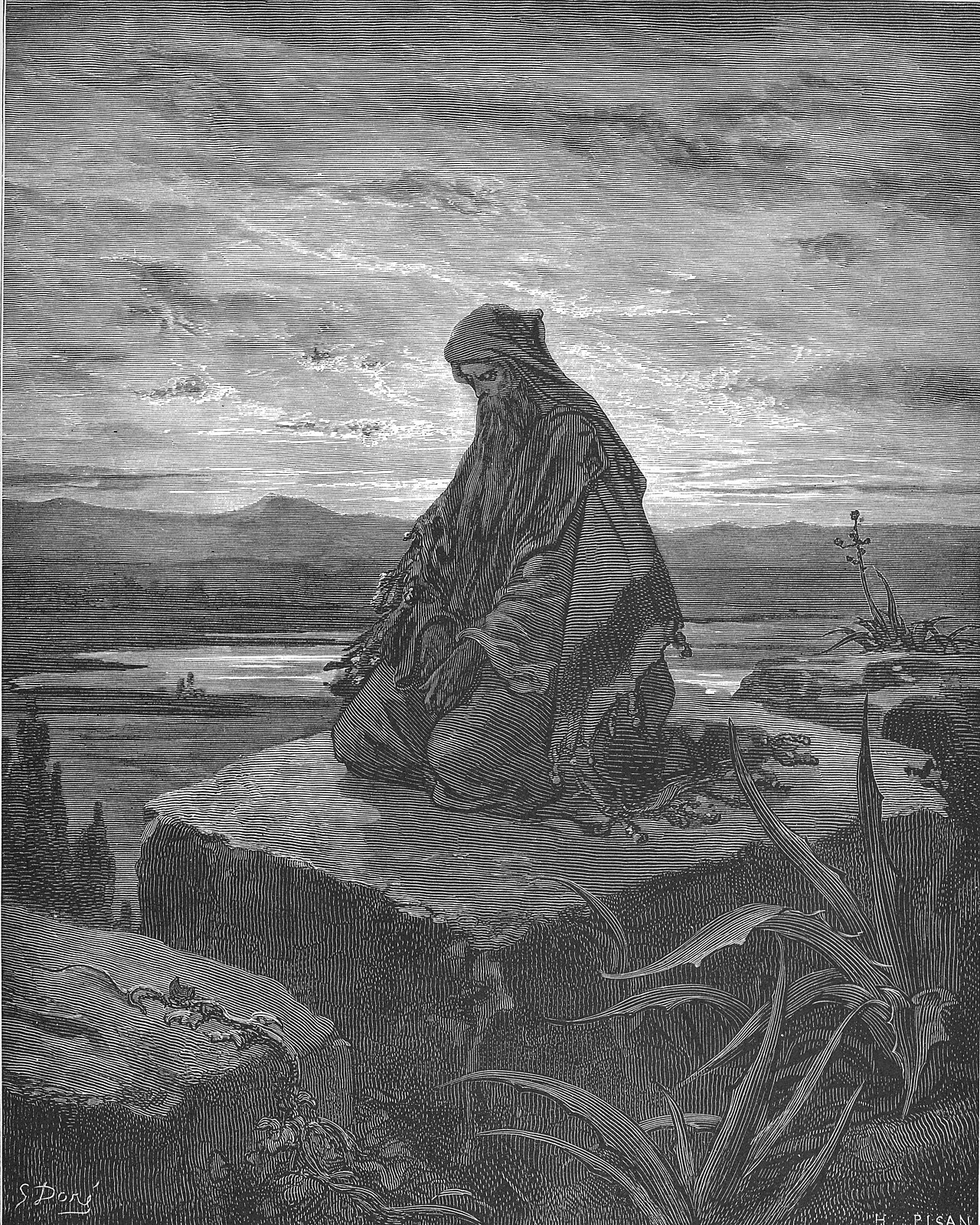
Isaiahchapter 41
29 verses · Isaiah · 8th century BC · The Prophets
Do not fear, for I am with you; do not be afraid, for I am your God. I will strengthen you; I will surely help you; I will uphold you with My right hand of righteousness.
Introduction
Isaiah, The Prophets, Isaiah Overview.
Isaiah wrote this chapter for the exiles in Babylon, a people living among the temples of a religion that looked as if it had won. It is set as a court hearing, with the nations summoned and their gods called to give evidence. The test put to those gods is whether they can tell what is coming before it comes. Between the sessions the LORD turns and speaks to Israel in words of reassurance. Listen for the difference between the way He speaks to the idols and the way He speaks to His servant. Watch too for the conqueror He says He has stirred up from the east.
Context
- Who
- Exiles surrounded by the temples of a religion that appeared to have won
- What
- A trial in which the LORD challenges the gods of the nations to prove themselves, with words of reassurance to Israel between the hearings.
- Where
- A courtroom scene with the coastlands and the nations summoned, spoken to the exiles in Babylon.
- When
- Spoken about 700 to 690 BC by the book's own reading, about a conqueror who rose in the 500s BC.
- Why
- To show that only the LORD foretells and directs history, so that His people need not fear.
Historical context
The chapter is staged as a legal hearing. The coastlands are summoned to be silent and come near; the peoples are told to renew their strength and state their case; let us come together for judgment. Ancient trials were public and oral, and the party who could produce evidence won.
Show the rest of the historical context, 4 more paragraphs
The evidence demanded is prediction. Bring out your case, says the LORD; produce your strong reasons. Tell us the former things, what they were, or declare to us things to come, so we may know that you are gods. Do something, good or bad, so that we may be dismayed. That is the test the whole section runs on, and it is the reason the naming of Cyrus a few chapters later is not an embarrassment to the traditional view but the whole exhibit.
The idol shop appears again, now with the workers encouraging each other. The carpenter cheers on the goldsmith, and the man smoothing with the hammer encourages the man at the anvil; they say of the soldering, it is good; and then they fasten it down with nails so it will not fall over. That last line is the joke: the god has to be secured against gravity.
The threshing image applied to Israel is a real machine. A threshing sledge was a heavy board dragged over the spread sheaves, its underside set with sharp stones or iron teeth to cut the straw and free the grain. God tells the worm Jacob that he will make him a new sharp threshing instrument with teeth, the smallest thing in the field turned into the tool that goes over the mountains.
The desert planting list is a forester's list of what will grow where nothing grew: cedar, acacia, myrtle, olive, cypress, pine, and box tree together, with rivers opened on bare heights and pools in the valley. Nobody plants a cedar and an acacia in the same soil. That is the point.
Significance
To exiles, the most useful sentence in the chapter is the smallest: fear not, for I am with you; I will strengthen you, I will help you, I will uphold you with the right hand of my righteousness.
Show the rest of the significance, 1 more paragraph
And the identity given to them is a family one. Israel is called the seed of Abraham my friend, a people whose standing rests on a promise made to one wandering man, and therefore on nothing that Babylon can confiscate.
This chapter in Jewish lifeWhat this chapter is in Jewish life and reading.
What is done
The first sixteen verses of this chapter are read aloud in the synagogue in both the Ashkenazi and the Sephardi rites. The site's table in src/lib/hebraic/readings.ts records Isaiah 40:27 to 41:16 as the Haftarah of the portion Lech-Lecha, which reads Genesis 12:1 to 17:27, the call of Abraham. The pairing is visible in the commentary below, where Rashi reads the one raised from the east as Abraham.
How it is read
Rashi is quoted here from The Judaica Press complete Tanach with Rashi, translated by A. J. Rosenberg, which Sefaria reports as CC-BY, and Ibn Ezra from the Commentary of Ibn Ezra on Isaiah translated by M. Friedlander in 1873, which Sefaria reports as public domain. Rashi reads the one raised up from the east as Abraham, brought from Aram, with righteousness at his feet wherever he went (Rashi on Isaiah 41:2:1). The One who did it is "He Who called the generations from the beginning", who did the same for Abraham (Rashi on Isaiah 41:4:1). The Haftarah that ends at the sixteenth verse is read with the portion of Abraham's call, and this reading of the second verse is the thread between them.
Rashi says outright where he parts from the Midrash. The eighth verse opens a section he reads by its plain sense, God's servant Israel told not to fear, while "the Midrash Aggadah in Gen. Rabbah 44:7 expounds the entire section as alluding to Malchizedek and Abraham" (Rashi on Isaiah 41:8:1). Ibn Ezra reads the same chapter of Babylon. The ones incensed against Israel are the Babylonians, and the wonder is that Babylon was taken and Israel came through unhurt (Ibn Ezra on Isaiah 41:11:1 and 41:13:1). Three readings of one section stand in the corpus side by side.
The worm of Jacob is a family "which is weak like a worm, which has no strength except in its mouth" (Rashi on Isaiah 41:14:1). The thirst of the seventeenth verse is the thirst of Amos 8:11, a famine for the words of the Lord, answered when God's spirit rests again on the prophets (Rashi on Isaiah 41:17:1).
What the rabbis say
The corpus carries forty rabbinic locators on this chapter and the text of none, so each is cited by ref here and none is quoted or paraphrased. On the first verse it holds Aggadat Bereshit 20:2 and Midrash Sekhel Tov, Shemot 4:11:3. On the second verse it holds Aggadat Bereshit 16:3 and Aggadat Bereshit 21:1. On the third verse it holds Aggadat Bereshit 13:3 and Midrash Aggadah, Numbers 33:1:2. On the fourth verse it holds Aggadat Bereshit 68:1 and Ein Yaakov (Glick Edition), Eduyot 2:1. On the fifth verse it holds Bereshit Rabbah 44:7 and Yalkut Shimoni on Torah 76:8.
On the eighth verse it holds Aggadat Bereshit 34:2 and Aggadat Bereshit 56:1. On the tenth verse it holds Bereshit Rabbah 44:3 and Bereshit Rabbah 65:19. On the twelfth verse it holds Bereshit Rabbati, Parashat Vayetze 51. On the thirteenth verse it holds Bamidbar Rabbah 2:13 and Pesikta Rabbati 11:1. On the fourteenth verse it holds Bereshit Rabbah 100:3 and Mekhilta DeRabbi Shimon Ben Yochai 14:10.
On the fifteenth verse it holds Avodah Zarah 24b:5 and Ein Yaakov, Zevakhim 14:5. On the sixteenth verse it holds Avodah Zarah 44a:9 and Bereshit Rabbah 83:5. On the seventeenth verse it holds Midrash Sekhel Tov, Bereshit 32:33:4 and Midrash Tehillim 5:4. On the eighteenth verse it holds Bamidbar Rabbah 14:2 and Bamidbar Rabbah 23:4. On the nineteenth verse it holds Bamidbar Rabbah 21:22 and Bava Batra 80b:17.
On the twenty-first verse it holds Mekhilta DeRabbi Shimon Ben Yochai 16:9 and Midrash Tehillim 20:1. On the twenty-third verse it holds Midrash Lekach Tov, Exodus 7:9:1 and Tractate Soferim 7:2. On the twenty-fourth verse it holds Midrash Sekhel Tov, Bereshit 29:4:3 and Midrash Tanchuma Buber, Emor 14:1. On the twenty-fifth verse it holds Bamidbar Rabbah 13:2 and Midrash Aggadah, Deuteronomy 2:3:1. On the twenty-seventh verse it holds Bereshit Rabbah 63:8 and Ein Yaakov, Pesakhim 1:11.
The corpus files one further locator under a verse number this chapter does not reach. The site's table in src/data/bible/chapter-verse-counts.json counts the chapter at 29 verses in the Berean Standard Bible. The corpus files Midrash Lekach Tov, Exodus 20:2:6 at the number 30. It is cited as the corpus files it, and the anchor is left for a check against the source. What each of them teaches is a saying of the rabbis, and it is reported as theirs wherever this site quotes one. The quotations wait on a fetch that carries the text.
Sources: Rashi, Rashi on Isaiah 41:1:1 to 41:24:1, The Judaica Press complete Tanach with Rashi, translated by A. J. Rosenberg, reported CC-BY; Ibn Ezra, Ibn Ezra on Isaiah 41:11:1 to 41:20:1, Commentary of Ibn Ezra on Isaiah, translated by M. Friedlander, 1873, reported public domain; The Sefaria corpus, scripts/data/sources/sefaria/isaiah/41.json, the 40 Talmud and Midrash locators of this chapter; The site's own files, src/lib/hebraic/readings.ts, the Haftarah of Lech-Lecha (both rites, Isaiah 40:27 to 41:16), and src/data/bible/chapter-verse-counts.json for the verse count.
The heads below are this chapter's scenes. The numbered points under each are its verses.
Who Hath Raised Up One from the East?
Isaiah 41:1-2
The trial of the gods opens with a summons, Be silent before Me, O islands. The first exhibit is a question, Who has aroused one from the east? The man has been identified as Abraham, who defeated the kings of Genesis 14, and as Cyrus, named at 44:28.
Isaiah 41:1
“The design of this chapter is the same as that of the preceding, and it is to be regarded as the continuation of the argument commenced there. Its object is to lead those who were addressed, to put confidence in God. In the introduction to Isa. 40 it was remarked, that this is to be considered as addressed to the exile Jews in Babylon, near the close of their captivity. Their country, city, and temple had been laid waste.”
Who has aroused one from the east: Wesley places the east in Persia, which lay due east of both Judah and Babylon. The Hebrew for righteousness may be read as a noun, and Maurer, cited by Jamieson, Fausset and Brown, has salvation meeting the one called. Before him kings and nations turn to dust.
Isaiah 41:2
“The righteous man - The Chaldee and Vulgate seem to have read צדיק tsaddik. But Jerome, though his translation has justum, appears to have read צדק tsedek; for in his comment he expresses it by justum, sive justitiam. However, I think all interpreters understand it of a person. So the Septuagint in MS. Pachom. εκαλεσεν αυτον, “he hath called him;” but the other copies have αυτην, her. They are divided in ascertaining this person; some explain it of Abraham, others of Cyrus.”
Adam Clarke · Commentary on the Bible (1810-1826)evangelical
2 more voices on this verse
Isaiah 41:2
“Who - Was it not my work alone? Raised - Into being and power, stirring up his spirit, and strengthening him to the work. The east - Persia was directly eastward, both from Judea and from Babylon.”
John Wesley · Explanatory Notes upon the Old Testament (1765)evangelical
Isaiah 41:2
“Raised him up in righteousness. The Septuagint takes the Hebrew as a noun "righteousness." MAURER translates, "Who raised up him whom salvation (national and temporal, the gift of God's 'righteousness' to the good, Isa 32:17; compare Isa 45:8; 51:5) meets at his foot" (that is, wherever he goes).”
Jamieson, Fausset & Brown · Commentary Critical and Explanatory on the Whole Bible (1871)reformed
Isaiah 41:3-4
He pursues them, going on safely: The conqueror pursues without loss, hardly touching the path with his feet. The question turns to his sender, Who has performed this, calling forth the generations from the beginning? The answer is the LORD naming Himself the first and the last, a claim the book repeats at 44:6 and 48:12.
Isaiah 41:3
“He pursued them - When they were driven away. He followed on, and devoted them to discomfiture and ruin. And passed safely - Margin, as Hebrew, ‘In peace.’ That is, he followed them uninjured; they had no power to rally, he was not led into ambush, and he was safe as far as he chose to pursue them. Even by the way that he had not gone with his feet - By a way that he had not been accustomed to march; in an unusual journey; in a land of strangers.”
1 more voice on this verse
Isaiah 41:3
“Cyrus had not visited the regions of the Euphrates and westward until he visited them for conquest. So the gospel conquests penetrated regions where the name of God was unknown before.”
Jamieson, Fausset & Brown · Commentary Critical and Explanatory on the Whole Bible (1871)reformed
calling forth the generations from the beginning?: Wesley reads the calling of the generations as the LORD summoning each age of mankind into being and ordering it as He sees fit. A conqueror's rise is one such summons. Clarke notes that an ancient manuscript, with the Septuagint, Vulgate and Chaldee, supplies the words these things.
Isaiah 41:4
“Calling - Them out of nothing, giving them breath and being: disposing and employing them as he sees fit. From the beginning - All persons and generations of mankind from the beginning of the world. I - Who was before all things even from eternity, and shall be unto eternity.”
John Wesley · Explanatory Notes upon the Old Testament (1765)evangelical
2 more voices on this verse
Isaiah 41:4
“Who hath wrought and done it “Who hath performed and made these things” - A word is here lost out of the text. It is sups plied by an ancient MS., אלה elleh, “these things; “and by the Septuagint, ταυτα; and by the Vulgate, haec; and by the Chaldee, אלן elin; all of the same meaning.”
Adam Clarke · Commentary on the Bible (1810-1826)evangelical
Isaiah 41:4
“Now observe what is here said concerning him. [1.] That he was a righteous man, or righteousness, a man of righteousness, that believed God, and it was counted to him for righteousness; and so he became the father of all those who by faith in Christ are made the righteousness of God through him, Rom. iv.”
Matthew Henry · Commentary on the Whole Bible (1707-1721)puritan
Isaiah 41:5-7
The islands see and fear: , and the ends of the earth tremble. Their answer is to strengthen their idols, as each one says to his brother, Be strong. The work ends when the smith nails it down, a god fastened in place, set against the LORD, who needs no support.
Isaiah 41:5
“The isles saw it - The distant nations (see the note at Isa 41:1). They saw what was done in the conquests of the man whom God in this remarkable manner had raised up; and they had had demonstration, therefore, of the mighty power of Yahweh above the power of idols. And feared - Were alarmed, and trembled. All were apprehensive that they would be subdued, and driven away as with the tempest. The ends of the earth - Distant nations occupying the extremities of the globe (see the note at Isa 40:28).”
Each one helps the other: Barnes reads the mutual help as a league of idolatrous nations formed against the one God had raised up from the east. Gill hears in the cry be strong the voice of men whose trade and gods stood in danger. The scene recalls the silversmiths of Ephesus in Acts 19.
Isaiah 41:6
“They helped everyone his neighbour,.... By advice and counsel, by the best arguments they could make use of, to withstand the new religion, and defend the old one; to prevent the embracing the one, and relinquishing the other: and everyone said to his brother, be of good courage: or, "be strong" (m); they strengthened one another's hands in their idolatrous worship, encouraged each other to oppose the prevailing doctrine; urging, that the craft of some was in danger, and the religion of them all at stake, and their gods like to fall into contempt.”
1 more voice on this verse
Isaiah 41:6
“They helped every one his neighbor - The idolatrous nations. The idea is, that they formed confederations to strengthen each other, and to oppose him whom God had raised up to subdue them.”
The craftsman encourages the goldsmith: Barnes sees haste in the scene. Each craftsman urges on the next so the idol is finished before the danger arrives, as if a god welded could turn the conqueror back. Theodoret has converts point to the nails as proof that an idol must be kept from being toppled.
Isaiah 41:7
“So the carpenter - (See the note at Isa 40:19). Encouraged the goldsmith - Margin, ‘The founder’ (see the note at Isa 40:19). The word properly means one who melts or smelts metals of any kind; and may be applied either to one who works in gold, silver, or brass. The image here is that of haste, anxiety, solicitude. One workman in the manufacture of idols encouraged another, in order that the idols might be finished as soon as possible, and that thus the favor of the gods might be propitiated, and the impending danger averted.”
Fear Not, Thou Worm Jacob; I Will Help Thee
Isaiah 41:8-10
Against the frightened nations stands Israel, My servant, Jacob, descendant of Abraham My friend. The reassurance rises to the chapter's best known line, Do not fear, for I am with you. Every verb of the promise is first person, I will strengthen you, I will surely help you.
Isaiah 41:8
Contrast between the idolatrous nations whom God will destroy by Cyrus, and Israel whom God will deliver by the same man for their forefathers' sake. servant--so termed as being chosen by God to worship Him themselves, and to lead other peoples to do the same (Isa 45:4). Jacob . . . chosen-- (Ps 135:4). my friend--literally, "loving me."
Jamieson, Fausset & Brown · Commentary Critical and Explanatory on the Whole Bible (1871)reformed
called you from its farthest corners: Barnes places the ends of the earth in Chaldea, the far country from which Abraham was called out of Ur. Israel in exile is back where the chosen line began. The God who called Abraham from that land can call his descendants from it again.
Isaiah 41:9
“Thou whom I have taken from the ends of the earth - From Chaldea - regarded by the Jews as the remote part of the earth. Thus in Isa 13:5, it is said of the Medes that they came ‘from a far country, from the end of heaven’ (see the note on that place). Abraham was called from Ur of the Chaldees - a city still remaining on the east of the river Euphrates. It is probably the same place as the Persian fortress Ur, between Nesibis and the Tigris.”
uphold you with My right hand: The Hebrew verb behind do not be afraid, which Clarke gives as tishta, pictures a man glancing about in alarm for danger. The cure offered is a fixed point to look to. His right hand of righteousness keeps its promise to strengthen and help Israel.
Isaiah 41:10
“Be not dismayed - ואל תשתע veal tishta, “And be not dismayed. “The ו vau is added by twenty-one of Dr. Kennicott’s MSS., thirty of De Rossi’s, and one of my own, and three editions. It makes the sense more complete.”
Adam Clarke · Commentary on the Bible (1810-1826)evangelical
Isaiah 41:11-13
will be ashamed and disgraced: The promise turns to Israel's adversaries, all who rage against you will be ashamed and disgraced. Verse 12 presses further, You will seek them but will not find them. The section closes on the hand of verse 10, the LORD your God, who takes hold of your right hand.
Isaiah 41:11
“All they that were incensed against thee - They who were enraged against thee, that is, the Chaldeans who made war upon you, and reduced you to bondage. Shall be ashamed and confounded - To be ashamed and confounded is often used as synonymous with being overcome and destroyed. They that strive with thee - Margin, as Hebrew, ‘The men of thy strife.’ The expression refers to their enemies, the Babylonians.”
You will seek them: Aquinas reads the fruitless search as proof that the enemy cannot return, and joins it to Psalm 37:35-36, where the wicked is sought and gone. Matthew Henry draws a duty from the promise. The people of God are to wait His time and leave those who wage war to Him.
Isaiah 41:12
“And the impossibility of restoration: you shall seek them: I have seen the wicked highly exalted. And I passed by, and lo, he was not (Ps 36[37]:35–36).”
Thomas Aquinas · written before 1274 · Commentary on Isaiahpatristic
1 more voice on this verse
Isaiah 41:12
“But let not God's people be incensed at them, nor strive with them, nor render evil for evil; but wait God's time, and believe, 1. That they shall be convinced of the folly, at least, if not of the sin of striving with God's people; and, finding it to no purpose, they shall be ashamed and confounded, which might bring them to repentance, but will rather fill them with rage.”
Matthew Henry · Commentary on the Whole Bible (1707-1721)puritan
who takes hold of your right hand: The Septuagint that Jerome sets out renders the line as the Lord your God who holds your right hand, the grip of a guide. The same grasp is given to Cyrus at 45:1. The hand that leads the conqueror also leads the exiles he will set free.
Isaiah 41:13
“For I the Lord thy God will hold thy right hand,.... Take hold of it, join in league and alliance with his people as it were, go hand in hand with them; and having such an one with them, and on their side, they need fear no enemy: or it is expressive of great freedom, familiarity, and friendship, which may assure believers of the strong affection of God towards them; and they may conclude themselves safe, being held by him as a child in the hand of its parents, which is then not afraid of anything.”
2 more voices on this verse
Isaiah 41:13
“He also shows the reason for their destruction: for I am the Lord your God: put forth your hand from on high (Ps 143:7[144:6]).”
Thomas Aquinas · written before 1274 · Commentary on Isaiahpatristic
Isaiah 41:13
There are many who think of the holy mysteries and the saving message in disrespectful ways, but they amount to nothing, and such impious adversaries will perish. For those who oppose the divine agents of preaching are doing no less than fighting against the teachings of godliness.… For thousands will make war against God's ministers, but these will end up as though they never existed and will clearly be brought low, falling under the machinery of the wrath of God.
Cyril of Alexandria · written before 444 · Commentary on Isaiah 3:5.41:11-14patristic
Isaiah 41:14-16
Do not fear, O worm of Jacob: Do not fear, O worm, a title of weakness set beside a strong one, Your Redeemer is the Holy One of Israel. Isaiah carries that title in twenty five of the thirty one verses that use it. Israel becomes a threshing sledge, a figure Gill takes from the farm.
Isaiah 41:14
“AND WHY DOES it say, “and thy Redeemer?” What was the use of appending the Redeemers name to this precious exhortation? By God’s help it shall be the business of this evening to show why there is a peculiar blessedness in the fact that God hath not only said, “I will help thee, saith the Lord,” but has added, “and thy redeemer, the Holy One of Israel.” You will please to notice that it looks as if this were a repetition by three different persons.”
2 more voices on this verse
Isaiah 41:14
“LOWTH translates, "Ye mortals of Israel." The Septuagint, "altogether diminutive." MAURER supports English Version, which the Hebrew text best accords with. the Lord--in general. and thy redeemer--in particular; a still stronger reason why He should "help" them.”
Jamieson, Fausset & Brown · Commentary Critical and Explanatory on the Whole Bible (1871)reformed
Isaiah 41:14
“Fear not, thou worm Jacob - In the rabbinical commentary on the five books of Moses, Yelamedenu, it is asked, Why are the Israelites called a worm? To signify, that as the worm does not smite, that is, gnaw the cedars, but with its mouth, which is very tender, yet it nevertheless destroys the hard wood; so all the strength of the Israelites is in prayer, by which they smite the wicked of this world, though strong like the cedars, to which they are compared, Eze 31:3.”
Adam Clarke · Commentary on the Bible (1810-1826)evangelical
a threshing sledge, new and sharp: Barnes describes the threshing sledge of the East. Dragged over a heap of sheaves, it crushed out the grain and left chaff for the wind. Jamieson, Fausset and Brown explain the teeth as serrations that cut the straw, and read the mountains and hills as hostile kingdoms great and small.
Isaiah 41:15
“Behold, I will make thee ... - The object of the illustration in this verse and the following is, to show that God would clothe them with power, and that all difficulties in their way would vanish. To express this idea, the prophet uses an image derived front the mode of threshing in the East, where the heavy wain or sledge was made to pass over a large pile of sheaves, and to bruise out the grain, and separate the chaff, so that the wind would drive it away.”
1 more voice on this verse
Isaiah 41:15
“God will make Israel to destroy their enemies as the Eastern corn-drag (Isa 28:27, 28) bruises out the grain with its teeth, and gives the chaff to the winds to scatter. teeth--serrated, so as to cut up the straw for fodder and separate the grain from the chaff. mountains . . . hills--kingdoms more or less powerful that were hostile to Israel (Isa 2:14).”
Jamieson, Fausset & Brown · Commentary Critical and Explanatory on the Whole Bible (1871)reformed
You will winnow them: Barnes describes winnowing, the threshed grain tossed into the air with a shovel so the wind carries away the chaff. The nations of verse 2 were chaff before the conqueror, and here they are chaff before Israel. The last line gives the glory to the Holy One.
Isaiah 41:16
“Thou shalt fan them - Keeping up the figure commenced in the previous verse. To fan here means to winnow, an operation which was performed by throwing the threshed grain up with a shovel into the air, so that the wind drove the chaff away. So all their enemies, and all the obstacles which were in their way should be scattered. And the whirlwind shall scatter them - The ancients believed that people might be swept away by a storm or whirlwind.”
Rivers on the Bare Heights for the Thirsty
Isaiah 41:17-18
The poor and needy seek water: The evidence turns to compassion, for the poor and needy seek water, but there is none. The LORD answers them, I, the God of Israel, will not forsake them. The supply is generous, rivers on the barren heights, and He will turn the desert into a pool of water.
Isaiah 41:17
“When the poor and needy seek water - Water is often used in the Scriptures as an emblem of the provisions of divine mercy. Bursting fountains in a desert, and flowing streams unexpectedly met with in a dry and thirsty land, are often also employed to denote the comfort and refreshment which the gospel furnishes to sinful and suffering man in his journey through this world. The ‘poor and needy’ here, doubtless refer primarily to the afflicted captives in Babylon.”
open rivers on the barren heights: Barnes hears in it the water God gave in the desert. Wesley notes that the barren heights are mountains, where rivers never rise by nature. Tertullian read the promise as figure and remarked that God is hardly offering His services as a water manager or a farmer.
Isaiah 41:18
“I will open rivers - That is, I will cause rivers to flow (see the note at Isa 35:7). The allusion here is doubtless to the miraculous supply of water in the desert when the Israelites had come out of Egypt. God then supplied their needs; and in a similar manner he would always meet his people, and would supply their needs as if rivers of pure water were made to flow from dry and barren hills.”
2 more voices on this verse
Isaiah 41:18
God is not offering his services as a water manager or a farmer when he says, "I will open rivers in a dry land; I will plant in the wilderness the cedar and the box tree."
Tertullian · written before 220 · Against Marcion 3.5patristic
Isaiah 41:18
“In high places - Upon the mountains where by the course of nature there are no rivers. The dry land - Their people who are like a dry and barren wilderness.”
John Wesley · Explanatory Notes upon the Old Testament (1765)evangelical
Isaiah 41:19-20
I will plant cedars in the wilderness: The watered wilderness is planted with seven kinds of tree, where the desert had offered none. The purpose is stated, so that all may see and know, that the hand of the LORD has done this. The verse joins the hand of the LORD to the Holy One of Israel.
Isaiah 41:19
“I will plant in the wilderness - The image in this verse is one that is frequent in Isaiah. It is designed to show that God would furnish for his people abundant consolations, and that he would furnish unanticipated sources of comfort, and would remove from them their anticipated trials and calamities. The image refers to the return of the exiles to their own land. That journey lay through Arabia Deserta - a vast desert - where they would naturally expect to meet with nothing but barren hills, naked rocks, parched plains, and burning sands.”
so that all may see and know: The closing verb is bara, the word of Genesis 1:1, used only of the making by God. The desert counts as a new act of creation. Clarke records the proposal of Houbigant to read consider as wonder, and Aquinas names the fruit as knowing there is no God beside Him.
Isaiah 41:20
“And consider - The verb ישימו yasimu, without לב leb added, cannot signify to apply the heart, or to attend to a thing, as Houbigant has observed; he therefore reads ישמו yashshemu, they shall wonder.”
Adam Clarke · Commentary on the Bible (1810-1826)evangelical
Produce Your Cause: the Idols Are Less Than Nothing
Isaiah 41:21-23
The trial reaches its center with a challenge to the idols, Present your case, says the King of Jacob. The test set is prophecy, a demand for knowledge of time the idols cannot meet. The standard for deity is stated outright, so that we may know that you are gods.
Isaiah 41:21
“Produce your cause - This address is made to the same persons who are referred to in Isa 41:1 - the worshippers of idols; and the prophet here returns to the subject with reference to a further argument on the comparative power of Yahweh and idols.”
1 more voice on this verse
Isaiah 41:21
“A new challenge to the idolaters (see Isa 41:1, 7) to say, can their idols predict future events as Jehovah can (Isa 41:22-25, &c.)? your strong reasons--the reasons for idol-worship which you think especially strong.”
Jamieson, Fausset & Brown · Commentary Critical and Explanatory on the Whole Bible (1871)reformed
Tell the former things: The test has two halves. The idols must tell what the former things meant and what outcome they led to, or announce what is coming. Barnes lists the later places where the LORD rests His claim to be God on the same test, Isaiah 44:7-8, 45:3-7 and 46:9-10.
Isaiah 41:22
“Let them bring them forth - Let the idols, or the worshippers of idols, bring forth the evidences of their divine nature and power. Or more probably it means, ‘let them draw near or approach.’ And show us what shall happen - None but the true God can discern the future, and predict what is to occur. To be able to do this, is therefore a proof of divinity to which God often appeals as a demonstration of his own divine character (see Isa 44:7-8; Isa 45:3-7; Isa 46:9-10).”
do something good or evil: Wesley gives the dare a sharp edge. The gods are challenged to protect worshippers the LORD means to destroy, or ruin the people He means to save. Jerome draws the inference that a god unable to do good or evil is no god, the point Jeremiah 10:5 makes of idols.
Isaiah 41:23
“Do good - Protect your worshippers whom I intend to destroy, and destroy my people whom I intend to save. That - That I and my people may be astonished, and forced to acknowledge your godhead.”
John Wesley · Explanatory Notes upon the Old Testament (1765)evangelical
Isaiah 41:24-25
you are nothing: The verdict on the idols comes in the middle of the trial, you are nothing. The next exhibit follows, I have raised up one from the north, one from the east. The figure matches Cyrus, named at 44:28, and the book's two datings differ over this prediction.
Isaiah 41:24
“Your work of naught “Your operation is less than naught” - For מאפע meepha, read מאפס meephes; so the Chaldee and Vulgate. A manifest error of the text; compare Isa 40:17. The rabbins acknowledge no such error, but say that the former word signifies the same with the latter, by a change of the two letters ס samech and ע ain. - Sal ben Melec in loc.”
Adam Clarke · Commentary on the Bible (1810-1826)evangelical
raised up one from the north: He comes from both the north and the east. Wesley explains the north by the Median mother of Cyrus and the Median troops he led. Matthew Henry reads the verse of Christ, raised up in Nazareth in the north and coming from the east as the angel of the covenant.
Isaiah 41:25
“Raised - Cyrus, might be said to come from the north, because he was a Mede by his mother, as he was a Persian by his father; or because a great part of his army was gathered out of Media, which was northward, in reference to Judea, and because Darius the Mede was joined with him in this expedition.”
John Wesley · Explanatory Notes upon the Old Testament (1765)evangelical
1 more voice on this verse
Isaiah 41:25
“I have raised up one - In the previous verses God had shown that the idols had no power of predicting future events. He stakes, so to speak, the question of his divinity on that point, and the whole controversy between him and them is to be decided by the inquiry whether they had the power of foretelling what would come to pass. He here urges his claims to divinity on this ground, that he had power to foretell future events.”
Isaiah 41:26-27
Who has declared this from the beginning: The case closes with a string of denials, No one announced it, no one heard your words. Against that silence the LORD answers His own challenge, I gave to Jerusalem a herald of good news. Henry sets this herald beside the herald of good news at 40:9.
Isaiah 41:26
“Who--of the idolatrous soothsayers? When this prophecy shall be fulfilled, all shall see that God foretold as to Cyrus, which none of the soothsayers have. beforetime--before the event occurred. He is righteous--rather, "It is true"; it was a true prophecy, as the event shows.”
Jamieson, Fausset & Brown · Commentary Critical and Explanatory on the Whole Bible (1871)reformed
1 more voice on this verse
Isaiah 41:26
“None of all the gods of the nations have shown their worshippers the way of salvation, which God will show by the Messiah. The good tidings which the Lord will send in the gospel is a mystery hidden from ages and generations, Rom. xvi.”
Matthew Henry · Commentary on the Whole Bible (1707-1721)puritan
I was the first to tell Zion: Barnes found the King James wording unclear and rendered the line as the LORD first announcing these things to Zion, the sense the Berean follows. Jerome read the herald of good news as the apostles carrying the gospel. He took Zion and Jerusalem as two names for one church.
Isaiah 41:27
“The first shall say to Zion - This translation is unhappy. It does not convey any clear meaning, nor is it possible from the translation to conjecture what the word ‘first’ refers to. The correct rendering undoubtedly is, ‘I first said to Zion;’ and the sense is, ‘I, Yahweh, first gave to Zion the announcement of these things.”
1 more voice on this verse
Isaiah 41:27
“This is applicable to the work of redemption, in which the Lord showed himself much more than in the release of the Jews out of Babylon: he it was that contrived our salvation, and he brought it about, and he has given to us the glad tidings of reconciliation. Judgment is here given upon this trial.”
Matthew Henry · Commentary on the Whole Bible (1707-1721)puritan
Isaiah 41:28-29
When I look, there is no one: The LORD's search comes up empty, When I look, there is no one. The final verdict falls without qualification, they are all a delusion, and their images are as empty as the wind. The trial that opened with the workshop of verses 6 and 7 closes on the same idols.
Isaiah 41:28
“Among them “Among the idols” - For ומאלה umeelleh, I read ומאלים umeellim, with the Septuagint, και απο των ειδωλων, “and from or among the idols. “See Exo 15:11; Isa 57:5. R. D. Kimchi has many good observations on this chapter. Bishop Lowth follows him in applying it to Abraham, and not to Cyrus; the whole being spoken in the past tense, which is not used, or rarely, in such a case for the future. Almost the whole of the rabbins understand it of Abraham. On Kimchi’s plan, the following is a paraphrase.”
Adam Clarke · Commentary on the Bible (1810-1826)evangelical
they are all a delusion: Wesley marks this as the verdict that closes the dispute. Empty renders tohu, the word of Genesis 1:2 for the unformed earth, used at 40:17 of the nations. Theodoret carries the charge from the images to their makers, whose works of nothing expose their own folly.
Isaiah 41:29
“Behold, they are all vanity - They are unable to predict future events; they are unable to defend their friends, or to injure their enemies. This is the conclusion of the trial or debate (notes, Isa 41:1), and that conclusion is, that they were utterly destitute of strength, and that they were entirely unworthy of confidence and regard. Their molten images - (See the note at Isa 40:19). Are wind - Have no solidity or power. The doctrine of the whole chapter is, that confidence should be reposed in God, and in him alone.”
2 more voices on this verse
Isaiah 41:29
“Behold - This is the conclusion of the dispute, but under these he comprehends all images whatsoever. Wind - Empty and unsatisfying things. Confusion - Confused and useless things, like that rude heap in the beginning of God's creation, of which this very word is used, Gen. i, 2.”
John Wesley · Explanatory Notes upon the Old Testament (1765)evangelical
Isaiah 41:29
“It is in a perfectly appropriate way that he both shows the stupid nature of the idols and accuses of impiety those who have fashioned them. For if the idols are inanimate, their makers are full of stupidity and impiety.”
Theodoret of Cyrus · written before 458 · Commentary on Isaiah 12:41.29patristic
Keep studying
Sources for this chapter
The summary
Jamieson, Fausset & Brown, Commentary Critical and Explanatory; John Calvin, Commentaries; John Wesley, Notes on the Old Testament and Matthew Henry, Complete Commentary.
The exposition
Adam Clarke, Commentary on the Bible; Albert Barnes; Franz Delitzsch, Biblical Commentary on the Prophecies of Isaiah; Jamieson, Fausset & Brown, Commentary Critical and Explanatory on the Whole Bible; Jerome, Commentary on Isaiah; John Gill; John Wesley, Explanatory Notes upon the Old Testament; Matthew Henry, Commentary on the Whole Bible; Tertullian, AGAINST MARCION 3.5; Theodoret of Cyrus and Thomas Aquinas, Commentary on Isaiah.