
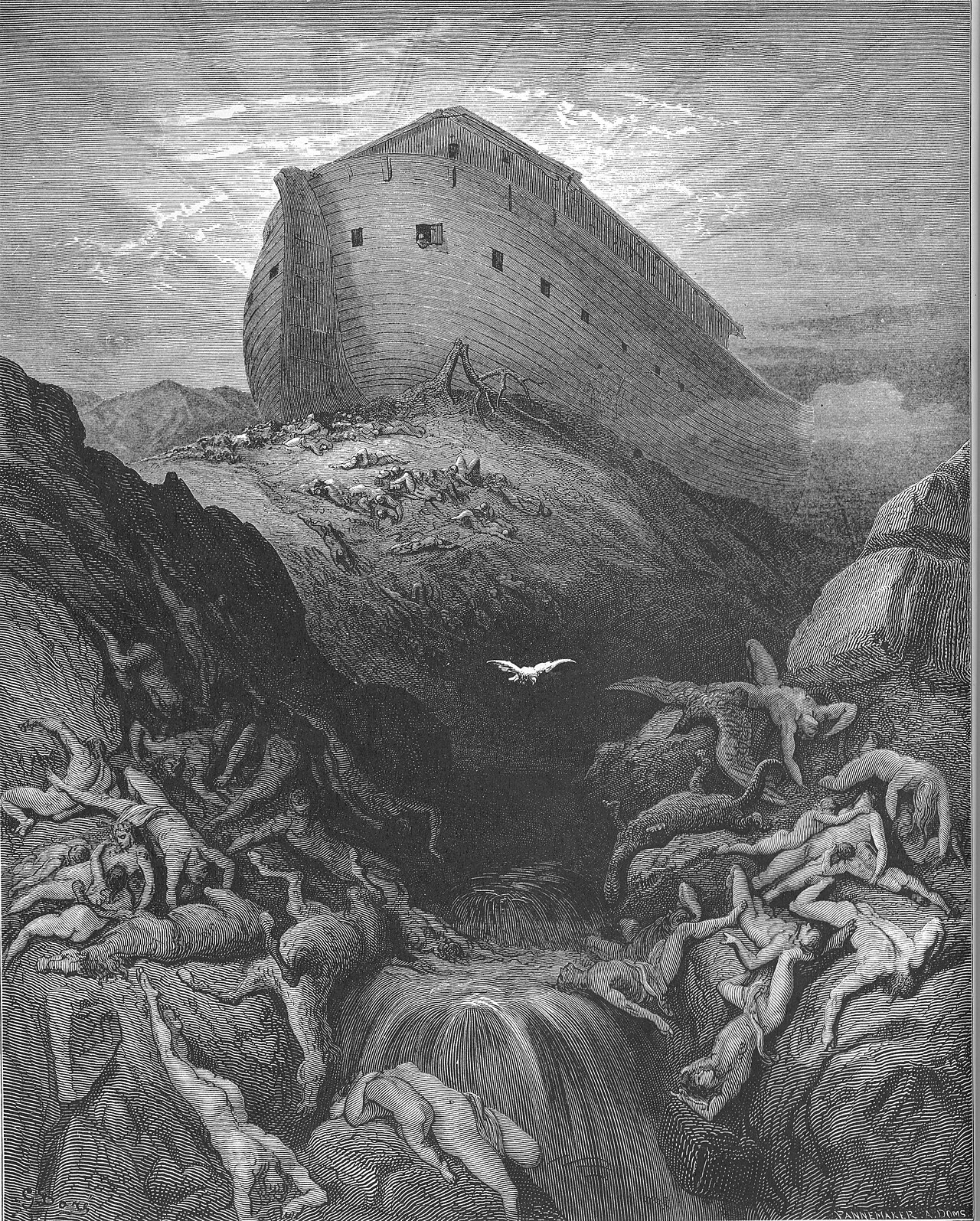
Genesischapter 8
22 verses · Moses, by tradition · 15th to 13th century BC · The Law
Then Noah built an altar to the LORD. And taking from every kind of clean animal and clean bird, he offered burnt offerings on the altar.
Introduction
Moses, by tradition, The Law, Genesis Overview.
This chapter was written for Israel in the wilderness, a people waiting on God to bring them into a land of their own, and tradition gives it to Moses. It tells the end of the flood and the first days of a new world. Much of it is about waiting, measured in months and days. Listen for the sentence on which the whole flood account turns, and for the first thing Noah does when he steps onto dry ground. Notice what God promises at the close and whom the promise covers. Farmers in Canaan would live inside that promise every year.
Context
- Who
- Israel in the wilderness, waiting on God's timing in a country of their own
- What
- An account of the waters going down, the ark coming to rest, Noah leaving it, his sacrifice, and God's promise to keep the seasons.
- Where
- The mountains of Ararat, in the highlands of eastern Turkey and Armenia, and the dry ground below them.
- When
- Before any dated history; the chapter is dated within Noah's six hundredth and six hundred and first years.
- Why
- To show that God remembers those He has saved and that He will uphold the order of the earth while it lasts.
Historical context
The chapter closes the flood inside the generations of Noah, and its turn comes at the line that God remembered Noah. Noah is the one who waits, opens, sends and builds.
Show the rest of the historical context, 4 more paragraphs
The mountains of Ararat are the rugged highlands of what later became the kingdom of Urartu, in eastern Turkey and Armenia. The text says mountains in the plural, which names a region.
Sending out birds was standard practice at sea long before the compass. Sailors carried birds because a bird that does not come back has found land, and the Babylonian flood account has its hero release a dove, a swallow and a raven.
The raven and the dove behave true to type. A raven is a scavenger and can feed on carrion floating on water, so it keeps going, while a dove needs dry ground and a clean perch, so it returns until there is one and then brings back an olive leaf. Olives grow low and leaf out early.
Noah waits after the ground is dry and leaves when he is told. His first act on dry land is to build an altar, which is what the extra clean animals of chapter 7 were aboard for.
Significance
The promise of seedtime and harvest, cold and heat, was the ground under every farming year Israel would have in Canaan.
Show the rest of the significance, 1 more paragraph
It taught them also that God remembers, since the turn of the chapter comes at that sentence rather than at a change in the weather.
This chapter in Jewish lifeWhat this chapter is in Jewish life and reading.
What is done
This chapter is heard inside the second portion of the annual cycle, in the same sitting as the rest of the flood account and the table of the nations (src/lib/hebraic/readings.ts). The going out of the ark and the altar built after it are read without a break from the rising of the waters. The card above carries the portion and the prophetic reading set beside it.
How it is read
Rashi is quoted here from the public domain Rosenbaum and Silbermann edition. Sforno stands with one comment, in the CC-BY translation of Eliyahu Munk, HaChut Hameshulash.
Rashi reads the divine name in the first verse as a change of measure. The name of strict justice is turned to mercy by the prayers of the righteous. The mercy of God is turned back to justice by the deeds of the wicked (Rashi on Genesis 8:1:1, citing Genesis Rabbah 33:3). He asks what was remembered of the cattle, and answers that they had kept to their own kind before the flood and lived apart in the ark (Rashi on Genesis 8:1:2).
The dating of the chapter is where Rashi works hardest. He counts the hundred and fifty days from the day the rain stopped, and sets the decrease on the first of Sivan (Rashi on Genesis 8:3:1). He reads the seventh month as Sivan and the tenth as Av, and argues the two counts against each other at length (Rashi on Genesis 8:4:1 and 8:5:1, citing Genesis Rabbah 30:6). On the first month of the thirteenth verse he reports the dispute plainly. Rabbi Eliezer reads it as Tishri and Rabbi Joshua as Nisan (Rashi on Genesis 8:13:1, citing Rosh Hashanah 11b). He reads the twenty seventh day of the fourteenth verse by the ten days the solar year runs beyond the lunar one. The judgment therefore lasted a full solar year (Rashi on Genesis 8:14:1, citing Genesis Rabbah 33:17).
Sforno reads the dove finding no rest for her foot at its plainest. The mountain tops were visible and still wet through, so there was nowhere on them to stand (Sforno on Genesis 8:9:1).
Ibn Ezra and Radak carry one comment each that the corpus holds by reference alone, because the licence Sefaria reports for the English versions keeps the text out. They are Ibn Ezra on Genesis 8:3:1 and Radak on Genesis 8:18:1.
What the rabbis say
Rashi carries five sayings of the rabbis on this chapter, and each stands here as what they taught.
On the stopping of the springs he reports that the word for all is missing from the second verse on purpose. The springs the world needed were left open, and Rashi names "the hot springs of Tiberias and their like" among them (Rashi on Genesis 8:2:1, citing Sanhedrin 108a).
On the raven he reports the reading of the Aggadah that the bird circled the ark and would not go. It suspected that Noah wanted its mate (Rashi on Genesis 8:7:1, citing Sanhedrin 108b).
On the going out he reports two things. The husband and wife are named together because family life was allowed again (Rashi on Genesis 8:16:1, citing Genesis Rabbah 34:8). The animals took it on themselves to keep to their own kind (Rashi on Genesis 8:19:1). On the altar he reports Noah reasoning that the seven pairs of clean animals were commanded for the sake of this offering (Rashi on Genesis 8:20:1, citing Genesis Rabbah 34:9).
The last is on the evil inclination. Rashi reports a reading of the spelling in the twenty first verse, that the inclination is given to a person from the first stirring in the womb (Rashi on Genesis 8:21:1, citing Genesis Rabbah 34:10). The six seasons of the last verse he reads as two months each, in the division the Talmud sets out (Rashi on Genesis 8:22:1, citing Bava Metzia 106b).
The corpus records forty places where the Midrash and the Talmud cite this chapter, thirty four under Midrash and six under Talmud, with the locator for each one and no text. Bereshit Rabbah reads the second verse at 33:4, the sixth at 33:5, the tenth at 33:6 and the thirteenth at 33:7. It reads the fifteenth verse at 34:1, the sixteenth at 31:12, and the seventeenth at 34:8.
Midrash Aggadah runs almost the length of the chapter, at Genesis 8:4:1, 8:5:1, 8:6:1, 8:9:1, 8:12:1, 8:12:2, 8:14:1, 8:17:1 and 8:18:1. Midrash Lekach Tov reads the second, third, seventh, eighth, tenth and fourteenth verses at the locators of the same names. Eikhah Rabbah reads the dove at 1:29, and Bereshit Rabbati reads the third verse at Parashat Noah 16 and the eleventh at Parashat Noah 18.
The Talmud is cited at Avodah Zarah 51a:15 on the altar, at Avot DeRabbi Natan 32:2 on the evil inclination and at Bava Metzia 106b:5 on the six seasons. The Jerusalem Talmud reads the fifth verse at Rosh Hashanah 1:1:2, the thirteenth at Rosh Hashanah 1:1:3 and the fifteenth at Makkot 2:6:11.
Sources: Rashi, Rashi on Genesis 8, in Pentateuch with Rashi's commentary by M. Rosenbaum and A. M. Silbermann, 1929 to 1934, public domain, about 1090; Sforno, Sforno on Genesis 8:9:1, in HaChut Hameshulash, translated by Eliyahu Munk, CC-BY, about 1520; Ibn Ezra and Radak, their two comments on Genesis 8, cited by reference; the licence Sefaria reports for the English versions keeps the text out of the corpus; The Midrash and the Talmud, the forty locators on Genesis 8 in scripts/data/sources/sefaria/genesis/8.json; MannaFest, the annual cycle table at src/lib/hebraic/readings.ts, 2026.
The heads below are this chapter's scenes. The numbered points under each are its verses.
God Remembered Noah
God remembered Noah: The verb remembered marks God moving on a promise already made. Genesis uses it again when Lot is pulled out of Sodom at 19:29 and when Rachel's barrenness ends at 30:22. The wind God sends over the waters is ruach, the Hebrew word for the Spirit hovering over the deep at Genesis 1:2. The waters subside and the dry ground comes back, as it did on the third day.
Genesis 8:1
“And the Lord brought a spirit upon the earth, and the water ceased (Genesis VIII, 1). I do not think this is said in such a way that we should understand the spirit as the name for wind. For the wind could not have dried up the flood. Otherwise, since the sea is stirred up daily by winds, it would certainly be emptied.”
Ambrose of Milan · written before 397 · On Noah and the Ark, 16.58patristic
Genesis 8:2-3
The springs of the deep: are shut, and the floodgates of the heavens with them, the same two openings that burst at 7:11. The Hebrew of verse 3 has the waters going and returning, a withdrawal by stages. It takes 150 days for them to go down. The rain itself had fallen for forty.
Genesis 8:2
“And the fountains of the deep were closed, and the windows of heaven, and the rains from heaven were restrained, and the waters returned from the earth, going and coming, and they began to decrease after one hundred and fifty days.”
Bede · written before 735 · Commentary on Genesis (Hexaemeron)patristic
1 more voice on this verse
Genesis 8:2
“His sacrifice of praise which he offered to God upon his enlargement, ver. 20. God's acceptance of his sacrifice; and the promise he made thereupon not to drown the world again, ver. 21, 22. And thus at length mercy rejoiceth against judgment.”
John Wesley · Explanatory Notes upon the Old Testament (1765)evangelical
ConnectionsGenesis 7:11
The waters receded steadily: The 150 days match the span the waters prevailed at 7:24, so the flood turns at its height. Counted from 7:11, five months of thirty days bring the ark to rest in verse 4. John Wesley credits the sun's heat and caverns under the ground.
Genesis 8:3
“The waters returned from off the earth continually - Hebrew. they were going and returning; a gradual departure. The heat of the sun exhaled much, and perhaps the subterraneous caverns soaked in more.”
John Wesley · Explanatory Notes upon the Old Testament (1765)evangelical
ConnectionsGenesis 7:24
Genesis 8:4-5
the ark came to rest: The verb behind came to rest is nuach, the root that gives Noah his name. It sounds twice more in this chapter, in the dove that finds no place to rest her foot at verse 9 and in the pleasing aroma of verse 21. The ark settles two and a half months before the tops of the mountains become visible. Ararat in the Hebrew names a whole region.
Genesis 8:4
“The mountains of Ararat - That Ararat was a mountain of Armenia is almost universally agreed. What is commonly thought to be the Ararat of the Scriptures, has been visited by many travelers, and on it there are several monasteries. For a long time the world has been amused with reports that the remains of the ark were still visible there; but Mr. Tournefort, a famous French naturalist, who was on the spot, assures us that nothing of the kind is there to be seen.”
Adam Clarke · Commentary on the Bible (1810-1826)evangelical
1 more voice on this verse
Genesis 8:4
“The mountain which tradition points to as the one on which the ark rested is now called Ara Dagh, the "finger mountain." Its summit consists of two peaks, the higher of which is 17,750 feet and the other 13,420 above the level of the sea.”
Jamieson, Fausset & Brown · Commentary Critical and Explanatory on the Whole Bible (1871)reformed
the tops of the mountains: are the first ground seen since 7:20, when the waters stood fifteen cubits over them. Jamieson, Fausset and Brown note that the waters took nearly twice as long to go down as to rise. They receded from the seventh month to the tenth.
Genesis 8:5
“And the waters decreased continually--The decrease of the waters was for wise reasons exceedingly slow and gradual--the period of their return being nearly twice as long as that of their rise.”
Jamieson, Fausset & Brown · Commentary Critical and Explanatory on the Whole Bible (1871)reformed
The Raven and the Dove
Genesis 8:6-7
Noah opened the window he had made: Noah opens the window he had made after forty days, the same span the rain fell at 7:12. He sends out a raven, which keeps flying back and forth until the waters dry up. A raven feeds on carrion and can rest anywhere on a drowned world, so it brings no word back. Leviticus 11:15 later lists it among the unclean birds.
Genesis 8:6
“And it came to pass at the end of forty days,.... From the appearance of the mountains, that is, from the first day of the tenth month, to forty days after; and being ended, this must be the eleventh day of the eleventh month, the month Ab, which answers to July and August; and according to Bishop Usher (k) it was Friday the twenty eighth of August: that Noah opened the window of the ark which he had made; of which See Gill on Gen 6:16. (k) Ut supra. (Annales Vet. Test. p. 4.)”
1 more voice on this verse
Genesis 8:6
“That though Noah by faith expected his enlargement, and by patience waited for it, yet he was inquisitive concerning it, as one that thought it long to be thus confined. Note, Desires of release out of trouble, earnest expectations of it, and enquiries concerning its advances towards us, will very well consist with the sincerity of faith and patience.”
Matthew Henry · Commentary on the Whole Bible (1707-1721)puritan
ConnectionsGenesis 7:16
and sent out a raven: The Hebrew has the raven going out and returning, with the same verb of return used for the waters in verse 3. Adam Clarke reads it to mean the bird came back to the ark again and again. John Wesley has it resting on the ark, outside.
Genesis 8:7
“Noah sent forth a raven through the window of the ark, which went forth, as the Hebrew phrase is, going forth and returning, that is, flying about, but returning to the ark for rest; probably not in it, but upon it.”
John Wesley · Explanatory Notes upon the Old Testament (1765)evangelical
1 more voice on this verse
Genesis 8:7
“He sent forth a raven, which went forth to and fro - It is generally supposed that the raven flew off, and was seen no more, but this meaning the Hebrew text will not bear; ויצא יצוא ושוב vaiyetse yatso vashob, and it went forth, going forth and returning. From which it is evident that she did return, but was not taken into the ark.”
Adam Clarke · Commentary on the Bible (1810-1826)evangelical
Genesis 8:8-9
Noah sent out a dove: Verse 8 gives Noah's own reason for sending the dove, to see whether the waters had receded from the ground. She finds no place to rest her foot and comes back, and Noah reaches out his hand and brings her inside the ark. Water still covers the whole surface. Deuteronomy 28:65 gives scattered Israel the same picture, no resting place for the foot.
Genesis 8:8
“Also he sent forth a dove from him,.... Seven days after he had sent out the raven, as in Gen 8:10. to see if the waters were abated from off the face of the ground; for the dove is a creature that delights in cleanness, flies low, and goes far off, so that if it returned not again, he might conclude that the waters were gone off the earth; but being a sociable creature, and familiar to men, and especially loving to its mate, if they were not gone off, it would certainly return again.”
1 more voice on this verse
Genesis 8:8
“He sent forth a dove - The dove was sent forth thrice; the first time she speedily returned, having, in all probability, gone but a little way from the ark, as she must naturally be terrified at the appearance of the waters. After seven days, being sent out a second time, she returned with an olive leaf pluckt off, Gen 8:11, an emblem of the restoration of peace between God and the earth; and from this circumstance the olive has been the emblem of peace among all civilized nations.”
Adam Clarke · Commentary on the Bible (1810-1826)evangelical
no place to rest her foot: John Gill notes that a dove flies low, loves clean ground and keeps close to people, so her return was a sure sign the water still stood. Charles Spurgeon records that preachers made the raven and the dove into allegories. Some cast the raven as the Law.
Genesis 8:9
“THE sending forth of the raven and of the dove have furnished ready materials for numerous allegories with which Divines in different ages have sometimes edified and more frequently amused their hearers. We cannot afford time to mention many of them, but one of the host may serve as a specimen. Certain expositors have fancied that the mission of the raven prefigured the sending forth of the Law, which was black and terrible and which came not back to man bearing any token of comfort, or sign of hope.”
Genesis 8:10-12
Noah waited seven more days: Noah waits in sevens, the same count as the seven days of warning at 7:4 and the seven pairs of clean animals at 7:2. The dove comes back that evening with an olive leaf freshly plucked, which means something is growing on the drained ground. On the third sending she does not return. That silence is the answer.
Genesis 8:10
“And he stayed yet other seven days,.... As he had stayed seven days between the sending out of the raven and the dove, so he stayed seven days more after he had sent out the dove, and it returned to him, waiting patiently for his deliverance, and the signs of it; though he could have been glad to have known its near approach, for which he made the experiments be did: and again he sent forth the dove out of the ark; very probably the selfsame dove he had sent out before.”
a freshly plucked olive leaf: Adam Clarke reads the olive leaf as a token of peace restored between God and the earth, and from it the olive became the emblem of peace among the nations. The olive grows on low ground. A freshly plucked leaf meant the lower slopes stood clear of water.
Genesis 8:11
“It is not difficult to see why everlasting peace is signified by the olive branch that the dove, returning, brought back to the ark. For we know that the smooth surface of oil is not readily hindered by a different liquid. And the olive tree itself is forever in leaf.”
Augustine of Hippo · written before 430 · CHRISTIAN INSTRUCTION 2.16.24patristic
1 more voice on this verse
Genesis 8:11
“But after waiting another seven days, he again sent the dove out of the ark; and it came back to him in the evening, carrying a fresh olive branch in its mouth.”
Bede · written before 735 · Commentary on Genesis (Hexaemeron)patristic
she did not return to him: The dove that did not return told Noah the ground was dry enough to hold life, yet he waited in the ark until God spoke. Matthew Henry saw faith and patience in that waiting, joined to an eager wish to know. Noah sent the dove and waited on God.
Genesis 8:12
“Noah then understood that the waters had subsided from the earth, and he waited another seven days, and sent out the dove, which did not return to him again.”
Bede · written before 735 · Commentary on Genesis (Hexaemeron)patristic
Genesis 8:13-14
In Noah’s six hundred and first year: The waters have dried up by the first day of the first month, a new year opening on a new world. Noah removes the covering from the ark and sees dry ground. He waits almost two more months for the earth to be fully dry. He entered on the seventeenth day of the second month at 7:11 and comes out on the twenty-seventh, a year and ten days.
Genesis 8:13
“Noah removed the covering of the ark - Not the whole covering, but so much as would suffice to give him a prospect of the earth about it: and behold the face of the ground was dry.”
John Wesley · Explanatory Notes upon the Old Testament (1765)evangelical
2 more voices on this verse
Genesis 8:13
“NOAH knew that God would, in due time, let him out of the ark. He was quite sure that the Lord had not put him into the ark to make a great coffin of it—that he and all those living creatures that went in with him should perish there. And, because he believed in God, he, therefore, removed the covering of the ark and looked abroad, expecting, by-and-by, to see not only the tops of the mountains, but also a dry and green earth once more. True faith often goes to the window.”
Charles Spurgeon · written before 1892 · The Metropolitan Tabernacle Pulpit, Sermon No. 2373: “The Weary Dove's Return” (lightly modernized text, CCEL edition)Particular Baptist
Genesis 8:13
“For behold, behold and wonder, the face of the ground was dry. Note, (1.) It is a great mercy to see ground about us. Noah was more sensible of it than we are; for mercies restored are much more affecting than mercies continued.”
Matthew Henry · Commentary on the Whole Bible (1707-1721)puritan
the earth was fully dry: Adam Clarke counts the stay in the ark as a complete solar year of 365 days. Twelve lunar months come to 354 days, and the eleven days from the seventeenth to the twenty-seventh, counted inclusively, make up the rest. Matthew Henry called God's time for mercy the best time.
Genesis 8:14
“And in the second month, on the seven and twentieth day - From this it appears that Noah was in the ark a complete solar year, or three hundred and sixty-five days; for he entered the ark the 17th day of the second month, in the six hundredth year of his life, Gen 7:11, Gen 7:13, and continued in it till the 27th day of the second month, in the six hundredth and first year of his life, as we see above.”
Adam Clarke · Commentary on the Bible (1810-1826)evangelical
1 more voice on this verse
Genesis 8:14
“We would go out of the ark before the ground is dried: and perhaps, if the door be shut, are ready to remove the covering, and to climb up some other way; but we should be satisfied that God's time of showing mercy is certainly the best time, when the mercy is ripe for us and we are ready for it.”
Matthew Henry · Commentary on the Whole Bible (1707-1721)puritan
Go Out of the Ark
Genesis 8:15-16
Then God said to Noah: God had shut the door at 7:16, and God is the one who opens the matter now, by speaking. Noah had seen dry ground back at verse 13 and had stayed where he was. He waits for the word. God tells him to come out with his wife, his sons and their wives, the same eight who went in.
Genesis 8:15
“And God spake unto Noah, saying,.... Whether in a dream or vision, or by an articulate voice, appearing in an human form, or by an impulse on his mind, is not certain; however, the Lord spoke so to him, that he heard him and understood him: it was, no doubt, very rejoicing to him, since he had not heard his voice for a year or more, at least that we read of; and what he said to him was as follows.”
God's command pairs each man with his wife, where 7:13 lists the men entering ahead of the women. John Damascene read the change as the end of a season of separation kept in the ark. Ephrem the Syrian made the same point at verse 17.
Genesis 8:16
When Noah was ordered to enter the ark and was entrusted with the safeguarding of the seed of the earth, he was given this command, which reads, "Go forth from the ark, you and your wife, and your sons and your sons' wives with you." He had separated them from their wives, so that with the help of chastity they might escape the deep and that worldwide destruction. However, after the cessation of the flood, the command was "Go forth from the ark, you and your wife, and your sons and your sons' wives with you."
John Damascene · written before 749 · ORTHODOX FAITH 4.24patristic
Genesis 8:17-19
Bring out all the living creatures: Be fruitful and multiply are the words spoken over the creatures on the fifth day at Genesis 1:22 and over man at 1:28, and God says them to Noah again at 9:1. The book starts the world over in the language it used to start it. Every creature comes out kind by kind. The blessing is handed to a family that watched the judgment fall.
Genesis 8:17
Those whom he had brought in "one by one" in order to maintain chastity on the ark, he now brought out "two by two" so that they might "be fruitful and multiply in creation."
Ephrem the Syrian · written before 373 · COMMENTARY ON GENESIS 6.12.2patristic
So Noah came out: The names come in the order of 7:13, Noah with his sons first and the women after. John Wesley observes that until now Noah had done nothing without a particular command from God. The altar of verse 20 is his first act unbidden.
Genesis 8:18
“Now let us inquire by what order they entered into the ark, how long they remained there, and in what order they went out; how in the first instance Noah entered, and after him his sons; then his wife, and the wives of his sons; and when they went out, in what order they went forth. For it is written: 'Noah went forth, and his wife, and his sons, and the wives of his sons' (Genesis 8:18). And the letter indeed signifies, in the entrance, the abstinence from generation, and in the going out, the use of generation.”
Ambrose of Milan · written before 397 · On Noah and the Ark, 21.76patristic
the ark, kind by kind: Every creature came out kind by kind, and the Hebrew there reads by their families, the word later used for the clans of chapter 10. Ephrem the Syrian has them sent out two by two to be fruitful and multiply. The ark empties in order.
Seedtime and Harvest Shall Not Cease
Noah built an altar to the LORD: This is the first altar in Scripture. The first act of the new world is worship. Noah takes clean animals and clean birds and offers burnt offerings. The altar then marks the men who walk with God, Abram at Shechem in 12:7, Isaac at Beersheba in 26:25 and Jacob at Bethel in 35:7.
Genesis 8:20
“Noah builded an altar - As we have already seen that Adam, Cain, and Abel, offered sacrifices, there can be no doubt that they had altars on which they offered them; but this, builded by Noah, is certainly the first on record. It is worthy of remark that, as the old world began with sacrifice, so also did the new. Religion or the proper mode of worshipping the Divine Being, is the invention or institution of God himself; and sacrifice, in the act and design, is the essence of religion.”
Adam Clarke · Commentary on the Bible (1810-1826)evangelical
1 more voice on this verse
Genesis 8:20
“And Noah builded an altar - Hitherto he had done nothing without particular instructions and commands from God but altars and sacrifices being already of Divine institution, he did not stay for a particular command thus to express his thankfulness.”
John Wesley · Explanatory Notes upon the Old Testament (1765)evangelical
Genesis 8:21-22
When the LORD smelled the pleasing aroma: The charge that brought the flood at 6:5, that every inclination of the heart is evil from youth, is now the ground of mercy. The Greek of the pleasing aroma is the phrase Paul uses at Ephesians 5:2 of Christ's fragrant offering to God. Seedtime and harvest, cold and heat, summer and winter will hold as long as the earth endures, and God will never curse the ground again.
Genesis 8:21
“Lord said in his heart--same as "I have sworn that the waters of Noah should no more go over the earth" (Isa 54:9). for--that is, "though the imagination is evil"; instead of inflicting another destructive flood, I shall spare them--to enjoy the blessings of grace, through a Saviour.”
Jamieson, Fausset & Brown · Commentary Critical and Explanatory on the Whole Bible (1871)reformed
3 more voices on this verse
Genesis 8:21
“Herein he had an eye, not so much to Noah's sacrifice as to Christ's sacrifice of himself, which was typified and represented by it, and which was indeed an offering of a sweet-smelling savour, Eph. v. 2 . Good security is here given, and that which may be relied upon, (1.) That this judgment should never be repeated.”
Matthew Henry · Commentary on the Whole Bible (1707-1721)puritan
Genesis 8:21
“The Lord smelled a sweet savor - That is, he was well pleased with this religious act, performed in obedience to his own appointment, and in faith of the promised Savior. That this sacrifice prefigured that which was offered by our blessed Redeemer in behalf of the world, is sufficiently evident from the words of St. Paul, Eph 5:2: Christ hath loved us, and given himself for its an offering and a sacrifice to God for a Sweet-Smelling Savor; where the words οσμην ευωδιας of the apostle are the very words used by the Septuagint in this place.”
Adam Clarke · Commentary on the Bible (1810-1826)evangelical
Genesis 8:21
“PETER tells us that Noah's ark and Baptism are figures of salvation. He puts the two together as pictures of the way by which we are saved. Noah was not saved by the world's being gradually reformed and restored to its primitive innocence, but a sentence of condemnation was pronounced and death, burial and resurrection ensued. Noah must go into the ark and become dead to the world. The floods must descend from Heaven and rise upward from their secret fountains beneath the earth. The ark must be submerged with many waters—here was burial.”
As long as the earth endures: The Hebrew reads all the days of the earth, and Adam Clarke took it to mean the earth's days have an end. Ephrem the Syrian noted that the flood year had no seedtime and no harvest, and this promise restored them. Cold and heat, day and night, keep their turns until then.
Genesis 8:22
“While the earth remaineth, seed-time and harvest, etc. - There is something very expressive in the original, עד כל ימי הארץ od col yemey haarets, until all the Days of the earth; for God does not reckon its duration by centuries, and the words themselves afford a strong presumption that the earth shall not have an endless duration. Seed-time and harvest - It is very probable that the seasons, which were distinctly marked immediately after the deluge, are mentioned in this place; but it is difficult to ascertain them.”
Adam Clarke · Commentary on the Bible (1810-1826)evangelical
3 more voices on this verse
Genesis 8:22
“It is constant in this inconstancy. These seasons have never ceased, nor shall cease, while the sun continued such a steady measurer of time and the moon such a faithful witness in heaven. This is God's covenant of the day and of the night, the stability of which is mentioned for the confirming of our faith in the covenant of grace, which is no less inviolable, Jer. xxxiii.”
Matthew Henry · Commentary on the Whole Bible (1707-1721)puritan
Genesis 8:22
“And because there was neither planting nor harvest during that year and the seasonal cycles had been disturbed, God restored to the earth that which had been taken away in his anger.”
Ephrem the Syrian · written before 373 · COMMENTARY ON GENESIS 6.13.3patristic
Genesis 8:22
“While the earth remaineth--The consummation, as intimated in 2Pe 3:7, does not frustrate a promise which held good only during the continuance of that system.”
Jamieson, Fausset & Brown · Commentary Critical and Explanatory on the Whole Bible (1871)reformed
How this psalm is built
The form: A narrative of the waters going down, closing in a sacrifice of praise, its acceptance, and the promise that the earth will keep its seasons while it lasts, as Wesley classes it.
The patterns in this chapter
| Device | What it does | Where to see it |
|---|---|---|
| Rest, the root under the man's name | The verb behind came to rest at verse 4 is nuach, the root that gives Noah his name, and it sounds again at verse 9 in the dove that came back for want of anywhere to settle. This site's published exposition of verses 4 and 5 marks the play and marks the gap in the chapter's own time, since the ark settles two and a half months before the tops of the mountains become visible.This site's published exposition of Genesis, the published note on Genesis 8:4 and 5 in the store, whose sources are John Gill, Exposition of the Old Testament, and Adam Clarke, Commentary on the Bible. | Genesis 8:4, Genesis 8:9 |
| The two openings, burst and then shut | Genesis 7:11 opened the deep below and the heavens above on one day, and verse 2 here shuts the same two and holds back the rain. The flood is framed by one sentence at each end, and the framing is the chapter's way of saying that the same hand did both. This site's published exposition of verses 2 and 3 marks the pair, and it reads the Hebrew of verse 3 as waters going and returning, a withdrawal by stages over a hundred and fifty days.This site's published exposition of Genesis, the published note on Genesis 8:2 and 3 in the store, whose sources are Adam Clarke, Commentary on the Bible, and Jamieson, Fausset & Brown, Commentary Critical and Explanatory on the Whole Bible. | Genesis 7:11, Genesis 8:2, Genesis 8:3 |
| The dove sent three times, seven days apart | Adam Clarke sets out the pattern: the dove was sent forth three times, the first time returning quickly because the waters frightened her back, the second time after seven days returning with an olive leaf plucked off, and the third time staying away. John Wesley counts the same intervals and adds that the first sending of the dove came seven days after the raven. The three journeys are the chapter's own instrument for measuring a world coming back.Adam Clarke, Commentary on the Bible, 1832, on Genesis 8:8. | Genesis 8:8, Genesis 8:10, Genesis 8:11, Genesis 8:12 |
| The dates given to the day | Four dates carry the chapter. Verse 4 gives month seven, day seventeen, and verse 5 gives month ten, day one. Verse 13 gives month one, day one of the six hundred and first year, and verse 14 gives month two, day twenty-seven. Adam Clarke reads the first and the last of them against Genesis 7:11 and 7:13 and makes the stay in the ark a complete solar year.Adam Clarke, Commentary on the Bible, 1832, on Genesis 8:14. | Genesis 8:4, Genesis 8:5, Genesis 8:13, Genesis 8:14 |
The debate over the mountains of Ararat
11 more paragraphs on the patterns
The traditional identification. On this reading the resting place is the peak in Armenia that bears the name, which Jamieson, Fausset and Brown call Ara Dagh, the finger mountain, giving its two summits at 17,750 feet and 13,420 feet above sea level (Commentary Critical and Explanatory on the Whole Bible, 1871, on Genesis 8:4). Adam Clarke reports the identification as almost universally agreed in his day, with many travellers on the mountain and several monasteries standing on it (Commentary on the Bible, 1832, on Genesis 8:4). The reading has a long and locally continuous tradition behind it, and the height of the peak fits a text that has the tops of mountains appearing months after the ark settled. The strongest objection is the one Clarke himself reports, that the accounts of visible remains were examined on the spot by the naturalist Tournefort, who reported the mountain bare of them.
The region reading. On this reading the phrase is plural in the Hebrew and Ararat names a whole region rather than one summit, so the text places the ark somewhere in a range and leaves the peak unnamed. This site's published exposition of verses 4 and 5 states it. The reading takes the text at its own level of precision and explains why the search for one mountain has produced tradition rather than evidence. The strongest objection is that the local tradition Clarke reports is old and has been held where the events are placed, and a tradition of that kind is evidence of a sort even when it falls short of proof.
The chapter itself gives a plural phrase and a date and stops there. Both readings agree on what the verse reports.
The New Testament's use
Peter reads the ark as the figure behind baptism. Charles Spurgeon opens his sermon on verse 21 with that use, that Peter puts Noah's ark and baptism together as pictures of the way salvation comes, with the ark submerged in the waters as a burial and Noah brought out into a new world (The Metropolitan Tabernacle Pulpit, Sermon No. 615: "Human Depravity And Divine Mercy" (lightly modernized text, CCEL edition), 1865).
Paul reads the aroma of verse 21. Adam Clarke notes that the Septuagint renders the pleasing aroma with the very words Paul uses at Ephesians 5:2 of Christ giving Himself as an offering and a sacrifice to God (Commentary on the Bible, 1832, on Genesis 8:21). This site's published exposition of verses 21 and 22 records the same link.
Peter reads verse 22 as well. Jamieson, Fausset and Brown hold that the consummation spoken of at 2 Peter 3:7 stands with the promise of verse 22 rather than against it, since the promise was given for the continuance of the present order (Commentary Critical and Explanatory on the Whole Bible, 1871, on Genesis 8:22).
What verse 22 says, and what can be said with it
What the text says. Verse 22 gives four pairs of opposites, drawn from the farming year, from the climate, from the seasons and from the day, and it binds all four to one condition, the endurance of the earth. Verse 21 gives the ground of the promise, and it is the same charge that brought the flood at Genesis 6:5, now standing as the reason for mercy rather than for judgment. This site's published exposition of verses 21 and 22 marks that reversal.
What is held with the text. Matthew Henry reads the constancy of the seasons as God's covenant of the day and of the night, and he brings Jeremiah 33:20 in as the passage that uses the same stability to confirm the covenant of grace (Commentary on the Whole Bible, 1710, on Genesis 8:22). John Wesley states the same reading at verse 21.
What is contested. Adam Clarke holds it probable that the seasons named here are the ones distinctly marked immediately after the deluge, and he states in the same breath that they are difficult to ascertain (Commentary on the Bible, 1832, on Genesis 8:22). He also reads the Hebrew phrase at the head of verse 22 as until all the days of the earth, and takes the wording as a strong presumption that the earth has a term. Jamieson, Fausset and Brown reach the same conclusion from 2 Peter 3:7. Both are inferences from wording, offered by their holders as inferences.
Keep studying
Sources for this chapter
The summary
Jamieson, Fausset & Brown, Commentary Critical and Explanatory; John Wesley, Notes on the Old Testament and Matthew Henry, Complete Commentary.
The form and classifications
Adam Clarke, Commentary on the Bible, 1832, on Genesis 8:14; Jamieson, Fausset & Brown, Commentary Critical and Explanatory on the Whole Bible, 1871, on Genesis 8:5; John Wesley, Explanatory Notes upon the Old Testament, 1765, on Genesis 8:2 and Matthew Henry, Commentary on the Whole Bible, 1710, on Genesis 8:14.
The exposition
Adam Clarke, Commentary on the Bible; Charles Spurgeon, The Metropolitan Tabernacle Pulpit, Sermon No. 637: “The Dove'S Return To The Ark” (lightly modernized text, CCEL edition); Ephrem the Syrian; Jamieson, Fausset & Brown, Commentary Critical and Explanatory on the Whole Bible; John Calvin, Commentary on Genesis; John Damascene, ORTHODOX FAITH 4.24; John Gill; John Wesley, Explanatory Notes upon the Old Testament and Matthew Henry, Commentary on the Whole Bible.