
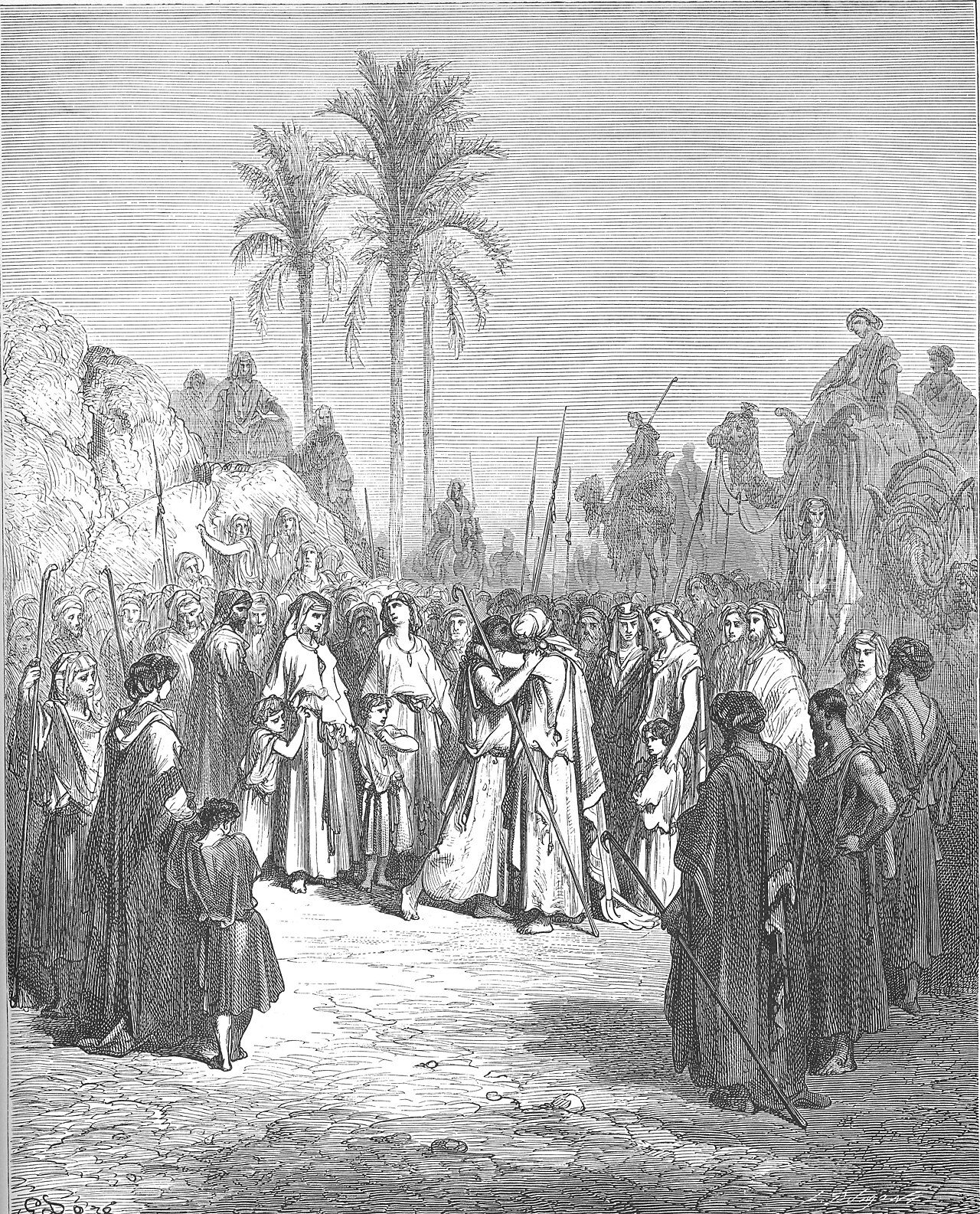
Genesischapter 33
20 verses · Moses, by tradition · 15th to 13th century BC · The Law
And the plot of ground where he pitched his tent, he purchased from the sons of Hamor, Shechem’s father, for a hundred pieces of silver.
Introduction
Moses, by tradition, The Law, Genesis Overview.
This chapter was written for Israel, the nation named after Jacob, whose own road into Canaan would pass the land of Esau's descendants. It settles a quarrel that had stood for twenty years between twin brothers. Everything turns on one meeting, and the reader knows only what Jacob knows as the other man comes near. Listen for the language of gifts and of blessing, and for the words each brother uses to address the other. Notice where Jacob goes afterward, and how far he travels. The chapter ends with the family's first purchase of ground in Canaan since Abraham bought a grave.
Context
- Who
- Israel in the wilderness, on their way to camp in the valley Jacob bought into
- What
- A narrative of the meeting between Jacob and Esau, their parting, and Jacob's settling at Succoth and then at Shechem.
- Where
- The meeting place east of the Jordan, then Succoth, then a field bought outside the town of Shechem in Canaan.
- When
- About 1909 BC by the traditional dating, on the day after the night at the Jabbok.
- Why
- To show that God answered Jacob's prayer by turning his brother's heart, and to record the family's first holding of land beside the grave at Machpelah.
Historical context
The chapter is Jacob's and Esau's, and Esau comes as a man with four hundred men behind him and a country of his own.
Show the rest of the historical context, 5 more paragraphs
The ground runs from the meeting place on the east side to Succoth, then across into Canaan as far as Shechem.
The occasion is the reconciliation of two brothers who had last parted with one of them planning the other's death.
A first hearer recognised the bowing. Diplomatic letters from Canaan in this era open with rulers prostrating themselves seven times before a superior, so the formula was standard, and Jacob is presenting himself to his brother as a vassal.
He also knew the etiquette of a gift. Refusal is expected, pressing is expected, and acceptance settles the matter, which Adam Clarke gives as the custom underneath verse 10. Jacob calls the gift by the word berakah, blessing, the same word Esau cried over at Genesis 27:36.
The excuse about the frail children and the nursing flocks is true to herding, because young animals driven hard die, and it is also a courteous way to decline an escort. At Shechem Jacob buys a piece of ground for a hundred pieces of silver and sets an altar on it, and that plot, like Machpelah, is a purchased holding.
Significance
Twenty years of dread ended in a run and an embrace, and Israel heard that God can turn a brother's heart while a man is still afraid of him.
Show the rest of the significance, 2 more paragraphs
The altar Jacob names El-Elohe-Israel is the first time the new name is used in worship, so the God of the nation is now named by the nation's name.
The nation also heard where the ground was. Joseph's bones are buried in this plot at Joshua 24:32, and it became an inheritance for Joseph's descendants.
This chapter in Jewish lifeWhat this chapter is in Jewish life and reading.
How it is read
The meeting of the brothers is the chapter where the classical readers part company most visibly, and the place they part is the kiss. Rashi records that the scribal tradition puts dots above that word, and hands on the dispute rather than settling it: "Dots are placed above the letters of this word, and a difference of opinion is expressed in the Baraitha of Sifré" as to what the dots mean, one view being that the kiss was not wholehearted (Rashi on Genesis 33:4:2, the Pentateuch with Rashi's commentary by M. Rosenbaum and A. M. Silbermann, 1929 to 1934, public domain). On the embrace itself he is warmer, "His pity was aroused when he saw him prostrating himself so many times", on Genesis Rabbah 78:8 (Rashi on Genesis 33:4:1). He reads the ordering of the families as a ranking of love, and Jacob going first as a father putting himself in the way: "He thought: if that wicked man comes to fight let him fight me first" (Rashi on Genesis 33:2:1 and 33:3:1). Esau's refusal of the gift he takes as a legal concession, "In these words he admitted his right to the blessings", on Genesis Rabbah 78:11 (Rashi on Genesis 33:9:1). He reads the booths of the seventeenth verse as a stay of eighteen months, a summer, a winter and a summer, on Megillah 17a, and the word for Jacob's arrival at Shechem as three kinds of wholeness, among them "unimpaired in body (health) because he was cured of his lameness" (Rashi on Genesis 33:17:1 and 33:18:1). On the price paid for the field he quotes Rabbi Akiba on a coin he had met in the field: "When I visited the coast-towns I found that they called a Meah a Kesittah", on Rosh Hashanah 26a (Rashi on Genesis 33:19:1). Radak and Sforno read the scene as diplomacy under threat. Radak says Jacob divided the children among their mothers because "Each mother would naturally have stronger concern for her own children", and that Jacob went ahead of them all as a father who has compassion on his children: "He offered himself as the butt of Esau's anger hoping thereby to save the lives of his children" (Radak on Genesis 33:1:1 and 33:3:1, translated by Eliyahu Munk, HaChut Hameshulash, CC-BY). Sforno reads the four hundred men as evidence that the gift had failed, "To tell us that he had not been appeased even by the substantial gift Yaakov had sent him" (Sforno on Genesis 33:1:1, Munk translation, CC-BY). Ibn Ezra comments here at 33:2:1 and Malbim at 33:6:1, and the corpus holds no English of either under a licence permitting quotation, so they stand as citations.
What the rabbis say
The corpus records forty rabbinic locators on this chapter, thirty-one of them Midrash and nine Talmud, and the Talmud count is the highest of any chapter in this half of the book. Bereshit Rabbah runs through the meeting at 78:7, 78:8, 78:10, 78:11, 78:13, 78:14 and 78:15, and on to the field at Shechem and the altar at 79:7 and 79:8. Bereshit Rabbati is cited at Parashat Vayishlach 11, 12 and 49, Midrash Aggadah at Genesis 32:4:1, 33:13:1 and 33:15:1, Devarim Rabbah at 1:17 and 1:18, and Aggadat Bereshit at 42:1, 54:2 and 69:2. The nine Talmud locators cluster at the kiss and at Jacob's refusal to travel with Esau: Avot DeRabbi Natan 34:5 and 34:6 at the embrace, Bava Batra 17a:1 at the gift, Avodah Zarah 8b:9 and Chagigah 5b:6 at Esau's offer to go along, Avodah Zarah 25b:8 and 25b:9 at Jacob's answer and at the booths, Jerusalem Talmud Yevamot 1:6:2 at Esau's return, and Chullin 91a:22. Rashi hands on further sayings with their locators, among them Genesis Rabbah 78:8 and 78:11, the Baraitha of Sifré on the dotted word, Megillah 17a and Rosh Hashanah 26a.
Sources: Rashi, Rashi on Genesis 33:2:1, 33:3:1, 33:4:1, 33:4:2, 33:5:1, 33:7:1, 33:8:1, 33:9:1, 33:10:1, 33:11:1, 33:12:1, 33:13:1, 33:14:1, 33:15:1, 33:16:1, 33:17:1, 33:18:1, 33:19:1 and 33:20:1, the Pentateuch with Rashi's commentary by M. Rosenbaum and A. M. Silbermann, 1929 to 1934, public domain; Radak, Radak on Genesis 33:1:1 and 33:3:1, translated by Eliyahu Munk, HaChut Hameshulash, CC-BY; Sforno, Sforno on Genesis 33:1:1, translated by Eliyahu Munk, HaChut Hameshulash, CC-BY; Ibn Ezra, Ibn Ezra on Genesis 33:2:1, cited only, no English version in the corpus under a licence permitting quotation; Malbim, Malbim on Genesis 33:6:1, cited only; Midrash, Bereshit Rabbah 11:7, 43:8, 75:10, 77:3, 78:7, 78:8, 78:10, 78:11, 78:13, 78:14, 78:15, 79:7, 79:8, 90:4 and 98:18; Bereshit Rabbati, Parashat Vayishlach 11, 12 and 49; Midrash Aggadah, Genesis 32:4:1, 33:13:1 and 33:15:1; Devarim Rabbah 1:17 and 1:18; Aggadat Bereshit 42:1, 54:2 and 69:2; Bamidbar Rabbah 11:6; Midrash Sekhel Tov, Bereshit 33:7:1; Midrash Lekach Tov on Esther 3:4:2; Midrash Tanchuma Buber, Vayeshev 12:2; Ein Yaakov, Sukkah 3:9; Babylonian Talmud, Bava Batra 17a:1, Avodah Zarah 8b:9, 25b:8 and 25b:9, Chagigah 5b:6, Chullin 91a:22; Megillah 17a and Rosh Hashanah 26a as Rashi cites them; Jerusalem Talmud, Jerusalem Talmud Yevamot 1:6:2; Avot DeRabbi Natan, Avot DeRabbi Natan 34:5 and 34:6; Sifre, the Baraitha of Sifre on the dotted word, as Rashi cites it at Rashi on Genesis 33:4:2.
The heads below are this chapter's scenes. The numbered points under each are its verses.
The Brothers Embrace and Weep
Genesis 33:1-2
Esau coming toward him with four hundred men: These are the four hundred men reported to Jacob at Genesis 32:6, and the night at the ford stands between the report and the meeting. The order he puts them in runs from the maidservants to Rachel and Joseph at the rear. Clarke asks the question that order raises, whether the ones set in front were the ones least esteemed. The household's own ranking is written down here.
Genesis 33:1
“Observe what a different figure these two brothers made. Esau is attended with a guard of 400 men, and looks big; Jacob is followed by a cumbersome train of women and children that are his care, and he looks tender and solicitous for their safety; and yet Jacob had the birthright, and was to have the dominion, and was every way the better man.”
Matthew Henry · Commentary on the Whole Bible (1707-1721)puritan
Rachel and Joseph at the rear: The rear is the place farthest from the four hundred men, and the order runs from least guarded to most guarded. The two camps of 32:7 have become four households in line. The same preference for Rachel's son puts the robe on Joseph at 37:3.
Genesis 33:2
“He put the handmaids and their children foremost - There is something so artificial in this arrangement of Jacob’s family, that it must have had some peculiar design. Was Jacob still apprehensive of danger, and put those foremost whom he least esteemed, that if the foremost met with any evil, those who were behind might escape on their swift beasts?”
Adam Clarke · Commentary on the Bible (1810-1826)evangelical
Genesis 33:3-4
bowed to the ground seven times: Isaac's blessing had put Esau's family on the ground before Jacob. The man who took that blessing at Genesis 27 is the one bowing seven times, before the brother he took it from. Esau runs to him, embraces him, puts his arms around his neck and kisses him, and they both weep. Wesley notes that God holds the hearts of men and turned this one before a word was spoken.
Genesis 33:3
“The members of his family did the same. This was a token of profound respect, and, though very marked, it would appear natural; for Esau being the elder brother, was, according to the custom of the East, entitled to respectful treatment from his younger brother.”
Jamieson, Fausset & Brown · Commentary Critical and Explanatory on the Whole Bible (1871)reformed
Esau, however, ran to him: In Luke 15:20 the father of the prodigal ran to his son, embraced him and kissed him, the same three things Esau does for his brother. In the Hebrew text the word for kissed carries a row of dots above its letters, one of ten places in the Torah so marked. Jewish readers argued over whether Esau kissed his brother sincerely.
Genesis 33:4
“And Esau ran to meet him - Not in passion but in love. Embraced him, fell on his neck and kissed him - God hath the hearts of all men in his hands, and can turn them when and how he pleases. He can of a sudden convert enemies into friends, as he did two Sauls, one by restraining grace, 1 Sam. xxvi, 21, 25, the other by renewing grace, Acts ix, 21.”
John Wesley · Explanatory Notes upon the Old Testament (1765)evangelical
1 more voice on this verse
Genesis 33:4
“Esau ran to meet him - How sincere and genuine is this conduct of Esau, and at the same time how magnanimous! He had buried all his resentment, and forgotten all his injuries; and receives his brother with the strongest demonstrations, not only of forgiveness, but of fraternal affection. And kissed him - וישקהו vaiyishshakehu. In the Masoretic Bibles each letter of this word is noted with a point over it to make it emphatic.”
Adam Clarke · Commentary on the Bible (1810-1826)evangelical
Genesis 33:5-7
Jacob answers that God has graciously given him the children, and he takes the lower place again. The families then come forward in the order he had set, and the ranking is acted out in front of Esau. Joseph is the only child named. He is named ahead of his own mother, the first sign in the text of his place in that house.
Genesis 33:5
“Eleven or twelve little ones followed Jacob, the eldest of them not fourteen years old: Who are these? saith Esau. Jacob had sent him an account of the increase of his estate, but made no mention of his children, perhaps because he would not expose them to his rage, if he should meet him as an enemy. Esau therefore had reason to ask who are those with thee?”
John Wesley · Explanatory Notes upon the Old Testament (1765)evangelical
the maidservants and their children approached: The maidservants' sons are Dan and Naphtali, born to Bilhah, and Gad and Asher, born to Zilpah, four of the future tribes. Bowed down is the verb of homage before a ruler, and it also names worship. The whole house bows in turn.
Genesis 33:6
“Then the handmaids came near, they and their children,.... Being foremost, and next to, Jacob, as Bilhah and her two sons, Dan and Naphtali, and Zilpah and her two sons, Gad and Asher: and they bowed themselves; in token of respect to Esau, as Jacob had done before them, and set them an example, and no doubt instructed them to do it.”
then Joseph and Rachel approached and bowed down: Leah comes with six sons and Dinah, whose story opens the next chapter. Joseph bows here beside his mother before Esau. His dream at Genesis 37:9 sets the sun, the moon and eleven stars bowing to him, and his brothers bow before him at 42:6.
Genesis 33:8-9
The company is the gift Jacob sent ahead at Genesis 32. Esau has to ask what it is for, and he answers Jacob's plea for favor by calling him brother. He already has plenty, and he tells Jacob to keep what belongs to him. Gill reads the refusal of payment as the mark of a real reconciliation.
Genesis 33:8
“And he said, what meanest thou by all this drove which I met?....”
Esau's wealth is real. At Genesis 36:6 and 7 the brothers own so much livestock that the land cannot hold them both, and Esau moves his household away from Jacob. Abram and Lot parted for the same reason at 13:6.
Genesis 33:9
“And Esau said, I have enough, my brother,.... Or "I have much" (o), and stand in no need of this present, or have much more than thou hast: keep that thou hast unto thyself; for the use of himself and family, which is large; in this Esau showed himself not only not a covetous man, but that he was truly reconciled to his brother, and needed not anything from him, to make up the difference between them. (o) יש לי רב "est mihi multum", Pagninus, Montanus, Drusius; "plurima", V. L. "quamplurima", Vatablus.”
like seeing the face of God: Jacob tells Esau that seeing his face is like seeing the face of God. He had named the ford Peniel the night before for the same sight. Henry takes it as Jacob reading God's favor in his brother's. Clarke gives the custom underneath the asking, that a gift accepted in that country settled a friendship.
Genesis 33:10
“Receive my present at my hand - Jacob could not be certain that he had found favor with Esau, unless the present had been received; for in accepting it Esau necessarily became his friend, according to the custom of those times, and in that country. In the eastern countries, if your present be received by your superior, you may rely on his friendship; if it be not received, you have every thing to fear.”
Adam Clarke · Commentary on the Bible (1810-1826)evangelical
1 more voice on this verse
Genesis 33:10
“It is a very high compliment that he passes upon him: I have seen thy face, as though I had seen the face of God, that is, "I have seen thee reconciled to me, and at peace with me, as I desire to see God reconciled." Or the meaning is that Jacob saw God's favour to him in Esau's: it was a token for good to him that God had accepted his prayers.”
Matthew Henry · Commentary on the Whole Bible (1707-1721)puritan
my gift that was brought to you: The word behind gift here is berakah, blessing, the word Esau cried over at Genesis 27:36. What was taken then cannot be handed back, so what is pressed on Esau is livestock called by that name. Gill notes that Esau's answer in the verse before says much, where Jacob's word here is all. Jacob pressed him, and he accepted.
Genesis 33:11
“He urged him and he took it--In the East the acceptance by a superior is a proof of friendship, and by an enemy, of reconciliation. It was on both accounts Jacob was so anxious that his brother should receive the cattle; and in Esau's acceptance he had the strongest proofs of a good feeling being established that Eastern notions admit of.”
Jamieson, Fausset & Brown · Commentary Critical and Explanatory on the Whole Bible (1871)reformed
Jacob Turns Aside to Succoth
Genesis 33:12-14
Esau offers to travel with him, and Jacob gives the pace of the frail children and the nursing flocks. He then says he will come on to his lord at Seir, and Genesis never records the visit. Clarke takes the promise as sincere and undone later, and Jamieson, Fausset and Brown read the refusal as prudence between brothers now unlike each other. The text gives the words and leaves the motive out.
Genesis 33:12
“But the proposal was prudently declined. Jacob did not need any worldly state or equipage. Notwithstanding the present cordiality, the brothers were so different in spirit, character, and habits--the one so much a man of the world, and the other a man of God, that there was great risk of something occurring to disturb the harmony.”
Jamieson, Fausset & Brown · Commentary Critical and Explanatory on the Whole Bible (1871)reformed
the children are frail: Frail is rak, tender, used of Leah's weak eyes at 29:17. Joseph, the youngest, was about six, born before Jacob's last six years with Laban at 30:25 and 31:41. Isaiah 40:11 gives the LORD the same care as shepherd, gently leading the nursing ewes.
Genesis 33:13
“Christ, the good Shepherd, does so, Isa. xl. Now Jacob will not desire Esau to slacken his pace, nor force his family to quicken theirs, nor leave them, to keep company with his brother, as many would have done, that love any society better than their own house; but he desires Esau to march before, and promises to follow him leisurely, as he could get forward.”
Matthew Henry · Commentary on the Whole Bible (1707-1721)puritan
at a comfortable pace for the livestock and children: The Hebrew for comfortable pace is by the foot of the livestock and by the foot of the children. Jacob sets the march by the slowest feet in his house. Seir lies far to the south in Edom, and verse 17 takes him to Succoth.
Genesis 33:14
“Until I come unto my lord unto Seir - It is very likely that Jacob was perfectly sincere in his expressed purpose of visiting Esau at Seir, but it is as likely that circumstances afterwards occurred that rendered it either improper or impracticable; and we find that Esau afterwards removed to Canaan, and he and Jacob dwelt there together for several years. See Gen 36:6.”
Adam Clarke · Commentary on the Bible (1810-1826)evangelical
Genesis 33:15-16
Esau offers an escort out of his own four hundred, and Jacob wants none of them. Wesley reads the refusal as the answer of a man who already has a guard, the two camps of angels he met at Genesis 32:1 and 2. Esau starts back to Seir that same day. The brothers stand together once more in the book, at their father's grave in Genesis 35:29.
Genesis 33:15
“He is under the Divine protection. Those are sufficiently guarded that have God for their guard, and are under a convoy of his hosts, as Jacob was. Jacob adds, only let me find grace in the sight of my Lord - Having thy favour I have all I need, all I desire from thee.”
John Wesley · Explanatory Notes upon the Old Testament (1765)evangelical
Esau started on his way back to Seir: Seir sounds like the Hebrew for hairy, the word used of Esau at his birth in Genesis 25:25. Esau goes back that day to the land of Seir, south of the Dead Sea, which became Edom. Deuteronomy 2:5 records that God gave Mount Seir to Esau.
Genesis 33:16
“So Esau returned that day on his way unto Seir. Took his leave of Jacob the same day he met him, and proceeded on in his journey towards Seir; whether he arrived there the same day is not certain, probably it was more than a day's journey.”
1 more voice on this verse
Genesis 33:16
“The place was afterwards known by the name of Succoth, a city in the tribe of Gad, on the other side Jordan (it signifies booths ), that when his posterity afterwards dwelt in houses of stone, they might remember that the Syrian ready to perish was their father, who was glad of booths ( Deut. xxvi.”
Matthew Henry · Commentary on the Whole Bible (1707-1721)puritan
he built a house for himself: Jacob builds a house, and Hebrews 11:9 remembers the three patriarchs as men who lived in tents in the land of promise. Jerome places Succoth beyond the Jordan near Scythopolis, so the house goes up on the far side of the river from the land he was given. Succoth means shelters. Israel keeps a feast of them every year for the season when it had no house at all.
Genesis 33:17
“Jacob journeyed to Succoth--that is, "booths," that being the first station at which Jacob halted on his arrival in Canaan. His posterity, when dwelling in houses of stone, built a city there and called it Succoth, to commemorate the fact that their ancestor, "a Syrian ready to perish" [De 26:5], was glad to dwell in booths.”
Jamieson, Fausset & Brown · Commentary Critical and Explanatory on the Whole Bible (1871)reformed
1 more voice on this verse
Genesis 33:17
“Journeyed to Succoth - So called from סכת succoth, the booths or tents which Jacob erected there for the resting and convenience of his family, who in all probability continued there for some considerable time.”
Adam Clarke · Commentary on the Bible (1810-1826)evangelical
An Altar Raised at Shechem
he arrived safely at the city of Shechem: Clarke and Jamieson, Fausset and Brown read shalem as a word before it is a place, that Jacob came whole, or safe, or in peace. His vow at Genesis 28:21 was to come again to his father's house in peace, and that word stands on the same root. He is back in Canaan unharmed. He has stopped short of Bethel and short of his father's house.
Genesis 33:18
“Shalem--that is, "peace"; and the meaning may be that Jacob came into Canaan, arriving safe and sound at the city Shechem--a tribute to Him who had promised such a return (compare Ge 28:15). But most writers take Shalem as a proper name--a city of Shechem, and the site is marked by one of the little villages about two miles to the northeast.”
Jamieson, Fausset & Brown · Commentary Critical and Explanatory on the Whole Bible (1871)reformed
1 more voice on this verse
Genesis 33:18
“And Jacob came to Shalem, a city of Shechem - The word שלם shalem, in the Samaritan שלום shalom, should be translated here in peace, or in safety. After resting some time at Succoth, which was necessary for the safety of his flocks and the comfort of his family, he got safely to a city of Shechem, in health of body, without any loss of his cattle or servants, his wives and children being also in safety.”
Adam Clarke · Commentary on the Bible (1810-1826)evangelical
the plot of ground where he pitched his tent: This is the second plot of ground a patriarch buys in the land of promise, after the field and cave at Machpelah in Genesis 23. Henry notes that the country was already Jacob's by promise and he pays the sons of Hamor for the plot anyway. Joseph's bones are buried in this ground at Joshua 24:32. The purchase is made where he had pitched his tent, outside the city of Shechem.
Genesis 33:19
“For a hundred pieces of money - The original, במאה קשיטה bemeah kesitah, has been a matter of long and learned discussion among critics. As kesitah signifies a lamb, it may imply that Jacob gave the Hamorites one hundred lambs for the field; but if it be the same transaction that St. Stephen refers to in Act 7:16, it was money, τιμης αργυριον, a sum or price of silver, which was given on the occasion.”
Adam Clarke · Commentary on the Bible (1810-1826)evangelical
1 more voice on this verse
Genesis 33:19
“Though the land of Canaan was his by promise, yet, the time for taking possession not having yet come, he is content to pay for his own, to prevent disputes with the present occupants. Note, Dominion is not founded in grace.”
Matthew Henry · Commentary on the Whole Bible (1707-1721)puritan
he set up an altar: El-Elohe-Israel is God, the God of Israel, and Israel is the name he was given at the ford. The new name is fastened to God first. Henry puts it that an honor becomes an honor when it is turned back to God. Abraham had built at Shechem and then at Bethel, and God has to tell Jacob at Genesis 35:1 to go up to Bethel and pay the vow.
Genesis 33:20
“God had lately called him by the name of Israel, and now he calls God the God of Israel; though he is styled a prince with God, God shall still be a prince with him, his Lord and his God. Note, Our honours then become honours indeed to us when they are consecrated to God's honour; Israel's God is Israel's glory.”
Matthew Henry · Commentary on the Whole Bible (1707-1721)puritan
How this psalm is built
The form: A narrative of reconciliation, closing on a settlement short of the place Jacob had vowed to return to, as Henry classes it.
The patterns in this chapter
| Device | What it does | Where to see it |
|---|---|---|
| Bowed to the ground seven times | Isaac's blessing at Genesis 27:29 had set Esau's family on the ground before Jacob, and the man who took that blessing is the one bowing here, seven times, before his brother. John Wesley notes that God turned Esau's heart before a word was spoken.John Wesley, Explanatory Notes upon the Old Testament, 1765, on Genesis 33:3 and 4. | Genesis 33:3 |
| The blessing handed back under its own name | The word behind the gift Jacob presses on Esau at verse 11 is berakah, blessing, the word Esau cried over at Genesis 27:36. What was taken then cannot be handed back, so what is pressed on him now is livestock called by that name. Jacob pressed him, and he accepted.John Gill, Exposition of the Old Testament, 1748 to 1763, on Genesis 33:11. | Genesis 33:11 |
| The face of God, said of a brother | Jacob had named the ford Peniel the night before for seeing God face to face. He tells Esau at verse 10 that seeing his face is like seeing the face of God. Matthew Henry takes it as Jacob reading God's favour in his brother's, and Adam Clarke gives the custom underneath the asking, that a gift accepted in that country settled a friendship.Matthew Henry, Commentary on the Whole Bible, 1710, on Genesis 33:10. | Genesis 33:10 |
| He came safely, on the root of his own vow | Adam Clarke and Jamieson, Fausset and Brown read shalem at verse 18 as a word before it is a place, that Jacob arrived whole, or safe, or in peace. His vow at Genesis 28:21 was to come again to his father's house in peace, and that word stands on the same root. He is inside Canaan and short of both Bethel and his father's house.Adam Clarke, Commentary on the Bible, 1832, on Genesis 33:18. | Genesis 33:18 |
The historical value
11 more paragraphs on the patterns
The chapter records the second plot of ground a patriarch buys in the land of promise, after the field and cave at Machpelah in Genesis 23. Matthew Henry notes that the country was already Jacob's by promise and he pays the sons of Hamor for it anyway. Joseph's bones are buried in that ground at Joshua 24:32, and the plot is still named there as the one Jacob bought.
It also records the custom Adam Clarke names at verse 10, that a gift accepted in that country settled a friendship, which is why Jacob presses Esau until he takes the drove.
Succoth means shelters, and Israel keeps a feast of them for the season when it had no house.
The debated concept
Whether Jacob meant to go to Seir is the chapter's open question. He tells Esau at verse 14 that he will come on at the pace of the frail children and the nursing flocks, and Genesis never reports the visit. Adam Clarke takes the promise as sincere and undone later. Jamieson, Fausset and Brown read the whole exchange as prudence between two brothers who have become unlike each other, which makes the words a courteous parting rather than an appointment. The text gives the words and gives no visit, and leaves the reading to the reader.
The second question is the settlement itself. Jerome places Succoth beyond the Jordan, outside the land given him, and verse 18 has him arrive inside Canaan and stop at Shechem. Whether the stop is a delay in obedience or a stage of a long return is not stated, and Genesis 35:1 is the only comment the book makes on it.
The New Testament's use
Hebrews 11:9 is the New Testament place that reads this stage of the patriarchs' lives. It says Abraham dwelt in the promised land as a stranger in a foreign country and lived in tents, as did Isaac and Jacob, who were heirs with him of the same promise. The house Jacob builds at Succoth at verse 17 stands against that description.
Joshua 24:32 is the Old Testament's use of the plot bought at verse 19, and it makes the ground an inheritance for Joseph's descendants.
The divine connection
Esau's heart is what the chapter turns on, and Genesis reports the change without explaining it. The last thing recorded of Esau was the grudge and the plan at Genesis 27:41. The next thing recorded is that he ran, embraced his brother, fell on his neck and wept. John Wesley reads it as God turning that heart before a word was spoken. At the Evidence Standard what the text supports is this: Jacob had prayed at Genesis 32:11 to be delivered from the hand of his brother, and the deliverance recorded is an embrace rather than an escape.
Keep studying
Sources for this chapter
The summary
Jamieson, Fausset & Brown, Commentary Critical and Explanatory; John Calvin, Commentaries; John Wesley, Notes on the Old Testament and Matthew Henry, Complete Commentary.
The context
John Calvin, Commentary on Genesis and Matthew Henry, Commentary on the Whole Bible.
The form and classifications
Adam Clarke, Commentary on the Bible, 1832, on Genesis 33:19; John Gill, Exposition of the Old Testament, 1748 to 1763, on Genesis 33:8 and 9; John Wesley, Explanatory Notes upon the Old Testament, 1765, on Genesis 33:3 and 4 and Matthew Henry, Commentary on the Whole Bible, 1710, on Genesis 33.
The exposition
Adam Clarke, Commentary on the Bible; Jamieson, Fausset & Brown, Commentary Critical and Explanatory on the Whole Bible; Jerome, Hebrew Questions on Genesis; John Gill, Exposition of the Old Testament; John Wesley, Explanatory Notes upon the Old Testament; Keil and Delitzsch, Biblical Commentary on the Old Testament and Matthew Henry, Commentary on the Whole Bible.