
Genesis 33:2
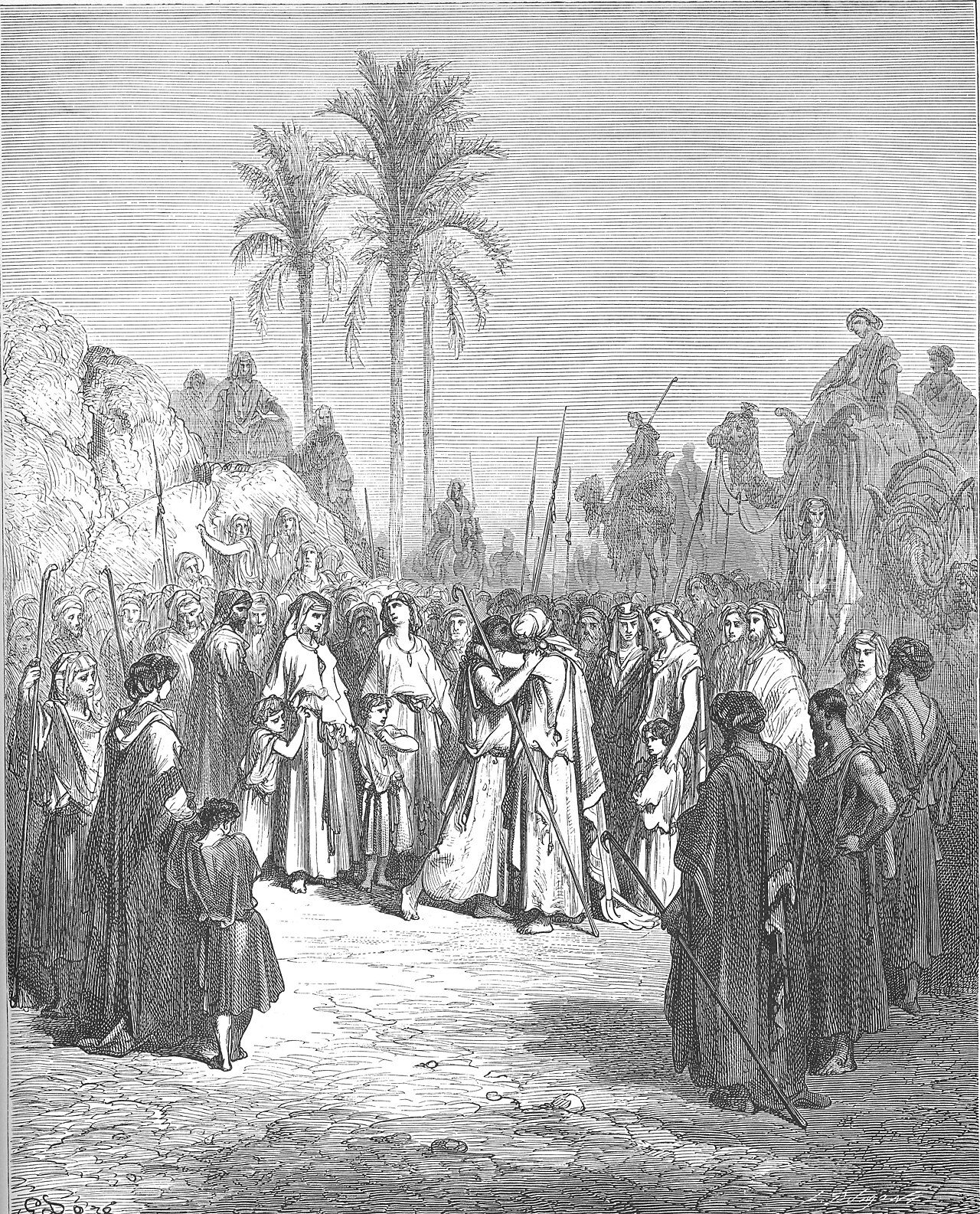
in Genesis 33He put the maidservants and their children in front, Leah and her children next, and Rachel and Joseph at the rear.
BSB
The same verse in ASV and KJV ▾
ASV
And he put the handmaids and their children foremost, and Leah and her children after, and Rachel and Joseph hindermost.
KJV
And he put the handmaids and their children foremost, and Leah and her children after, and Rachel and Joseph hindermost.
⋯
This verse in Genesis 33
Commentary
6 notes on this verse(Chapter 33, verses 1 and 2.) And he divided the children over Leah and over Rachel, and over the two maidservants, and he placed the maidservants and their firstborn sons: but Leah and her youngest sons, and Rachel and Joseph the youngest. And he himself went before them. No, as most people think, he did not make three groups, but two.
This site's exposition
Esau coming toward him with four hundred men
on Genesis 33:1-2
These are the four hundred men reported to Jacob at Genesis 32:6, and the night at the ford stands between the report and the meeting. The order he puts them in runs from the maidservants to Rachel and Joseph at the rear. Clarke asks the question that order raises, whether the ones set in front were the ones least esteemed. The household's own ranking is written down here.
This site's exposition
Rachel and Joseph at the rear
The rear is the place farthest from the four hundred men, and the order runs from least guarded to most guarded. The two camps of 32:7 have become four households in line. The same preference for Rachel's son puts the robe on Joseph at 37:3.
The record, by era
The Puritans and the Awakening2 voices
Observe what a different figure these two brothers made. Esau is attended with a guard of 400 men, and looks big; Jacob is followed by a cumbersome train of women and children that are his care, and he looks tender and solicitous for their safety; and yet Jacob had the birthright, and was to have the dominion, and was every way the better man.
And he put the handmaids and their children foremost,.... In the first division, as being less honourable and less beloved by him: and Leah and her children after; still according to the degree of honour and affection due unto them; Leah being a wife that was imposed and forced upon him: and Rachel and Joseph hindermost; being most beloved by him, and therefore most careful of them; Rachel being his principal and lawful wife, and who had the greatest share in his affection, and Joseph his only child by her.
The Nineteenth Century1 voice
He put the handmaids and their children foremost - There is something so artificial in this arrangement of Jacob’s family, that it must have had some peculiar design. Was Jacob still apprehensive of danger, and put those foremost whom he least esteemed, that if the foremost met with any evil, those who were behind might escape on their swift beasts?
The words behind it
15 Hebrew wordsEvery Hebrew word of this verse in the order it stands, with what it means and the door to its own study. The last column counts the times a word stands in the whole Bible: the rarer the word, the more the places it appears belong together.
| Hebrew | Sound | Meaning | Word study | In the Bible |
|---|---|---|---|---|
| וַיָּ֧שֶׂם | vaiyasem | and he put | H7760 → | 584 times |
| אֶת־ | ʾet- | <obj.> | H853 → | 10935 times |
| הַשְּׁפָח֛וֹת | hashefachot | the maidservants | H8198 → | 63 times |
| וְאֶת־ | veet | and <obj.> | H853 → | 10935 times |
| יַלְדֵיהֶ֖ן | yaldeihen | children their | H3206 → | 89 times |
| רִֽאשֹׁנָ֑ה | rishonah | first | H7223 → | 182 times |
| וְאֶת־ | veet | and <obj.> | H853 → | 10935 times |
| לֵאָ֤ה | leah | Leah | H3812 → | 34 times |
| וִֽילָדֶ֙יהָ֙ | viladeiha | and children her | H3206 → | 89 times |
| אַחֲרֹנִ֔ים | ʾacharonim | behind | H314 → | |
| וְאֶת־ | veet | and <obj.> | H853 → | 10935 times |
| רָחֵ֥ל | rachel | Rachel | H7354 → | 47 times |
| וְאֶת־ | veet | and <obj.> | H853 → | 10935 times |
| יוֹסֵ֖ף | yosef | Joseph | H3130 → | 213 times |
| אַחֲרֹנִֽים׃ | ʾacharonim | behind | H314 → |
וַיָּ֧שֶׂםand he put
vaiyasemH7760 →584 times
אֶת־<obj.>
ʾet-H853 →10935 times
הַשְּׁפָח֛וֹתthe maidservants
hashefachotH8198 →63 times
וְאֶת־and <obj.>
veetH853 →10935 times
יַלְדֵיהֶ֖ןchildren their
yaldeihenH3206 →89 times
רִֽאשֹׁנָ֑הfirst
rishonahH7223 →182 times
וְאֶת־and <obj.>
veetH853 →10935 times
לֵאָ֤הLeah
leahH3812 →34 times
וִֽילָדֶ֙יהָ֙and children her
viladeihaH3206 →89 times
אַחֲרֹנִ֔יםbehind
ʾacharonimH314 →
וְאֶת־and <obj.>
veetH853 →10935 times
רָחֵ֥לRachel
rachelH7354 →47 times
וְאֶת־and <obj.>
veetH853 →10935 times
יוֹסֵ֖ףJoseph
yosefH3130 →213 times
אַחֲרֹנִֽים׃behind
ʾacharonimH314 →
A shaded row is a word that stands 400 times or fewer in the Bible.
The walk
8 stopsEach card is a verse this one points to, and under it the verses that one points to in turn. Where several paths arrive at the same place, that place is listed first: the text keeps returning to it.
Through
Malachi 3:17“They will be Mine,” says the LORD of Hosts, “on the day when I prepare My treasured possession. And I will spare them as a man spares his own son who serves him.
it leads to
- Exodus 19:5
Now if you will indeed obey My voice and keep My covenant, you will be My treasured possession out of all the nations—for the whole earth is Mine.
- Deuteronomy 7:6
For you are a people holy to the LORD your God. The LORD your God has chosen you to be a people for His prized possession out of all peoples on the face of…
- 2 Corinthians 6:18
And: “I will be a Father to you, and you will be My sons and daughters, says the Lord Almighty.”
- Isaiah 62:3–4
You will be a crown of glory in the hand of the LORD, a royal diadem in the palm of your God.
- Romans 8:32
He who did not spare His own Son but gave Him up for us all, how will He not also, along with Him, freely give us all things?
- Exodus 19:5
Through
Genesis 29:30Jacob slept with Rachel as well, and indeed, he loved Rachel more than Leah. So he worked for Laban another seven years.
it leads to
- Genesis 31:41
Thus for twenty years I have served in your household—fourteen years for your two daughters and six years for your flocks—and you have changed my wages ten times!
- Genesis 31:15
Are we not regarded by him as outsiders? Not only has he sold us, but he has certainly squandered what was paid for us.
- Genesis 29:20
So Jacob served seven years for Rachel, yet it seemed but a few days because of his love for her.
- Genesis 31:41
Where this verse is studied
On this page
Studies1
About Genesis
Who and where
3 names in this verse with a page on the site.
- PersonPatriarchsLeahJacob's unloved first wife, on whom the LORD's eye fell — the mother of Judah, the messianic tribe, and of Levi, the priestly trib…
- PersonPatriarchsRachelJacob's beloved wife; mother of Joseph and Benjamin, who dies on the road to Bethlehem — later wept for in the prophets (Jer 31:15…
- PersonPatriarchsJosephThe rejected-then-exalted son — Genesis's great Christ-type; preserver of his family and of Egypt; the bridge into Exodus.
This page draws on Adam Clarke, Commentary on the Bible; Jerome, Hebrew Questions on Genesis; John Gill, Exposition of the Old Testament; John Gill, Exposition of the Old Testament (1748-1763) and Matthew Henry, Commentary on the Whole Bible.