
Genesis 33:11
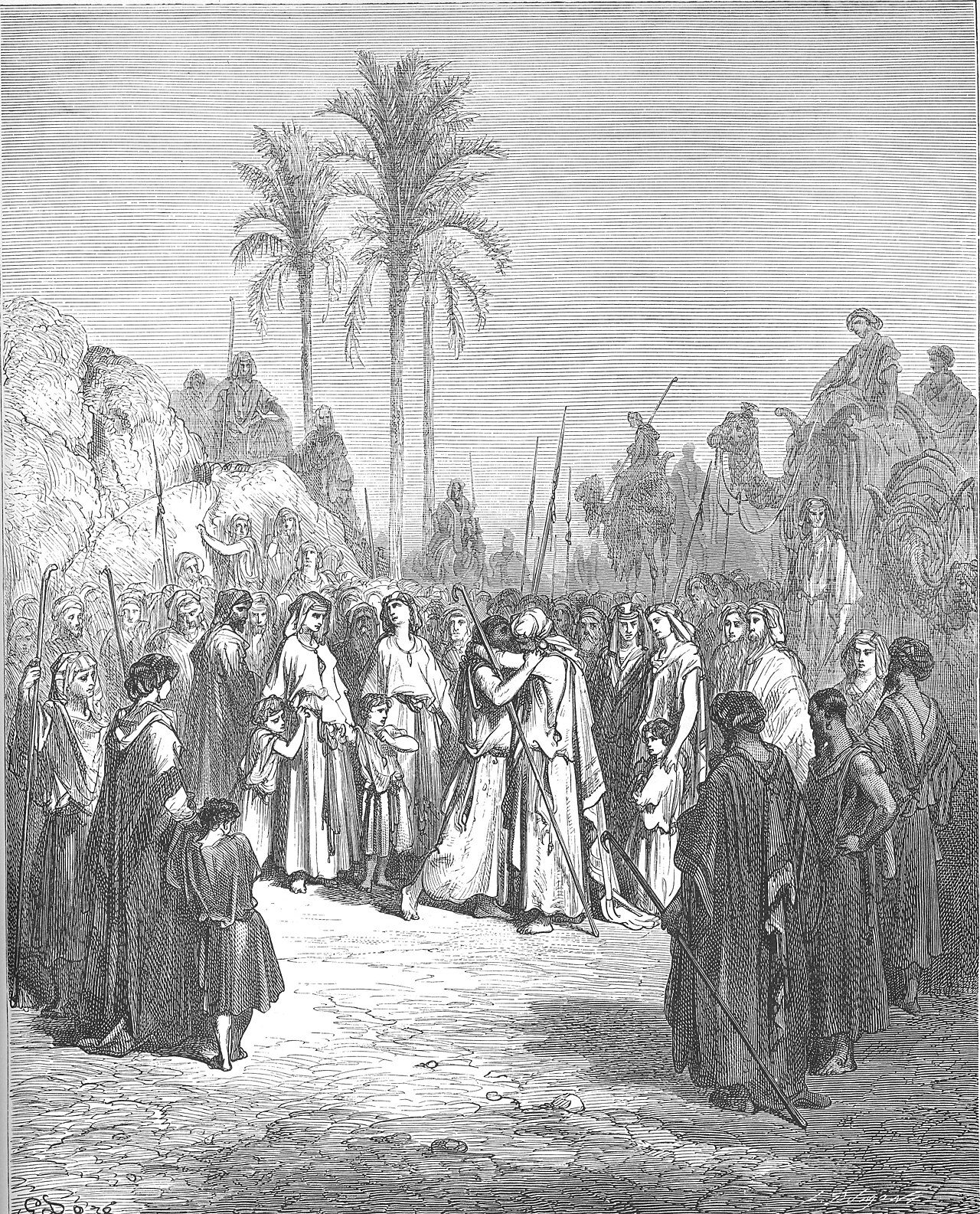
in Genesis 33Please accept my gift that was brought to you, because God has been gracious to me and I have all I need.” So Jacob pressed him until he accepted.
BSB
The same verse in ASV and KJV ▾
ASV
Take, I pray thee, my gift that is brought to thee; because God hath dealt graciously with me, and because I have enough. And he urged him, and he took it.
KJV
Take, I pray thee, my blessing that is brought to thee; because God hath dealt graciously with me, and because I have enough. And he urged him, and he took it.
⋯
This verse in Genesis 33
Commentary
6 notes on this verseA commentator
Jamieson, Fausset & Brown1802–1910
Commentary Critical and Explanatory on the Whole Bible (1871)
He urged him and he took it--In the East the acceptance by a superior is a proof of friendship, and by an enemy, of reconciliation. It was on both accounts Jacob was so anxious that his brother should receive the cattle; and in Esau's acceptance he had the strongest proofs of a good feeling being established that Eastern notions admit of.
This site's exposition
my gift that was brought to you
The word behind gift here is berakah, blessing, the word Esau cried over at Genesis 27:36. What was taken then cannot be handed back, so what is pressed on Esau is livestock called by that name. Gill notes that Esau's answer in the verse before says much, where Jacob's word here is all. Jacob pressed him, and he accepted.
The record, by era
The Puritans and the Awakening2 voices
It is a very high compliment that he passes upon him: I have seen thy face, as though I had seen the face of God, that is, "I have seen thee reconciled to me, and at peace with me, as I desire to see God reconciled." Or the meaning is that Jacob saw God's favour to him in Esau's: it was a token for good to him that God had accepted his prayers.
Take, I pray thee, my blessing that is brought to thee,....
The Nineteenth Century2 voices
A commentator
Charles Spurgeon1834–1892
The Metropolitan Tabernacle Pulpit, Sermon No. 2739: “'I Have Enough'” (lightly modernized text, CCEL edition) · Written before 1892.
proposed
IT is a very rare thing to meet with people who say that they have enough, for those who have most generally desire more, and those who have little feel that contentment is a thing which cannot reasonably be expected from them. For any person honestly and truthfully to say, "I have enough," is so unusual a circumstance that I do not remember having heard it often. I have done so a few times, at long intervals.
A commentator
Charles Spurgeon1834–1892
The Metropolitan Tabernacle Pulpit, Sermon No. 2739: “'I Have Enough'” (lightly modernized text, CCEL edition) · Written before 1892.
proposed
IT is a very rare thing to meet with people who say that they have enough, for those who have most generally desire more, and those who have little feel that contentment is a thing which cannot reasonably be expected from them. For any person honestly and truthfully to say, "I have enough," is so unusual a circumstance that I do not remember having heard it often. I have done so a few times, at long intervals. This being the case as a rule, it is very remarkable that there should be, in this chapter, a record of two persons who each said, "I have enough." It is specially noteworthy that this was said by two brothers, for, generally, if one of two brothers is contented, the other is of quite a different disposition. One may be of a very happy and easy-going spirit, but the other possesses enough worry and care to have stocked the two. But here are two brothers, twins, yet each one says, "I have enough." It will appear to you as a still more singular fact if you remember that these brothers differed so greatly from one another in other respects. The one was described by the Apostle Paul as a "profane person, who for one morsel of meat sold his birthright." Yet he says, "I have enough." The other was a man who had wrestled with God and who had power with God and with men as a prince! He also says, "I have enough." It seems to me as if, on that occasion, the blessing of their father Isaac rested upon them both, for you remember that, although Esau did not receive the great blessing—the Covenant blessing—that having gone to Jacob who secured it by deception, yet Esau did receive a great blessing of a temporal kind which Isaac pronounced upon him with all the fervor of a father who loved his son most ardently.
How the passage was read
What the Jewish commentators add
I.e., the gift. Likewise, Make your blessing with me. II Kings:31. means “bring me a gift” or “make your peace with me.” So also, Take a blessing of thy servant. Ibid.,:15. means “take a present from thy servant.
1 more on this passage, in their own words ▾
Some say that nisah (let us take our journey) is an imperative.
This section is reception history: how the passage was read and kept in the Jewish tradition. Where a reading parts from an essential of the Christian faith, the section says so at that point.
Texts and citation data: Sefaria; each excerpt follows its version’s licence. 4 further sources are cited on this chapter that carry no English text this site may quote or only restate the verse.
The words behind it
17 Hebrew wordsEvery Hebrew word of this verse in the order it stands, with what it means and the door to its own study. The last column counts the times a word stands in the whole Bible: the rarer the word, the more the places it appears belong together.
| Hebrew | Sound | Meaning | Word study | In the Bible |
|---|---|---|---|---|
| קַח־ | kach- | take | H3947 → | 966 times |
| נָ֤א | na' | please | H4994 → | 404 times |
| אֶת־ | ʾet- | <obj.> | H853 → | 10935 times |
| בִּרְכָתִי֙ | birkhati | blessing my | H1293 → | 69 times |
| אֲשֶׁ֣ר | ʾasher | which | H834 → | 5497 times |
| הֻבָ֣את | huvat | it was brought | H935 → | 2568 times |
| לָ֔ךְ | lakh | to <the> you | ||
| כִּֽי־ | ki- | for | H3588 → | 4482 times |
| חַנַּ֥נִי | chanani | he has shown favor to me | H2603 → | 78 times |
| אֱלֹהִ֖ים | ʾelohim | God | H430 → | 2601 times |
| וְכִ֣י | vekhi | and that | H3588 → | 4482 times |
| יֶשׁ־ | yesh- | there | H3426 → | 140 times |
| לִי־ | li- | [belongs] to <the> me | ||
| כֹ֑ל | khol | everything | H3605 → | 5413 times |
| וַיִּפְצַר־ | vaiyiftzar- | and he urged | H6484 → | 7 times |
| בּ֖וֹ | bo | <in> <the> him | ||
| וַיִּקָּֽח׃ | vaiyikach | and he took [it] | H3947 → | 966 times |
קַח־take
kach-H3947 →966 times
נָ֤אplease
na'H4994 →404 times
אֶת־<obj.>
ʾet-H853 →10935 times
בִּרְכָתִי֙blessing my
birkhatiH1293 →69 times
אֲשֶׁ֣רwhich
ʾasherH834 →5497 times
הֻבָ֣אתit was brought
huvatH935 →2568 times
לָ֔ךְto <the> you
lakh
כִּֽי־for
ki-H3588 →4482 times
חַנַּ֥נִיhe has shown favor to me
chananiH2603 →78 times
אֱלֹהִ֖יםGod
ʾelohimH430 →2601 times
וְכִ֣יand that
vekhiH3588 →4482 times
יֶשׁ־there
yesh-H3426 →140 times
לִי־[belongs] to <the> me
li-
כֹ֑לeverything
kholH3605 →5413 times
וַיִּפְצַר־and he urged
vaiyiftzar-H6484 →7 times
בּ֖וֹ<in> <the> him
bo
וַיִּקָּֽח׃and he took [it]
vaiyikachH3947 →966 times
A shaded row is a word that stands 400 times or fewer in the Bible.
The walk
8 stopsEach card is a verse this one points to, and under it the verses that one points to in turn. Where several paths arrive at the same place, that place is listed first: the text keeps returning to it.
Through
Philippians 4:18I have all I need and more, now that I have received your gifts from Epaphroditus. They are a fragrant offering, an acceptable sacrifice, well-pleasing to God.
it leads to
- Hebrews 13:16
And do not neglect to do good and to share with others, for with such sacrifices God is pleased.
- 2 Corinthians 9:12
For this ministry of service is not only supplying the needs of the saints, but is also overflowing in many expressions of thanksgiving to God.
- Philippians 4:12
I know how to live humbly, and I know how to abound. I am accustomed to any and every situation—to being filled and being hungry, to having plenty and having need.
- Ephesians 5:2
and walk in love, just as Christ loved us and gave Himself up for us as a fragrant sacrificial offering to God.
- Philippians 2:25–26
But I thought it necessary to send back to you Epaphroditus, my brother, fellow worker, and fellow soldier, who is also your messenger and minister to my needs.
- Hebrews 13:16
Through
Genesis 30:43Thus Jacob became exceedingly prosperous. He owned large flocks, maidservants and menservants, and camels and donkeys.
it leads to
- Genesis 26:13–14
and he became richer and richer, until he was exceedingly wealthy.
- Genesis 30:30
Indeed, you had very little before my arrival, but now your wealth has increased many times over. The LORD has blessed you wherever I set foot. But now, when may I also provide for…
- Genesis 24:35
“The LORD has greatly blessed my master, and he has become rich. He has given him sheep and cattle, silver and gold, menservants and maidservants, camels and donkeys.
- Genesis 26:13–14
Where this verse is studied
On this page
Studies1
About Genesis
Who and where
1 name in this verse with a page on the site.
This page draws on Charles Spurgeon, The Metropolitan Tabernacle Pulpit, Sermon No. 2739: “'I Have Enough'” (lightly modernized text, CCEL edition); Jamieson, Fausset & Brown, Commentary Critical and Explanatory on the Whole Bible; John Gill, Exposition of the Old Testament; John Gill, Exposition of the Old Testament (1748-1763) and Matthew Henry, Commentary on the Whole Bible.