
Genesis 33:1
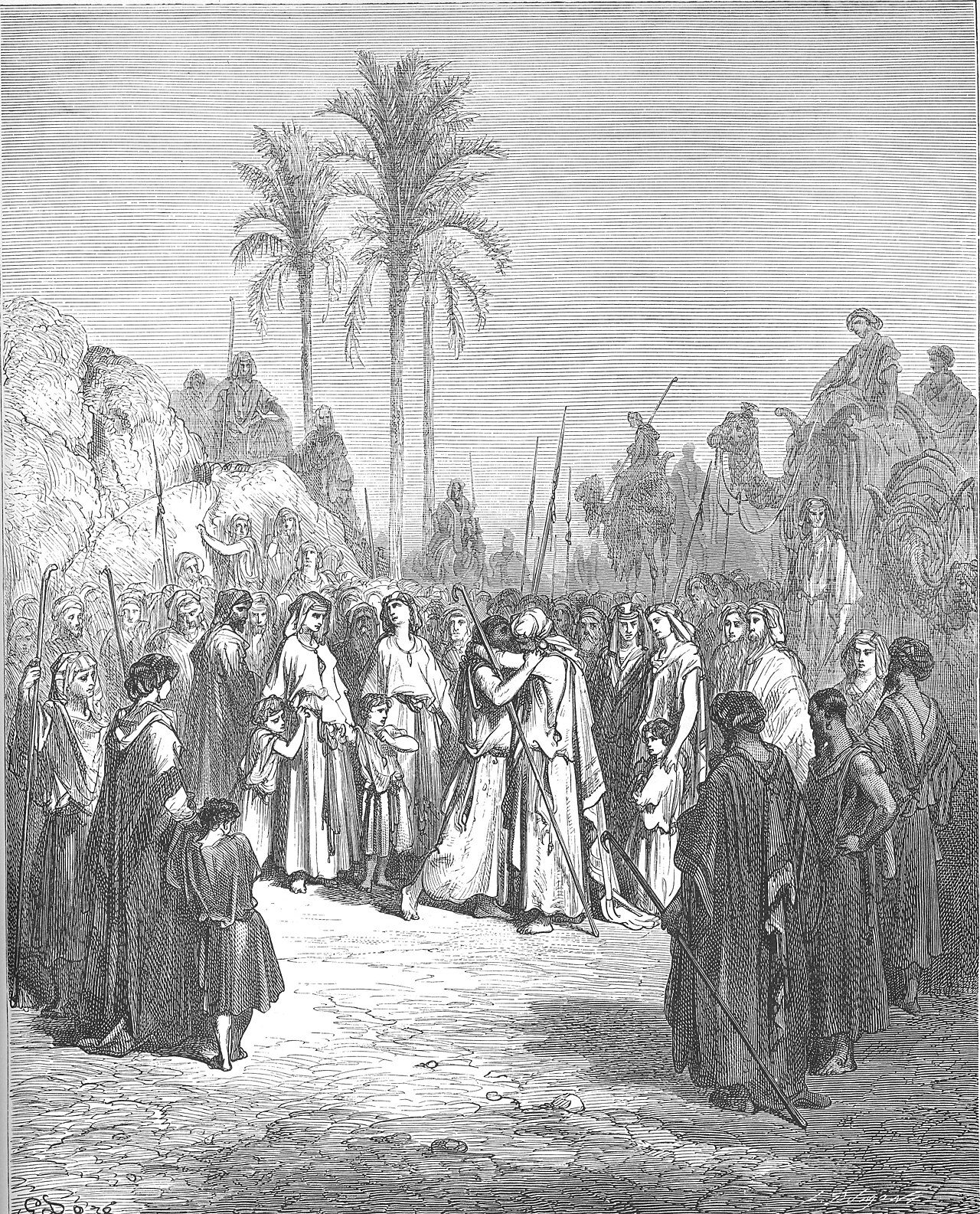
in Genesis 33Now Jacob looked up and saw Esau coming toward him with four hundred men. So he divided the children among Leah, Rachel, and the two maidservants.
BSB
The same verse in ASV and KJV ▾
ASV
And Jacob lifted up his eyes, and looked, and, behold, Esau was coming, and with him four hundred men. And he divided the children unto Leah, and unto Rachel, and unto the two handmaids.
KJV
And Jacob lifted up his eyes, and looked, and, behold, Esau came, and with him four hundred men. And he divided the children unto Leah, and unto Rachel, and unto the two handmaids.
⋯
This verse in Genesis 33
Commentary
8 notes on this verse(Chapter 33, verses 1 and 2.) And he divided the children over Leah and over Rachel, and over the two maidservants, and he placed the maidservants and their firstborn sons: but Leah and her youngest sons, and Rachel and Joseph the youngest. And he himself went before them. No, as most people think, he did not make three groups, but two.
This site's exposition
Esau coming toward him with four hundred men
on Genesis 33:1-2
These are the four hundred men reported to Jacob at Genesis 32:6, and the night at the ford stands between the report and the meeting. The order he puts them in runs from the maidservants to Rachel and Joseph at the rear. Clarke asks the question that order raises, whether the ones set in front were the ones least esteemed. The household's own ranking is written down here.
The record, by era
The Puritans and the Awakening3 voices
Observe what a different figure these two brothers made. Esau is attended with a guard of 400 men, and looks big; Jacob is followed by a cumbersome train of women and children that are his care, and he looks tender and solicitous for their safety; and yet Jacob had the birthright, and was to have the dominion, and was every way the better man.
And Jacob lifted up his eyes, and looked,....
Some think that his lifting up his eyes denotes his cheerfulness and confidence, in opposition to a dejected countenance; having by prayer committed his case to God, he went on his way, and his countenance was no more sad, 1 Sam. i.
The Nineteenth Century2 voices
A commentator
Jamieson, Fausset & Brown1802–1910
Commentary Critical and Explanatory on the Whole Bible (1871)
proposed
His faith was strengthened and his fears gone (Ps 27:3). Having had power to prevail with God, he was confident of the same power with man, according to the promise (compare Ge 32:28).
Behold, Esau came, and with him four hundred men - It has been generally supposed that Esau came with an intention to destroy his brother, and for that purpose brought with him four hundred armed men. But, 1. There is no kind of evidence of this pretended hostility. 2. There is no proof that the four hundred men that Esau brought with him were at all armed. 3. But there is every proof that he acted towards his brother Jacob with all openness and candour, and with such a forgetfulness of past injuries as none but a great mind could have been capable of. Why then should the character of this man be perpetually vilified? Here is the secret. With some people, on the most ungrounded assumption, Esau is a reprobate, and the type and figure of all reprobates, and therefore he must be everything that is bad. This serves a system; but, whether true or false in itself, it has neither countenance nor support from the character or conduct of Esau.
1 more voice on this verse
The Nineteenth Century1 voice
A commentator
Albert Barnes1798–1870
Notes, Explanatory and Practical, on the Old and New Testaments (1832-1869)
proposed
- Jacob and Esau Meet 17. סכת sûkkôth, Sukkoth, “booths,” consisting of poles forming a roof covered with branches, leaves, or grass. 19. חמור chămôr Chamor, “ass, red, heap.” קשׂיטה qeśı̂yṭâh Qesitah, weighed or measured. Ἀμνὸς Amnos, Septuagint and Onkelos Jacob has a friendly interview with Esau, and re-+enters Kenaan. Gen 33:1-3 Jacob, upon seeing Esau approach with his four hundred men, advances with circumspection and lowly obeisance. He divided his family, arranged them according to their preciousness in his eyes, and walks himself in front.
The words behind it
21 Hebrew wordsEvery Hebrew word of this verse in the order it stands, with what it means and the door to its own study. The last column counts the times a word stands in the whole Bible: the rarer the word, the more the places it appears belong together.
| Hebrew | Sound | Meaning | Word study | In the Bible |
|---|---|---|---|---|
| וַיִּשָּׂ֨א | vaiyisa' | and he lifted up | H5375 → | 656 times |
| יַעֲקֹ֜ב | yaako | Jacob | H3290 → | 350 times |
| עֵינָ֗יו | ʾeinav | eyes his | H5869 → | 887 times |
| וַיַּרְא֙ | vaiyar' | and he saw | H7200 → | 1300 times |
| וְהִנֵּ֣ה | vehineh | and there! | H2009 → | 843 times |
| עֵשָׂ֣ו | ʾesav | Esau | H6215 → | 97 times |
| בָּ֔א | ba' | [was] coming | H935 → | 2568 times |
| וְעִמּ֕וֹ | veimo | and [were] with him | H5973 → | 1050 times |
| אַרְבַּ֥ע | ʾarba' | four | H702 → | 318 times |
| מֵא֖וֹת | meot | hundred<s> | H3967 → | 581 times |
| אִ֑ישׁ | ʾish | man | H376 → | 1663 times |
| וַיַּ֣חַץ | vaiyachatz | and he divided | H2673 → | |
| אֶת־ | ʾet- | <obj.> | H853 → | 10935 times |
| הַיְלָדִ֗ים | hayladim | the children | H3206 → | 89 times |
| עַל־ | ʾal- | with | H5921 → | 5755 times |
| לֵאָה֙ | leah | Leah | H3812 → | 34 times |
| וְעַל־ | veal- | and with | H5921 → | 5755 times |
| רָחֵ֔ל | rachel | Rachel | H7354 → | 47 times |
| וְעַ֖ל | veal | and with | H5921 → | 5755 times |
| שְׁתֵּ֥י | shetei | [the] two | H8147 → | 768 times |
| הַשְּׁפָחֽוֹת׃ | hashefachot | the maidservants | H8198 → | 63 times |
וַיִּשָּׂ֨אand he lifted up
vaiyisa'H5375 →656 times
יַעֲקֹ֜בJacob
yaakoH3290 →350 times
עֵינָ֗יוeyes his
ʾeinavH5869 →887 times
וַיַּרְא֙and he saw
vaiyar'H7200 →1300 times
וְהִנֵּ֣הand there!
vehinehH2009 →843 times
עֵשָׂ֣וEsau
ʾesavH6215 →97 times
בָּ֔א[was] coming
ba'H935 →2568 times
וְעִמּ֕וֹand [were] with him
veimoH5973 →1050 times
אַרְבַּ֥עfour
ʾarba'H702 →318 times
מֵא֖וֹתhundred<s>
meotH3967 →581 times
אִ֑ישׁman
ʾishH376 →1663 times
וַיַּ֣חַץand he divided
vaiyachatzH2673 →
אֶת־<obj.>
ʾet-H853 →10935 times
הַיְלָדִ֗יםthe children
hayladimH3206 →89 times
עַל־with
ʾal-H5921 →5755 times
לֵאָה֙Leah
leahH3812 →34 times
וְעַל־and with
veal-H5921 →5755 times
רָחֵ֔לRachel
rachelH7354 →47 times
וְעַ֖לand with
vealH5921 →5755 times
שְׁתֵּ֥י[the] two
sheteiH8147 →768 times
הַשְּׁפָחֽוֹת׃the maidservants
hashefachotH8198 →63 times
A shaded row is a word that stands 400 times or fewer in the Bible.
The walk
5 stopsEach card is a verse this one points to, and under it the verses that one points to in turn. Where several paths arrive at the same place, that place is listed first: the text keeps returning to it.
Through
Genesis 32:16He entrusted them to his servants in separate herds and told them, “Go on ahead of me, and keep some distance between the herds.”
it leads to
- Genesis 32:20
You are also to say, ‘Look, your servant Jacob is right behind us.’” For he thought, “I will appease Esau with the gift that is going before me. After that I can face him,…
- Genesis 33:8–9
“What do you mean by sending this whole company to meet me?” asked Esau. “To find favor in your sight, my lord,” Jacob answered.
- Proverbs 2:11
Discretion will watch over you, and understanding will guard you,
- Isaiah 28:26
For his God instructs and teaches him properly.
- Psalms 112:5
It is well with the man who is generous and lends freely, whose affairs are guided by justice.
- Genesis 32:20
Where this verse is studied
On this page
Studies1
About Genesis
Who and where
4 names in this verse with a page on the site.
- PersonPatriarchsEsauIsaac's elder son who despised his birthright (Heb 12:16); father of Edom, Israel's perennial neighbor and adversary.
- PersonPatriarchsLeahJacob's unloved first wife, on whom the LORD's eye fell — the mother of Judah, the messianic tribe, and of Levi, the priestly trib…
- PersonPatriarchsRachelJacob's beloved wife; mother of Joseph and Benjamin, who dies on the road to Bethlehem — later wept for in the prophets (Jer 31:15…
- PersonPatriarchsJacobThe heel-grasping supplanter reshaped at Peniel into 'Israel, he who strives with God' — father of the twelve tribes.
This page draws on Adam Clarke, Commentary on the Bible; Albert Barnes, Notes, Explanatory and Practical, on the Old and New Testaments (1832-1869); Jamieson, Fausset & Brown, Commentary Critical and Explanatory on the Whole Bible; Jerome, Hebrew Questions on Genesis; John Gill, Exposition of the Old Testament (1748-1763) and Matthew Henry, Commentary on the Whole Bible.