
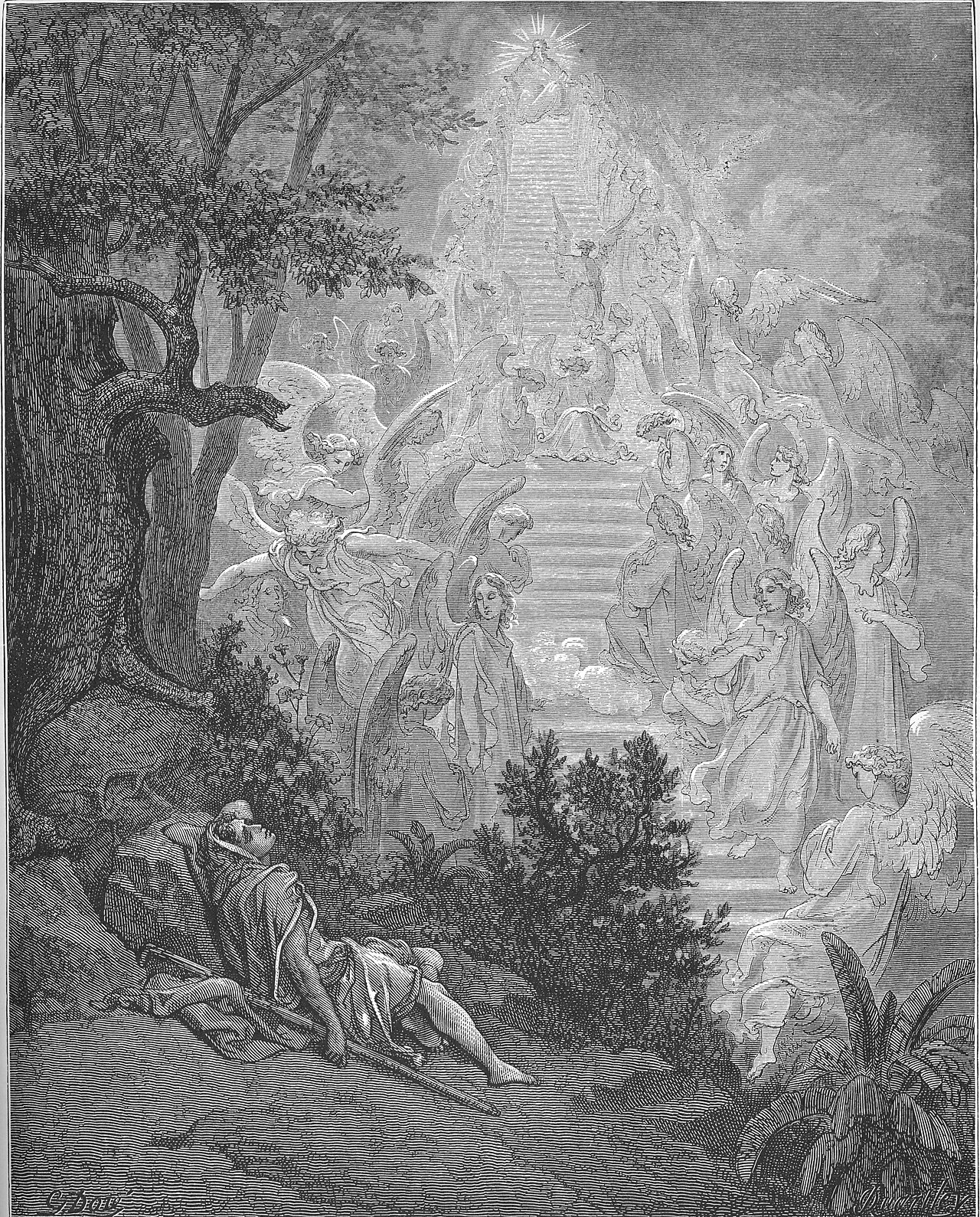
Genesischapter 28
22 verses · Moses, by tradition · 15th to 13th century BC · The Law
In Jewish life
The reading
Weekly portion 6 of 54
תּוֹלְדֹת Toldot, Genesis 25:19 to 28:9
Read with it: Malachi 1:1 to 2:7.
Weekly portion 7 of 54
וַיֵּצֵא Vayetzei, Genesis 28:10 to 32:3
Read with it: Hosea 12:13 to 14:10 in Ashkenazi use, and Hosea 11:7 to 12:12 in Sephardi use.
The verse numbers here are the ones a Hebrew Bible carries, which differ from an English Bible by a verse or two in several places. The Sephardi reading is named only where this site records a difference; communities vary beyond what is listed. What these books are, and how a Christian reader meets them →
What is done
A seam of the reading cycle falls inside this chapter. The portion Toldot ends at Genesis 28:9 and the portion Vayetzei begins at 28:10, so a congregation reading the annual cycle hears the first nine verses on one Sabbath and the rest on the next, and the chapter is never read through in one sitting (src/lib/hebraic/readings.ts, the entries for portions six and seven). Rashi noticed the same break from inside the text. He reads verses six to nine as an interruption, and says that "Scripture broke off the narrative contained, in the section dealing with Jacob" to record Esau's further marriage, and picked the thread up again at the tenth verse (Rashi on Genesis 28:10:1, the Pentateuch with Rashi's commentary by M. Rosenbaum and A. M. Silbermann, 1929 to 1934, public domain). The break the readers hear and the break Rashi describes fall at the same line.
How it is read
Rashi reads the ladder as a change of guard rather than a picture of traffic. On the angels going up before they come down he says that "Those angels who accompanied him in the land of Israel were not permitted to leave the Land: they ascended to Heaven and angels which were to minister outside the Land descended to accompany him", citing Genesis Rabbah 68:12. He takes the place Jacob lighted upon to be Mount Moriah, and builds a long argument out of the distances between Beersheba, Jerusalem and Bethel, with the ground itself moving towards Jacob, drawing on Chullin 91b and Pesachim 88a and on Genesis Rabbah 69:7 for the saying of R. Eleazar in the name of R. Jose the son of Zimra that the ladder stood in Beersheba with its slope reaching opposite the Temple (Rashi on Genesis 28:11:1 and 28:17:1). On Jacob's waking he keeps the sense plain: "for had I known it I would not have slept in such a holy place as this" (Rashi on Genesis 28:16:1). He also uses the ninth verse to fix Jacob's age at sixty-three and to argue that the fourteen unaccounted years were spent studying in the school of Eber, on the authority of Megillah 17a. Radak reads the chapter for its plain human sense, and on Esau's realisation he notes that the Torah describes it as seeing because sight is the most reliable of the senses (Radak on Genesis 28:6:1, translated by Eliyahu Munk, HaChut Hameshulash, CC-BY), and that Esau turned to Ishmael only when he saw how deeply his father resented his Canaanite wives (Radak on Genesis 28:8:1). Malbim comments here at 28:1:1 and 28:19:1 and Ibn Ezra at 28:18:1, and the corpus holds no English of either under a licence permitting quotation, so they stand as citations.
What the rabbis say
The corpus records forty rabbinic locators on this chapter, thirty-seven of them Midrash and three Talmud. Aggadat Bereshit takes the chapter up eleven times, and its densest run is on the departure and the dream at 46:1, 46:2, 46:3, 55:1, 39:1 and 45:1. Bereshit Rabbah stands at ten places, among them 63:4 on Rebekah as the mother of the two brothers, 47:6 and 50:9 on the dream, 69:7 on Jacob's waking word and 44:8 on the vow that closes the chapter. Bereshit Rabbati is cited at Parashat Vayishlach 28, Parashat Lech Lecha 23 and Parashat Vayetze 52, Bamidbar Rabbah at 17:3, 8:9 and 11:7, and Midrash Aggadah at Genesis 27:6:1, 28:7:1, 28:16:1 and 28:17:1. The three Talmud locators are Megillah 17a:2 at the sixth verse, Berakhot 4a:16 at the promise of the fifteenth and Avot DeRabbi Natan 37:12. Rashi hands on further sayings with their own locators, among them Genesis Rabbah 68:12, 69:3, 69:7 and 70:4, Chullin 91b, Pesachim 88a and Yevamot 13b.
The text, verse by verse
Each word shows the Hebrew, the English under it, how it sounds and its Strong’s number. A rule between verses marks where the Hebrew manuscripts end a paragraph.
Sent to Paddan-aram for a Wife
Onkelos Genesis 28:1
Yitzchok called Yaakov and blessed him. He commanded him and said to him, Do not marry a woman of the daughters of Canaan.
Read it in full at Sefaria · Metsudah Chumash, Metsudah Publications, 2009 [with Onkelos translation]
A Ladder Set Up to Heaven
Ibn Ezra on Genesis 28:11
[AND HE LIGHTED UPON THE PLACE.] The reason the bet of ba-makom (the place) 10 There is a difference between be-makom and ba-makom.
Read it in full at Sefaria · Ibn Ezra's commentary on the Pentateuch, tran. and annot. by H. Norman Strickman and Arthur M. Silver. Menorah Pub., 1988-2004
The House of God, the Gate of Heaven
Hebrew words in this chapter
The 40 most used Hebrew words of the chapter, counted by lemma. The article, the object marker, the negatives and the common prepositions are left out.
| Word | Sense here | Uses | Strong’s |
|---|---|---|---|
| יַעֲקֹבYaʻăqôb | Jacob | 9 | H3290 |
| אֱלֹהִיםʼĕlôhîym | God | 8 | H430 |
| לָקַחlâqach | to take | 7 | H3947 |
| הָלַךְhâlak | went | 7 | H1980 |
| אָמַרʼâmar | to say | 6 | H559 |
| אִשָּׁהʼishshâh | a wife | 6 | H802 |
| מָקוֹםmâqôwm | place | 6 | H4725 |
| יִצְחָקYitschâq | Isaac | 5 | H3327 |
| בָרַךְbârak | to bless | 5 | H1288 |
| בַּתbath | daughter | 5 | H1323 |
| אָבʼâb | father | 5 | H1 |
| נָתַןnâthan | to give | 5 | H5414 |
| פַּדָּןPaddân | Paddan | 4 | H6307 |
| אֲרָםʼĂrâm | Aram | 4 | H758 |
| בַּיִתbayith | house of towards | 4 | H1004 |
| אֵםʼêm | mother | 4 | H517 |
| אַבְרָהָםʼAbrâhâm | Abraham | 4 | H85 |
| זֶרַעzeraʻ | and to offspring your | 4 | H2233 |
| אֶרֶץʼerets | land | 4 | H776 |
| עֵשָׂוʻÊsâv | Esau | 4 | H6215 |
| Word | Sense here | Uses | Strong’s |
|---|---|---|---|
| שׂוּםsûwm | to set | 4 | H7760 |
| הִנֵּהhinnêh | and there | 4 | H2009 |
| יְהֹוָהYᵉhôvâh | yahweh | 4 | H3068 |
| כְּנַעַןKᵉnaʻan | Canaan | 3 | H3667 |
| שָׁםshâm | there | 3 | H8033 |
| אֶבֶןʼeben | stone | 3 | H68 |
| אָנֹכִיʼânôkîy | I | 3 | H595 |
| קָרָאqârâʼ | to call | 2 | H7121 |
| צָוָהtsâvâh | to command | 2 | H6680 |
| בְּתוּאֵלBᵉthûwʼêl | Bethuel | 2 | H1328 |
| לָבָןLâbân | Laban | 2 | H3837 |
| אָחʼâch | brother | 2 | H251 |
| שָׁלַחshâlach | and he sent off | 2 | H7971 |
| בֵּןbên | son | 2 | H1121 |
| רָאָהrâʼâh | and he saw | 2 | H7200 |
| יִשְׁמָעֵאלYishmâʻêʼl | Ishmael | 2 | H3458 |
| בְּאֵר שֶׁבַעBᵉʼêr Shebaʻ | from beer | 2 | H884 |
| מְרַאֲשָׁהmᵉraʼăshâh | head | 2 | H4763 |
| שָׁכַבshâkab | to lie down | 2 | H7901 |
| נָצַבnâtsab | to stand | 2 | H5324 |
Keep studying
Sources for this chapter
The Hebrew text
STEP Bible, the tagged Hebrew text and its English glosses and James Strong, Strong's Exhaustive Concordance.
In Jewish life
Rashi, Rashi on Genesis 28:2:1, 28:2:2, 28:3:1, 28:4:1, 28:5:1, 28:7:1, 28:9:1, 28:10:1, 28:11:1, 28:12:1, 28:13:1, 28:14:1, 28:15:1, 28:16:1, 28:17:1, 28:20:1, 28:21:1 and 28:22:1, the Pentateuch with Rashi's commentary by M. Rosenbaum and A. M. Silbermann, 1929 to 1934, public domain; Radak, Radak on Genesis 28:1:1, 28:6:1 and 28:8:1, translated by Eliyahu Munk, HaChut Hameshulash, CC-BY; Malbim, Malbim on Genesis 28:1:1 and 28:19:1, cited only, no English version in the corpus under a licence permitting quotation; Ibn Ezra, Ibn Ezra on Genesis 28:18:1, cited only; Midrash, Bereshit Rabbah 44:8, 47:6, 50:9, 63:4, 65:15, 67:12, 69:7, 79:4, 82:2 and 100:12; Aggadat Bereshit 2:2, 39:1, 42:1, 45:1, 46:1, 46:2, 46:3, 47:2, 55:1, 67:2, 73:1 and 82:2; Bereshit Rabbati, Parashat Vayishlach 28, Parashat Lech Lecha 23 and Parashat Vayetze 52; Bamidbar Rabbah 8:9, 11:7 and 17:3; Midrash Aggadah, Genesis 27:6:1, 28:7:1, 28:16:1 and 28:17:1; Midrash Lekach Tov, Genesis 28:4:1 and 28:6:1; Eikhah Rabbah 1:1; Esther Rabbah 7:9; Ein Yaakov (Glick Edition), Pesakhim 8:8; Babylonian Talmud, Megillah 17a:2, Berakhot 4a:16; Chullin 91b, Pesachim 88a, Megillah 17a and Yevamot 13b as Rashi cites them; Avot DeRabbi Natan, Avot DeRabbi Natan 37:12 and MannaFest, the annual cycle table, src/lib/hebraic/readings.ts.
The rabbinic texts
Ibn Ezra, Ibn Ezra's commentary on the Pentateuch, tran. and annot. by H. Norman Strickman and Arthur M. Silver. Menorah Pub., 1988-2004; Targum, Metsudah Chumash, Metsudah Publications, 2009 [with Onkelos translation] and Sefaria, texts and citation data.