
Genesischapter 21
34 verses · Moses, by tradition · 15th to 13th century BC · The Law
In Jewish life
The reading
Weekly portion 4 of 54
וַיֵּרָא Vayera, Genesis 18:1 to 22:24
Read with it: 2 Kings 4:1 to 4:37 in Ashkenazi use, and 2 Kings 4:1 to 4:23 in Sephardi use.
The verse numbers here are the ones a Hebrew Bible carries, which differ from an English Bible by a verse or two in several places. The Sephardi reading is named only where this site records a difference; communities vary beyond what is listed. What these books are, and how a Christian reader meets them →
What is done
This chapter is heard inside the fourth portion of the annual cycle, in the same sitting as the visit at the oaks and the binding of Isaac (src/lib/hebraic/readings.ts).
The circumcision of Isaac on the eighth day stands in the fourth verse, and the corpus carries a ruling of practice on it. Radak reports that the sages read the wording as laying the duty on the father. The father is the one commanded to have his son circumcised (Radak on Genesis 21:4:1, referring back to Genesis 17:12). The card above carries the portion and the prophetic reading set beside it.
How it is read
The corpus holds the English text of six comments on this chapter and the reference alone for eighteen more. Radak is quoted from the CC-BY translation of Eliyahu Munk, HaChut Hameshulash.
Radak reads the fifth verse as a check on the reckoning. The age of Abraham at the covenant and the year named for the birth already give the number, and the text sets it down again so that the count is certain (Radak on Genesis 21:5:1).
He reads the two promises about Ishmael as words of comfort. The son of the servant will not perish away from the house, and God says "I will make him develop into a great nation" for his father's sake (Radak on Genesis 21:13:1). At the well he reads the word to Hagar as a command to hold on to the boy, since he will not die of thirst (Radak on Genesis 21:18:1). On the opening of her eyes he gives two plain readings. The well may have stood there all along under a covering that hid it, or it may have been some way off (Radak on Genesis 21:19:1).
Rashi comments on sixteen verses of this chapter, and the corpus holds the text of none of them, because the licence Sefaria reports for that English version keeps it out. They run from Rashi on Genesis 21:1:1 on the visiting of Sarah to Rashi on Genesis 21:23:1 on the oath with Abimelech. They cover the laughter of the sixth verse, the feast at the weaning in the eighth and the mocking in the ninth. They cover the sending away in the fourteenth verse and the crying of the boy in the seventeenth. Ibn Ezra stands on the third verse at Ibn Ezra on Genesis 21:3:1.
What the rabbis say
The corpus records forty places where the Midrash and the Talmud cite this chapter, thirty seven under Midrash and three under Talmud, which is the lightest Talmud weight after Genesis 10. It carries the locator for each one with no text, so the references stand here and the sayings are read at the source.
Bereshit Rabbah reads the third verse at 53:7, the fourth at 60:5, the sixth at 53:8 and the eighth at 48:11. It reads the eleventh verse at 53:12, the fourteenth at 53:13, the twentieth at 53:15 and the twenty second at 54:1. It reads the twenty fourth verse at 54:3, the twenty seventh at 28:5 and the thirtieth at 54:5.
Aggadat Bereshit reads the first verse at 28:1 and 28:2, the second at 28:4 and 37:1, and the ninth at 61:2. It reads the tenth verse at 34:1, the twelfth at 22:2, the twenty first at 37:4 and the thirty third at 13:2. Bereshit Rabbati reads five places in Parashat Vayera and Parashat Lech Lecha, at 25, 23, 43, 22 and 19.
Bamidbar Rabbah reads the thirteenth verse at 19:3, the twenty third at 14:1 and the thirty first and thirty second at 9:47. Eikhah Rabbah reads the crying of the boy at 2:4. Midrash Sekhel Tov reads the eighteenth and thirty second verses at the locators of the same names, and Midrash Lekach Tov reads the third, twenty fifth and twenty sixth at theirs.
The three Talmud locators are Bava Metzia 87a:12 on the seventh verse, Avot DeRabbi Natan in its second recension at 47:6 on the sixteenth, and Jerusalem Talmud Taanit 4:5:19 on the well of the nineteenth.
The text, verse by verse
Each word shows the Hebrew, the English under it, how it sounds and its Strong’s number. A rule between verses marks where the Hebrew manuscripts end a paragraph.
Isaac, the Son of Laughter
Ramban on Genesis 21:1
AND THE ETERNAL ‘PAKAD’ (VISITED) SARAH AS HE HAD SAID. That is, by granting her pregnancy. And the Eternal did unto Sarah as He had spoken by granting her the birth of a son.Thus the words of Rashi.
Read it in full at Sefaria · Commentary on the Torah by Ramban (Nachmanides). Translated and annotated by Charles B. Chavel. New York, Shilo Pub. House, 1971-1976
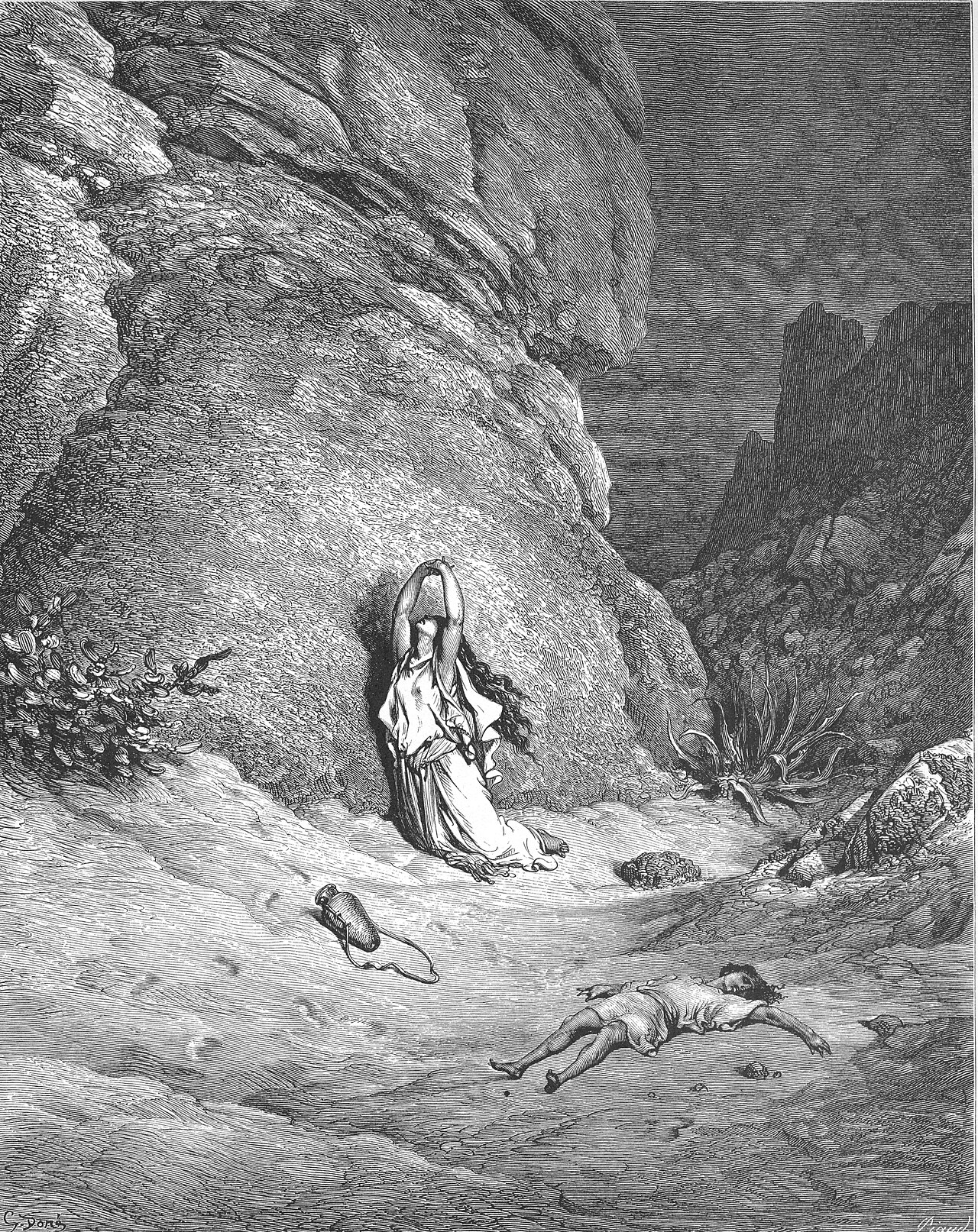
Hagar and Ishmael Sent Away
Onkelos Genesis 21:10
She said to Avraham, Drive out this slave-woman and her son, for the son of this slave-woman will not inherit with my son, with Yitzchok.
Read it in full at Sefaria · Metsudah Chumash, Metsudah Publications, 2009 [with Onkelos translation]
Ramban on Genesis 21:11
AND THE THING WAS VERY GRIEVOUS IN ABRAHAM’s SIGHT ON ACCOUNT OF HIS SON. That is, for he had taken to degenerate ways. The plain meaning, however, is that he was grieved because she had told him to send him away. Thus the language of Rashi.
Read it in full at Sefaria · Commentary on the Torah by Ramban (Nachmanides). Translated and annotated by Charles B. Chavel. New York, Shilo Pub. House, 1971-1976
Ramban on Genesis 21:14
This is to be understood in connection with the above: And he gave to Hagar [the bread and bottle of water]… and the child, for he gave her the child also to go with her wherever she will go.
Read it in full at Sefaria · Commentary on the Torah by Ramban (Nachmanides). Translated and annotated by Charles B. Chavel. New York, Shilo Pub. House, 1971-1976
The Oath at the Well of Beersheba
Hebrew words in this chapter
The 40 most used Hebrew words of the chapter, counted by lemma. The article, the object marker, the negatives and the common prepositions are left out.
| Word | Sense here | Uses | Strong’s |
|---|---|---|---|
| אַבְרָהָםʼAbrâhâm | Abraham | 18 | H85 |
| אָמַרʼâmar | to say | 14 | H559 |
| בֵּןbên | son | 14 | H1121 |
| אֱלֹהִיםʼĕlôhîym | God | 11 | H430 |
| שָׂרָהSârâh | Sarah | 8 | H8283 |
| בְּאֵר שֶׁבַעBᵉʼêr Shebaʻ | beer | 8 | H884 |
| עָשָׂהʻâsâh | and he did | 7 | H6213 |
| אֲבִימֶלֶךְʼĂbîymelek | Abimelech | 7 | H40 |
| יָלַדyâlad | and she bore | 6 | H3205 |
| יִצְחָקYitschâq | Isaac | 6 | H3327 |
| נַעַרnaʻar | the lad | 6 | H5288 |
| קָרָאqârâʼ | to call | 5 | H7121 |
| שָׁמַעshâmaʻ | to hear | 5 | H8085 |
| מַיִםmayim | water | 5 | H4325 |
| יוֹםyôwm | day | 4 | H3117 |
| יֶלֶדyeled | the child | 4 | H3206 |
| הָגָרHâgâr | Hagar | 4 | H1904 |
| אָמָהʼâmâh | the slave woman | 4 | H519 |
| קוֹלqôwl | voice | 4 | H6963 |
| לָקַחlâqach | to take | 4 | H3947 |
| Word | Sense here | Uses | Strong’s |
|---|---|---|---|
| יָשַׁבyâshab | and she sat | 4 | H3427 |
| אֶרֶץʼerets | land | 4 | H776 |
| יְהֹוָהYᵉhôvâh | and yahweh | 3 | H3068 |
| רָאָהrâʼâh | and she saw | 3 | H7200 |
| עַיִןʻayin | in eyes of | 3 | H5869 |
| שׂוּםsûwm | make | 3 | H7760 |
| חֵמֶתchêmeth | and a skin of | 3 | H2573 |
| הָלַךְhâlak | went | 3 | H1980 |
| מִדְבָּרmidbâr | in wilderness of | 3 | H4057 |
| שָׁםshâm | there | 3 | H8033 |
| בְּאֵרbᵉʼêr | well | 3 | H875 |
| שָׁבַעshâbaʻ | to swear | 3 | H7650 |
| שֶׁבַעshebaʻ | seven | 3 | H7651 |
| כִּבְשָׂהkibsâh | ewe-lamb | 3 | H3535 |
| דָבַרdâbar | he had spoken | 2 | H1696 |
| זָקֻןzâqun | extreme age | 2 | H2208 |
| שֵׁםshêm | name | 2 | H8034 |
| צָחַקtsâchaq | to laugh | 2 | H6711 |
| גָּדַלgâdal | and he grew up | 2 | H1431 |
| גָּמַלgâmal | to wean | 2 | H1580 |
Keep studying
Studies9
Words12
Trails1
Sources for this chapter
The Hebrew text
STEP Bible, the tagged Hebrew text and its English glosses and James Strong, Strong's Exhaustive Concordance.
In Jewish life
Radak, Radak on Genesis 21:4:1, 21:5:1, 21:13:1, 21:18:1, 21:19:1 and 21:24:1, in HaChut Hameshulash, translated by Eliyahu Munk, CC-BY; Rashi and Ibn Ezra, their eighteen comments on Genesis 21, cited by reference; the licence Sefaria reports for the English versions keeps the text out of the corpus; The Midrash and the Talmud, the forty locators on Genesis 21 in scripts/data/sources/sefaria/genesis/21.json and MannaFest, the annual cycle table at src/lib/hebraic/readings.ts.
The rabbinic texts
Ramban, Commentary on the Torah by Ramban (Nachmanides). Translated and annotated by Charles B. Chavel. New York, Shilo Pub. House, 1971-1976; Targum, Metsudah Chumash, Metsudah Publications, 2009 [with Onkelos translation] and Sefaria, texts and citation data.