
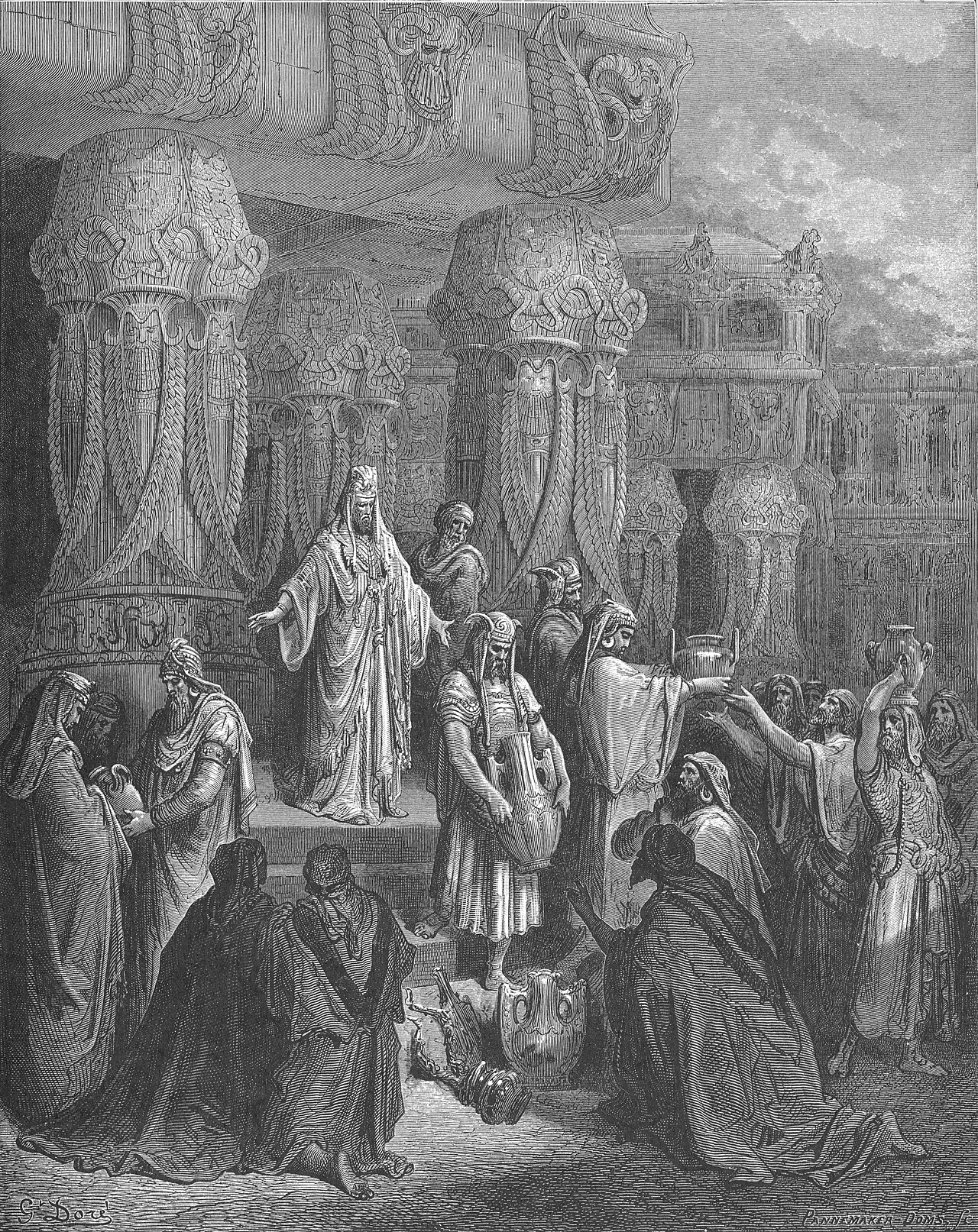
Ezrachapter 6
22 verses · Ezra, by tradition · 5th century BC · History
And this temple was completed on the third day of the month of Adar, in the sixth year of the reign of King Darius.
Introduction
Ezra, by tradition, History, Ezra Overview.
This chapter was written for a generation that saw the completion of a work their parents had left unfinished. Tradition gives the book to Ezra, and the first half keeps a royal decree in the Aramaic of the Persian court. Its first hearers knew how much a king's archive and a king's word could change. The chapter closes the first part of the book, which began with the decree of Cyrus. Listen for who ends up paying for the work, and for the feast that follows the dedication. Notice the offerings made for all twelve tribes. Read it as a long promise brought to its end.
Context
- Who
- A generation that got to see a project their parents had abandoned
- What
- An account of the search of the archives, the decree of Darius, the finishing and dedication of the temple and the Passover that followed.
- Where
- The Persian archives, found at Ecbatana in Media, and then the finished temple in Jerusalem.
- When
- The decree about 519 BC and the temple finished on the third day of Adar in the sixth year of Darius, 516 BC, a date held with good certainty.
- Why
- To show the returned people that the LORD had turned the empire from destroying His house to paying for its worship.
Historical context
Darius orders a search, and the record is not found in Babylon. It turns up at Ecbatana, in the palace in the province of Media, the summer capital, in the cooler highlands, where the court went to escape the heat. Cyrus had spent time there in his first year, so that is where his memorandum was filed.
Show the rest of the historical context, 4 more paragraphs
The document found is a memorandum rather than a public proclamation, and it reads like an accounting note: the house to be built, dimensions given, costs to be paid out of the king's house, and the vessels restored. Persian archives really did keep this kind of record, and the detail that it was found in the right regional archive rather than the main one is the sort of thing a fiction writer would not bother with.
Darius's response goes further than the Jews asked. He orders Tattenai to keep away, funds the work out of the province's own tribute revenue, provides bulls, rams, lambs, wheat, salt, wine, and oil for the sacrifices, and asks for prayers for the king and his sons. Persian kings routinely supported local sanctuaries and asked their gods' favor, a similar practice appears in the Jewish community's papyri at Elephantine in Egypt.
He attaches a penalty clause of the kind Persian decrees used: anyone who alters this will have a beam pulled out of his house and be hanged on it.
The temple was finished on 12 March 516 BC, about seventy years after Nebuchadnezzar burned the first one in 586 BC. They dedicated it with sacrifices, appointed the priests and Levites by their divisions as written in the book of Moses, and then kept Passover the following month.
Significance
For the community, the great reversal here is who is paying. The empire that had once funded the destruction of the temple was now funding its sacrifices out of tax revenue.
Show the rest of the significance, 1 more paragraph
The dedication is modest compared with Solomon's, hundreds of animals, not tens of thousands, and the text does not pretend otherwise. But they "kept the feast with joy: for the LORD had made them joyful," and the sin offering was twelve goats, one for each tribe. A community of two tribes' worth of people offered for all twelve.
This chapter in Jewish lifeWhat this chapter is in Jewish life and reading.
What is done
This chapter is not read in the synagogue year. The site's own table in src/lib/hebraic/readings.ts printed parashot total 0 and haftarah uses total 0 for Ezra, and no festival reading.
The chapter itself records two observances at the finished House, and Rashi dates both. The dedication offerings he calls "a temporary ruling" (Rashi on Ezra 6:17:1). The Passover followed: "Israel made the Passover offering on this fourteenth of Nissan, which followed this Adar, when the building was completed" (Rashi on Ezra 6:19:1). The corpus sets Midrash Tanchuma, Vayeshev 2:15 under the twelfth verse, and Midrash Tanchuma, Nasso 15:1 with Midrash Tanchuma Buber, Nasso 23:1 under the seventeenth, the dedication.
How it is read
Rashi is the one commentator on this chapter whose English the corpus carries, quoted here from The Judaica Press complete Tanach with Rashi, translated by A. J. Rosenberg, which Sefaria reports as CC-BY. At the finding of the decree he explains the container it lay in. The interpreters read the word as "a receptacle made for letters, written sheets and books", taking it from the skin of water in Genesis 21:14 (Rashi on Ezra 6:2:1). The rows of the building he reads as walls of marble, with the Old French word beside the Aramaic (Rashi on Ezra 6:4:1).
The king's reply he reads as provision for worship and prayer. The offerings were given so "that they should pray for the life of the king and his children" (Rashi on Ezra 6:10:1). The building went forward "according to the prophecy of Haggai and Zechariah" and by the authorization of Cyrus and of Darius (Rashi on Ezra 6:14:1).
He works the dates of the completion. The House was finished on the third of Adar in the sixth year of Darius, "hence the building of the House took four years" (Rashi on Ezra 6:15:1). The priests were set in their divisions and the Levites in their watches (Rashi on Ezra 6:18:1). Those who separated themselves to join the Passover "are the proselytes, who were separated from the defilement of the nations to cleave to Israel" (Rashi on Ezra 6:21:1). The king of Assyria whose heart was turned he reads as the king ruling over the Israelites who dwelt in the land of Assyria (Rashi on Ezra 6:22:1).
The corpus carries two further notes on this chapter without an English text. Rashi on Ezra 6:5:1 is marked linked because the text fetch returned nothing, and Metzudat David on Ezra 6:16:1 because Sefaria holds no English version of the ref. Both stand cited and unquoted.
What the rabbis say
The corpus carries thirty-one rabbinic locators on this chapter and the text of none, so each is cited here rather than quoted. On the third verse, the decree, it holds Bamidbar Rabbah 14:18, Esther Rabbah 1:5 and a passage of Otzar Midrashim from the Baraita of Rabbi Pinchas Ben Yair, at 1:17. On the fourth it holds Rosh Hashanah 4a:4 and an entry of Introductions to Amoraic Literature, Part II, on Baba Batra, Chapter I, at 12. On the ninth it holds Rosh Hashanah 4a:1, and on the tenth, the prayer for the king, Bava Batra 10b:7 with Ein Yaakov (Glick Edition), Bava Batra 1:22.
The king's sanction draws the next run. On the eleventh verse the corpus holds Pirkei DeRabbi Eliezer 49:13 and 50:10 and Midrash Lekach Tov on Esther 9:7:1. With them stand Sifrei Aggadah on Esther, Midrash Panim Acherim, Version II 5:7, and the same Introductions entry on Baba Batra, Chapter I, at 290. On the twelfth it holds Midrash Tanchuma, Vayeshev 2:15 and Pirkei DeRabbi Eliezer 38:26. On the fourteenth it holds Esther Rabbah 1:1 and Seder Olam Rabbah 30:1.
The completion and the dedication carry the rest. On the fifteenth verse the corpus holds Rosh Hashanah 3b:3 and 3b:9, Arakhin 13a:3, Ein Yaakov, Rosh Hashanah 1:3, Ein Yaakov (Glick Edition), Rosh Hashanah 1:2, and Seder Olam Rabbah 29:1. On the sixteenth it holds Shir HaShirim Rabbah 1:4:7. On the seventeenth it holds Bamidbar Rabbah 13:1, Midrash Tanchuma, Nasso 15:1, Midrash Tanchuma Buber, Nasso 23:1, Pesikta Rabbati 2:1 and Yalkut Shimoni on Torah 714:3. On the twenty-first, the proselytes, it holds Kiddushin 70a:2 and Jerusalem Talmud Kiddushin 4:1:6. What each of them teaches is a saying of the rabbis, and is reported as theirs wherever this site quotes one. The quotations wait on a fetch that carries the text.
Sources: Rashi, Rashi on Ezra 6:1:1 to 6:22:1, The Judaica Press complete Tanach with Rashi, translated by A. J. Rosenberg, reported CC-BY; Rashi on Ezra 6:5:1 cited by ref because the text fetch returned nothing; Metzudat David, Metzudat David on Ezra 6:16:1, cited by ref because the corpus carries no English text; The Sefaria corpus, scripts/data/sources/sefaria/ezra/6.json, the 31 Talmud and Midrash locators of this chapter; The site's own files, src/lib/hebraic/readings.ts, probed for this book and printing parashot total 0, haftarah uses total 0 and festivalReadingForBook null.
The heads below are this chapter's scenes. The numbered points under each are its verses.
The scroll found at Achmetha, and Darius makes the enemies pay
Ezra 6:1-2
ordered a search of the archives: Darius orders a search of the archives in the treasury of Babylon, and the scroll turns up in the fortress of Ecbatana. Cyrus's decree had lain filed there for years, out of reach of the officials who now doubted it. The empire's own records end up vindicating the builders.
Ezra 6:1
“A “house of the rolls” was discovered at Koyunjik, the ancient Nineveh, in 1850 - a set of chambers, i. e., in the palace devoted exclusively to the storing of public documents. These were in baked clay, and covered the floor to the depth of more than a foot. Such a “house” was probably that at Babylon.”
1 more voice on this verseWhat preachers and commentators have said about this verse, in their own words.
Ezra 6:1
“The cuneiform characters on most of them were singularly sharp and well-defined, but so minute in some instances as to be almost illegible without a magnifying glass.”
Jamieson, Fausset & Brown · Commentary Critical and Explanatory on the Whole Bible (1871)reformed
the fortress of Ecbatana: Tattenai's letter at 5:17 asked Darius to search the royal archives in Babylon. Albert Barnes notes that the decree turned up in Ecbatana instead, a provincial capital outside the search Tattenai had asked for. Bede cites Josephus placing it in a built tower there.
Ezra 6:2
“Achmetha--long supposed to be the capital of Greater Media (the Ecbatana of classical, the Hamadan of modern times), [is] at the foot of the Elwund range of hills, where, for its coolness and salubrity, Cyrus and his successors on the Persian throne established their summer residence.”
Jamieson, Fausset & Brown · Commentary Critical and Explanatory on the Whole Bible (1871)reformed
Ezra 6:3-5
Let the house be rebuilt: The house is to be rebuilt, and the costs paid from the royal treasury. The gold and silver articles Nebuchadnezzar carried to Babylon must be returned and deposited in the house of God. The temple's furnishings and its funding both trace to one decree of a pagan king.
Ezra 6:3
“Cubits - Those proportions differ from those of Solomon's temple, which was but thirty cubits high, only the porch was a hundred and twenty cubits high, and but twenty cubits in breadth. Either therefore Solomon's cubits were sacred cubits, which were larger than the other, and these but common cubits. Or, the sixty cubits of height are meant only for the porch.”
John Wesley · Explanatory Notes upon the Old Testament (1765)evangelical
1 more voice on this verse
Ezra 6:3
“It is difficult to reconcile the dimentions here with expressions in Zechariah Zec 4:10, Haggai Hag 2:3, and even Ezra Ezr 3:12, which imply that the second temple was smaller than the first (compare 1Ki 6:2). Perhaps the dimensions here are those which Cyrus required the Jews not to exceed.”
three layers of cut stones: Tattenai's report at 5:8 found the builders laying large stones with timbers, the method this decree sets out. Adam Clarke notes that Cyrus paid for timber cut on Libanus and carried to Joppa, while the Jews met the other costs themselves. Darius orders the full cost paid in verse 8.
Ezra 6:4
“Three rows of great stones, and a row of new timber - We have noticed this kind of building before, three courses of stones, and then a course of strong balk; and this continued to the square of the building. And let the expenses be given - Cyrus had ordered wood to be cut at Libanus, and conveyed to Joppa at his expense; but it does not appear that he furnished the other expenses of the building, for we have already seen that the Jews contributed for the defraying of all others.”
Adam Clarke · Commentary on the Bible (1810-1826)evangelical
must also be returned to the temple: The elders told Tattenai at 5:14 that Cyrus gave these articles to Sheshbazzar, and the memorandum now confirms their account from the king's own file. Ezra 1:8 to 11 records Mithredath the treasurer counting out 5,400 gold and silver articles. Sheshbazzar brought them to Jerusalem with the first exiles.
Ezra 6:5
“And also let the golden and silver vessels,.... See Ezr 1:7 and which confirms what the Jews said to Tatnai, Ezr 5:14.”
Ezra 6:6-8
You must stay away from that place!: Darius orders the governor and his associates to stay away and let the governor and elders of the Jews rebuild the house of God. He funds the work, paying the cost in full from the royal treasury. A king who could have shut the project down becomes its paymaster.
Ezra 6:6
“Now therefore Tatnai, governor beyond the river,.... The river Euphrates, that side of it towards the land of Israel; Josephus (z) calls this man master of the horse: Shetharboznai, and your companions the Apharsachites, which are beyond the river, be ye far from thence; keep at a distance from the Jews, and give them no disturbance, nor interrupt them in their work of building of the temple, but mind your own business and government. (z) Ibid. (Antiqu.) l. 11. c. 4. sect. 7.”
on its original site: The words on its original site echo Cyrus's instruction as the elders quoted it at 5:15, and Darius now confirms it. Their governor stands beside the elders. Adam Clarke names Zerubbabel as the civil governor who led the rebuilding with Jeshua the high priest.
Ezra 6:7
“Let the work of this house of God alone,.... Suffer them to go on with it, and do not hinder them; it looks, by these expressions, as if he had some suspicion or hint given him that they were inclined to molest them, or that there were some that stirred them up to it, and were desirous of it: let the governor of the Jews, and the elders of the Jews, build this house of God in his place; where it formerly stood; that is, go on with the building of it.”
4 more voices on this verse
Ezra 6:7
“And this was nothing wonderful for God to do, who, in the captivity of the people under Nebuchadnezzar, when the Scriptures had been destroyed, and the Jews had returned to their own country after seventy years, afterwards, in the time of Artaxerxes, king of the Persians, inspired Ezra the priest, of the tribe of Levi, to relate all the words of the former prophets, and to restore to the people the legislation of Moses. [quoting Irenaeus] Such are the words of Irenaeus.”
Eusebius of Caesarea · written before 339 · The Church History of Eusebius, Book 5patristic
Ezra 6:7
“And there was nothing astonishing in God having done this,-He who, when, during the captivity of the people under Nebuchadnezzar, the Scriptures had been corrupted, and when, after seventy years, the Jews had returned to their own land, then, in the times of Artaxerxes king of the Persians, inspired Esdras the priest, of the tribe of Levi, to recast all the words of the former prophets, and to re-establish with the people the Mosaic legislation.”
Irenaeus · written before 202 · Irenaeus Against Heresies Book 3patristic
Ezra 6:7
“If (Noah) had not had this (conservative power) by so short a route, there would (still) be this (consideration) to warrant our assertion of (the genuineness of) this Scripture: he could equally have renewed it, under the Spirit's inspiration, after it had been destroyed by the violence of the deluge, as, after the destruction of Jerusalem by the Babylonian storming of it, every document of the Jewish literature is generally agreed to have been restored through Ezra.”
Tertullian · written before 220 · On the Apparel of Women Book Ipatristic
Ezra 6:7
“We must certainly understand by this day the time of the composition of the history, whether you prefer the view that Moses was the author of the Pentateuch or that Ezra re-edited it. In either case I make no objection.”
Jerome · written before 420 · The Perpetual Virginity of Blessed Marypatristic
so that the work will not be hindered: At 4:5 the opponents hired counselors to frustrate the builders down to the reign of Darius. Albert Barnes reads those counselors as officials at the Persian court bribed to hinder the work. Darius now pays the builders in full.
Ezra 6:8
“Moreover, I make a decree, what ye shall do to the elders of these Jews, for the building of this house of God,....”
Ezra 6:9-10
wheat, salt, wine, and oil: The decree lists young bulls, rams and lambs for burnt offerings, with wheat, salt, wine and oil, given daily without fail. The offerings go to the God of heaven, the court title for Israel's God. Darius asks something in return, prayer for the lives of the king and his sons.
to pray for the lives of the king: Clarke finds a common belief behind the king's request: even heathens held that sacrifices offered for them to the God of the Jews would avail. The decree ties the daily offerings of verse 9 to prayer for the king and his sons. Darius paid for those prayers.
Ezra 6:10
“And pray for the life of the king, and of his sons - Even heathens believed that offerings made in their behalf to the God of the Jews would be available. And this principle has had considerable influence in certain states where there was even a form of religion established by the law, to induce them to tolerate other forms, that the state might have the benefit of their prayers.”
Adam Clarke · Commentary on the Bible (1810-1826)evangelical
Ezra 6:11-12
a pile of rubble for this offense: Darius backs the decree with a threat as severe as the grant is generous. Anyone who interferes will have a beam torn from his house and be impaled on it. He closes by asking God to overthrow any king or people who lifts a hand to alter the decree.
Ezra 6:11
“Also I have made a decree, that whosoever shall alter this word,.... Act contrary to this command, will not obey it, but as much as in him lies changes and revokes it: let timber be pulled down from his house, and being set up, let him, be hanged thereon; that is, let a beam be taken from it, and a gallows or gibbet made of it, and hang him on it: and let his house be made a dunghill for this; be pulled down, and never rebuilt more; see Gill on Dan 2:2; see Gill on Dan 2:9.”
1 more voice on this verse
Ezra 6:11
“Being set up, let him be hanged thereon - Rather, “let him be lifted up and crucified upon it.” Crucifixion was the most common form of capital punishment among the Persians.”
who has caused His Name to dwell there: Barnes reads alter and destroy as two steps: a king or people would first alter the decree and then destroy the house. He sets beside this the curse Darius placed at the end of his own inscription at Behistun. Wesley suggests Rome felt the curse after it destroyed this temple.
Ezra 6:12
“Destroy all - A similar malediction is found at the end of the great inscription of this same king Darius at Behistun: If anyone injures the tablet which he has set up, he prays that Ormazd will be their enemy, and that they may have no offspring, and that whatever they do, Ormazd may curse it for them. To alter and to destroy this house - i. e., to alter the decree, and then proceed to destroy the house.”
1 more voice on this verse
Ezra 6:12
“Destroy - Tho' this temple was at length most justly destroyed by the righteous hand of God, yet perhaps the Romans, who were the instruments of that destruction, felt the effects of this curse. For that empire sensibly declined ever after, 'till it was wholly destroyed.”
John Wesley · Explanatory Notes upon the Old Testament (1765)evangelical
The house finished with joy in the sixth year of Darius
Ezra 6:13-15
diligently carried out what King Darius had decreed: Verse 14 names the cause behind the royal paperwork. The Jewish elders built and prospered through the prophesying of Haggai and Zechariah son of Iddo. The temple is completed on the third day of Adar, in the sixth year of Darius, four years after the decree that restarted the work.
and Artaxerxes, kings of Persia: Artaxerxes is named though the house was finished under Darius. Bede notes that Artaxerxes reigned after Darius and sent Ezra up, and he raises the question how the building could be by his order. Adam Clarke reads the verse as the writer gathering every Persian king who favoured the Jews.
Ezra 6:14
“According to the commandment of the God of Israel - He first gave the order, and stirred up the hearts of the following Persian kings to second that order. Of Cyrus - This sovereign gave his orders for the rebuilding of the temple about A.M. 3468. And Darius - Darius Hystaspes confirmed the above orders, A. M. 3485. And Artaxerxes - Artaxerxes Longimanus sent Ezra to Judea with new privileges, A.M. 3547. With the permission of the same king, Nehemiah came to Judea in 3550. The writer recapitulates the different sovereigns who favored the Jews after the Babylonish captivity.”
Adam Clarke · Commentary on the Bible (1810-1826)evangelical
1 more voice on this verse
Ezra 6:14
“Through the prophesying - This is a seasonable intimation that this great and unexpected success was not to be ascribed to chance, or to the kindness or good humour of Darius, but unto God only, who by his prophets had required and encouraged them to proceed in the work, and by his mighty power disposed Darius's heart to such kind and noble purposes.”
John Wesley · Explanatory Notes upon the Old Testament (1765)evangelical
the third day of the month of Adar: Adar is the twelfth month of the Jewish year, near March, and Albert Barnes dates the sixth year of Darius to 516 to 515 BC. The temple stood finished at the close of the year. John Gill notes that the Passover of verse 19 fell in the very next month.
Ezra 6:15
“And this house was finished on the third day of the month Adar,.... The twelfth month of the year with the Jews, and answers to part of our February and part of March: which was in the sixth year of the reign of Darius the king; four years after the decree came forth.”
1 more voice on this verse
Ezra 6:15
“Adar” was the twelfth or last month of the Jewish year, corresponding nearly with our March. The sixth year of Darius was 516-515 B.C.
Ezra 6:16-18
The priests, the Levites and the rest of the exiles celebrate the dedication with joy. The offerings are modest beside Solomon's thousands, a hundred bulls, two hundred rams and four hundred lambs. The sin offering for all Israel is twelve male goats, so the remnant offers for the twelve-tribe nation.
Ezra 6:16
“And the children of Israel,.... Those of the ten tribes that remained after the body of the people were carried captive, or came with the Jews at their return: the priests and the Levites, and the rest of the children of the captivity; those of the tribes of Judah and Benjamin: kept the dedication of this house of God with joy; they set it apart for sacred use and service, with feasting and other expressions of joy and gladness, as follows.”
a sin offering for all Israel: Matthew Henry reads the twelve male goats as atonement the people held necessary before their service could be accepted. Albert Barnes calls the whole offering fitting for the day of small things of Zechariah 4:10. Ezra's company repeats the twelve goats at 8:35.
Ezra 6:17
“These hundreds were more to them than Solomon's thousands were to him. But, besides these, they offered twelve he-goats for sin-offerings, one for every tribe, to make atonement for their sins, which they looked upon as necessary in order to the acceptance of their services.”
Matthew Henry · Commentary on the Whole Bible (1707-1721)puritan
1 more voice on this verse
Ezra 6:17
“Compare with this modest sacrifice, which suits well “the day of small things” Zec 4:10, the lavish offering of Solomon (see the marginal reference “n”).”
written in the Book of Moses: Gill reads the phrase as evidence that Moses wrote the Pentateuch. He sets it against the suspicion of Spinoza that Ezra wrote it. Henry finds the glory of this poorer house of God in service kept by what is written.
Ezra 6:18
“And they set the priests in their divisions, and the Levites in their courses, for the service of God which is at Jerusalem,.... All in their proper classes and courses, to do the work of the temple at Jerusalem in their turns: as it is written in the book of Moses; see Num 3:6, from hence it is plain the Pentateuch was not written by Ezra, as suspected by Spinosa (m), but by Moses; see the argument of the book of Genesis. See Gill on Gen 1:1. (m) Tract. Theolog. Polit. c. 8. p. 163.”
1 more voice on this verse
Ezra 6:18
“Though the temple service could not now be performed with so much pomp and plenty as formerly, because of their poverty, yet perhaps it was performed with as much purity and close adherence to the divine institution as ever, which was the true glory of it. No beauty like the beauty of holiness.”
Matthew Henry · Commentary on the Whole Bible (1707-1721)puritan
A Passover kept by all who had separated themselves
Ezra 6:19-20
On the fourteenth day of the first month: With the Passover the Aramaic of the Persian correspondence that has run since Ezra 4:8 gives way here to Hebrew. The exiles keep the Passover on the fourteenth day of the first month, the day the law commands. All the priests and Levites had purified themselves and were ceremonially clean.
Ezra 6:19
“And the children of the captivity kept the passover upon the fourteenth day of the first month. The month Nisan or Abib, which was the month following that in which the temple was finished, Ezr 6:15, this passover was kept at the exact time the law commanded, Exo 12:2.”
1 more voice on this verse
Ezra 6:19
“With this verse the writer resumes the use of the Hebrew language, which he had discarded for the Chaldee from Ezr 4:8. With the exception of the letter of Artaxerxes Ezr 7:12-26, all the remainder of the book is in Hebrew.”
had purified themselves: Clarke notes that the priests and Levites were all clean at one time, so the exiles needed no second Passover. He points to 2 Chronicles 30:3, where Hezekiah kept the Passover in the second month after too few priests had consecrated themselves. Hezekiah's priests were ashamed; these priests were ready.
Ezra 6:20
“The Levites were purified together - They were all ready at one time to observe the proper rites and ceremonies, and had no need of having a second passover, which was appointed by the law for those who had been accidentally defiled, or were at a distance from the tabernacle. See 2Ch 30:3.”
Adam Clarke · Commentary on the Bible (1810-1826)evangelical
Ezra 6:21-22
separated themselves from the uncleanness of the peoples: Proselytes join the remnant. They keep the Feast of Unleavened Bread with joy, because the LORD had turned the heart of the king of Assyria toward them. Adam Clarke explains the title: Persia's kings inherited the rights of the Assyrian throne.
Ezra 6:21
“They separated themselves from the filthiness of sin and fellowship with sinners, joined themselves with the Israel of God in conformity and communion, and set themselves to seek the God of Israel; and those that do so in sincerity, though strangers and foreigners, are welcome to eat of the gospel feast, as fellow-citizens with the saints and of the household of God.”
Matthew Henry · Commentary on the Whole Bible (1707-1721)puritan
1 more voice on this verse
Ezra 6:21
“And all such as had separated themselves - These were the proselytes who had embraced the Jewish religion by having mingled with the Jews in their captivity. This proves that there the poor captives had so acted according to the principles of their religion, that the heathens saw it, and walked in the light of the Lord with them. A good example is very persuasive; and particularly so when founded on pure principles.”
Adam Clarke · Commentary on the Bible (1810-1826)evangelical
the heart of the king of Assyria: At 4:2 the opponents traced their settlement to Esar-haddon of Assyria. The chapter ends with the heart of the king of Assyria turned toward the builders. Bede reads the week of unleavened bread spiritually, through the Apostle's charge to keep the feast free of malice and wickedness.
Ezra 6:22
“Turned the heart of the king of Assyria - I am of Calmet’s mind, that king of Assyria is here put for king of Persia. Cyrus and his successors possessed all the rights and estates of the ancient kings of Assyria, and therefore the same monarch may be styled king of Assyria as well as king of Persia. Darius had a very high character, as a wise, just, and merciful prince.”
Adam Clarke · Commentary on the Bible (1810-1826)evangelical
Keep studying
Studies10
Sources for this chapter
The summary
Jamieson, Fausset & Brown, Commentary Critical and Explanatory; John Wesley, Notes on the Old Testament and Matthew Henry, Complete Commentary.
The exposition
Adam Clarke, Commentary on the Bible; Albert Barnes, Notes, Explanatory and Practical, on the Old and New Testaments (1832-1869); Bede, Commentary on Ezra and Nehemiah; Berean Standard Bible; John Gill; John Wesley, Explanatory Notes upon the Old Testament and Matthew Henry, Commentary on the Whole Bible.