
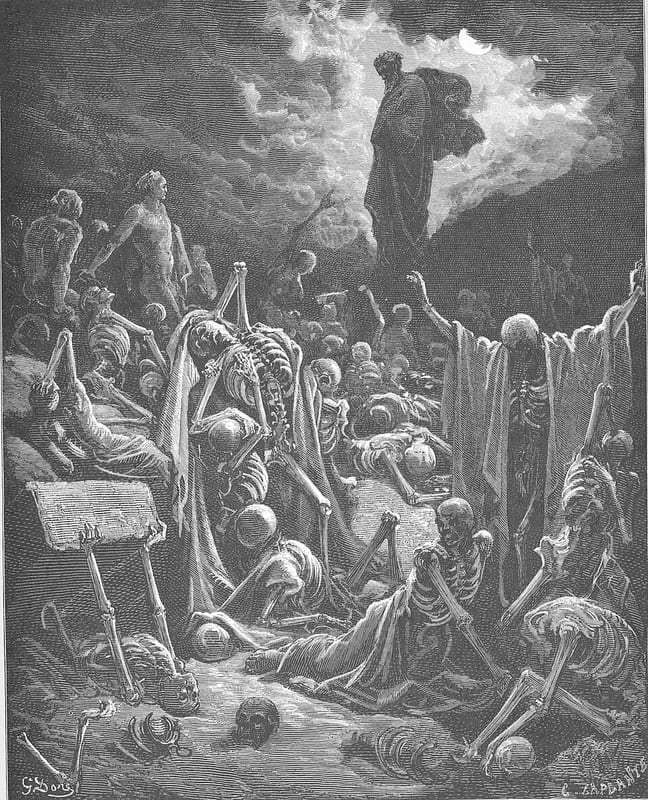
Ezekielchapter 23
49 verses · Ezekiel · 593 to 571 BC · The Prophets
They have also done this to Me: On that very same day, they defiled My sanctuary and profaned My Sabbaths.
Introduction
Ezekiel, The Prophets, Ezekiel Overview.
Ezekiel spoke this to exiles who thought of alliances with great empires as sensible statecraft. He tells the foreign policy of both Israelite kingdoms as the story of two sisters, and the story is frank on purpose. The chapter reaches back to Egypt and forward to the siege of Jerusalem. Listen for the meaning of the two names, and for how each empire the sisters pursued in turn becomes the power that attacks them. It asks a reader what they trust for safety, and what that trust costs them.
Context
- Who
- Exiles who thought of alliances as sensible statecraft, not betrayal
- What
- An allegory of two sisters, Oholah for Samaria and Oholibah for Jerusalem, whose alliances with Assyria, Babylon and Egypt are charged as unfaithfulness to God.
- Where
- Tel Abib in Babylonia, speaking of Samaria and Jerusalem and the empires around them.
- When
- About 589 to 588 BC, before Jerusalem's fall, looking back to Samaria's fall in 722 BC.
- Why
- To show that seeking safety in foreign powers was unfaithfulness to God and that those powers would become the instruments of judgment.
Historical context
The two sisters are named for tents: Oholah, her tent, is Samaria and the northern kingdom; Oholibah, my tent is in her, is Jerusalem, where the sanctuary stood. The names carry the difference in guilt before the story starts.
Show the rest of the historical context, 4 more paragraphs
Their sin is described as adultery, but the events behind it are treaties. Samaria courted Assyria, officers in blue, governors and commanders, handsome young men on horseback, and Assyrian palace reliefs show exactly those cavalrymen in exactly that finery. Judah's kings paid tribute to Assyria too; Ahaz travelled to meet Tiglath-pileser III in Damascus and had a copy of the altar he saw there installed in the Jerusalem temple.
Then Jerusalem sees Babylonians portrayed in vermilion on a wall, men with belts around their waists and flowing turbans on their heads, and sends messengers to them. Babylonian art really did use brightly painted and glazed brick reliefs, so this is a picture of falling for an image before you have met the man.
The reason a treaty counted as unfaithfulness is not obvious to modern readers. In that world a vassal treaty meant recognizing the overlord's gods as witnesses and often importing his worship. Political dependence and religious compromise arrived in the same delegation, which is why the prophets treat foreign alliances as a marriage betrayal rather than a policy disagreement.
The judgment is that the lovers turn on her. Assyria destroyed Samaria in 722 BC. Babylon besieged Jerusalem. In both cases the empire courted became the empire that came.
Significance
Jerusalem's leaders had watched Samaria's destruction a hundred and thirty years earlier and drawn no lesson from it. Ezekiel says the younger sister saw the whole thing and became more corrupt than her.
Show the rest of the significance, 1 more paragraph
For exiles still hoping a clever alliance with Egypt would rescue the city, the chapter is a history lesson with a single point: every empire Judah ever climbed into bed with eventually arrived with an army.
This chapter in Jewish lifeWhat this chapter is in Jewish life and reading.
What is done
The site's table of synagogue readings ties no weekly portion and no Haftarah to this chapter. Probed for this lane, src/lib/hebraic/readings.ts printed parashot 0 and haftarah uses 0 for Ezekiel 23, and no festival reading for the book. The table holds the Haftarah of each weekly portion and the six books read whole on a feast or a fast. Across chapters 1 to 24 of Ezekiel the same probe found a Haftarah only in chapters 20 and 22.
How it is read
Rashi is the main commentator on this chapter in the corpus. He is quoted here from The Judaica Press complete Tanach with Rashi, translated by A. J. Rosenberg, which Sefaria reports as CC-BY. The translation is modern, so every quotation from it is fifty words or fewer.
The two sisters are "Two states, which are like two women" (Rashi on Ezekiel 23:2:1). Their names are "their nicknames were Oholah and Oholibah" (Rashi on Ezekiel 23:4:1). Rashi reads each turn of the story as a treaty in the history of the kings.
Samaria kept her ties to Egypt, as when Hoshea son of Elah sent messengers to So king of Egypt (Rashi on Ezekiel 23:8:1). Then "Sennacherib came and exiled them" (Rashi on Ezekiel 23:9:1). Jerusalem saw it and "was unafraid" (Rashi on Ezekiel 23:11:1). Her lust for Assyria "is Ahaz, who sent to the king of Assyria for aid" (Rashi on Ezekiel 23:12:1).
The men of Babylon who came to her bed are the envoys of Merodach-baladan, whom Hezekiah welcomed and showed his treasures (Rashi on Ezekiel 23:17:1). She remembered the days of her youth when Zedekiah sent to Egypt (Rashi on Ezekiel 23:19:1). At Pekod, Shoa and Koa Rashi reports Jonathan, who reads them as the names of states, and the commentators, who read them otherwise (Rashi on Ezekiel 23:23:1).
The corpus carries 4 notes on this chapter without an English text, marked linked. Radak's notes stand at 23:1:1, 23:6:1, 23:13:1 and 23:18:1. Each stands cited and unquoted, because Sefaria holds no English version of the ref.
What the rabbis say
The corpus carries 39 rabbinic locators on the verses of this chapter, 8 filed under the Talmud and 31 under the Midrash. It carries the text of none, so each is cited by ref here and never quoted or paraphrased. The verse numbers are the Hebrew ones the corpus prints.
On verse 4 it holds Midrash Tanchuma Buber, Noach 20:7. On verse 10 it holds Midrash Sekhel Tov, Shemot 18:22:6 and Shemot Rabbah 8:2. On verse 11 it holds Shemot Rabbah 15:1. On verse 14 it holds Jerusalem Talmud Pesachim 9:1:5, Shir HaShirim Rabbah 8:11:1 and Vayikra Rabbah 33:6. On verse 15 it holds Shabbat 9b:7.
On verse 16 it holds Tractate Soferim 7:2. On verse 17 it holds Midrash Sekhel Tov, Bereshit 34:5:2 and Midrash Sekhel Tov, Shemot 15:17:3. On verse 18 it holds Bereshit Rabbah 77:3, Midrash Lekach Tov, Genesis 32:26:6 and Shir HaShirim Rabbah 3:6:3. On verse 19 it holds Midrash Tanchuma Buber, Lech Lecha 8:1 and Midrash Tanchuma, Lech Lecha 5:1. On verse 20 it holds Aggadat Bereshit 37:4, Arakhin 19b:3 and Bamidbar Rabbah 4:5.
On verse 21 it holds Niddah 48a:20. On verse 23 it holds Bereshit Rabbah 5:10, Mekhilta DeRabbi Shimon Ben Yochai 14:7 and Mekhilta DeRabbi Yishmael, Tractate Vayehi Beshalach 2:30. On verse 26 it holds Aggadat Bereshit 64:1 and Aggadat Bereshit 68:2. On verse 31 it holds Jerusalem Talmud Sanhedrin 10:5:5 and Seder Olam Rabbah 26:1. On verse 32 it holds Midrash Tehillim 75:4 and Midrash Tehillim 75:5.
On verse 34 it holds Midrash Tannaim on Deuteronomy 32:34:6. On verse 37 it holds Ein Yaakov, Nedarim 11:4 and Jerusalem Talmud Avodah Zarah 2:3:7. On verse 38 it holds Shemot Rabbah 49:2. On verse 43 it holds Ein Yaakov (Glick Edition), Yoma 8:9 and Ein Yaakov, Yoma 8:17. On verse 45 it holds Vayikra Rabbah 5:7.
On verse 47 it holds Avot DeRabbi Natan 2:3. On verse 48 it holds Bamidbar Rabbah 9:33 and Ein Yaakov, Sotah 1:17.
The corpus also files one entry from a modern study, Introductions to Amoraic Literature, on verse 3. It is left out of the list above because it is not a saying of the rabbis.
What each of them teaches is a saying of the rabbis, and is reported as theirs wherever this site quotes one. The quotations wait on a fetch that carries the text.
Sources: Rashi, Rashi on Ezekiel 23:2:1 to 23:23:1, The Judaica Press complete Tanach with Rashi, translated by A. J. Rosenberg, reported CC-BY; Radak, Radak on Ezekiel 23:1:1 to 23:18:1, cited by ref only: Sefaria holds no English version of the ref; The Sefaria corpus, scripts/data/sources/sefaria/ezekiel/23.json, the 39 Talmud and Midrash locators on the verses of this chapter; The site's own files, src/lib/hebraic/readings.ts, probed for Ezekiel 23: parashot 0, haftarah uses 0, no festival reading for the book.
The heads below are this chapter's scenes. The numbered points under each are its verses.
Oholah's lust for Assyria and her end
Ezekiel 23:1-4
Two sisters, daughters of one mother, are named, Aholah the elder standing for Samaria and Aholibah standing for Jerusalem. Henry reads the shared mother as the common stock of the twelve tribes. Gill notes the sisters' names carry meaning in Hebrew, her own tent and my tent is in her.
Ezekiel 23:1
“The seventh word of judgment. The allegory of Aholah and Aholibah.”
daughters of the same mother: The two women are Samaria and Jerusalem, daughters of the one people of Israel. Clarke traced their common mother back to Abraham and Sarah. The sisters' story follows both to the same end.
Ezekiel 23:2
“Son of man, there were two women - All the Hebrews were derived from one source, Abraham and Sarah; and, till the schism under Rehoboam, formed but one people: but as these ten tribes and a half separated from Judah and Benjamin, they became two distinct people under different kings; called the kingdom of Judah, and the kingdom of Israel. They are called here, because of their consanguinity, two sisters.”
Adam Clarke · Commentary on the Bible (1810-1826)evangelical
they played in Egypt: The unfaithfulness is traced back to Egypt, before the covenant at Sinai. Jamieson, Fausset and Brown linked it to 20:7 and 8, where Israel refused to throw away the idols of Egypt. The early start made the sin worse.
Ezekiel 23:3
“Even so early in their history as their Egyptian sojourn, they committed idolatries (see on Eze 20:6-8; 14). in their youth--an aggravation of their sin. It was at the very time of their receiving extraordinary favors from God (Eze 16:6, 22). they bruised--namely, the Egyptians.”
Jamieson, Fausset & Brown · Commentary Critical and Explanatory on the Whole Bible (1871)reformed
Oholah is Samaria: Henry read Oholah as a worship of Samaria's own devising, with shrines set up apart from the temple. Wesley read They became Mine as a marriage covenant. The older sister is Samaria, the larger kingdom of the two.
Ezekiel 23:4
“Aholibah - That is, my tabernacle in her: the two tribes had the temple of God with them. Mine - By solemn marriage-covenant. Bare sons - Were fruitful and brought forth children to me; they increased in numbers of people; and among these, some there were that were children of God by faith, love, and obedience.”
John Wesley · Explanatory Notes upon the Old Testament (1765)evangelical
Ezekiel 23:5-8
Samaria's course is told first, doting on the Assyrians. Clarke reads the historical record behind the figure, the treaties Menahem and Hoshea made with Assyria, national policy pictured as a woman's infatuation. JFB notes the figure never drops the earlier history, the whoredoms from Egypt she brought with her.
Ezekiel 23:5
“And Aholah played the harlot when she was mine,.... His married wife, and so ought to have cleaved to him alone: or, under me (o); under his cover, power, and protection, and therefore it was their interest to serve him only: or, "instead of me" (p); or, as the Syriac version, "besides me": they worshipped other gods in the room of the true God, or other gods besides him.”
clothed in blue: Blue was a costly dye, and Clarke noted it was worn first by kings and later by high officers. The Assyrian governors, commanders and horsemen drew Samaria by their splendor. Her lust began with the eye.
Ezekiel 23:6
“Clothed with blue - The purple dye was highly valued among the ancients, and at first was only used by kings, at last it was used among the military, particularly by officers of high rank in the country.”
Adam Clarke · Commentary on the Bible (1810-1826)evangelical
all the elite of Assyria: The treaty with Assyria brought the idols of Assyria with it. Gill read the prostitution as alliance and idol worship joined together with the elite of the empire. Samaria defiled herself with both.
Ezekiel 23:7
“Thus she committed her whoredoms with them,.... Entered into alliance with them, and joined them in their idolatrous worship: with all them that were the chosen men of Assyria; before described by their habit, office, and age: and with all on whom she doted; had an insatiable desire and lust after: with all their idols she defiled herself; worshipped all the idols the Assyrians did; and which were defiling, as they must needs be, since, as the word used signifies, they were dunghill gods.”
she began in Egypt: The habit formed in Egypt in verse 3 followed Samaria through her whole history. Jamieson, Fausset and Brown traced it to the idols Israel kept from Egypt. The sin of youth was never broken.
Ezekiel 23:9-10
The Lord delivers Samaria into the hand of the very lovers she doted on. Wesley reads the poetic justice as the chapter's recurring method, the ally trusted becomes the executioner. Henry notes the closing line, she became famous among women, marks the fall of the northern kingdom as a byword.
Ezekiel 23:9
“Wherefore I have delivered her into the hand of her lovers,.... To destruction; their persons, families, riches, and kingdom itself: into the hand of the Assyrians, on whom she doted; first into the hands of Pul, then Tiglathpileser, then Shalmaneser, all kings of Assyria, by whom they were spoiled or carried captive; by the two first in part, by the last wholly; see 2Ki 15:19.”
a byword among women: Samaria fell to Assyria under its last king, Hoshea. Wesley named Shalmaneser as the conqueror, and Henry pointed to 2 Kings 17, where the fall is told at length. The city's name became a warning spoken among the nations.
Ezekiel 23:10
“Discovered - Stript her naked, and exposed her to shame. Took her sons - Captives. Slew her - The kingdom of Israel, under Hoshea, was by Salmanesar utterly destroyed.”
John Wesley · Explanatory Notes upon the Old Testament (1765)evangelical
Oholibah, the younger sister, who was worse
Ezekiel 23:11-13
Jerusalem watches her sister's fall and draws the opposite lesson, growing more corrupt rather than less. Gill reads the verse as the chapter's hardest charge, a warning seen firsthand and disregarded. Keil notes the phrase they took both one way closes the comparison plainly, two sisters walking the identical road.
Ezekiel 23:11
“And when her sister Aholibah saw this,.... The two tribes of Judah and Benjamin, when, they saw the idolatries the ten tribes fell into, and the destruction which came upon them for the same; instead of receiving instruction, and taking caution by all this, she was more corrupt in her inordinate love than she; in courting the friendship, alliance, and help of their Heathen neighbours: and in her whoredoms more than her sister in her whoredoms; guilty of more idolatries than the ten tribes, as in the times of Manasseh; see Jer 2:28.”
1 more voice on this verse
Ezekiel 23:11
“The idolatries of Manasseh’s reign exceeded all that had gone before either in Israel or in Judah 2 Kings 21:1-16; 2Ch 33:1-10.”
Judah repeated Samaria's courtship of Assyria. Ahaz sent messengers to the Assyrian king for help against Aram and Israel, as 2 Kings 16:7 records. Barnes traced Judah's intrigues first with Assyria and then with Babylon.
Ezekiel 23:12
“Thus she increased her whoredoms; she fell in love, fell in league, with the Chaldeans. Hezekiah himself was faulty this way when he was proud of the court which the king of Babylon made to him and complimented his ambassadors with the sight of all his treasures, Isa. xxxix.”
Matthew Henry · Commentary on the Whole Bible (1707-1721)puritan
both of them had taken the same path: God's verdict sets the two kingdoms on one road. Gill observed at verse 11 that Judah watched the fall of the ten tribes and drew no lesson from it. The same path leads to the same end, as the cup of verse 31 shows.
Ezekiel 23:13
“Then I saw that she was defiled,.... With idols, and the worship of them, Eze 23:7, that they took both one way; the same way of idolatry; worshipped the same idols, lived the same course of life, were guilty of the same sin, both Israel and Judah.”
Ezekiel 23:14-18
Jerusalem's course moves past living armies to painted ones, wall images of Chaldean officers in vermilion drawing her eyes. Fairbairn reads the detail as the chapter's sharpest satire, an infatuation with mere portraits. Barnes notes the outcome the moment the affair is finished, my mind was alienated from her.
Ezekiel 23:14
“After Israel’s captivity Judah intrigued first with Assyria, then with Babylon, courting their monarchs, imitating their customs, and learning their idolatries. Pourtrayed upon the wall - The monuments of Nineveh show how the walls of its palaces were adorned with figures precisely answering to this description. There is evidence that these sculptures were highly colored with vermilion, or rather, red ochre.”
belts on their waists: The dress described is that of Babylonian officers as they appear in carved and painted reliefs. Barnes pointed to the monuments of Nineveh, where such figures stood on the walls. Judah admired the pictures before meeting the men.
sent messengers to them in Chaldea: Jerusalem courted the Babylonians by messengers long before they came as an army. Henry traced this back to Hezekiah, who showed his treasures to the Babylonian envoys in Isaiah 39. The images on the wall led to the messengers.
Ezekiel 23:16
“And as soon as she saw them with her eyes, she doted upon them,.... As lustful women, on the sight of the pictures of men, fall in love with them, and are mad after them; such a vehement desire after the idols of the Chaldeans prevailed, upon seeing their images: and sent messengers unto them in Chaldea; to make alliances with the Chaldeans, and to have their idols, and worship them.”
2 more voices on this verse
Ezekiel 23:16
“The sending of “messengers” refers to the act of Ahaz 2Ki 16:7.”
Ezekiel 23:16
“It was she that solicited the Chaldeans, not they her. Probably the occasion was when Judah sought to strengthen herself by a Chaldean alliance against a menaced attack by Egypt (compare 2Ki 23:29-35; God made the object of their sinful desire the instrument of their punishment.”
Jamieson, Fausset & Brown · Commentary Critical and Explanatory on the Whole Bible (1871)reformed
she turned away in disgust: Barnes read the disgust as Jerusalem's revolt against the Babylonians. Jehoiakim served Nebuchadnezzar three years and then rebelled, as 2 Kings 24:1 records. The lovers she had sent for became the enemy she turned away from.
Ezekiel 23:17
“After Josiah’s death and the usurpation of dominion by the Egyptians, the Babylonians were no doubt welcomed as friends 2Ki 24:1. But the Jews were soon tired of their alliance and disgusted with their friends, and this led to the rebellion of Jehoiakim and the first captivity.”
exposed her nakedness: The same word of disgust now describes God's response to Judah. Henry wrote that sin estranges God from the sinner, as it first estranges the sinner from God. Samaria's rejection in verse 9 is now Jerusalem's.
Ezekiel 23:18
“How could the pure and holy God any longer take delight in such a lewd generation? Note, Sin alienates God's mind from the sinner, and justly, for it is the alienation of the sinner's mind from God; but woe, and a thousand woes, to those from whom God's mind is alienated; for whom he turns from he will turn against.”
Matthew Henry · Commentary on the Whole Bible (1707-1721)puritan
Ezekiel 23:19-21
Jerusalem's infidelity turns backward, calling to remembrance the days of her youth in Egypt. Henry reads the regression as the chapter's diagnosis of an appetite that cannot be satisfied by any single ally. Clarke notes the coarse figure of verse 20 is deliberately unflattering, stripping any romance from alliances.
Ezekiel 23:19
“Egypt - The kings of Judah played alternately Egypt against Babylon, and Babylon against Egypt. Jehoahaz was displaced by Necho for Jehoiakim, who then turned to the Chaldaeans, and afterward rebelling sought aid from Egypt. So Zedekiah was continually meditating help from Egypt, against which Jeremiah and Ezekiel were continually protesting.”
lusted after their lovers: The coarse image names how strongly Jerusalem lusted after the power of Egypt. Clarke sent the reader back to the same charge in chapter 16. Henry read it as seeking help from men in place of God.
Ezekiel 23:20
“She doted upon their paramours - פלגשיהם pillagsheyhem, their harlots or concubines. Anciently harlot meant in our language either the male or female prostitute. Whose flesh is as the flesh of asses - See on Eze 16:25 (note).”
Adam Clarke · Commentary on the Bible (1810-1826)evangelical
the indecency of your youth: Turning to Egypt for help revived the oldest habit in Israel's history. Henry saw Judah trusting Egypt on the strength of old acquaintance, like the Israelites who longed for its food in the wilderness. Barnes followed the kings who played Egypt against Babylon.
Ezekiel 23:21
“When they began to set their affections upon Egypt, they encouraged themselves to put a confidence in that kingdom, because of the old acquaintance they had with it, as if they still retained the gust and relish of the leeks and onions they ate there, or rather of the idolatrous worship they learned there, and brought up with them thence.”
Matthew Henry · Commentary on the Whole Bible (1707-1721)puritan
The cup of horror pressed into her hand
Ezekiel 23:22-27
The Lord raises up Jerusalem's own former lovers, the Babylonians and their allies. Keil reads the mutilation named at verse 25 against known penalties for adultery in the surrounding cultures. Fairbairn notes the stripping of clothes and jewels at verse 26 answers the ornaments the Lord gave in chapter 16.
Ezekiel 23:22
“Therefore, O Aholibah, thus saith the Lord God,.... Or, ye two tribes of Benjamin and Judah, hear what the Lord says unto you: behold, I will raise up thy lovers against thee; the Chaldeans, whom they had formerly loved, and in whose alliance they were, and whose idols they worshipped: from whom thy mind is alienated; having broke covenant with them, and cast off their yoke, and rebelled against them: and I will bring them against thee on every side; to besiege and encompass Jerusalem on every side with their army, as they did, so that there was no escaping.”
Pekod, Shoa, and Koa: Wesley took Pekod, Shoa and Koa as regions of the Babylonian empire. Jamieson, Fausset and Brown read Pekod as a wordplay on visitation, a land that brings judgment, as in Jeremiah 50:21. Both readings put the whole empire in the attack.
Ezekiel 23:23
“Pekod - Pekod is the province between Tigris, and Lycus; in this was old Nineveh. Shoa - Either Sia in Armenia, or the Sohia, among which were the Adiabeni, and this contained the middle part of the kingdom of Babylon.”
John Wesley · Explanatory Notes upon the Old Testament (1765)evangelical
1 more voice on this verse
Ezekiel 23:23
“Pekod, &c.-- (Jer 50:21). Not a geographical name, but descriptive of Babylon. "Visitation," peculiarly the land of "judgment"; in a double sense: actively, the inflicter of judgment on Judah; passively, as about to be afterwards herself the object of judgment.”
Jamieson, Fausset & Brown · Commentary Critical and Explanatory on the Whole Bible (1871)reformed
according to their own standards: The LORD delegates judgment to the Babylonians, and they punish by their own standards. Wesley read this as a conqueror's right over rebels, joined to God's own right over His people. The fury of verse 25 comes from the lovers Jerusalem chose.
Ezekiel 23:24
“I will set - Give them a power in right of conquest over their rebels, as well as mine, and I will give them a spirit of judgment to discern the greatness of this people's sins. Judge - Condemn, and execute sentence upon thee. According - To their will, power, wrath, and custom, against rebels; for these are their rules of judgment.”
John Wesley · Explanatory Notes upon the Old Testament (1765)evangelical
cut off your noses and ears: Cutting off noses and ears was done to captives in the ancient east. Barnes added that an Egyptian law set this punishment for an adulteress. The jealous rage is God's own, a husband's anger.
Ezekiel 23:25
“If men deal ever so hatefully, ever so furiously, with us, yet, if we have God on our side, we need not fear them; they can do us no real hurt. But if men deal furiously with us, and God set his jealousy against us too, what will become of us? The particulars of the sentence here passed upon this notorious adulteress are, (1.) That all she has shall be seized on.”
Matthew Henry · Commentary on the Whole Bible (1707-1721)puritan
1 more voice on this verse
Ezekiel 23:25
“Take away thy nose and thine ears - Alluding to the barbarous custom of mutilating prisoners in the east Dan 2:5. An Egyptian law prescribed this punishment for an adulteress. Fire - A mode of capital punishment Jer 29:22; Dan. 3.”
take your fine jewelry: Captives were stripped of clothes and jewelry. Gill noted that the Hebrew can be read as the vessels of your glory. The fine things Jerusalem spent on her lovers are taken by those same lovers.
Ezekiel 23:26
“They shall also strip thee out of thy clothes,.... As such who are taken captives are usually served: and take away, thy fair jewels; their ornaments of every kind: or "the vessels of thy glory" (c); Kimchi observes this may be meant either of the garments of the priests, and the vessels of the sanctuary; or of whole spoil of the city in general, whether in the temple, or in other houses. (c) כלי תפארתך "vasa gloria tuae", V. L. Pagninus, Montanus; "instrumenta ornatus tui", Junius & Tremellius, Polanus, Piscator; "vasa ornatus tui", Starckius.”
Egypt stands at both ends of the story, where the prostitution began in verse 3 and where Jerusalem looked for help at the last. The exile ends that path. The captivity became the lasting end of the nation's idolatry, as Jamieson, Fausset and Brown observed.
Ezekiel 23:28-31
The Lord states the same sentence a second time. Gill reads the repetition as the chapter's method throughout, saying the same judgment more than once. Wesley notes verse 31's turn formally joins Jerusalem's sentence to Samaria's by name, one cup for both sisters because one sin ran through both.
leave you naked and bare: The punishment returns Jerusalem to the condition of her birth in chapter 16, before God clothed her. Everything gained under His care is taken away. Gill noted that captives were stripped in this way.
defiled yourself with their idols: The Chaldeans do the damage, and God names Himself as the one behind it. Gill explained that God is said to do what He ordered and permitted as punishment. The cause is worship given to foreign gods.
Ezekiel 23:30
“And I will do these things unto thee,.... What the Chaldeans did God is said to do, because he suffered them to do these things, as a punishment for their sins; yea, it was according to his will, and by his orders. The Septuagint and Vulgate Latin versions render it, "they have done these things unto thee"; that is, the Chaldeans. The Targum is, "thy sins are the cause of these things unto thee;'' that is, their idolatry and other iniquities.”
the path of your sister: The cup is a prophetic picture of God's wrath, handed to the guilty to drink. Gill called it the cup of Samaria's vengeance, the same destruction the northern kingdom suffered. Her road brings her end.
Ezekiel 23:31
“Thou hast walked in the way of thy sister,.... Samaria, or the ten tribes of Israel; followed them in their idolatrous practices, were guilty of the same: therefore will I give her cup into thine hand; the cup of her vengeance, as the Targum; inflict the same punishment on the two tribes as on the ten, and suffer them to be carried captive as they had been.”
Ezekiel 23:32-35
The cup figure returns from the shared sentence of verse 31, filled with drunkenness and sorrow. Barnes reads the physical detail of verse 34 as grief turned inward once judgment lands. Henry notes the reason is stated once more, because thou hast forgotten me, and cast me behind thy back.
Ezekiel 23:32
“Thus saith the Lord God, thou shall drink of thy sister's cup deep and large,.... That is, partake of the same punishment, which was very great, signified by a deep and large cup, which holds much: thou shall be laughed to scorn, and had in derision; by the nations round about, who, instead of pitying them under their troubles, will rejoice at them; just as drunken men are laughed at, when intoxicated and reeling about: it containeth much; the cup of wrath and vengeance; as much as will last severity years drinking.”
the cup of your sister Samaria: Drunkenness here is the stagger of a people overwhelmed by disaster. Gill read the deep and wide cup of verse 32 as a punishment equal to Samaria's in size. Devastation and desolation describe the land after the siege.
Ezekiel 23:33
“Who would think that that which is such a force upon nature, such a scandal to it, which deprives men of their reason, disorders them to the last degree, and is therefore expressive of the greatest misery, should yet be with many a beloved sin, that they should damn their own souls to distemper their own bodies?”
Matthew Henry · Commentary on the Whole Bible (1707-1721)puritan
tear your breasts: Jerusalem drains the cup and then smashes it in grief. Clarke explained tearing the breast as an ancient act of extreme sorrow, known also from Ovid. The shame of the earlier verses turns into anguish.
Ezekiel 23:34
“Thou shalt - pluck off thine own breasts - Thou shalt tear them; a frequent action in extreme sorrow and desolation. Weeping, tearing the bosom, and beating the breasts. Tunc vero rupique sinus, et pectora planxi. Ovid’s Ep. 5.”
Adam Clarke · Commentary on the Bible (1810-1826)evangelical
cast Me behind your back: Casting a thing behind the back puts it out of sight on purpose. Henry wrote that sinners need no weight to sink them beyond their own sins. The whole charge rests on forgetting God.
Ezekiel 23:35
“Therefore bear thou also thy lewdness and thy whoredoms; that is, thou shalt suffer the punishment of them, and thou alone must bear the blame. Men need no more to sink them than the weight of their own sins; and those who will not part with their lewdness and their whoredoms must bear them.”
Matthew Henry · Commentary on the Whole Bible (1707-1721)puritan
Both sisters judged by righteous men
Ezekiel 23:36-39
JFB reads verse 39 as the chapter's most severe count, child sacrifice followed on the same day by entering the Lord's sanctuary to worship there. Keil notes the phrase profaned my sabbaths ties the sexual and political figure back to the plain covenant law the book keeps returning to.
Ezekiel 23:36
“The Lord said moreover unto me, son of man, wilt thou judge Aholah and Aholibah?....”
1 more voice on this verse
Ezekiel 23:36
“Thou seest the matter is so bad as not to bear an excuse." Or, rather, "Thou shalt now be employed, in God's name, to judge them, ch. xx. The matter is rather worse than better since the union." I. Let them be made to see the sins they are guilty of: Declare unto them openly and boldly their abominations.”
Matthew Henry · Commentary on the Whole Bible (1707-1721)puritan
sacrificed their children: The children are called those whom the sisters bore to God, so the offering took what belonged to Him. Barnes pointed to the idolatries of Manasseh's reign in 2 Kings 21, which exceeded all before them. Adultery and bloodshed are the two charges of the trial.
Ezekiel 23:37
“Blood - One of the chief sins of Manasseh was that he shed innocent blood 2Ki 21:16; 2Ki 24:4.”
defiled My sanctuary: Temple and Sabbath marked Israel as God's people. Henry wrote that contempt for any holy thing is contempt for God, from whom it takes its holiness. One day saw both profaned.
Ezekiel 23:38
“Every contempt put upon that which is holy reflects upon him who is the fountain of holiness, and from a relation to whom whatever is called holy has its denomination.”
Matthew Henry · Commentary on the Whole Bible (1707-1721)puritan
inside My house: The same people who slaughtered their children for idols came into the sanctuary that very day. Barnes observed that the LORD had been placed in a list of gods, with idols set close to His house while the worship went on. Jeremiah 32:34 records the same.
Ezekiel 23:39
“Yahweh was placed as it were in the list of deities, not acknowledged as the One God. Idols and idol-temples were erected close to the House of God, and yet the temple-service went on Jer 32:34.”
1 more voice on this verse
Ezekiel 23:39
“Friend, how camest thou in hither? They have courted foreign alliances, been proud of them, and reposed a confidence in them. This also is represented by the sin of adultery, for it was a departure from God, not only to whom alone they ought to pay their homage and not to idols, but in whom alone they ought to put their trust, and not in creatures.”
Matthew Henry · Commentary on the Whole Bible (1707-1721)puritan
Ezekiel 23:40-42
The figure returns to the adorning of chapter 16. Fairbairn reads the detail of a stately bed and prepared table as royal court imagery, the alliances conducted with the ceremony of state visits. Gill notes the Sabeans from the wilderness named alongside the Babylonians widen the guest list further.
Ezekiel 23:40
“Thou didst wash thyself, paintedst thy eyes, and deckedst thyself with ornaments - This is exactly the way in which a loose female in Bengal adorns herself to receive guests. She first bathes, then rubs black paint around her eyes, and then covers her body with ornaments. - Ward’s Customs.”
Adam Clarke · Commentary on the Bible (1810-1826)evangelical
a couch of luxury: Jerusalem sets a table for her foreign lovers. Gill read the couch as a seat of state for receiving the messengers of other kings, and Clarke saw an altar Ahaz copied from Damascus. The incense and oil were God's, and she spent them on others.
Ezekiel 23:41
“And satest upon a stately bed - Hast raised a stately altar to thy idols; probably alluding to that which Ahaz ordered to be made, after the similitude of that which he saw at Damascus. The bed here is in allusion to the sofas on which the ancients were accustomed to recline at their meals; or to the couches on which they place Asiatic brides, with incense pots and sweetmeats on a table before them.”
Adam Clarke · Commentary on the Bible (1810-1826)evangelical
1 more voice on this verse
Ezekiel 23:41
“And satest upon a stately bed,.... Or honourable (g), a bed of state: either a throne, a royal seat under a canopy, on which the king of Judah sat to receive foreign ambassadors; or a stately bed at a feast, made for the entertainment of them; it being usual in the eastern nations to sit on beds at eating, to which the next clause agrees.”
Drunkards were brought in: The Hebrew margin reads drunkards, and the written text reads Sabeans, the desert raiders of Job 1:15, as Jamieson, Fausset and Brown noted. The sisters sink from Assyrian officers to men of the rabble. Their lovers grow worse.
Ezekiel 23:42
“Sabeans--Not content with the princely, handsome Assyrians, the sisters brought to themselves the rude robber hordes of Sabeans (Job 1:15). The Keri, or Margin, reads "drunkards." upon their hands--upon the hands of the sisters, that is, they allured Samaria and Judah to worship their gods.”
Jamieson, Fausset & Brown · Commentary Critical and Explanatory on the Whole Bible (1871)reformed
Ezekiel 23:43-45
Wesley reads verse 45 as answering any doubt the allegory has left standing, righteous men shall judge them after the manner of adulteresses. Clarke notes righteous men here most likely refers to the Babylonians and their allies acting as unwitting instruments of a justice they did not intend.
Ezekiel 23:43
“Will they now commit ... - Rather, Now shall there be committed her whoredom, even this; i. e., when Israel and Judah had courted these alliances God said in wrath, “This sin too shall be committed, and so (not “yet) they went in;” the alliances were made according to their desires, and then followed the consequent punishment.”
those lewd women: The alliances went ahead just as God said they would. Barnes read verse 43 as God's word in wrath giving the sisters over to the sin they had chosen. Both kingdoms are named together for the last time before sentence.
righteous men will sentence them: The righteous men are the Assyrians and Babylonians who carry out the sentence. Henry called them righteous by comparison, nations with a sense of justice who resented broken treaties. Barnes read the title as marking them God's instruments of judgment.
Ezekiel 23:45
“The judgment to be executed by the hands of their allies. Eze 23:45 The righteous men - Or, righteous men. The allies are so called as the instruments of God’s righteous judgments. Eze 23:48 To cease - Because they are stricken and consumed. Compare marginal reference. All women - i. e., all countries.”
1 more voice on this verse
Ezekiel 23:45
“The Assyrians that destroyed Samaria, the Chaldeans that destroyed Jerusalem, those were comparatively righteous, had a sense of justice between man and man and justly resented the treachery of the Jewish nation; however, they executed God's judgments, which, we are sure, are all righteous.”
Matthew Henry · Commentary on the Whole Bible (1707-1721)puritan
Ezekiel 23:46-49
The sentence is carried out by a company that stones, dispatches with the sword, and burns the houses, the penalty the law set for adultery. Henry reads the stated purpose of verse 48, that all women may be taught not to do after your lewdness, as a public lesson.
The mob will stone them: Stoning was the Law's penalty for idolaters, as Deuteronomy 13:10 prescribes. Gill applied it to the stones the Chaldean slings and engines hurled into Jerusalem. The burning of houses matches the city's end in 2 Kings 25.
Ezekiel 23:47
“And the company shall stone them with stones,.... Which was the punishment of adulterers and idolaters, Deu 13:10, this seems to refer to the Chaldean army casting out stones from their slings and engines into the city of Jerusalem, when they besieged it, by which they killed some, and beat down the houses, which fell upon others, and destroyed them.”
all the women will be admonished: The women who watch are the other nations, and the punishment is public so that they take warning. Clarke read the ending of indecency as the end of idol worship among the Jews. The lesson outlasted the exile.
Ezekiel 23:48
“Thus will I cause lewdness to cease - Idolatry; and from that time to the present day the Jews never relapsed into idolatry.”
Adam Clarke · Commentary on the Bible (1810-1826)evangelical
your sins of idolatry: The sins of idolatry come back on the ones who committed them. Henry read the whole chapter as a warning against idols, trust in human strength, and alliances with the ungodly. It ends in the knowledge of the LORD.
Ezekiel 23:49
“Ye shall bear the sins of your idols - The punishment due to your adultery; your apostasy from God, and setting up idolatry in the land.”
Adam Clarke · Commentary on the Bible (1810-1826)evangelical
1 more voice on this verse
Ezekiel 23:49
“The sins - The guilt of worshipping idols; and you shall bear the punishment of idolaters.”
John Wesley · Explanatory Notes upon the Old Testament (1765)evangelical
Keep studying
Sources for this chapter
The summary
Jamieson, Fausset & Brown, Commentary Critical and Explanatory; John Wesley, Notes on the Old Testament and Matthew Henry, Complete Commentary.
The exposition
Adam Clarke, Commentary on the Bible; Albert Barnes; Carl Friedrich Keil, Biblical Commentary on the Prophecies of Ezekiel; Jamieson, Fausset & Brown, Commentary Critical and Explanatory on the Whole Bible; Jamieson, Fausset and Brown, Commentary Critical and Explanatory on the Whole Bible; John Gill; John Wesley, Explanatory Notes upon the Old Testament; Matthew Henry, Commentary on the Whole Bible and Patrick Fairbairn, An Exposition of Ezekiel.