
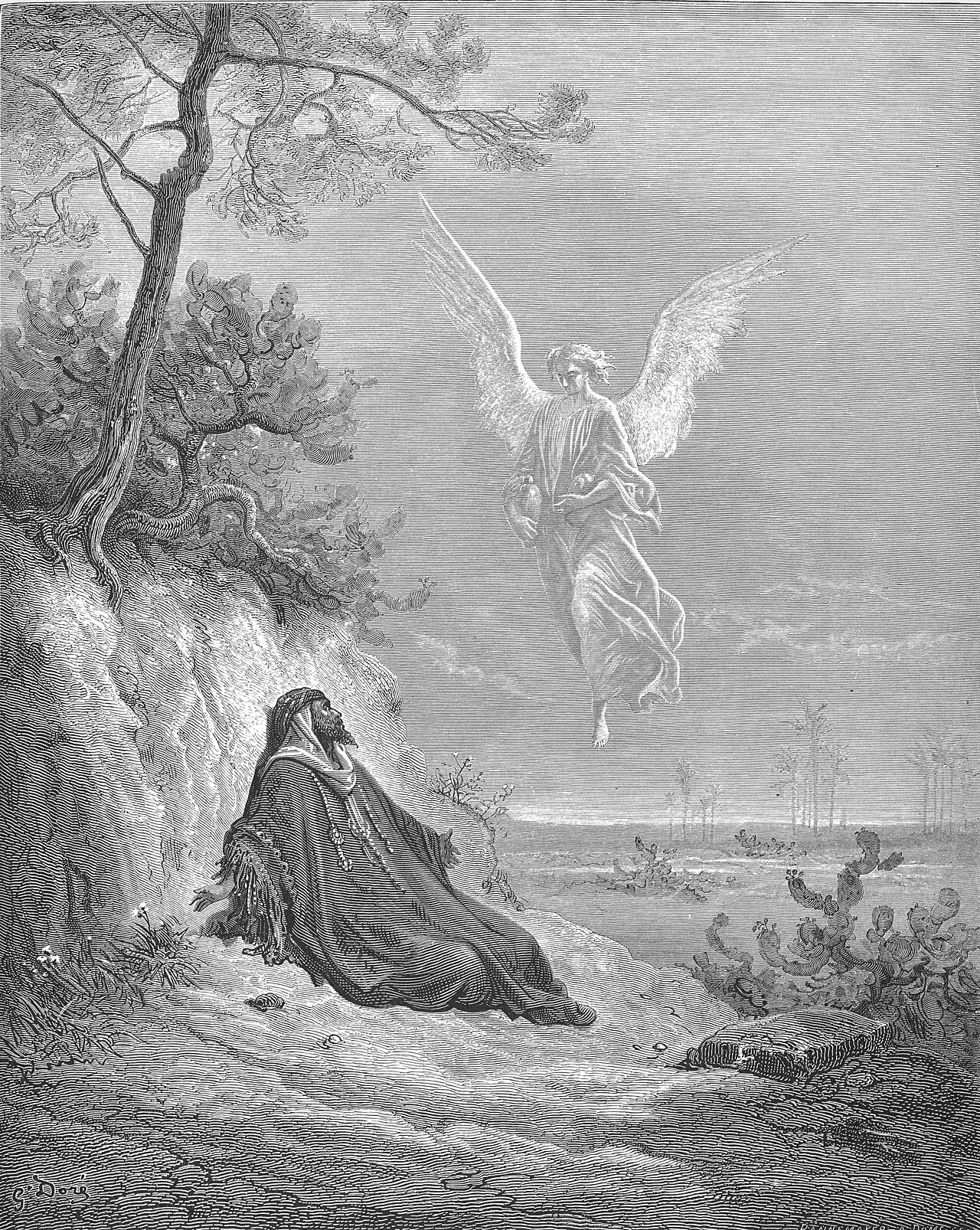
1 Kingschapter 19
21 verses · Jeremiah, by tradition · 6th century BC · History
And Ahab told Jezebel all that Elijah had done, and withal how he had slain all the prophets with the sword.
Introduction
Jeremiah, by tradition, History, 1 Kings Overview.
The writer of Kings is not named, and Jewish tradition gives the book to Jeremiah. He follows the great public victory of his work with its most private scene. His first hearers were exiles who had seen their hopes rise and fall and wondered whether anyone was left who served the LORD. The chapter is prophetic narrative that takes a prophet back to the mountain where the covenant was given. It shows God dealing with a servant who has reached the end of his strength. Listen for the question God asks twice and the answer given twice, and for what comes after the wind, the earthquake and the fire.
Context
- Who
- Israelites who thought a public victory would change a nation overnight
- What
- An account of Elijah fleeing Jezebel's threat, being fed in the wilderness, meeting God at Horeb, and calling Elisha.
- Where
- Jezreel, Beersheba at the southern edge of Judah, the wilderness beyond it, Horeb in Sinai, and Elisha's farm at Abel-meholah.
- When
- About 862 BC, within days of the contest on Carmel; the year is a reckoning.
- Why
- To show God restoring a despairing prophet, correcting his belief that he alone was left, and providing for the work after him.
Historical context
The chapter belongs to Elijah at the end of himself, and to Elisha son of Shaphat, a farmer at Abel-meholah who becomes his successor.
Show the rest of the historical context, 6 more paragraphs
The time is immediately after Carmel, since Jezebel's threat is sworn for the following day.
The places run from one end of the land to the other and past it. Beersheba was the traditional southern limit, so Elijah leaves Ahab's kingdom, crosses Judah and goes a day's walk beyond its edge. Horeb is Sinai under its other name, the mountain where the covenant was made and where Moses spent forty days.
The occasion is a message rather than an arrest, since Jezebel swears by her own gods and sends a messenger.
A first hearer knew the desert plant Elijah lay under, since the broom shrub has thin branches that give the only shade for miles.
He knew the order of the great sights as well, because wind, earthquake and fire are the imagery of a storm theophany and the imagery used of Baal. What follows the three is a sound so faint the text calls it a thin silence.
The field at the end measures a household, since twelve teams of oxen with Elisha at the twelfth is a wealthy family's farm.
Significance
The first hearers had just watched fire fall from heaven and a nation shout the right words, and in the next scene the prophet is under a bush asking to die. The book is honest about what a public victory leaves unfixed.
Show the rest of the significance, 1 more paragraph
The number seven thousand mattered to a discouraged people. Elijah believed he was the only one left, and he was wrong by seven thousand with no way of knowing it until he was told.
This chapter in Jewish lifeWhat this chapter is in Jewish life and reading.
What is done
The whole of this chapter is read aloud in the annual cycle, and it is read as the tail of a passage that begins at the end of the chapter before it. The reading opens with the run before the chariot in the rain and closes with the ploughman leaving his oxen. A congregation hears the flight, the juniper tree, the forty days, the mountain, the quiet voice and the calling of a successor in one continuous piece. The victory on Carmel stands behind it, as the last thing read before the flight begins (src/lib/hebraic/readings.ts, the portion numbered 41). The card above this paragraph prints the reading and its verses. Both rites read it the same way, and the reading is the same in each.
The Torah portion it is paired with is the one that opens with the covenant of peace given to Phinehas for his zeal (readings.ts, portion 41). The corpus makes the same join from its own side. The midrashic locator it carries on the verse where the prophet states his zeal is located at Numbers 25:13, which is inside that portion. Why the cycle set the two together is a question no work in this repository answers, so this card states the pairing and the locator and leaves the reason open.
How it is read
Rashi reads the flight as a response to a specific threat. He glosses the oath sent from the palace as meaning "As you have done to the prophets of the Baal." (Rashi on I Kings 19:2:1, The Metsudah Tanach series, Lakewood, N.J, CC-BY). The tree in the wilderness he names with one word of old French, Genevrier (Rashi on I Kings 19:4:1). The bread baked at the prophet's head he reads as baked on hot coals, pointing to the coal in the hand of the seraph in Isaiah for the same word (Rashi on I Kings 19:6:1).
The cave is where the corpus does its heaviest work, and it does it by identification rather than by argument. Rashi says the cave is "the cleft of the rock where Moshe stood", the same place named in Exodus when the glory passes by. He points to the Talmud at Megillah for it (Rashi on I Kings 19:9:1). Everything that follows is then read against that identification. The wind is rendered from Targum Yonatan as "a camp of angels of the wind." and the fire as "a camp of angels of fire." (Rashi on I Kings 19:11:1 and 19:12:1). The wrapping of the face at the quiet voice is read as the same gesture Moses made at the bush. The word itself is compared to a sword wrapped in a cloth in Samuel (Rashi on I Kings 19:13:1). The altars the prophet says have been thrown down Rashi identifies as the private altars built in the Name of Heaven, rather than the altar in Jerusalem. He carries Ralbag's reading of the complaint, that the prophet was asking God to take vengeance on Israel (Rashi on I Kings 19:10:1).
That reading of the complaint governs how the corpus hears the answer. On the command to anoint a successor Rashi has God say, "I do not want your prophecy, because you plead for the prosecution of My children". He sets Radak's alternative beside it, that the prophet had asked to die and is being taken at his word (Rashi on I Kings 19:16:1). The sentence about the sword of the successor he treats as a problem in the text and solves it from the later book. He says that the only killing recorded of Elisha is the children and the bears. Ralbag's alternative is that the famine in Samaria began with his curse (Rashi on I Kings 19:17:1). At the calling of the ploughman the word sent back Rashi reads as a release, "From following me.", with Radak's note that the prophet was testing his resolve (Rashi on I Kings 19:20:1). The last verse he reads against Dunash, Menachem and Targum Yonatan, who divide one word into two. He states his own view, that the word stands whole and that the yoke of oxen means two beasts and their flesh (Rashi on I Kings 19:21:1). That is the one place in these eleven chapters where the corpus preserves Rashi differing from the grammarians in his own words.
Radak, Metzudat David and Malbim comment across the chapter as well. The corpus carries their refs with the reason that Sefaria holds no English version of them, so they stand here cited and unquoted. The corpus holds Radak on I Kings 19:2:1, 19:3:1, 19:5:1, 19:7:1, 19:8:1, 19:15:1, 19:18:1 and 19:19:1. It holds Metzudat David on I Kings 19:1:1, 19:3:1 and 19:14:1. It holds Malbim on I Kings 19:1:1.
What the rabbis say
The corpus carries forty rabbinic locators for this chapter and the text of none, so each is cited and linked here rather than quoted. The flight carries the first group. Midrash Tanchuma, Bo 7:3 stands on the first verse. Midrash Shmuel 22:3 and Shir HaShirim Rabbah 1:6:4 stand on the second, and Sifrei Devarim 319:1 on the third. Midrash Tanchuma, Bereshit 7:11 and Otzar Midrashim, Midrashim on Missing and Extra Letters 1:28 stand on the fourth, where the prophet asks to die. Eikhah Rabbah 5:1 and Midrash Lekach Tov on Lamentations 5:1:1 stand on the sixth, both of them in works about a people at the end of its strength.
The forty days carry four on the eighth verse, and all four stand in places about Moses and Sinai. They are Midrash Aggadah, Exodus 3:1:2, Midrash Tanchuma Buber, Shemot 12:2, Midrash Tanchuma, Shemot 14:2 and Midrash Tannaim on Deuteronomy 1:2:1. The mountain itself carries the densest run in the chapter. Megillah 19b:4 stands across the ninth to the eleventh, which is the passage Rashi cites for the cleft of the rock, and Pirkei DeRabbi Eliezer 46:10 stands on the ninth. On the tenth, the complaint, the corpus carries Aggadat Bereshit 71:2, Avot DeRabbi Natan, Recension B 47:1, Mekhilta DeRabbi Yishmael, Tractate Pischa 1:17 and Midrash Sekhel Tov, Bereshit 37:11:1. On the eleventh it carries Berakhot 58a:11, Bereshit Rabbah 24:4 and Chagigah 16a:4, with Ein Yaakov (Glick Edition), Khagigah 2:29 across the eleventh and twelfth. On the twelfth, the quiet voice, it carries Ein Yaakov (Glick Edition), Berakhot 9:8, Sifrei Bamidbar 58:2, Tanna DeBei Eliyahu Zuta 8:1 and Yalkut Shimoni on Torah 718:1. Two of those works are named for the prophet of this chapter, which is the corpus recording that a whole literature grew around him.
The complaint repeated at the fourteenth verse carries Midrash Aggadah, Numbers 25:13:2 and Shir HaShirim Rabbah 1:6:1. The commission carries four on the fifteenth, Bamidbar Rabbah 14:4, Eikhah Rabbah 1:23, Midrash Shmuel 14:1 and Midrash Tannaim on Deuteronomy 11:13:14, and Yalkut Shimoni on Torah 764:4 on the sixteenth. The seven thousand carry three on the eighteenth, Bereshit Rabbati, Parashat Toldot 13, Chullin 4b:15 and Ein Yaakov (Glick Edition), Sanhedrin 11:75. The calling of the successor carries three on the nineteenth. They are Midrash Tannaim on Deuteronomy 5:14:9, Sifra, Emor, Section 2 1 and Tanna DeBei Eliyahu Rabbah 5:1. The first of them stands in a place about resting an ox. The last verse, where the oxen are killed and their gear burned for the fire, carries Vayikra Rabbah 7:5, a work on offerings. What each of them teaches is a saying of the rabbis, and is reported as theirs wherever this site quotes one. The quotations wait on a fetch that carries the text.
Sources: Rashi, Rashi on I Kings 19:2:1, 19:4:1, 19:6:1, 19:9:1, 19:10:1, 19:11:1, 19:12:1, 19:13:1, 19:16:1, 19:17:1, 19:20:1 and 19:21:1, The Metsudah Tanach series, Lakewood, N.J, CC-BY; Radak, Radak on I Kings 19:2:1, 19:3:1, 19:5:1, 19:7:1, 19:8:1, 19:15:1, 19:18:1 and 19:19:1, cited by ref because the corpus carries no English text; Metzudat David, Metzudat David on I Kings 19:1:1, 19:3:1 and 19:14:1, cited by ref because the corpus carries no English text; Malbim, Malbim on I Kings 19:1:1, cited by ref because the corpus carries no English text; The reading table, src/lib/hebraic/readings.ts, the portion numbered 41 and its Haftarah field, printed by haftarahUsesForChapter for this chapter; The Sefaria corpus, scripts/data/sources/sefaria/1-kings/19.json, the 40 Talmud and Midrash locators of this chapter.
The heads below are this chapter's scenes. The numbered points under each are its verses.
A juniper tree, a death wish, and an angel's cake
1 Kings 19:1-2
all that Elijah had done: Ahab reports Carmel accurately and draws no conclusion from it: the king who watched fire fall and heard all Israel confess the Lord he is the God tells his wife only that the prophets are dead. Jezebel answers with an oath sworn by her own gods, promising Elijah's life within a day. The victory of chapter eighteen survives one king's silence and does not survive one queen's threat.
1 Kings 19:1
“His heart was set upon them, and he aggravated the slaying of them as Elijah's crime, without taking notice that it was a just reprisal upon Jezebel for killing God's prophets, ch. xviii.”
Matthew Henry · Commentary on the Whole Bible (1707-1721)puritan
Albert Barnes notes that Jezebel was the daughter of a priest and of a king, so the killing of the prophets of Baal struck at her own house. Barnes also calls her oath a common form of the time. Her messenger gives Elijah a day's notice.
1 Kings 19:2
“The prophet had not long to wait before learning the intentions of the queen. A priest’s daughter herself, she would avenge the slaughtered priests; a king’s wife and a king’s child, she would not quail before a subject. That very night a messenger declared her determination to compass the prophet’s death within the space of a day. So let the gods ... - A common oath about this time (marginal references).”
1 Kings 19:3-4
he arose, and went for his life: The man who faced four hundred and fifty prophets alone on Carmel now travels a day into the wilderness at one woman's threat and sits under a juniper tree asking to die. Great faith is not always equally strong, as Henry notes of this very collapse. Elijah's plea, it is enough, and his reason, I am not better than my fathers, set him beside Moses and Jonah among the prophets who asked the Lord to end their lives rather than carry on the calling.
1 Kings 19:3
“The rapid movement of the original is very striking. “And he saw (or, “feared,” as some read), and he rose, and he went, etc.” The fear and flight of Elijah are very remarkable. Jezebel’s threat alone, had not, in all probability, produced the extraordinary change but, partly, physical reaction from the over-excitement of the preceding day; and, partly, internal disquietude and doubt as to the wisdom of the course which he had adopted. Beer-sheba is about 95 miles from Jezreel, on the very borders of the desert et-Tih.”
1 more voice on this verse
1 Kings 19:3
“Nay, which kept him by his sacrifice when the fire of God fell upon it? He that stood undaunted in the midst of the terrors both of heaven and earth trembles at the impotent menaces of a proud passionate woman. Great faith is not always alike strong.”
Matthew Henry · Commentary on the Whole Bible (1707-1721)puritan
John Wesley reads the flight beyond Beersheba as distrust of Judah, whose king was allied with Ahab. Jerome held up Elijah here as a righteous man who still gave way to fear and weariness. Matthew Henry sets the prayer beside Job's wish to die.
1 Kings 19:4
“Elijah, whom John the Baptist followed in spirit and virtue and who caused fire to fall from heaven and the waters of the Jordan to part by his prayers, was afraid of Jezebel and fled, and exhausted, he sat down in the wilderness under a tree, and, wearied from walking, he prayed for death, saying, "It is enough for me, Lord, take away my soul, for I am no better than my ancestors." Who can deny that he was a just man?”
Jerome · written before 420 · Against the Pelagians 2.21patristic
2 more voices on this verse
1 Kings 19:4
“He requested for his life (so it is in the margin), that he might die; for death is life to a good man; the death of the body is the life of the soul. Yet that was not the reason why he wished to die; it was not the deliberate desire of grace, as Paul's, to depart and be with Christ, but the passionate wish of his corruption, as Job's.”
Matthew Henry · Commentary on the Whole Bible (1707-1721)puritan
1 Kings 19:4
“Into the wilderness - The vast wilderness of Arabia. He durst not stay in Judah, tho' good Jehosaphat reigned there, because he was allied to Ahab, and was a man of an easy temper, whom Ahab might circumvent, and either by force or art seize upon Elijah.”
John Wesley · Explanatory Notes upon the Old Testament (1765)evangelical
1 Kings 19:5-6
an angel touched him: Before any word of correction comes food: a cake baken on the coals and a cruse of water, the same pattern of provision that fed Elijah by ravens at Cherith and by a widow's meal at Zarephath in the previous chapters. Barnes reads the angel as no human messenger but a plain angelic ministration, continuing what began with the patriarchs and the judges. Elijah eats, sleeps, and is fed again before he is asked a single question.
1 Kings 19:5
An angel touched him - The friendly ministration of angels, common in the time of the patriarchs Gen 18:2-16; 19:1-22; Gen 28:12; Gen 32:1, Gen 32:24-29, and known also under the Judges Jdg 6:11-21; 13:3-20, was now extended to Elijah. Any other explanation of this passage does violence to the words. It is certainly not the intention of the writer to represent Elijah as relieved on this occasion by a human “messenger.”
1 more voice on this verse
1 Kings 19:5
“He needed not to complain of the unkindness of men when it was thus made up by the ministration of angels. Thus provided for, he had reason to think he had fared better than the prophets of the groves, that did eat at Jezebel's table. Wherever God's children are, as they are still upon their Father's ground, so they are still under their Father's eye and care.”
Matthew Henry · Commentary on the Whole Bible (1707-1721)puritan
Albert Barnes reads the cake as the ordinary baked bread of desert travellers, and the place by his head as the spot where a sleeper lays his head. Matthew Henry notes that Elijah ate better here than the prophets who ate at Jezebel's table in 18:19. He sleeps again at once.
1 Kings 19:6
A cake baken on the coals - It is not implied that Elijah found a fire lighted and the cake on it, but only that he found one of the usual baked cakes of the desert, which form the ordinary food of the Arab at the present day. At his head - The Hebrew word means simply “the place on which the head lies;” hence, the marginal rendering, “bolster.”
1 Kings 19:7-8
came again the second time: The angel returns and doubles the provision because what lies ahead is beyond what one meal could carry: forty days and forty nights in the strength of that meat to Horeb, the mount of God. Horeb is Sinai under its other name, and the forty days match the forty Moses spent on the same mountain without bread or water at Ex 34:28; Clarke and Henry both note the parallel and read Elijah as led, likely beyond his own planning, to meet God where the law was first given. The same number recurs at Christ's forty days in the wilderness, a likeness the commentators draw rather than a claim the text itself states.
1 Kings 19:7
“Arise and eat ... - i. e., “Eat a second time, for otherwise the journey will be beyond thy powers.” “The journey” was not simply a pilgrimage to Horeb, which was less than 200 miles distant, and might have been reached in six or seven days. It was to be a wandering in the wilderness, not unlike that of the Israelites when they came out of Egypt; only it was to last forty days instead of forty years.”
1 more voice on this verse
1 Kings 19:7
“Elijah housed in a cave at Mount Horeb, which is called the mount of God, because on it God had formerly manifested his glory. And perhaps this was the same cave, or cleft of a rock, in which Moses was hidden when the Lord passed by before him and proclaimed his name, Exod. xxxiii.”
Matthew Henry · Commentary on the Whole Bible (1707-1721)puritan
John Wesley notes that the direct road to Horeb took only three or four days, and he reads the forty days as wandering. Israel spent forty years in the wilderness by the sentence of Numbers 14:33. The food carried Elijah the whole way.
1 Kings 19:8
“Forty days and forty nights - So he fasted just the same time as Moses did at Horeb, and as Christ did in the wilderness.”
Adam Clarke · Commentary on the Bible (1810-1826)evangelical
1 more voice on this verse
1 Kings 19:8
“And went - He wandered hither and thither for forty days, 'till at last he came to Horeb, which in the direct road was not above three or four days journey.”
John Wesley · Explanatory Notes upon the Old Testament (1765)evangelical
Not in the wind, the earthquake, or the fire: a still small voice
1 Kings 19:9-10
What doest thou here, Elijah?: The question that opens Horeb is repeated word for word at verse thirteen after the whole demonstration of wind, earthquake and fire, and Elijah gives it the identical answer both times. His complaint runs four counts, jealousy for the Lord, Israel's forsaken covenant, thrown down altars, slain prophets, and his own claim, I even I only am left, though the caves Obadiah stocked in the previous chapter already say the count is off before the Lord answers it. The question is not an accusation but an invitation to name what has driven him this far.
1 Kings 19:9
“A cave - Rather, “the cave.” Some well-known cave must be intended - perhaps the “cliff of the rock” Exo 33:22. The traditional “cave of Elijah” which is shown in the secluded plain immediately below the highest summit of the Jebel Mousa, cannot, from its small size, be the real cavern.”
John Wesley reads the words of Elijah as meaning the only prophet still pleading for the LORD in public, while the other prophets hid from the sword. Wesley finds no fault in the flight from Jezebel. The LORD answers the count at verse 18.
1 Kings 19:10
“I only - Of all thy prophets, who boldly and publickly plead thy cause: for the rest of thy prophets who are not slain, hide themselves, and dare not appear to do thee any service. They seek my life - I despair of doing them any good: for instead of receiving my testimony, they hunt for my life. It does by no means appear, that he was at all to blame, for fleeing from Jezebel.”
John Wesley · Explanatory Notes upon the Old Testament (1765)evangelical
Cross references
1 Kings 19:10
- Quoted inRomans 11:3“Lord, they have killed Your prophets and torn down Your altars. I am the only one left, and they are seeking my life as well”?
'Lord, they have killed thy prophets' (Elijah's plea, 'the scripture saith of Elias')
1 Kings 19:11-12
a great and strong wind: Three phenomena pass in order, wind, earthquake and fire, each answered by the same refrain, but the Lord was not in it, until after the fire comes a still small voice, the only place this exact phrase occurs in all of Scripture. The mountain is Horeb, the same ground where Moses saw the Lord's glory pass by, but the mode of self-disclosure here is deliberately unlike Carmel's fire that fell in the chapter before. Spurgeon preached this scene at length as four messages carried in one still small voice, the plainest of them being that the Lord's chief work is not always the dramatic kind.
1 Kings 19:11
“And behold, the Lord passed by - The remainder of this verse and the whole of the next are placed by the Septuagint, and by the Arabic translator, in the mouth of the Angel. But it seems best to regard the vision as ending with the words “before the Lord” - and the writer as then assuming that this was done, and proceeding to describe what followed.”
Albert Barnes gives the Hebrew as a sound of soft stillness. After the wind, the earthquake and the fire, Barnes reads the voice as a rebuke to the fierce zeal Elijah claimed at verse 10. Matthew Henry hears the gentle voice of the gospel, set against the fire of the mountain in Hebrews 12.
1 Kings 19:12
“A still small voice - literally, “a sound of soft stillness.” The teaching is a condemnation of that “zeal” which Elijah had gloried in, a zeal exhibiting itself in fierce and terrible vengeances, and an exaltation and recommendation of that mild and gentle temper, which “beareth all things, believeth all things, hopeth all things, endureth all things.” But it was so contrary to the whole character of the stern, harsh, unsparing Tishbite, that it could have found no ready entrance into his heart.”
2 more voices on this verse
1 Kings 19:12
“Faith comes by hearing the word of God; miracles do but make way for it. [3.] Then God spoke to his people with terror; but in the gospel of Christ, which was to be introduced by the spirit and power of Elias, he would speak by a still small voice, the dread of which should not make us afraid; see Heb. xii.”
Matthew Henry · Commentary on the Whole Bible (1707-1721)puritan
1 Kings 19:12
“ELIJAH, no doubt, expected that after the wonderful display of God's power on Carmel the nation would give up its idols and would turn unto the only living and true God. Had they not confessed as with a voice of thunder, "Jehovah, He is the God! Jehovah, He is the God!"? The Prophet trusted that the heart of Ahab might, perhaps, be touched and possibly, through him, the heart of Jezebel. If she did not become converted, at least the manifest interposition of Jehovah might check her hand from future persecution.”
1 Kings 19:13-14
wrapped his face in his mantle: Elijah covers his face before the voice speaks, the same instinct that made Moses hide his face at the burning bush, afraid to look upon God. Asked the identical question a second time, he gives the identical answer, word for word, from I have been very jealous to I, even I only, am left: the display at Horeb has not moved him from his complaint. The mantle he wraps around his own face here is the same garment about to be laid on a successor six verses later.
1 Kings 19:13
“Mantle - The upper garment, a sort of short cloak or cape - perhaps made of untanned sheepskin, which was, besides the strip of leather round his loins, the sole apparel of the prophet (compare Mat 3:4). For the action compare the marginal references. There came a voice unto him ... - The question heard before in vision is now put again to the prophet by the Lord Himself. Elijah gives no humbler and more gentle answer. He is still satisfied with his own statement of his case.”
1 more voice on this verse
1 Kings 19:13
"What doest thou here, in this cave? Is this a place for a prophet of the Lord to lodge in? Is this a time for such men to retreat, when the public has such need of them?" In the retirement to which God sent Elijah ( ch. xvii. ) he was a blessing to a poor widow at Sarepta, but here he had no opportunity of doing good.
Matthew Henry · Commentary on the Whole Bible (1707-1721)puritan
Matthew Henry notes that these altars stood outside Jerusalem, raised in the north by faithful worshippers of the LORD. God counted them as His own, and their destruction is charged to Israel as a sin. The altar Elijah repaired on Carmel at 18:30 was one of them.
1 Kings 19:14
“These separate altars, though breaking in upon the unity of the church, yet, being erected and attended by those that sincerely aimed at the glory of God and served him faithfully, the seeming schism was excused. God owned them for his altars, as well as that at Jerusalem, and the putting of them down is charged upon Israel as a crying sin.”
Matthew Henry · Commentary on the Whole Bible (1707-1721)puritan
Seven thousand knees that have not bowed to Baal
1 Kings 19:15-17
return on thy way to the wilderness of Damascus: The answer to Elijah's complaint is not comfort but three commissions: Hazael to be anointed king over Syria, Jehu king over Israel, and Elisha prophet in Elijah's own room, the word anoint used here of a prophet's successor as it is elsewhere used of kings and priests. Verse seventeen binds the three into a single chain of judgment, whoever escapes Hazael's sword falls to Jehu, and whoever escapes Jehu's sword falls to Elisha, whom Barnes reads as a spiritual slaying by the word of the Lord rather than a literal one. The despairing I only am left is answered with instruments of judgment, not with sympathy.
1 Kings 19:15
“The answer is not a justification of the ways of God, nor a direct reproof of the prophet’s weakness and despondency, nor an explanation or application of what Elijah had seen. For the present, he is simply directed back into the path of practical duty. His mission is not yet over, there is still work for him to do.”
John Gill notes that Jehu was the grandson of Nimshi, and that a young prophet sent by Elisha anointed him at 2 Kings 9:1 under this command. Gill places Abel-meholah in the half tribe of Manasseh, named also at Judges 7:22. The charge passes through Elisha.
1 Kings 19:16
“And Jehu the son of Nimshi shalt thou anoint to be king over Israel,.... This was a son of Jehoshaphat, and a grandson of Nimshi; nor does he appear to have been anointed by Elijah, but by Elisha; and being done by his order and direction was the same as if it was done by himself, unless he was twice anointed, see 2Ki 9:1. and Elisha the son of Shaphat of Abelmeholah shalt thou anoint to be prophet in thy room; which was in the half tribe of Manasseh, on this side Jordan; See Gill on Jdg 7:22.”
1 more voice on this verse
1 Kings 19:16
“Elisha - shalt thou anoint to be prophet in thy room - Jarchi gives a strange turn to these words: “Thy prophecy (or execution of the prophetic office) does not please me, because thou art the constant accuser of my children.” With all their abominations, this rabbin would have us to believe that those vile idolaters and murderers were still the beloved children of God! And why?”
Adam Clarke · Commentary on the Bible (1810-1826)evangelical
John Wesley traces how it came true. Hazael began to kill Israelites before Jehu was king, and Jehu then struck down King Joram, Ahaziah and the family of Ahab. Elisha weeps over what Hazael will do at 2 Kings 8:12.
1 Kings 19:17
“Compare the marginal references. Shall Elisha slay - i. e., With a spiritual slaying by the “word of the Lord,” which is “sharper than any two-edged sword,” and may be said to slay those whose doom it pronounces (compare the marginal reference; Jer 1:10). Elisha does not seem, like Elijah, to have executed God’s judgments on the guilty.”
1 more voice on this verse
1 Kings 19:17
“Hazael began to slay them before Jehu was king, though his cruelty was much increased afterward. Jehu destroyed those whom Hazael did not, as king Joram himself, and Ahaziah, and all the near relations of Ahab.”
John Wesley · Explanatory Notes upon the Old Testament (1765)evangelical
seven thousand in Israel: Against Elijah's I, even I only, the Lord names seven thousand who have not bowed the knee to Baal nor kissed him, the bent knee and the kiss being the two gestures of Baal worship named together. Paul quotes this verse by name at Romans 11:4 as the pattern for a remnant according to grace in his own generation, an explicit New Testament use of the count. Clarke reads seven thousand as the language of completeness; Wesley allows either a literal figure or an indefinite way of saying many thousands, and both readings stand on the same verse.
1 Kings 19:18
“Seven thousand in Israel - That is, many thousands; for seven is a number of perfection, as we have often seen: so, The barren has borne seven - has had a numerous off-spring; Gold seven times purified - purified till all the dross is perfectly separated from it. The court and multitudes of the people had gone after Baal; but perhaps the majority of the common people still worshipped in secret the God of their fathers.”
Adam Clarke · Commentary on the Bible (1810-1826)evangelical
1 more voice on this verse
1 Kings 19:18
“In times of the greatest degeneracy and apostasy God has always had, and will have, a remnant faithful to him, some that keep their integrity and do not go down the stream. The apostle mentions this answer of God to Elijah ( Rom. xi. 4 ) and applies it to his own day, when the Jews generally rejected the gospel.”
Matthew Henry · Commentary on the Whole Bible (1707-1721)puritan
Cross references
1 Kings 19:18
- Quoted inRomans 11:4And what was the divine reply to him? “I have reserved for Myself seven thousand men who have not bowed the knee to Baal.”
'I have reserved... seven thousand men' (God's answer)
Elisha burns his plow and follows
1 Kings 19:19-21
plowing with twelve yoke of oxen: Twelve yoke of oxen sets the same number before the reader that stood in Elijah's own altar of twelve stones on Carmel, all Israel counted out again in Elisha's field. The mantle Elijah wrapped around his own face at Horeb is now cast on a successor without a word of instruction, and Elisha's one request, to kiss his father and mother, is granted where Elijah's own request to die was not. He answers the call by slaughtering the ox he plowed with and burning the plow's own wood to boil it, a farewell feast that leaves nothing of the old life to return to.
Elijah finds Elisha at the plow. Jamieson, Fausset and Brown take twelve teams of oxen as the mark of a man of substance, and the cloak thrown around him as his call to the prophet's office. Albert Barnes sets the settled farmer beside the homeless prophet from Gilead.
1 Kings 19:19
“Elisha the son of Shaphat--Most probably he belonged to a family distinguished for piety, and for their opposition to the prevailing calf-worship. ploughing with twelve yoke of oxen--indicating that he was a man of substance. Elijah . . . cast his mantle upon him--This was an investiture with the prophetic office.”
Jamieson, Fausset & Brown · Commentary Critical and Explanatory on the Whole Bible (1871)reformed
1 more voice on this verse
1 Kings 19:19
“Plowing - Elisha’s occupation is an indication of his character. He is emphatically a man of peace. He passes the year in those rural occupations which are natural to the son of a wealthy yeoman - superintending the field-laborers himself, and taking a share in their toils. He thus presents a strong contrast to the stern, harsh, rugged Gileadite, who is almost half an Arab, who seems to have no settled home, no quiet family circle, who avoids the haunts of men, and is content for months to dwell in a cavern instead of under a roof.”
Adam Clarke reads the reply of Elijah as a release: the call came from God, and Elisha answers to God for it. Matthew Henry sees an unseen hand moving Elisha to leave his farm, as Psalm 110:3 speaks of a people willing on the day of battle. Elisha asks only to say goodbye.
1 Kings 19:20
“Let me - kiss my father and my mother - Elisha fully understood that he was called by this ceremony to the prophetic office: and it is evident that he conferred not with flesh and blood, but resolved, immediately resolved, to obey; only he wished to bid farewell to his relatives. See below. What have I done to thee? - Thy call is not from me, but from God: to him, not to me, art thou accountable for thy use or abuse of it.”
Adam Clarke · Commentary on the Bible (1810-1826)evangelical
1 more voice on this verse
1 Kings 19:20
“An invisible hand touched his heart, and unaccountably inclined him by a secret power, without any external persuasions, to quit his husbandry and give himself to the ministry. It is in a day of power that Christ's subjects are made willing ( Ps. cx. 3 ), nor would any come to Christ unless they were thus drawn.”
Matthew Henry · Commentary on the Whole Bible (1707-1721)puritan
Albert Barnes compares the word serve with Joshua, who served Moses at Exodus 24:13 and later succeeded him, as Elisha will follow Elijah. Matthew Henry sets the feast beside the great banquet Levi gave for Jesus at Luke 5:29 when he left his tax work. Ishodad of Merv reads the slaughter as a meal.
1 Kings 19:21
“Elisha returns to his oxen and laborers. He indicates his relinquishment of his home and calling by the slaughter of the particular yoke of oxen with which he had himself been plowing, probably the best beasts of the twelve, and by burning the “instruments,” the p oughs and yokes, both made of wood. Next he feasts his people to show his gratitude for his call, Elijah apparently remaining the while; and then, leaving father and mother, cattle and land, good position and comfortable home, Elisha became the “minister” to the wanderer. Compare Exo 24:13; Jos 1:1.”
1 more voice on this verse
1 Kings 19:21
“It was a discouraging time for prophets to set out in. A man that had consulted with flesh and blood would not be fond of Elijah's mantle, nor willing to wear his coat; yet Elisha cheerfully, and with a great deal of satisfaction, leaves all to accompany him. Thus Matthew made a great fast when he left the receipt of custom to follow Christ.”
Matthew Henry · Commentary on the Whole Bible (1707-1721)puritan
How this psalm is built
The form: Prophetic narrative, and a theophany at Horeb set deliberately against the fire that had fallen on Carmel the chapter before, as Barnes classes it.
The patterns in this chapter
| Device | What it does | Where to see it |
|---|---|---|
| What are you doing here, Elijah? | The question opens Horeb at verse 9 and is asked again word for word at verse 13. Elijah gives the identical answer both times, from his zeal for the LORD to his claim that he alone is left. The whole display of wind, earthquake and fire stands between the two askings and moves him not one word. John Wesley reads the question as an invitation to name what has driven him this far.John Wesley and Adam Clarke, Explanatory Notes upon the Old Testament, 1765, and Commentary on the Bible, 1832, on 1 Kings 19:9. | 1 Kings 19:9, 1 Kings 19:10, 1 Kings 19:13, 1 Kings 19:14 |
| But the LORD was not in it | Three great sights pass in order at verses 11 and 12, wind that shatters rock, earthquake, and fire, and the same clause answers each of them. Then comes a still small voice, a phrase that occurs in this one place in all of Scripture. Albert Barnes marks the mode of disclosure here as chosen against the storm imagery used of Baal and against Carmel's own fire.Albert Barnes and Charles Spurgeon, Notes on the Old Testament, 1832 to 1869, and The Metropolitan Tabernacle Pulpit, Sermon No. 1668, 1882, on 1 Kings 19:12. | 1 Kings 19:11, 1 Kings 19:12 |
| Forty days on the mountain where the law was given | Elijah walks forty days and forty nights to Horeb, which is Sinai under its other name. Moses spent forty days on that mountain without bread or water at Exodus 34:28, and Moses hid his face there. Elijah wraps his face in his cloak at verse 13, and Moses hid his face at the burning bush. Adam Clarke and Matthew Henry both mark the parallel and read Elijah as led to meet God where the covenant began.Adam Clarke and Matthew Henry, Commentary on the Bible, 1832, and Commentary on the Whole Bible, 1710, on 1 Kings 19:8. | 1 Kings 19:8, 1 Kings 19:13 |
| Hazael, Jehu, Elisha | The answer to the complaint is a list of three anointings at verses 15 and 16, a king over Aram, a king over Israel, and a prophet in Elijah's own room. Verse 17 then binds the three into one chain of judgment, each sword catching what the last one missed. Albert Barnes notes that the word anoint is used here of a prophet's successor as it is used elsewhere of kings and priests.Albert Barnes, Notes on the Old Testament, 1832 to 1869, on 1 Kings 19:16. | 1 Kings 19:15, 1 Kings 19:16, 1 Kings 19:17 |
| The cloak over his own face, then over a successor | Elijah wraps his face in his cloak at the mouth of the cave at verse 13. Six verses later he throws the same garment around Elisha in a field and says nothing. The cave and the field are the two ends of the chapter's second half, and one piece of cloth joins them. The exposition notes mark the garment as the same in both scenes.John Wesley and Jamieson, Fausset and Brown, cited in the chapter's exposition notes, Explanatory Notes upon the Old Testament, 1765, and Commentary Critical and Explanatory on the Whole Bible, 1871, on 1 Kings 19:19. | 1 Kings 19:13, 1 Kings 19:19 |
The New Testament's use
9 more paragraphs on the patterns
Paul quotes verse 18 by name at Romans 11:4. He takes the seven thousand who had not bowed to Baal as the pattern for a remnant according to grace in his own generation, and builds the argument of Romans 11 on it. That is the chapter's one explicit New Testament use, and it is a use of the number rather than of the voice.
The forty days of verse 8 have been read alongside the forty days of Christ in the wilderness. The exposition notes state the status of that reading plainly. It is a likeness the commentators draw rather than a claim the text itself makes.
The debated concept
The first question is what the seven thousand counts. Adam Clarke reads it as the language of completeness, a round figure standing for the whole reserved number. John Wesley allows either a literal count or an indefinite way of saying many thousands. Both readings rest on the same verse, and the page states them side by side rather than choosing.
The second is what Elisha's sword means at verse 17. The chain runs from Hazael to Jehu to Elisha, and the first two are soldiers who killed with iron. Albert Barnes reads Elisha's part as a slaying by the word of the LORD rather than a literal one, since Elisha is a prophet and not a commander. The plain reading takes all three the same way, since the verse names them in one sequence. The record of 2 Kings supports both sides in part, and the page carries the question open.
The divine connection
The answer Elijah gets is the shape of the chapter's teaching. He asks to die and is given food and sleep before any correction. He states his complaint and is asked to come out and watch. He states it again unchanged and is handed three assignments and a count.
The count is the correction. Elijah says twice that he alone is left, and the caves of the previous chapter had already put a hundred prophets against that claim. The LORD raises the figure to seven thousand who have not bowed the knee to Baal nor kissed him, naming the two gestures of Baal worship together. A discouraged man was wrong by seven thousand and had no way of knowing it until he was told.
Two of the three commissions are carried out by Elisha rather than by Elijah. The chapter hands its own work forward, which is its quiet way of saying that no single prophet finishes it.
Keep studying
Studies6
Places1
Sources for this chapter
The summary
Jamieson, Fausset & Brown, Commentary Critical and Explanatory; John Wesley, Notes on the Old Testament and Matthew Henry, Complete Commentary.
The form and classifications
Adam Clarke, Commentary on the Bible, 1832, on 1 Kings 19:8; Albert Barnes, Notes on the Old Testament, 1832 to 1869, on 1 Kings 19:11; Charles Spurgeon, The Metropolitan Tabernacle Pulpit, Sermon No. 1668, The Still Small Voice, 1882 and Matthew Henry, Commentary on the Whole Bible, 1710, on 1 Kings 19:4.
The exposition
Adam Clarke, Commentary on the Bible; Albert Barnes; Charles Spurgeon, The Metropolitan Tabernacle Pulpit, Sermon No. 1668, The Still Small Voice; Ishodad of Merv, BOOKS OF SESSIONS 1 KINGS 14:13; Jamieson Fausset and Brown, Commentary Critical and Explanatory on the Whole Bible; Jamieson, Fausset & Brown, Commentary Critical and Explanatory on the Whole Bible; Jerome, Against the Pelagians 2.21; John Gill; John Wesley, Explanatory Notes upon the Old Testament and Matthew Henry, Commentary on the Whole Bible.