
1 Kings 19:12
in 1 Kings 19After the earthquake there was a fire, but the LORD was not in the fire. And after the fire came a still, small voice.
BSB
The same verse in ASV and KJV ▾
ASV
and after the earthquake a fire; but Jehovah was not in the fire: and after the fire a still small voice.
KJV
And after the earthquake a fire; but the Lord was not in the fire: and after the fire a still small voice.
⋯
This verse in 1 Kings 19
Commentary
15 notes on this verseA commentator
Albert Barnes1798–1870
Notes, Explanatory and Practical, on the Old and New Testaments (1832-1869)
A still small voice - literally, “a sound of soft stillness.” The teaching is a condemnation of that “zeal” which Elijah had gloried in, a zeal exhibiting itself in fierce and terrible vengeances, and an exaltation and recommendation of that mild and gentle temper, which “beareth all things, believeth all things, hopeth all things, endureth all things.” But it was so contrary to the whole character of the stern, harsh, unsparing Tishbite, that it could have found no ready entrance into his heart.
This site's exposition
a great and mighty wind
on 1 Kings 19:11-12
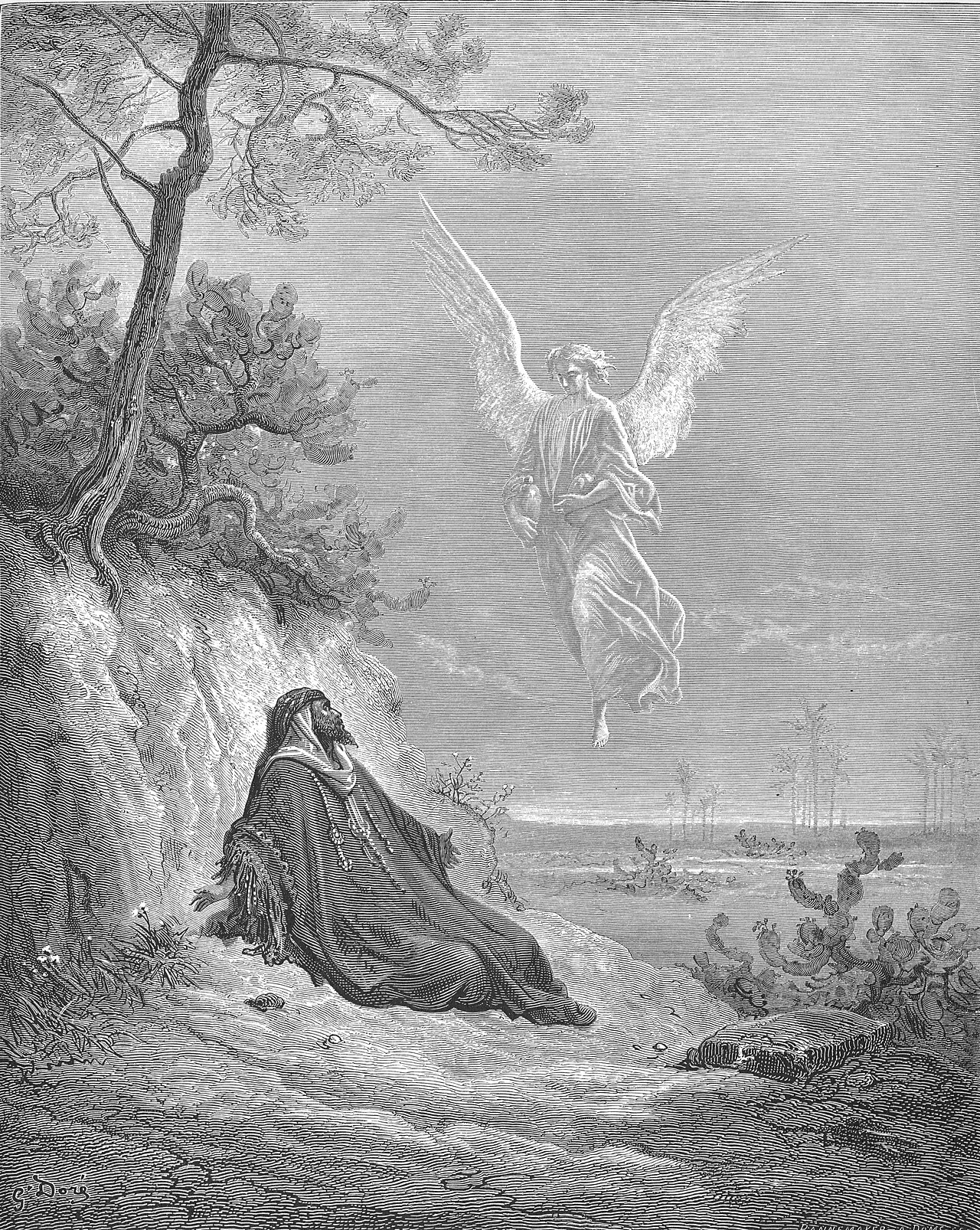
A wind, an earthquake and a fire pass in order, and the text says the LORD was in none of them. Then “after the fire came a still, small voice”, the only place this phrase occurs in Scripture. On Carmel in the chapter before, the LORD answered by fire.
This site's exposition
came a still, small voice
Albert Barnes gives the Hebrew as a sound of soft stillness. Barnes reads the voice as a rebuke to the fierce zeal Elijah claimed at verse 10. Matthew Henry hears the gentle voice of the gospel, set against the fire of the mountain in Hebrews 12.
The record, by era
The Church Fathers1 voice
"Now there was a great wind, so strong that it was splitting mountains and breaking rocks in pieces before the Lord, but the Lord was not in the wind." Now, after the wind, the earthquake came, and after the earthquake the fire, and [Elijah] noticed …
The Puritans and the Awakening2 voices
Faith comes by hearing the word of God; miracles do but make way for it. [3.] Then God spoke to his people with terror; but in the gospel of Christ, which was to be introduced by the spirit and power of Elias, he would speak by a still small voice, the dread of which should not make us afraid; see Heb. xii.
And after the earthquake a fire, but the Lord was not in the fire,....
The Nineteenth Century2 voices
ELIJAH, no doubt, expected that after the wonderful display of God's power on Carmel the nation would give up its idols and would turn unto the only living and true God. Had they not confessed as with a voice of thunder, "Jehovah, He is the God! Jehovah, He is the God!"? The Prophet trusted that the heart of Ahab might, perhaps, be touched and possibly, through him, the heart of Jezebel. If she did not become converted, at least the manifest interposition of Jehovah might check her hand from future persecution.
A commentator
Jamieson, Fausset & Brown1802–1910
Commentary Critical and Explanatory on the Whole Bible (1871)
proposed
In the solitude of Sinai, God appeared to instruct him. "What doest thou here, Elijah?" was a searching question addressed to one who had been called to so arduous and urgent a mission as his.
7 more voices on this verse
The Nineteenth Century5 voices
ELIJAH, no doubt, expected that after the wonderful display of God's power on Carmel the nation would give up its idols and would turn unto the only living and true God. Had they not confessed as with a voice of thunder, "Jehovah, He is the God! Jehovah, He is the God!"? The Prophet trusted that the heart of Ahab might, perhaps, be touched and possibly, through him, the heart of Jezebel. If she did not become converted, at least the manifest interposition of Jehovah might check her hand from future persecution. The Prophet hoped that by an influence thus established over the king and queen, the whole land would speedily glide back to its allegiance to Jehovah. Then would his stern heart have been glad before the Lord. When he found out that it was not so, his spirit fainted within him. The message from Jezebel, that he would be slain the next morning, was probably not so terrible to him as the discovery that came with it that his great demonstration against Baal was doomed to be a failure. The proud Sidonian queen would still rule over vacillating Ahab and, through Ahab, she would still keep power over the people—and the idol gods would sit safely on their thrones. The thought was gall and wormwood to the idol-hating Prophet. He became so despondent that he was ready to give up the conflict and to quit the battlefield. He could not bear to live in the land where the people were so blindly infatuated as to honor Baal and to dishonor Jehovah. He resolved to leave right away. But where shall he go? He traverses the land in hot haste. He flies into the wilderness. He will not lie down till he reaches a solitude where foot of man has not defiled the sward. But in which direction shall he hasten? He, the great Law-vindicator thinks of the spot where once stood the great Law-Giver and so he hastens off to Horeb, to the mount of God.
A commentator
Charles Spurgeon1834–1892
The Metropolitan Tabernacle Pulpit, Sermon No. 3171: “A Voice With Four Messages” (lightly modernized text, CCEL edition) · Written before 1892.
proposed
[Another Sermon by Mr. Spurgeon, upon verses 12 and 13, is #1668, Volume 28—THE STILL SMALL VOICE.] THERE may be a great deal more teaching in what Elijah saw and heard in the cave than I shall be able to bring out this evening. Indeed, I shall not attempt to exhaust the very wonderful practical sermon which was preached to the Prophet on the side of Mount Horeb, but in the still small voice I hear four messages. I. And first, THERE WAS A MESSAGE TO ELIJAH HIMSELF.
A commentator
Charles Spurgeon1834–1892
The Metropolitan Tabernacle Pulpit, Sermon No. 3171: “A Voice With Four Messages” (lightly modernized text, CCEL edition) · Written before 1892.
proposed
[Another Sermon by Mr. Spurgeon, upon verses 12 and 13, is #1668, Volume 28—THE STILL SMALL VOICE.] THERE may be a great deal more teaching in what Elijah saw and heard in the cave than I shall be able to bring out this evening. Indeed, I shall not attempt to exhaust the very wonderful practical sermon which was preached to the Prophet on the side of Mount Horeb, but in the still small voice I hear four messages. I. And first, THERE WAS A MESSAGE TO ELIJAH HIMSELF. He had, apparently, conceived the idea that the whole nation of Israel would be converted from idolatry by one grand display of Divine power. If it could once be indisputably proved that Baal was not God and that Jehovah, alone, was God, then he thought that, surely, the people would be convinced and would loyally return to their old Covenant with the one living and true God. But he found that it was not so. Although the fire of the Lord had fallen from Heaven and had consumed Elijah's sacrifice, burned up the very stones of the altar and licked up the water in the trench. And although the people had cried out, "Jehovah is God! Jehovah is God!" yet for all that, they forsook not Baal, nor the other idols that had been set up in the groves and on the high places—the sun-god was still worshipped and the God who made the sun was forgotten! Elijah seems to have also thought that a display of terrible severity was necessary to bring these people back to their allegiance to Jehovah. Hence he took the prophets of Baal and the prophets of the groves and slew them at the brook Ki-shon, not allowing any of them to escape.
A commentator
Charles Spurgeon1834–1892
The Metropolitan Tabernacle Pulpit, Sermon No. 3498: “God's Gentle Power” (lightly modernized text, CCEL edition) · Written before 1892.
proposed
ELIJAH was a man of like passions with ourselves. We all know that when we have passed through any great excitement of high joy there almost always comes following, a corresponding reaction and depression.
A commentator
Charles Spurgeon1834–1892
The Metropolitan Tabernacle Pulpit, Sermon No. 3498: “God's Gentle Power” (lightly modernized text, CCEL edition) · Written before 1892.
proposed
ELIJAH was a man of like passions with ourselves. We all know that when we have passed through any great excitement of high joy there almost always comes following, a corresponding reaction and depression. Elijah had gone to the top of Carmel and had pleaded his cause, and the rain floods had come in answer to his prayer He had taken the prophets of Baal, and had slain them, and gained a glorious victory for his God; and so full of excitement was he that he girded his loins as though he had been a young man, and ran before the chariot of Ahab, like the royal footmen. It was almost inevitable that after an excitement so high, and strong, that he should be desponding and depressed in spirits, and we find that he was so depressed. If the like should ever happen to any of you' my brethren and sisters, count it no strange thing, nor suppose that some extraordinary trial hath happened unto you. It is but a physical result from physical causes. The mind has operated upon the body. It has strung the bow too tightly, and now, unless the string be relaxed, there is a danger of its breaking altogether. Now as Elias was a man of like passions with us, we may conclude that the way in which God dealt with him is very much the way in which he would deal with us. With a similar case, and the same physician, we may look for the same treatment. As, therefore, the Lord spake to Elijah not by earthquake, nor wind, nor fire, but by the still small voice, so in all probability will he speak to us. It may be, it is just possible it may be, that here to-night there is some worker for God very much in the same condition as Elijah. You, my dear brother, have been working for God in a neighbourhood where you have met with little but opposition and disappointment, and you have almost resolved that you will go away from the place. "The soil is hard," you say, "and breaks the ploughshare.
Modern Voices2 voices
A commentator
Mark Virkler4 Keys to Hearing God – You Can Hear God's Voice! (Elijah List article) (2015)
proposed
Elijah described it as a still, small voice (see 1 Kings 19:12-13). I had previously listened for an inner audible voice, and God does speak that way at times. However, I have found that usually God's voice comes as spontaneous thoughts, visions, feelings, or impressions.
I have always maintained, quite seriously, that the Lord is not in the wind or thunder of the waste, but if anywhere in the still small voice of Fleet Street. I sincerely maintain that Nature-worship is more morally dangerous than the most vulgar man-worship of …
How the passage was read
What the Jewish commentators add
Fire. [Targum Yonoson rendered,] “a camp of angels of fire.”
2 more on this passage, in their own words ▾
And a great wind. [Targum Yonoson rendered,] “a camp of angels of the wind.”
He wrapped his face. [Targum Yonoson rendered,] “and he wrapped his face,” 8 In the same manner that Moshe covered his face at the “burning bush” in Shemos:6. and so it states, “wrapped up [לוטה] in a cloth.” 9 I Shmuel:10.
This section is reception history: how the passage was read and kept in the Jewish tradition. Where a reading parts from an essential of the Christian faith, the section says so at that point.
Texts and citation data: Sefaria; each excerpt follows its version’s licence. 3 further sources are cited on this chapter that carry no English text this site may quote or only restate the verse.
The words behind it
11 Hebrew wordsEvery Hebrew word of this verse in the order it stands, with what it means and the door to its own study. The last column counts the times a word stands in the whole Bible: the rarer the word, the more the places it appears belong together.
| Hebrew | Sound | Meaning | Word study | In the Bible |
|---|---|---|---|---|
| וְאַחַ֤ר | veachar | and [was] after | H310 → | 715 times |
| הָרַ֙עַשׁ֙ | haraash | the earthquake | H7494 → | 17 times |
| אֵ֔שׁ | ʾesh | a fire | H784 → | 378 times |
| לֹ֥א | lo' | not | H3808 → | 5168 times |
| בָאֵ֖שׁ | vaesh | [was] in the fire | H784 → | 378 times |
| יְהוָ֑ה | yahweh | Yahweh | H3068 → | 6520 times |
| וְאַחַ֣ר | veachar | and [was] after | H310 → | 715 times |
| הָאֵ֔שׁ | haesh | the fire | H784 → | 378 times |
| ק֖וֹל | kol | a sound of | H6963 → | 506 times |
| דְּמָמָ֥ה | demamah | a whisper | H1827 → | |
| דַקָּֽה׃ | dakah | soft | H1851 → |
וְאַחַ֤רand [was] after
veacharH310 →715 times
הָרַ֙עַשׁ֙the earthquake
haraashH7494 →17 times
אֵ֔שׁa fire
ʾeshH784 →378 times
לֹ֥אnot
lo'H3808 →5168 times
בָאֵ֖שׁ[was] in the fire
vaeshH784 →378 times
יְהוָ֑הYahweh
yahwehH3068 →6520 times
וְאַחַ֣רand [was] after
veacharH310 →715 times
הָאֵ֔שׁthe fire
haeshH784 →378 times
ק֖וֹלa sound of
kolH6963 →506 times
דְּמָמָ֥הa whisper
demamahH1827 →
דַקָּֽה׃soft
dakahH1851 →
A shaded row is a word that stands 400 times or fewer in the Bible.
The walk
8 stopsEach card is a verse this one points to, and under it the verses that one points to in turn. Where several paths arrive at the same place, that place is listed first: the text keeps returning to it.
Through
Zechariah 4:6So he said to me, “This is the word of the LORD to Zerubbabel: Not by might nor by power, but by My Spirit, says the LORD of Hosts.
it leads to
- 2 Chronicles 32:7–8
“Be strong and courageous! Do not be afraid or discouraged before the king of Assyria and the vast army with him, for there is a greater One with us than with him.
- 2 Corinthians 10:4–5
The weapons of our warfare are not the weapons of the world. Instead, they have divine power to demolish strongholds.
- 1 Corinthians 2:4–5
My message and my preaching were not with persuasive words of wisdom, but with a demonstration of the Spirit’s power,
- Psalms 33:16
No king is saved by his vast army; no warrior is delivered by his great strength.
- Isaiah 11:2–4
The Spirit of the LORD will rest on Him—the Spirit of wisdom and understanding, the Spirit of counsel and strength, the Spirit of knowledge and fear of the LORD.
- 2 Chronicles 32:7–8
Through
Job 33:7Surely no fear of me should terrify you; nor will my hand be heavy upon you.
it leads to
- Job 13:21
Withdraw Your hand from me, and do not let Your terror frighten me.
- Job 13:21
Through
Deuteronomy 4:33Has a people ever heard the voice of God speaking out of the fire, as you have, and lived?
it leads to
- Judges 6:22
When Gideon realized that it was the angel of the LORD, he said, “Oh no, Lord GOD! I have seen the angel of the LORD face to face!”
- Deuteronomy 5:24
and you said, “Behold, the LORD our God has shown us His glory and greatness, and we have heard His voice out of the fire. Today we have seen that a man can live…
- Judges 6:22
Where this verse is studied
On this page
Studies10
On this verse
About 1 Kings
This page draws on 12 works. Open the list of works
This page draws on Albert Barnes, Notes, Explanatory and Practical, on the Old and New Testaments (1832-1869); Albert Barnes, Notes on the Old Testament; Charles Spurgeon, The Metropolitan Tabernacle Pulpit, Sermon No. 1668, The Still Small Voice; Charles Spurgeon, The Metropolitan Tabernacle Pulpit, Sermon No. 1668: “The Still Small Voice” (lightly modernized text, CCEL edition); Charles Spurgeon, The Metropolitan Tabernacle Pulpit, Sermon No. 3171: “A Voice With Four Messages” (lightly modernized text, CCEL edition); Charles Spurgeon, The Metropolitan Tabernacle Pulpit, Sermon No. 3498: “God's Gentle Power” (lightly modernized text, CCEL edition); Ephrem the Syrian, ON THE FIRST BOOK OF KINGS 19:11; GK Chesterton, Alarms and Discursions, The Surrender of a Cockney (1910); Jamieson, Fausset & Brown, Commentary Critical and Explanatory on the Whole Bible; John Gill, Exposition of the Old Testament (1748-1763); Mark Virkler, 4 Keys to Hearing God – You Can Hear God's Voice! (Elijah List article) and Matthew Henry, Commentary on the Whole Bible.