
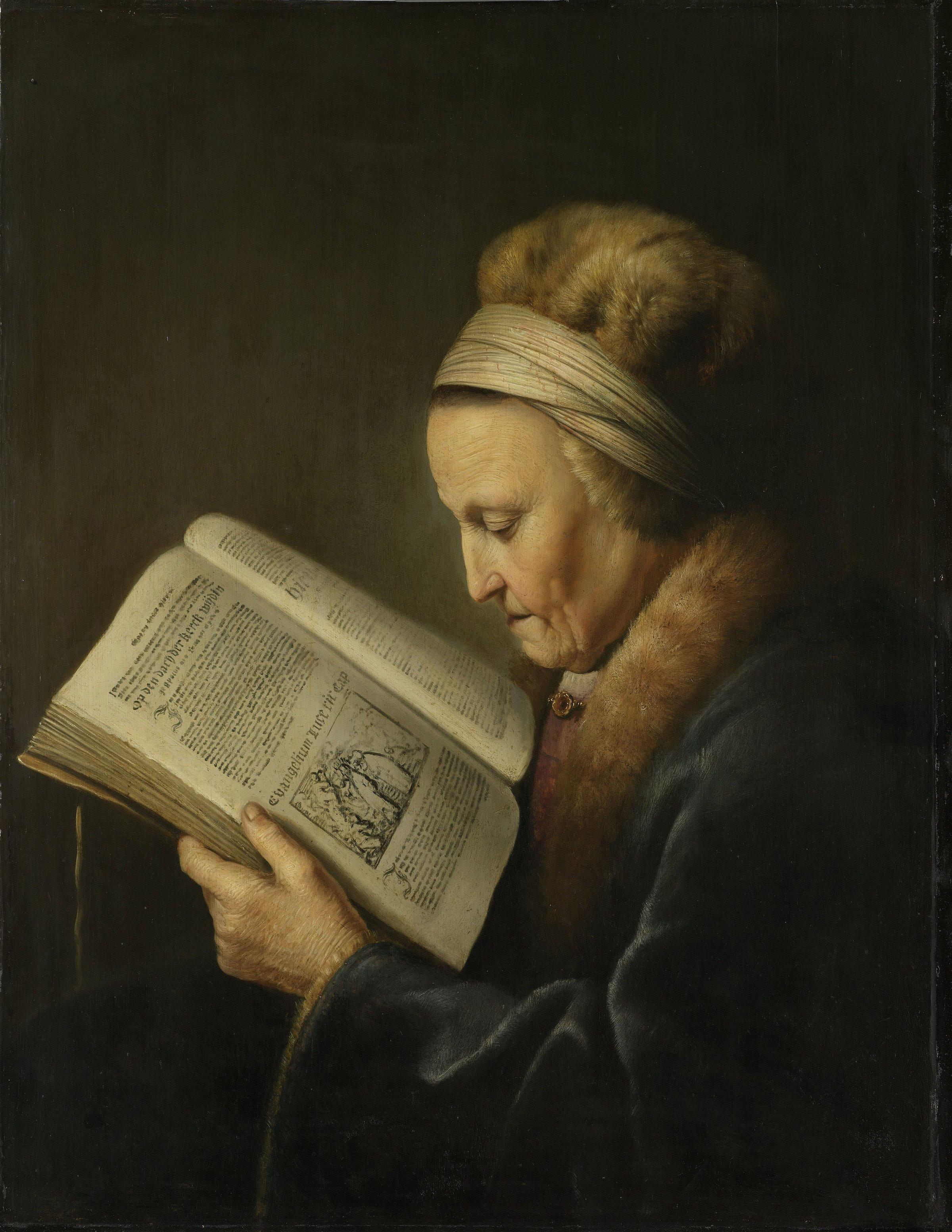
Gerrit Dou, Old Woman Reading, 1631 to 1632. Public domain.
Psalm 119 · Passage · Featured Study
Psalm 119
A persecuted believer prays through twenty-two stanzas of love for God's law.
Rulers press the poet, and he holds to the word.
Your word is a lamp to my feet and a light to my path.
Your word is a lamp to my feet and a light to my path.
- The passage
- Psalm 119:1 to 8, Psalm 119:9 to 16, Psalm 119:17 to 24, Psalm 119:57 to 64, Psalm 119:97 to 104, Psalm 119:121 to 128, Psalm 119:161 to 168, Psalm 119:169 to 176
- Book
- Psalms
- Hold in memory
- Psalm 119:105, Psalm 119:11, Psalm 119:18
Summary
The psalm praises the word of the LORD and asks for grace to keep it. Perowne, quoting The Psalms Chronologically Arranged, calls the psalm an epitome of all true religion.
- Nearly every line of the psalm names the law under one of its names.
- Commentators dispute the poet's age and the order of the stanzas.
- Monks drew a rule of daily prayer from Psalm 119:164.
Blessed Are the Blameless
The psalm opens with two blessings on those who keep the law.
Blessed are those whose way is blameless, who walk in the Law of the LORD. Blessed are those who keep His testimonies and seek Him with all their heart.These verses name the subject of all that follows.
Perowne names the law of God as the great subject of the psalm's praise. He calls the psalm an expansion of the latter part of Psalm 19.
The psalm is an acrostic of twenty-two stanzas of eight verses, and The Acrostic Psalms teaches that form.
The Eight Words for the Law
The table counts the verses in which each word stands.
Eight Hebrew words name the law across the psalm.
| Hebrew word | Strong's number | The Berean text renders it | Verses that use it |
|---|---|---|---|
| tôwrâh | H8451 | law | 25 |
| ʻêdâh and ʻêdûwth | H5713 and H5715 | testimonies | 23 |
| mishpâṭ | H4941 | judgments | 23 |
| dâbâr | H1697 | word | 23 |
| mitsvâh | H4687 | commandments | 22 |
| piqqûwd | H6490 | precepts | 21 |
| chôq | H2706 | statutes | 21 |
| ʼimrâh | H565 | word | 19 |
chôq, ʼimrâh
The eight words stand in 172 verses. Psalm 119:3, Psalm 119:37, Psalm 119:90 and Psalm 119:122 carry none of them.
The Masoretes counted ten names for the law, adding way and faithfulness. By that count only one verse lacks a name, as Perowne and Delitzsch report, and the Hebrew text bears this out.
Ensure Your servant’s well-being; do not let the arrogant oppress me.Delitzsch quotes the Masora's note on this verse.
A Prayer Under Persecution
The psalmist asks to be taught and kept while rulers oppose him.
Delitzsch calls the whole psalm a prayer for steadfastness among an ungodly people and in great trouble. In the Berean text the psalmist says teach me in ten verses and calls himself Your servant in thirteen.
Though rulers sit and slander me, Your servant meditates on Your statutes.Delitzsch cites this verse for a government hostile to the faith.
Though the ropes of the wicked bind me, I do not forget Your law.Delitzsch cites this verse for the poet's bonds.
Perowne describes the psalmist's enemies as men of rank and authority who have the power to crush him. He finds the psalmist urged to give up his faith for gain, and sad, yet resting on the word and promise of God.
A Plan or a String of Sayings
Delitzsch traces a movement through the stanzas, and others read a series of maxims.
A movement through the stanzasFranz Delitzsch
Delitzsch reads the stanzas as stages of one prayer. The poet praises faithfulness to the word, prays for light, strength and keeping, cries how long in the eleventh stanza, and closes asking God to seek him.
Against this reading, Hengstenberg and Hupfeld, as Delitzsch reports them, find no set plan at all.
Sayings bound by the alphabetJ. J. Stewart Perowne
Perowne does not find Delitzsch's analysis very successful. To a certain extent, he writes, the order of the alphabet fettered the thought.
Against this reading, Delitzsch answers that the psalm grows out of a real situation of persecution, and that its stanzas move with it.
The Psalm in Use
Readers have kept the psalm as an alphabet of the word and as a rule of hours.
Delitzsch reports the heading of the psalm in a German version, the Christian's golden A B C of the praise, love, power and use of the word of God.
“Some have called it the saints' alphabet; and it were to be wished we had it as ready in our memories as the very letters of our alphabet, as ready as our A B C.”
Matthew Henry · Commentary on the Whole Bible, on Psalm 119, the introductionPuritan
Seven times a day I praise You for Your righteous judgments.Cassian and Augustine read the number in this verse two ways.
John Cassian, in his Institutes, grounds the monks' daily services on Psalm 119:164. Augustine took the number as a figure for always.
Voices on the Psalm
Jerome and Jamieson, Fausset and Brown wrote on two prayers of the psalm.
Jerome (died 420)
LETTER 58.9
Jerome uses the psalmist's prayer for open eyes to teach a friend how to read Scripture.
“Hear me, therefore, my fellow servant, my friend, my brother; give ear for a moment that I may tell you how you are to walk in the holy Scriptures. All that we read in the divine books, while glistening and shining without, is yet far sweeter within. ‘He who desires to eat the kernel must first break the nut.’ ‘Open my eyes,’ says David, ‘that I may behold wondrous things out of your law.’”
on Psalm 119:18Patristic
Jamieson, Fausset & Brown (1802 to 1910)
Commentary Critical and Explanatory on the Whole Bible
Jamieson, Fausset and Brown read the psalm's last verse as a believer's.
“Not only the sinner before conversion, but the believer after conversion, is unable to recover himself; but the latter, after temporary wandering, knows to whom to look for restoration.”
on Psalm 119:176Reformed
Who Wrote the Psalm
Three readings place the poet at three ages of life.
I have more insight than all my teachers, for Your testimonies are my meditation. I discern more than the elders, for I obey Your precepts.The poet's age is argued from these verses.
A young man in prisonFranz Delitzsch; Hitzig on the prison, as Delitzsch reports him
Delitzsch takes Psalm 119:9 and the two verses above to show that the poet is a young man. He reads him as lying in bonds under a government hostile to the faith, in the years of Greek rule. Hitzig, as Delitzsch reports him, places the poet in prison in the Maccabean age.
Against this reading, Perowne hears Psalm 119:9 as the counsel of an older man to the young, as in Ecclesiastes 12:1.
A man in middle life after the exileJ. J. Stewart Perowne
Perowne holds that the poet was no longer young and had at least reached the middle of life. He places the psalm, probably, after the return from Babylon, when the written law was in the people's hands.
Against this reading, Delitzsch reads the rulers and the bonds of the psalm as the trials of the Greek period.
An old teacherEwald, as Delitzsch and Perowne report him
Ewald reads the psalm as the long prayer of an old and experienced teacher.
Against this reading, Perowne notes that an old man would not compare his knowledge with that of the aged.
Books to Read Next
Both commentaries are in the public domain, and each has a free copy to read.
The Book of Psalms: A New Translation, with Introductions and Notes, Explanatory and Critical, volume 2
J. J. Stewart Perowne · 1876
Perowne's introduction to the psalm is on pages 330 to 333.
Read at the Internet ArchiveBiblical Commentary on the Psalms, volume 3
Franz Delitzsch · 1877
Delitzsch sets out his plan of the stanzas on pages 242 to 245.
Read at the Internet ArchiveSeek Your Servant
After 175 verses of love for the law, the psalm ends with a confession and a plea.
I have strayed like a lost sheep; seek Your servant, for I have not forgotten Your commandments.The last stanza closes on the psalmist's own straying.
Sources
Scripture is the Berean Standard Bible.
- The Hebrew of Psalm 119 with Strong's numbers, counted verse by verse.
- J. J. Stewart Perowne, The Book of Psalms, W. F. Draper, Andover, 1876, vol. 2, pp. 330 to 333.
- Franz Delitzsch, Biblical Commentary on the Psalms, T. and T. Clark, Edinburgh, 1877, vol. 3, pp. 242 to 245.
- Matthew Henry, Commentary on the Whole Bible, on Psalm 119, the introduction.
- John Cassian, Institutes 3.4.
- Augustine of Hippo, Expositions on the Book of Psalms, Psalm 119, section 162.
- Jerome, Letter 58.9.
- Jamieson, Fausset and Brown, Commentary Critical and Explanatory on the Whole Bible, 1871, on Psalm 119:176.
Keep Studying
Studies8
Words1