
Lamentations 4:10
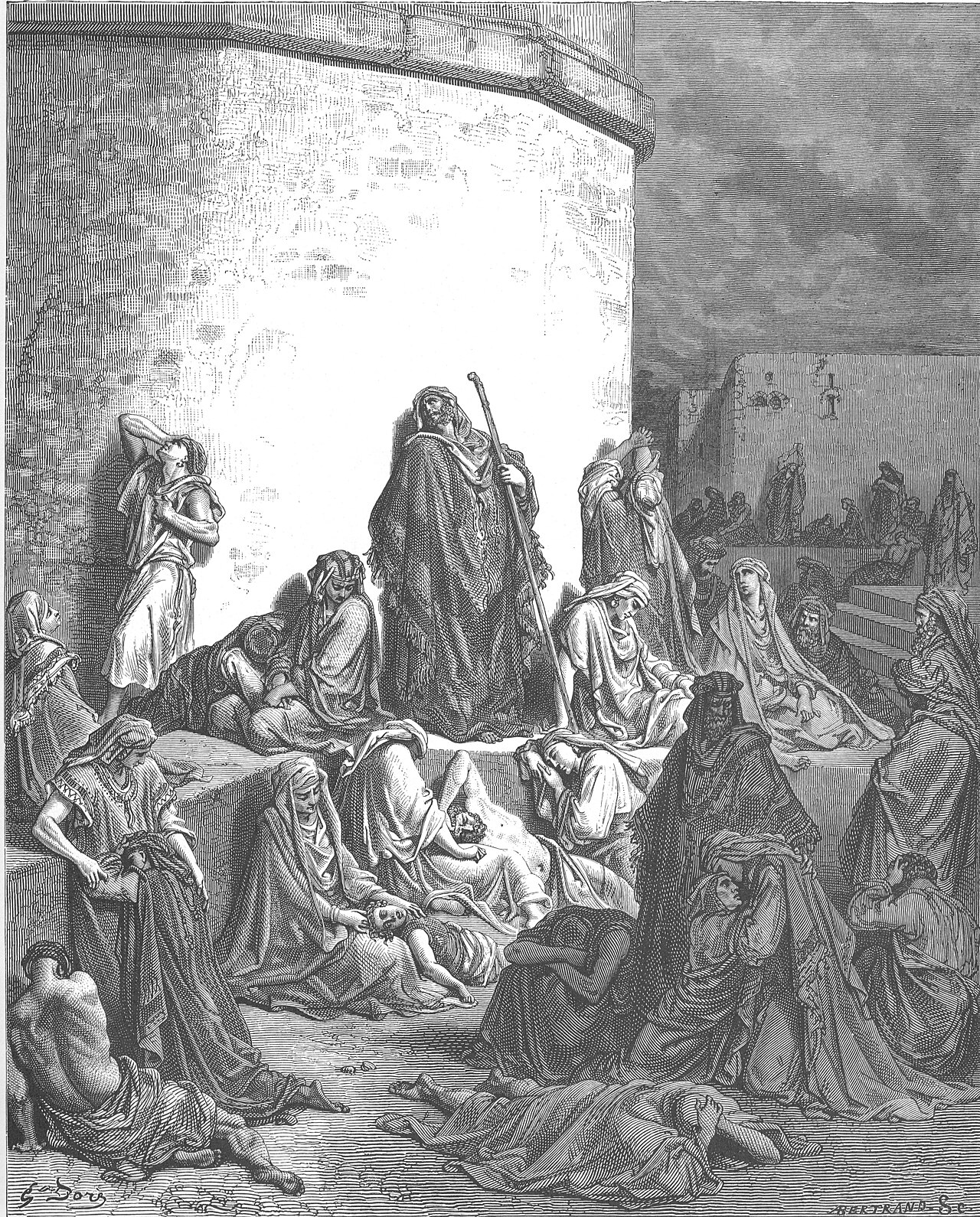
in Lamentations 4The hands of compassionate women have cooked their own children, who became their food in the destruction of the daughter of my people.
BSB
The same verse in ASV and KJV ▾
ASV
The hands of the pitiful women have boiled their own children; They were their food in the destruction of the daughter of my people.
KJV
The hands of the pitiful women have sodden their own children: they were their meat in the destruction of the daughter of my people.
⋯
This verse in Lamentations 4
Commentary
9 notes on this verseThe hands of the pitiful women have sodden their own children - See on Lam 2:20 (note). But here there is a reference to mothers eating their own children; and this was done, not by mothers cruel and brutal, but by נשים רחמניות nashim rachmaniyoth, the compassionate, the tender-hearted mothers. From these horrible scenes it is well to pass with as hasty a step as possible.
This site's exposition
Those slain by the sword are better off than those who die of hunger
on Lamentations 4:9-10
Verse 9 weighs two deaths and finds the quicker one lighter. Verse 10 names the famine's last horror plainly: “The hands of compassionate women have cooked their own children”. It is the curse Moses warned would fall on a besieged, covenant-breaking city in Deuteronomy 28:56-57 and Leviticus 26:29.
This site's exposition
compassionate women
Adam Clarke stresses the Hebrew: the women who cooked their children were the compassionate ones. Hunger did this, worse than the sword of verse 9. Lamentations 2:20 had already set this horror before the LORD, and John Chrysostom sets it beside the siege of Samaria in 2 Kings 6:28-29.
The record, by era
The Church Fathers1 voice
What were Israel's sufferings in Palestine, famines, pestilences, wars, captivities, under the Babylonians, and under the Assyrians, and their miseries from the Macedonians, and those under Hadrian and Vespasian? I have something that I wish, beloved, to relate to thee; nay, do not run away! Or rather I will tell thee another thing before it. There was once a famine, it says, and the king was walking upon the wall; then a woman came to him and uttered these words: "O king, this woman said to me, Let us roast thy son to-day, and eat him—to-morrow mine. And we roasted and ate, and now she does not give me hers." What can be more dreadful than this calamity? Again, in another place the Prophet says, "The hands of the pitiful women have sodden their own children." The Jews then suffered such punishment, and shall we not much rather suffer? Would you also hear other calamities of theirs? Read over Josephus, and you will learn that whole tragedy, if perchance we may persuade you from these things, that there is a hell. For consider, if they were punished, why are we not punished? or how is it reasonable that we are not now punished, who sin more grievously than they? Is it not manifest that it is, because the punishment is kept in store for us?
The Medieval Church2 voices
Here is considered the immense hunger of mothers, who eat their own children, through an excessive hunger. As said above in Chapter 2:20: "Should women eat their offspring, the children of their tender care?"
A commentator
BonaventureCollationes de Septem Donis, Collation 6 · Written in the 13th century.
proposed
See to it that each one of you has that ointment, so that he may be devoutly disposed toward God and may repent and guard himself from sin. Some have compassion on their flesh, not on their soul. Whence in Lamentations: "The hands of compassionate …
The Puritans and the Awakening2 voices
): The hands of the pitiful women have first slain and then sodden their own children. This was lamented before ( ch. ii. 20 ); and it was a thing to be greatly lamented that any should be so wicked as to do it and that they should be brought to such extremities as to be tempted to it.
quarantine:debris (2026-07-29) — leading-punctuation+unbalanced-parens
The hands of the pitiful women have sodden their own children,....
1 more voice on this verse
The Nineteenth Century1 voice
A commentator
Albert Barnes1798–1870
Notes, Explanatory and Practical, on the Old and New Testaments (1832-1869)
proposed
Pitiful - i. e. tender-hearted, compassionate. meat is used for food Psa 69:21. What is here stated actually occurred during the siege of Jerusalem by Titus.
How the passage was read
What the Jewish commentators add
On the verses either side of this one
Adonoy spent His wrath. Which burned in Him for many years. 17 God’s fury is compared to a ‘consuming fire’ as in Eichah:3 above; also see Devorim:24. He now spent it when He avenged Himself upon them.
This section is reception history: how the passage was read and kept in the Jewish tradition. Where a reading parts from an essential of the Christian faith, the section says so at that point.
Texts and citation data: Sefaria; each excerpt follows its version’s licence. 3 further sources are cited on this chapter that carry no English text this site may quote or only restate the verse.
The words behind it
11 Hebrew wordsEvery Hebrew word of this verse in the order it stands, with what it means and the door to its own study. The last column counts the times a word stands in the whole Bible: the rarer the word, the more the places it appears belong together.
| Hebrew | Sound | Meaning | Word study | In the Bible |
|---|---|---|---|---|
| יְדֵ֗י | yedei | [the] hands of | H3027 → | 1618 times |
| נָשִׁים֙ | nashim | women | H802 → | 781 times |
| רַחֲמָ֣נִיּ֔וֹת | rachamaniyot | compassionate | H7362 → | |
| בִּשְּׁל֖וּ | bishelu | they have boiled | H1310 → | |
| יַלְדֵיהֶ֑ן | yaldeihen | own children their | H3206 → | |
| הָי֤וּ | hayu | they have been | H1961 → | 3559 times |
| לְבָרוֹת֙ | levarot | for eating | H1262 → | |
| לָ֔מוֹ | lamo | for them | ||
| בְּשֶׁ֖בֶר | beshever | in [the] brokenness of | H7667 → | 45 times |
| בַּת־ | bat- | [the] daughter of | H1323 → | 588 times |
| עַמִּֽי׃ ס | ʾami | people my | H5971 → | 1873 times |
יְדֵ֗י[the] hands of
yedeiH3027 →1618 times
נָשִׁים֙women
nashimH802 →781 times
רַחֲמָ֣נִיּ֔וֹתcompassionate
rachamaniyotH7362 →
בִּשְּׁל֖וּthey have boiled
bisheluH1310 →
יַלְדֵיהֶ֑ןown children their
yaldeihenH3206 →
הָי֤וּthey have been
hayuH1961 →3559 times
לְבָרוֹת֙for eating
levarotH1262 →
לָ֔מוֹfor them
lamo
בְּשֶׁ֖בֶרin [the] brokenness of
besheverH7667 →45 times
בַּת־[the] daughter of
bat-H1323 →588 times
עַמִּֽי׃ סpeople my
ʾamiH5971 →1873 times
A shaded row is a word that stands 400 times or fewer in the Bible.
The walk
8 stopsEach card is a verse this one points to, and under it the verses that one points to in turn. Where several paths arrive at the same place, that place is listed first: the text keeps returning to it.
Through
Isaiah 49:15“Can a woman forget her nursing child, or lack compassion for the son of her womb? Even if she could forget, I will not forget you!
it leads to
- Psalms 103:13
As a father has compassion on his children, so the LORD has compassion on those who fear Him.
- Isaiah 44:21
Remember these things, O Jacob, for you are My servant, O Israel. I have made you, and you are My servant; O Israel, I will never forget you.
- Matthew 7:11
So if you who are evil know how to give good gifts to your children, how much more will your Father in heaven give good things to those who ask Him!
- Jeremiah 31:20
Is not Ephraim a precious son to Me, a delightful child? Though I often speak against him, I still remember him. Therefore My heart yearns for him; I have great compassion for him,” declares…
- Hosea 11:1
When Israel was a child, I loved him, and out of Egypt I called My son.
- Psalms 103:13
Through
Jeremiah 19:9I will make them eat the flesh of their sons and daughters, and they will eat one another’s flesh in the siege and distress inflicted on them by their enemies who seek their lives.’
it leads to
- Leviticus 26:29
You will eat the flesh of your own sons and daughters.
Reached by 2 separate paths from here.
- Isaiah 9:20
They carve out what is on the right, but they are still hungry; they eat what is on the left, but they are still not satisfied. Each one devours the flesh of his own…
- Leviticus 26:29
Through
Lamentations 2:20Look, O LORD, and consider: Whom have You ever treated like this? Should women eat their offspring, the infants they have nurtured? Should priests and prophets be killed in the sanctuary of the Lord?
it leads to
- Jeremiah 19:9
I will make them eat the flesh of their sons and daughters, and they will eat one another’s flesh in the siege and distress inflicted on them by their enemies who seek their lives.’
Reached by 2 separate paths from here.
- Jeremiah 19:9
Where this verse is studied
On this page
About Lamentations
This page draws on Adam Clarke, Commentary on the Bible; Albert Barnes, Notes, Explanatory and Practical, on the Old and New Testaments (1832-1869); Bonaventure, Collationes de Septem Donis, Collation 6; Carl Friedrich Keil, Lamentations; John Chrysostom, HOMILIES ON 1 THESSALONIANS 8; John Gill, Exposition of the Old Testament (1748-1763); Matthew Henry, Commentary on the Whole Bible and Thomas Aquinas, Commentary on Lamentations.