
MANNAFEST

New Testament · Philemon

One Letter, One Household, One Gospel Made Small

The shortest of Paul's letters does the gospel's most private, most costly work in one Colossian household. Paul will not command Philemon — he could — he appeals, staking his own relationship, reputation, and resources on a runaway slave's reception: "receive him as myself… no longer as a servant, but more than a servant, a brother beloved" (vv.16–17), and "put that to mine account… I will repay it" (vv.18–19) — a small, real, historical picture of what Christ does at the cross.

The Appeal's Staircase

six rising steps — every height computed, none hand-placed

In twenty-five verses Paul executes a complete ancient rhetorical appeal — commendation, petition, the pivot, the pledge, the close — without once issuing the command he has the authority to issue (v.8–9). Each step below carries more relational weight than the last, climbing to the letter's center of gravity: Paul's own body inserted between Onesimus's debt and Philemon's ledger.

01
CommendationPhilemon vv. 4–7

Paul thanks God for Philemon's love toward all the saints and faith toward the Lord Jesus, and prays “that the fellowship of thy faith may become effectual” (v.6) — the relational ground Paul is about to stand on.

02
Appeal, Not CommandPhilemon vv. 8–9

Though bold enough in Christ to command what is fitting, Paul instead appeals "for love's sake" — the rhetorical hinge that sets the tone for everything that follows.

03
The Wordplay: Useless Made UsefulPhilemon vv. 10–11, 20

Onesimus ("useful") was once achrēstos — the ASV's "unprofitable" — to Philemon; now he is euchrēstos, "profitable to thee and to me" (v.11). The slave's own name becomes the sermon.

04
Receive Him as MyselfPhilemon v. 17

"If then thou countest me a partner, receive him as myself" — Onesimus is to be accepted not on his own record but on the ground of union with his mediator, Paul.

05
Put That to Mine AccountPhilemon vv. 18–19

"But if he hath wronged thee at all, or oweth thee aught, put that to mine account... I will repay it" — imputation in miniature: a debt reckoned to the one who did not incur it.

06
The Confidence ClosePhilemon vv. 21–25

"Having confidence in thine obedience I write unto thee, knowing that thou wilt do even beyond what I say" — a gentle push, on the majority reading, toward Onesimus's outright freedom, never legislated, always invited.

The Argument

the whole letter in three sentences
Author
Paul, with Timothy — undisputed even by critical scholarship
Date/Place
c. AD 60–62, from Roman imprisonment (a minority reads it as Ephesian), alongside Colossians and Ephesians
Genre
A personal letter — the shortest of Paul's canonical letters, 25 verses
Shape
Greeting → thanksgiving → appeal → imputation offer → confidence close
  1. 1

    Philemon's runaway slave Onesimus — likely after some wrong or theft, v.18 — reached Paul in a Roman prison, was converted under his ministry, and became genuinely useful to him there; Paul now sends him back with this letter, alongside Tychicus carrying Colossians to the very same city (Col 4:7–9).

  2. 2

    Paul does not command what he could command — he appeals "for love's sake," leveraging gratitude, warmth, even a pun on Onesimus's own name, and finally a personal financial guarantee that mirrors the gospel itself: "put that to mine account."

  3. 3

    The ask is not merely legal freedom but a changed relationship — "no longer as a servant, but more than a servant, a brother beloved" — a private domestic matter that entered the New Testament canon anyway, itself a statement that the gospel's claim on economic and household relationships is not incidental to the faith.

Onesimus and Tychicus carry both letters on the same courier run (Col 4:7–9), which is why Philemon and Colossians are dated together — the same circle of names (Epaphras, Mark, Aristarchus, Demas, Luke) closes both letters (Col 4:10–14; Phm 23–24). The Colossians hub →

Christ in Philemon

a narrative parable of the gospel, labeled honestly as such
Paul as a small Christ-figure in the mediationvv. 18–19 → Isa 53:12

Paul stands between an offender and the offended party and absorbs the debt himself: "put that to mine account... I will repay it." This is the structure of the cross in miniature — the one who owes nothing takes the debt of the one who owes everything, so the guilty party is received as family rather than as a debtor. A small, real, historical echo of the Servant who "was numbered with the transgressors... and bare the sin of many."

"Receive him as myself" mirrors how the believer is received in Christv. 17 → Eph 1:6

Onesimus is accepted not on the ground of his own record but on the ground of union with the mediator — the same logic behind the believer being "accepted in the beloved."

"No longer as a servant... but a brother beloved"v. 16 → Gal 4:7; Ro 8:15–17

The gospel's status-change applied concretely: the same movement — doulos to huios, servant to son — that Paul describes doctrinally elsewhere. Whatever Onesimus's civil status remained, the family category had to change.

Onesimus's own name preachesvv. 11, 20 → Eph 2:10

The useless one made useful is the gospel's verdict on every believer — "created... unto good works." Traditionally (later, disputed) identified with the Onesimus named bishop of Ephesus in Ignatius's letter to the Ephesians, c. AD 110 — a church-tradition inference, not textually certain, and presented here as tradition, not fact.

The Hinge

vv. 18–19 — the thread the whole letter hangs from
Philemon 18–19 →

"But if he hath wronged thee at all, or oweth thee aught, put that to mine account; I Paul write it with mine own hand, I will repay it: that I say not unto thee that thou owest to me even thine own self besides."

Paul writes Philemon a legal-sounding promissory note in his own hand — imputation in miniature, though not itself an atonement text. The commercial term ellogeō ("put to one's account") is a thematic parallel to Paul's imputation vocabulary elsewhere (Ro 4; 2 Co 5:19), not identical terminology. The resemblance is thematic, and the page claims no more than that.

Themes

five load-bearing lines through the letter
01

Reconciliation applied at the household level

Philemon the whole letter

Paul's doctrine of reconciliation (2 Co 5:18–19; Eph 2:14–16) worked out in a single named relationship rather than argued in the abstract — what Col 3:11's "there cannot be... bondman, freeman; but Christ is all, and in all" looks like when it has to actually happen.

02

Imputation in miniature

Philemon vv. 18–19

"Put that to mine account (ellogeō)" is not itself an atonement text, but it is the New Testament's clearest lived illustration of the reckoning language Paul uses doctrinally — a thematic parallel to his imputation vocabulary, not identical terminology.

03

Koinōnia as the ground of the appeal

Philemon v. 6; v. 17

Paul's whole request rests on shared life in Christ — "the fellowship (koinōnia) of thy faith" (v.6), and "if then thou countest me a partner (koinōnon)" (v.17). Fellowship in Christ is what makes a slave a brother.

04

A changed relationship, not just a changed status

Philemon v. 16

Paul does not simply ask for Onesimus's legal freedom as an end in itself — he asks for a transformed relationship. The social category may or may not change; the family category must.

05

Costly mediation

Philemon vv. 18–19

Paul puts his own credibility, resources, and relationship on the line for someone with no standing to demand it. Onesimus did nothing to earn Paul's advocacy — it is entirely gift.

Original Language

the vocabulary of debt, fellowship, and family — each word a door

The achrēstos/euchrēstos pun (v.11) is sometimes heard, by ear rather than strict etymology, as echoing a-Christos, "without Christ" — flagged here as a homiletic observation, not asserted as Paul's deliberate authorial device.

The Approved Voices on Philemon

the roster applied — the specific work named, so you can go to it
Charles Spurgeonpublic domain

All of Grace (1886)

His teaching on the substitutionary shape of the gospel — Christ bearing the punishment of sin in his own person — is the natural lens for v.18–19's imputation picture. No verbatim quotation is asserted here.

R. C. Sproulcite-only ≤50w

What Is Reformed Theology? (1997)

Cite-only, ≤50 words: Sproul frames the cross as unintelligible apart from God's holiness and justice — the right doctrinal register for reading Paul's offer to personally repay Philemon as more than social nicety.

Chuck Misslercite-only ≤50w

Learn the Bible in 24 Hours (2002)

Marcus Brown's formative teacher. His stated method — small narrative texts read as deliberately Christ-pointing — fits Philemon closely. No dedicated Philemon or Prison Epistles series has been sourced for this page, so the general work is what is cited.

Jamieson, Fausset & Brownpublic domain

Commentary, Critical and Explanatory (David Brown's section, Romans–Philemon)

Covers Philemon verse by verse; the natural place to go next on vv.16–19, rather than reproduced here.

John Calvinpublic domain

commentary on Philemon (part of his complete commentary corpus)

Pointer for the workbench — likely strong on Christian equality-in-Christ overriding social station, consistent with his Institutes treatment of Gal 3:28-type texts.

John Wesleypublic domain

Explanatory Notes Upon the New Testament

Pointer for the workbench — likely to emphasize practical holiness and the transformed-master ethic.

Chrysostompublic domain

Homilies on Philemon (early church, public domain)

The classic patristic voice reading v.21 as a gentle push toward manumission. He preached a full series on this one-chapter letter; the individual homily is not yet sourced, so nothing is quoted from it here.

Marcus Brown's own commentary leads above all; within a tier, all voices are equal — no single voice, Spurgeon included, is elevated above its rating.

Contested Points

presented at full strength, then MannaFest's flag

The NT, Paul, and slavery

The history

Before either view, the historical shape of the thing Paul is writing about. Slavery in the first-century Roman world was not the institution modern readers picture. It was not racially defined; manumission was common and legally structured, whether by a master's declaration, by will, or by a slave purchasing his own freedom; and enslaved people could hold property, receive education, and work in skilled positions — physicians, tutors, and estate managers were often enslaved. None of that makes it benign. It was still founded on the ownership of persons, it was still enforced with real brutality, and a runaway (fugitivus) faced severe legal penalty, including branding, while anyone who harbored him carried legal risk of his own — which is part of why Paul sending Onesimus back with a letter, rather than simply keeping him, was itself a costly and deliberate act. But the social form Paul confronted differed from the transatlantic institution Christian abolitionists later fought, and that difference is why this letter reads as a personal appeal about one relationship rather than a manifesto against a trade.

The modern objection, presented at full strength

Paul had the opportunity here — writing directly to a slave-owner about a specific slave, with full apostolic authority — to unambiguously condemn chattel slavery, and he does not. He sends Onesimus back rather than declaring the institution sinful, and elsewhere gives household-code instructions that regulate rather than abolish (Eph 6:5–9; Col 3:22–4:1). Read uncharitably, the letter can look like accommodation to an unjust system at a vulnerable person's expense.

The gospel-subversion-from-within reading

Paul is not silent — he plants a bomb under the institution rather than attacking its walls directly. He reframes the relationship in terms structurally incompatible with slavery's logic ("a brother beloved," v.16), puts himself financially on the hook as if Onesimus's debt were his own to reckon, and invokes "how much more" language that submits the earthly relationship to the heavenly one. The household codes cut the same way once you know what they replaced: Greco-Roman household ethics did not address slaves as moral agents at all — they were the subject of instruction to the master, never its addressee — so Paul speaking directly to slaves (Eph 6:5–8), and holding masters accountable to a Master of their own in heaven, with whom "there is no respect of persons" (Eph 6:9), is itself the subversive act, whatever the content of the instruction. First-century Christianity lacked the social power to abolish slavery by decree; it planted the seed — Galatians 3:28, and 1 Corinthians 7:21's operative clause, "if thou canst become free, use it rather" — that later grew into the Christian abolitionist movement, with Wilberforce and the Clapham Sect reasoning explicitly from these texts.

MannaFest flag — Hold both truths without flattening either — Scripture does not present a modern abolitionist manifesto, because that was not the mission given to a persecuted, powerless first-century minority. It presents something that, followed to its logical end — a "brother beloved," not merely a servant, cannot remain property — dismantles the institution from the inside. The text is honest raw material, not a modern position paper, and the objection at its strongest above deserves its full airing rather than a dismissive answer.

Does Paul request Onesimus's legal freedom?

View 1 — no, or not directly

Paul never uses the language of legal manumission; his explicit ask is relational reception ("receive him... as a brother," v.16–17), and v.13–14 shows him deliberately not presuming to keep Onesimus without Philemon's consent. The letter is framed around consent and relationship, not a legal-status demand.

View 2 — yes, implicitly, or Paul hopes for "more"

v.21's "knowing that thou wilt do even beyond what I say" is widely read, from Chrysostom onward, as a gracious hint toward freeing Onesimus outright — stopping short of directly commanding it so Philemon's response is freely given rather than coerced, consistent with v.14's insistence on willingness.

MannaFest flag — View 2 is the more natural reading of v.21's "even beyond what I say" combined with v.14 — Paul maneuvering Philemon toward manumission without legislating it, consistent with his broader pattern of transforming hearts rather than issuing decrees where love can do the deeper work.

The Cast

a household, a courier, and Paul's prison circle
PaulAuthor, "a prisoner of Christ Jesus" (v.1, v.9) — his captivity framed as belonging to Christ, not Rome.TimothyCo-sender (v.1) — named alongside Paul in the greeting.
OnesimusPhilemon's runaway slave, converted through Paul in prison (v.10); named again in Col 4:9 as "the faithful and beloved brother, who is one of you."
PhilemonRecipient — a believer of some standing at Colossae, host of a house-church, "our beloved and fellow-worker" (v.1).
ApphiaCo-addressee, "our sister" (v.2) — traditionally Philemon's wife.
ArchippusCo-addressee, "our fellow-soldier" (v.2) — also charged in Col 4:17; traditionally Philemon and Apphia's son.
LukeNamed among Paul's fellow-workers sending greetings (v.24) — the same circle named at the close of Colossians.John MarkNamed among Paul's fellow-workers sending greetings (v.24, "Mark").
EpaphrasPaul's "fellow-prisoner in Christ Jesus" (v.23) — also named at the close of Colossians as "one of you."
AristarchusNamed among the fellow-workers sending greetings (v.24).
DemasNamed among the fellow-workers sending greetings (v.24) — the same name later noted as having forsaken Paul (2 Ti 4:10).

Places

RomePaul's likely imprisonment when he writes; a minority of scholars place the letter in an Ephesian imprisonment instead.
ColossaePhilemon's household and its house-church, inferred from the Onesimus/Tychicus overlap with Colossians (Col 4:9).

Keep studying

— more from The Letters

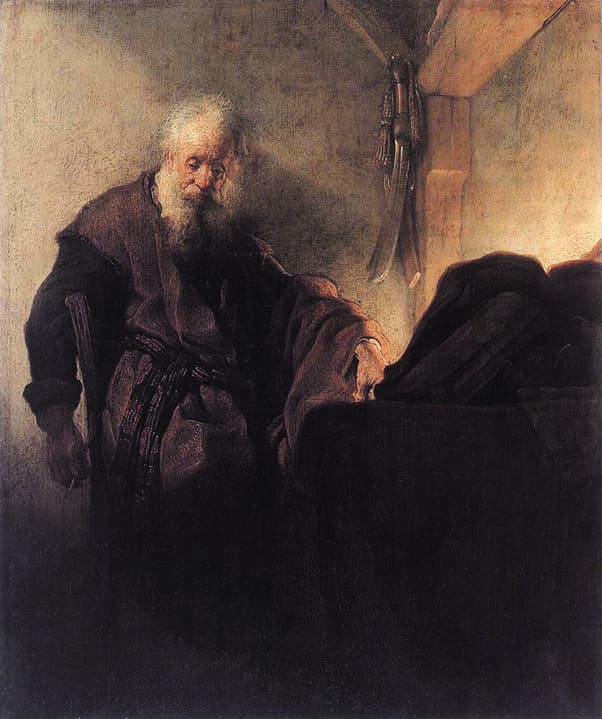
Artwork: Rembrandt, The Apostle Paul — public domain. Drafted from MannaFest's research brief on Philemon — public-domain commentators (Spurgeon, JFB, Calvin, Wesley, Chrysostom) as pointers, cite-only for moderns. Scripture ASV. Every cited work — the sources registry →