
Mark 5:22
in Mark 5A synagogue leader named Jairus arrived, and seeing Jesus, he fell at His feet
BSB
The same verse in ASV and KJV ▾
ASV
And there cometh one of the rulers of the synagogue, Jaïrus by name; and seeing him, he falleth at his feet,
KJV
And, behold, there cometh one of the rulers of the synagogue, Jairus by name; and when he saw him, he fell at his feet,
⋯
This verse in Mark 5
Commentary
14 notes on this verseLet our opponents-that is, they who speak against their own salvation-inform us [as to this point]: The deceased daughter of the high priest; the widow's dead son, who was being carded out [to burial] near the gate [of the city]; and Lazarus, who had lain four days in the tomb, -in what bodies did they rise again? In those same, no doubt, in which they had also died. For if it were not in the very same, then certainly those same individuals who had died did not rise again.
This site's exposition
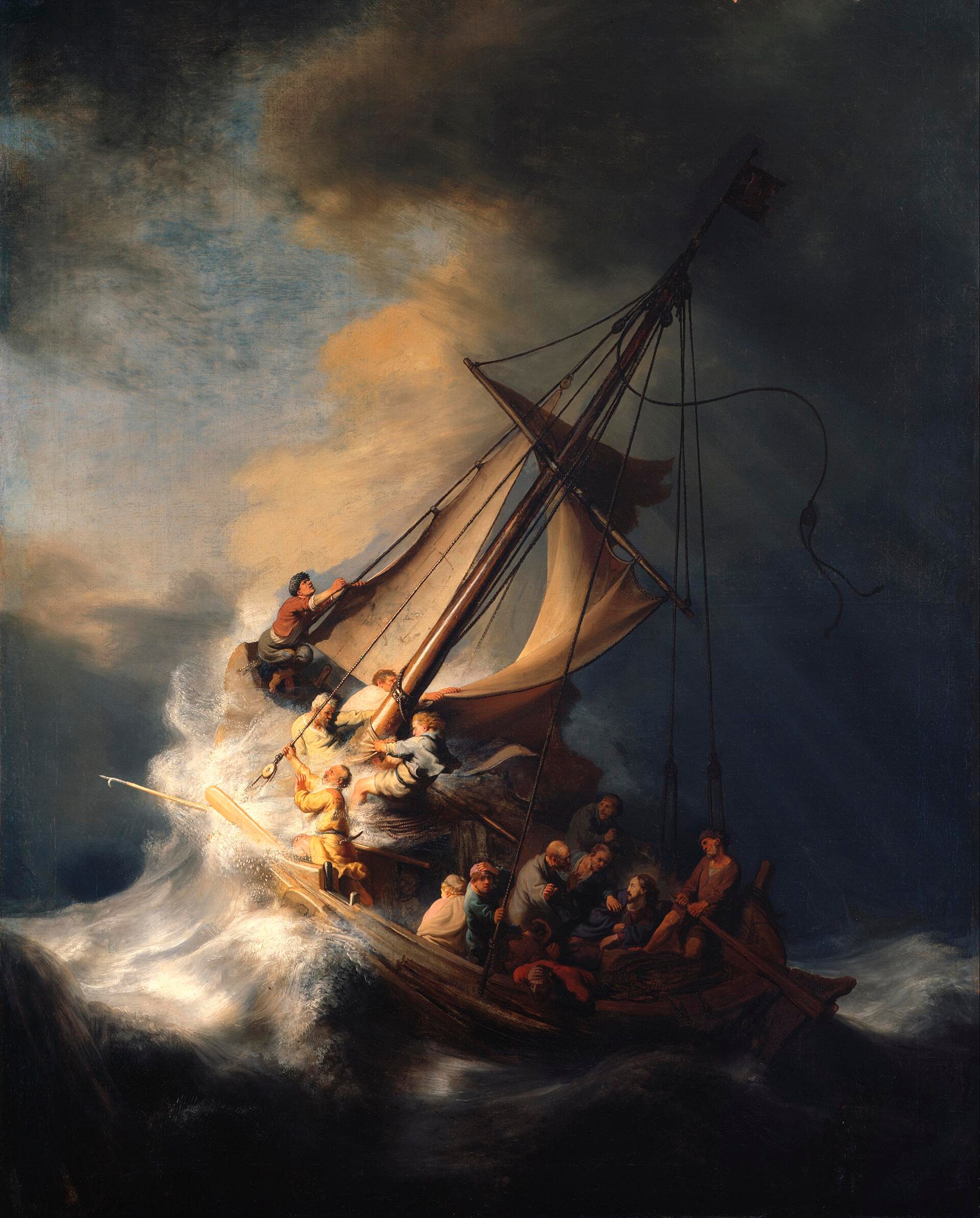
passed over again by ship
on Mark 5:21-24
When Jesus was passed over again by ship, Jairus, one of the rulers of the synagogue, falls at his feet for his little daughter at the point of death, and Mark now builds his signature structure: the Jairus story will be interrupted by the woman in the crowd and resumed after, each story reading the other. A synagogue ruler and an unclean woman, twelve years of a girl's life and twelve years of a woman's disease, a public plea and a hidden touch, and one word, faith, judging both. The exposition states the device here once and then walks the scenes at their own pace; Jesus goes with him, and the thronging crowd sets the stage for a touch nobody saw.
The record, by era
The Church Fathers2 voices
(de Con. Evan. 2. 28) But we must understand, that what is added of the daughter of the ruler of the synagogue, took place when Jesus had again crossed the sea in a ship, though how long after does not appear; for if there were not an interval, there could be no time for the taking place of that which Matthew relates, concerning the feast in his own house; after which event, nothing follows immediately, except this concerning the daughter of the chief of the synagogue. For he has so put it together, that the transition itself shows that the narrative follows the order of time. It goes on, There cometh one of the rulers of the synagogue, &c. (ubi sup.) For he attaches himself not to the words of the father, but to what is of most importance, his wishes; for he was in such despair, that his wish was that she should return to life, not thinking that she could be found alive, whom he had left dying.
(Vict. Ant. e Cat. in Marc.) He has recorded the name on account of the Jews of that time, that it might mark the miracle. It goes on, And when he saw him, he fell at his feet, and besought him greatly, &c. Matthew indeed relates that the chief of the synagogue reported that his daughter was dead, but Mark says that she was very sick, and that afterwards it was told to the ruler of the synagogue, when our Lord was about to go with him, that she was dead. The fact then, which Matthew implies, is the same, namely, that He raised her from the dead; and it is for the sake of brevity, that he says that she was dead, which was evident from her being raised.
The Medieval Church3 voices
Mystically, however, Jairus comes after the healing of the woman, because when the fulness of the Gentiles has come in, then shall Israel be saved. (v. Rom. 11) Jairus means either illuminating, or illuminated, that is, the Jewish people, having cast off the shadow of the letter, enlightened by the Spirit, and enlightening others, falling at the feet of the Word, that is, humbling itself before the Incarnation of Christ, prays for her daughter, for when a man lives himself, he makes others live also. Thus Abraham, and Moses, and Samuel, intercede for the people who are dead, and Jesus comes upon their prayers.
After the miracle over the demoniac, the Lord performs another miracle — He raises the daughter of the ruler of the synagogue. For the Jews who witnessed the event, the Evangelist also mentions the name of the ruler of the synagogue.
And there came one of the rulers of the synagogue, named Jairus, and seeing him, he fell at his feet, etc. In this reading, where the ruler of the synagogue asks for the salvation of his daughter, but as the Lord goes to his house, …
7 more voices on this verse
The Puritans and the Awakening3 voices
And behold, there cometh one of the rulers of the synagogue,.... Having heard of his return, and where he was; See Gill on Mat 9:18. Jairus by name; in Hebrew יאיר, "Jair": and Jerom says (n), it signifies "enlightening", or "enlightened": deriving it from אור, "to be light": and it is no doubt a Jewish name, since he was a ruler of the synagogue; and besides, it is often mentioned in the Old Testament, and particularly in Est 2:5, where, in the Septuagint, it is read, Ιαιρος, Jairus.
Now among the many that applied themselves to him, I. Here is one, that comes openly to beg a cure for a sick child; and it is no less a person than one of the rulers of the synagogue, one that presided in the synagogue-worship or, as some think, one of the judges of the consistory court, which was in every city, consisting of twenty-three.
The miserable condition that this poor creature was in; he was under the power of an unclean spirit, the devil got possession of him, and the effect of it was not, as in many, a silent melancholy, but a raging frenzy; he was raving mad; his condition seems to have been worse than any of the possessed, that were Christ's patients.
The Nineteenth Century4 voices
A commentator
Jamieson, Fausset & Brown1802–1910
Commentary Critical and Explanatory on the Whole Bible (1871)
Jairus by name--or "Jaeirus." It is the same name as Jair, in the Old Testament (Nu 32:41; Es 2:5). and when he saw him, he fell at his feet--in Matthew (Mt 9:18), "worshipped Him." The meaning is the same in both.
A commentator
J.C. Ryle1816–1900
Expository Thoughts on the Gospels: Mark (lightly modernized text, Grace Gems edition) (1857)
proposed
The main subject of these verses is the miraculous healing of a sick woman. Great is our Lord's experience in cases of disease! Great is his sympathy with His sick and ailing members! The gods of the heathen are generally represented as terrible and mighty in battle, delighting in bloodshed, the strong man's patrons, and the warrior's friends. The Savior of the Christian is always set before us as gentle, and easy to be entreated, the healer of the broken hearted, the refuge of the weak and helpless, the comforter of the distressed, the sick man's best friend.
A commentator
J.C. Ryle1816–1900
Expository Thoughts on the Gospels: Mark (lightly modernized text, Grace Gems edition) (1857)
proposed
The main subject of these verses is the miraculous healing of a sick woman. Great is our Lord's experience in cases of disease! Great is his sympathy with His sick and ailing members! The gods of the heathen are generally represented as terrible and mighty in battle, delighting in bloodshed, the strong man's patrons, and the warrior's friends. The Savior of the Christian is always set before us as gentle, and easy to be entreated, the healer of the broken hearted, the refuge of the weak and helpless, the comforter of the distressed, the sick man's best friend. And is not this just the Savior that human nature needs? The world is full of pain and trouble. The weak on earth are far more numerous than the strong. Let us mark, in these verses, what misery sin has brought into the world . We read of one who had had a most painful disease "for twelve years." She had "suffered many things of many physicians, and had spent all that she had, and was nothing better, but rather grew worse." Means of every kind had been tried in vain. Medical skill had proved unable to cure. Twelve long weary years had been spent in battling with disease, and relief seemed no nearer than at first. "Hope deferred" might well "make her heart sick." (Prov. 13:12.) How incredible it is that we do not hate sin more than we do! Sin is the cause of all the pain and disease in the world. God did not create man to be an ailing and suffering creature. It was sin, and nothing but sin, which brought in all the ills that flesh is heir to. It was sin to which we owe every racking pain, and every loathsome infirmity, and every humbling weakness to which our poor bodies are liable. Let us keep this ever in mind. Let us hate sin with a godly hatred. Let us mark, in the second place, how different are the feelings with which people draw near to Christ .
A commentator
Albert Barnes1798–1870
Notes, Explanatory and Practical, on the Old and New Testaments (1832-1869)
proposed
See the account of the raising of Jairus’ daughter, and the healing of the woman with an issue of blood, fully explained in the notes at Mat 9:18-26. Mar 5:23 Lieth at the point of death - Is dying; in the last agonies. Mar 5:26 Had suffered many things - Had resorted to many things painful, by the direction of the physicians, in order to be healed. Mar 5:27 Came in the press behind - In the crowd that pressed upon him. This was done to avoid being noticed. It was an act of faith.
The words behind it
15 Greek wordsEvery Greek word of this verse in the order it stands, with what it means and the door to its own study. The last column counts the times a word stands in the whole Bible: the rarer the word, the more the places it appears belong together.
| Greek | Sound | Meaning | Word study | In the Bible |
|---|---|---|---|---|
| Καὶ | kai | And | G2532 → | 9120 times |
| ἔρχεται | erchetai | comes | G2064 → | 628 times |
| εἷς | heis | one | G1520 → | 343 times |
| τῶν | ton | of the | G3588 → | 19766 times |
| ἀρχισυναγώγων, | archisunagogon | synagogue rulers, | G752 → | 9 times |
| ὀνόματι | onomati | named | G3686 → | 227 times |
| Ἰάϊρος· | iairos | Jairus; | G2383 → | |
| καὶ | kai | and | G2532 → | 9120 times |
| ἰδὼν | idon | having seen | G1492 → | 374 times |
| αὐτὸν | auton | Him | G846 → | 5565 times |
| πίπτει | piptei | he falls | G4098 → | 90 times |
| πρὸς | pros | at | G4314 → | 700 times |
| τοὺς | tous | the | G3588 → | 19766 times |
| πόδας | podas | feet | G4228 → | 93 times |
| αὐτοῦ | autou | of Him | G846 → | 5565 times |
ΚαὶAnd
kaiG2532 →9120 times
ἔρχεταιcomes
erchetaiG2064 →628 times
εἷςone
heisG1520 →343 times
τῶνof the
tonG3588 →19766 times
ἀρχισυναγώγων,synagogue rulers,
archisunagogonG752 →9 times
ὀνόματιnamed
onomatiG3686 →227 times
Ἰάϊρος·Jairus;
iairosG2383 →
καὶand
kaiG2532 →9120 times
ἰδὼνhaving seen
idonG1492 →374 times
αὐτὸνHim
autonG846 →5565 times
πίπτειhe falls
pipteiG4098 →90 times
πρὸςat
prosG4314 →700 times
τοὺςthe
tousG3588 →19766 times
πόδαςfeet
podasG4228 →93 times
αὐτοῦof Him
autouG846 →5565 times
A shaded row is a word that stands 400 times or fewer in the Bible.
The walk
8 stopsEach card is a verse this one points to, and under it the verses that one points to in turn. Where several paths arrive at the same place, that place is listed first: the text keeps returning to it.
Through
Luke 13:14But the synagogue leader was indignant that Jesus had healed on the Sabbath. “There are six days for work,” he told the crowd. “So come and be healed on those days and not on…
it leads to
- Exodus 20:9
Six days you shall labor and do all your work,
- Matthew 12:2
When the Pharisees saw this, they said to Him, “Look, Your disciples are doing what is unlawful on the Sabbath.”
- John 9:14–16
Now the day on which Jesus had made the mud and opened his eyes was a Sabbath.
- Exodus 20:9
Through
Acts 18:8Crispus, the synagogue leader, and his whole household believed in the Lord. And many of the Corinthians who heard the message believed and were baptized.
it leads to
- 1 Corinthians 1:13–17
Is Christ divided? Was Paul crucified for you? Were you baptized into the name of Paul?
- Mark 16:15–16
And He said to them, “Go into all the world and preach the gospel to every creature.
- Romans 10:14–17
How then can they call on the One in whom they have not believed? And how can they believe in the One of whom they have not heard? And how can they hear without…
- 1 Corinthians 1:13–17
Through
Acts 13:15After the reading from the Law and the Prophets, the synagogue leaders sent word to them: “Brothers, if you have a word of encouragement for the people, please speak.”
it leads to
- Hebrews 13:22
I urge you, brothers, to bear with my word of exhortation, for I have only written to you briefly.
- Hebrews 13:22
Through
Acts 18:17At this, the crowd seized Sosthenes the synagogue leader and beat him in front of the judgment seat. But none of this was of concern to Gallio.
it leads to
- 1 Corinthians 1:1
Paul, called to be an apostle of Christ Jesus by the will of God, and our brother Sosthenes,
- 1 Corinthians 1:1
Where this verse is studied
On this page
About Mark
This page draws on 13 works. Open the list of works
This page draws on Albert Barnes, Notes, Explanatory and Practical, on the Old and New Testaments (1832-1869); Alexander Maclaren, Expositions of Holy Scripture, Mark; Augustine of Hippo, Catena Aurea by Aquinas; Bede, On the Gospel of Mark; Irenaeus, AGAINST HERESIES 5.13.1; J.C. Ryle, Expository Thoughts on the Gospels: Mark (lightly modernized text, Grace Gems edition); Jamieson, Fausset & Brown, Commentary Critical and Explanatory on the Whole Bible; John Gill, Exposition of the New Testament; John Gill, Exposition of the New Testament (1746-1748); Matthew Henry, Commentary on the Whole Bible; Pseudo-Chrysostom, Catena Aurea by Aquinas; Pseudo-Jerome, Catena Aurea by Aquinas and Theophylact of Ohrid, Commentary on Mark.