
Mark 4:41
in Mark 4Overwhelmed with fear, they asked one another, “Who is this, that even the wind and the sea obey Him?”
BSB
The same verse in ASV and KJV ▾
ASV
And they feared exceedingly, and said one to another, Who then is this, that even the wind and the sea obey him?
KJV
And they feared exceedingly, and said one to another, What manner of man is this, that even the wind and the sea obey him?
⋯
This verse in Mark 4
Commentary
7 notes on this verseon Mark 4:35-41
(ubi sup.) Or else the ship into which He embarked, is taken to mean the tree of His passion, by which the faithful attain to the security of the safe shore. The other ships which are said to have been with the Lord, signify those, who are imbued with faith in the cross of Christ, and are not beaten about by the whirlwind of tribulation; or who, after the storms of temptation, are enjoying the serenity of peace.
This site's exposition
Why are ye so fearful
on Mark 4:40-41
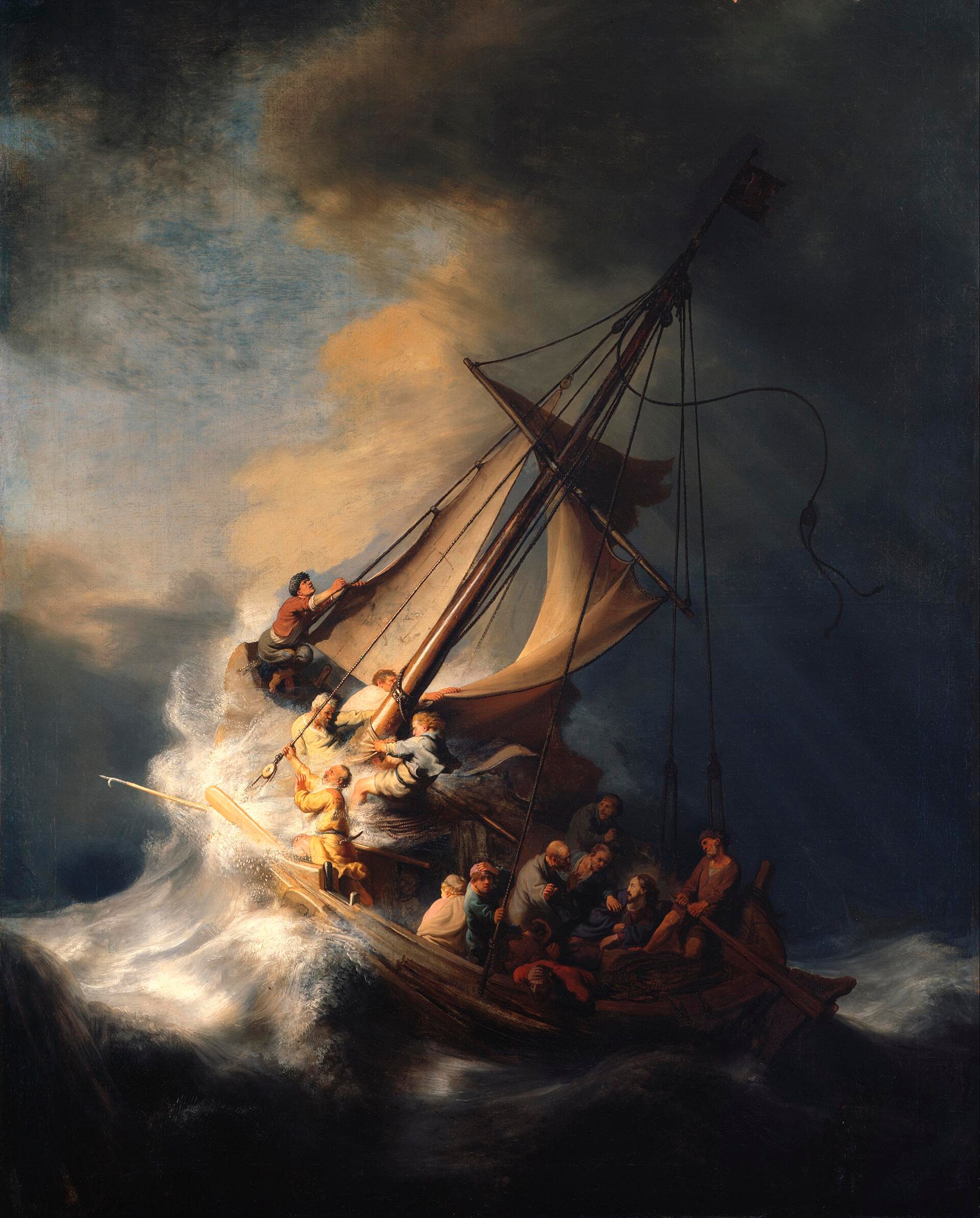
Jesus turns from the sea to the disciples with a question that measures their fear against their faith, why are ye so fearful, how is it that ye have no faith, since the one who could sleep through the storm never doubted its outcome. Their fear does not vanish with the wind; it deepens into something greater, they feared exceedingly, and their own question, what manner of man is this, is the chapter's real climax, the disciples asking in the boat the very question the whole Gospel is written to answer. The bench reads this as Mark's own Christology in miniature, awe answering a display of authority no ordinary man possesses.
The record, by era
The Medieval Church1 voice
The disciples said among themselves, "Who then is this?" because they still had an indefinite conception of Him. Since Christ calmed the sea by a single command, and not with a rod, like Moses, not with a prayerful cry, like Elisha at the Jordan, not …
The Reformation1 voice
But he arose, and rebuked the wind and the tempest of the water; and they ceased, and there was a calm. And he said to them, Where is your faith? And they were afraid, and wondered, saying among themselves, Who is this? for he commands even the winds and the water, and they obey him.
The Puritans and the Awakening1 voice
And they feared exceedingly,.... That is, the men in the ship, the mariners to whom the ship belonged, and who had the management of it: and said to one another, as persons in the greatest amazement, what manner of man is this, that even the wind and the sea obey him? Surely this person must not be a mere man; he must be more than a man; he must be truly God, that has such power over the wind and sea.
The Nineteenth Century2 voices
What manner of man is this? - They were astonished at such power proceeding from a person who appeared to be only like one of themselves. It is often profitable to entertain each other with the succor and support which we receive from God in times of temptation and distress; and to adore, with respectful awe, that sovereign power and goodness by which we have been delivered.
A commentator
J.C. Ryle1816–1900
Expository Thoughts on the Gospels: Mark (lightly modernized text, Grace Gems edition) (1857)
on Mark 4:35-41
These verses describe a storm on the sea of Galilee, when our Lord and His disciples were crossing it, and a miracle performed by our Lord in calming the storm in a moment. Few miracles recorded in the Gospel were so likely to strike the minds of the apostles as this. Four of them at least were fishermen. Peter, Andrew, James, and John, had probably known the sea of Galilee, and its storms, from their youth. Few events in our Lord's journeyings to and fro upon earth, contain more rich instruction than the one related in this passage.
The words behind it
21 Greek wordsEvery Greek word of this verse in the order it stands, with what it means and the door to its own study. The last column counts the times a word stands in the whole Bible: the rarer the word, the more the places it appears belong together.
| Greek | Sound | Meaning | Word study | In the Bible |
|---|---|---|---|---|
| καὶ | kai | And | G2532 → | 9120 times |
| ἐφοβήθησαν | ephobethesan | they feared | G5399 → | 95 times |
| φόβον | phobon | [with] fear | G5401 → | |
| μέγαν | megan | great | G3173 → | 243 times |
| καὶ | kai | and | G2532 → | 9120 times |
| ἔλεγον | elegon | were saying | G3004 → | 1325 times |
| πρὸς | pros | to | G4314 → | 700 times |
| ἀλλήλους· | allelous | each other; | G240 → | 100 times |
| τίς | tis | Who | G5101 → | 563 times |
| ἄρα | ara | then | G686 → | |
| οὗτός | houtos | this | G3778 → | 1381 times |
| ἐστιν | estin | is | G1510 → | 2333 times |
| ὅτι | hoti | that | G3754 → | 1292 times |
| καὶ | kai | even | G2532 → | 9120 times |
| ὁ | ho | the | G3588 → | 19766 times |
| ἄνεμος | anemos | wind | G417 → | 31 times |
| καὶ | kai | and | G2532 → | 9120 times |
| ἡ | he | the | G3588 → | 19766 times |
| θάλασσα | thalassa | sea | G2281 → | 90 times |
| ὑπακούει | hupakouei | it obeys | G5219 → | |
| αὐτῷ;¶ | auto | Him? | G846 → | 5565 times |
καὶAnd
kaiG2532 →9120 times
ἐφοβήθησανthey feared
ephobethesanG5399 →95 times
φόβον[with] fear
phobonG5401 →
μέγανgreat
meganG3173 →243 times
καὶand
kaiG2532 →9120 times
ἔλεγονwere saying
elegonG3004 →1325 times
πρὸςto
prosG4314 →700 times
ἀλλήλους·each other;
allelousG240 →100 times
τίςWho
tisG5101 →563 times
ἄραthen
araG686 →
οὗτόςthis
houtosG3778 →1381 times
ἐστινis
estinG1510 →2333 times
ὅτιthat
hotiG3754 →1292 times
καὶeven
kaiG2532 →9120 times
ὁthe
hoG3588 →19766 times
ἄνεμοςwind
anemosG417 →31 times
καὶand
kaiG2532 →9120 times
ἡthe
heG3588 →19766 times
θάλασσαsea
thalassaG2281 →90 times
ὑπακούειit obeys
hupakoueiG5219 →
αὐτῷ;¶Him?
autoG846 →5565 times
A shaded row is a word that stands 400 times or fewer in the Bible.
The walk
8 stopsEach card is a verse this one points to, and under it the verses that one points to in turn. Where several paths arrive at the same place, that place is listed first: the text keeps returning to it.
Through
Luke 8:25“Where is your faith?” He asked. Frightened and amazed, they asked one another, “Who is this? He commands even the winds and the water, and they obey Him!”
it leads to
- Matthew 8:26
“You of little faith,” Jesus replied, “why are you so afraid?” Then He got up and rebuked the winds and the sea, and it was perfectly calm.
- Mark 4:40–41
“Why are you so afraid?” He asked. “Do you still have no faith?”
- Proverbs 30:4
Who has ascended to heaven and come down? Who has gathered the wind in His hands? Who has bound up the waters in His cloak? Who has established all the ends of the earth?…
- Matthew 14:31
Immediately Jesus reached out His hand and took hold of Peter. “You of little faith,” He said, “why did you doubt?”
- John 11:40
Jesus replied, “Did I not tell you that if you believed, you would see the glory of God?”
- Matthew 8:26
Through
Psalms 89:7In the council of the holy ones, God is greatly feared, and awesome above all who surround Him.
it leads to
- Psalms 47:2
How awesome is the LORD Most High, the great King over all the earth!
- Psalms 76:7–11
You alone are to be feared. When You are angry, who can stand before You?
- Psalms 47:2
Through
Job 38:11and I declared: ‘You may come this far, but no farther; here your proud waves must stop’?
it leads to
- Psalms 89:9
You rule the raging sea; when its waves mount up, You still them.
- Psalms 89:9
Where this verse is studied
On this page
Studies5
On this verse
About Mark
This page draws on Adam Clarke, Commentary on the Bible; Bede, Catena Aurea by Aquinas; J. C. Ryle, Expository Thoughts on the Gospels, Mark; J.C. Ryle, Expository Thoughts on the Gospels: Mark (lightly modernized text, Grace Gems edition); Jamieson, Fausset & Brown, Commentary Critical and Explanatory on the Whole Bible; John Calvin, Commentaries; John Gill, Exposition of the New Testament (1746-1748) and Theophylact of Ohrid, Commentary on Mark.