
Mark 4:36
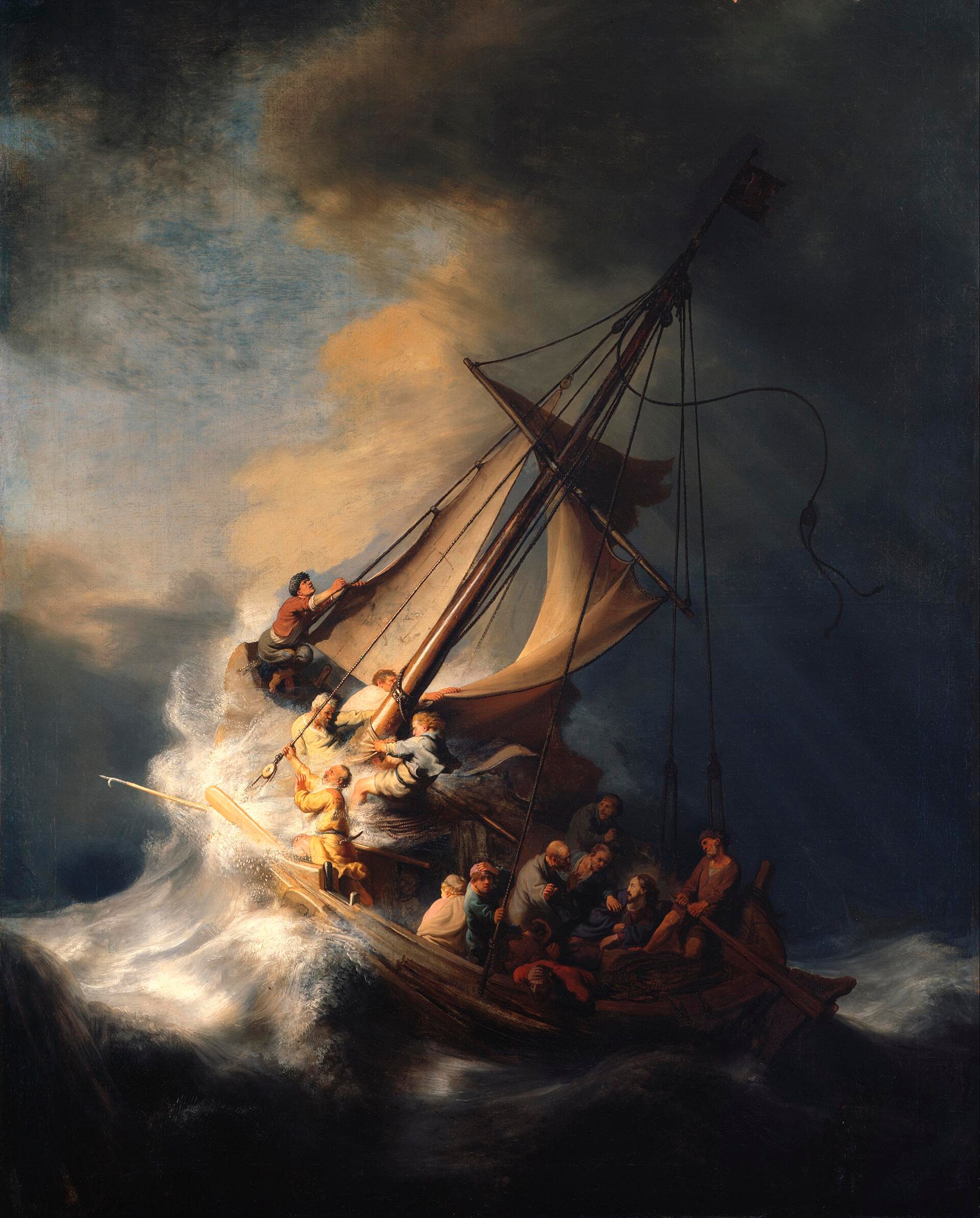
in Mark 4After they had dismissed the crowd, they took Jesus with them, since He was already in the boat. And there were other boats with Him.
BSB
The same verse in ASV and KJV ▾
ASV
And leaving the multitude, they take him with them, even as he was, in the boat. And other boats were with him.
KJV
And when they had sent away the multitude, they took him even as he was in the ship. And there were also with him other little ships.
⋯
This verse in Mark 4
Commentary
15 notes on this verse(ubi sup.) Or else the ship into which He embarked, is taken to mean the tree of His passion, by which the faithful attain to the security of the safe shore. The other ships which are said to have been with the Lord, signify those, who are imbued with faith in the cross of Christ, and are not beaten about by the whirlwind of tribulation; or who, after the storms of temptation, are enjoying the serenity of peace.
This site's exposition
Let us cross to the other side
on Mark 4:35-36
When that evening came, Jesus proposes the crossing that carries the disciples into a storm and then to the demon-possessed man of chapter five. After they had dismissed the crowd, they took Jesus with them, since He was already in the boat, and there were other boats with Him, details of an eyewitness who remembered that evening. The chapter turns from words about the kingdom to a display of the King's authority over creation.
This site's exposition
there were other boats with Him
John Chrysostom notes that the other boats crossed separately. Jesus kept the disciples with Him alone, he suggests, so that they would witness the miracle and others would not see their weak faith. Adam Clarke adds that the boat was His own, which usually waited on Him.
The record, by era
The Church Fathers3 voices
A commentator
Athanasius of Alexandria296–373
Letter 19.6, EASTER A.D. 347 · Written before 373.
proposed
They awakened the Word, who was sailing with them, and immediately the sea became smooth at the command of its Lord, and they were saved. They became proclaimers and teachers at the same time, attesting the miracles of our Savior, and also teaching us to imitate their example.
How mighty is the grace of water, in the sight of God and His Christ, for the confirmation of baptism! Never is Christ without water: if, that is, He is Himself baptized in water; inaugurates in water the first rudimentary displays of His power, when invited to the nuptials; invites the thirsty, when He makes a discourse, to His own sempiternal water; approves, when teaching concerning love, among works of charity, the cup of water offered to a poor (child); recruits His strength at a well; walks over the water; willingly crosses the sea; ministers water to His disciples.
Even while he was asleep on the pillow, the Lord was testing his disciples, when a miracle was wrought that was calculated especially to put even the wicked to contrition. For when he arose, and rebuked the sea, and silenced the storm, he plainly disclosed two things: that the storm of the sea was not simply from winds, but from the fear of the Lord who walked upon it;2 and that the Lord who rebuked it was not a creature, but rather its creator.
The Medieval Church2 voices
After His teaching, they come from that place to the sea, and are tossed by the waves. Wherefore it is said, And the same day, when the even was come, &c. Mystically, however, the hinder part of the ship is the beginning of the Church, in which the Lord sleeps in the body only, for He never sleepeth who keepeth Israel; for the ship with its skins of dead animals keeps in the living, and keeps out the waves, and is bound together by wood, that is, by the cross and the death of the Lord the Church is saved. The pillow is the body of the Lord, on which His Divinity, which is as His head, has come down. But the wind and the sea are devils and persecutors, to whom He says Peace, when He restrains the edicts of impious kings, as He will. The great calm is the peace of the Church after oppression, or a contemplative after an active life.
The Lord takes with Him the disciples alone, allowing them to be witnesses of the coming miracle.
7 more voices on this verse
The Puritans and the Awakening2 voices
11 And he said unto them, Unto you it is given to know the mystery of the kingdom of God: but unto them that are without, all these things are done in parables: 12 That seeing they may see, and not perceive; and hearing they may hear, and not understand; lest at any time they should be converted, and their sins should be forgiven them.
quarantine:scripture (2026-07-29) — verbatim-scripture
And when they had sent away the multitude,....
The Nineteenth Century5 voices
A commentator
Albert Barnes1798–1870
Notes, Explanatory and Practical, on the Old and New Testaments (1832-1869)
See the notes at Mat 8:18-27. Mar 4:36 Even as he was in the ship - They took him without making any preparation for the voyage; without providing any food or raiment. He was sitting in a ship, or boat, instructing the people. In the same boat, probably ill fitted to encounter a storm on the lake, they sailed. This would render their danger more imminent and the miracle more striking. There were with him other little ships - Belonging probably to the people, who, seeing him sail, resolved to follow him.
A commentator
J.C. Ryle1816–1900
Expository Thoughts on the Gospels: Mark (lightly modernized text, Grace Gems edition) (1857)
These verses describe a storm on the sea of Galilee, when our Lord and His disciples were crossing it, and a miracle performed by our Lord in calming the storm in a moment. Few miracles recorded in the Gospel were so likely to strike the minds of the apostles as this. Four of them at least were fishermen. Peter, Andrew, James, and John, had probably known the sea of Galilee, and its storms, from their youth. Few events in our Lord's journeyings to and fro upon earth, contain more rich instruction than the one related in this passage.
A commentator
Jamieson, Fausset & Brown1802–1910
Commentary Critical and Explanatory on the Whole Bible (1871)
proposed
And when they had sent away the multitude, they took him even as he was in the ship--that is, without any preparation, and without so much as leaving the vessel, out of which He had been all day teaching.
A commentator
J.C. Ryle1816–1900
Expository Thoughts on the Gospels: Mark (lightly modernized text, Grace Gems edition) (1857)
proposed
These verses describe a storm on the sea of Galilee, when our Lord and His disciples were crossing it, and a miracle performed by our Lord in calming the storm in a moment. Few miracles recorded in the Gospel were so likely to strike the minds of the apostles as this. Four of them at least were fishermen. Peter, Andrew, James, and John, had probably known the sea of Galilee, and its storms, from their youth. Few events in our Lord's journeyings to and fro upon earth, contain more rich instruction than the one related in this passage. Let us learn, in the first place, that Christ's service does not exempt His servants from storms . Here were the twelve disciples in the path of duty. They were obediently following Jesus, wherever He went. They were daily attending on His ministry, and hearkening to His word. They were daily testifying to the world, that, whatever Scribes and Pharisees might think, they believed on Jesus, loved Jesus, and were not ashamed to give up all for His sake. Yet here we see these men in trouble, tossed up and down by a tempest, and in danger of being drowned. Let us mark well this lesson. If we are true Christians, we must not expect everything smooth in our journey to heaven. We must count it no strange thing, if we have to endure sicknesses, losses, bereavements, and disappointments, just like other men. Free pardon and full forgiveness, grace along the way, and glory at the end — all this our Savior has promised to give. But He has never promised that we shall have no affliction. He loves us too well to promise that. By affliction He teaches us many precious lessons, which without it we should never learn. By affliction He shows us our emptiness and weakness, draws us to the throne of grace, purifies our affections, weans us from the world, makes us long for heaven.
They took him even as he was in the ship - That is, the disciples; he was now εν τῳ πλοιῳ, in the boat, i.e. his own boat which usually waited on him, and out of which it appears he was then teaching the people. There were several others there which he might have gone in, had this one not been in the place.
The words behind it
17 Greek wordsEvery Greek word of this verse in the order it stands, with what it means and the door to its own study. The last column counts the times a word stands in the whole Bible: the rarer the word, the more the places it appears belong together.
| Greek | Sound | Meaning | Word study | In the Bible |
|---|---|---|---|---|
| καὶ | kai | And | G2532 → | 9120 times |
| ἀφέντες | aphentes | having dismissed | G863 → | 143 times |
| τὸν | ton | the | G3588 → | 19766 times |
| ὄχλον | ochlon | crowd | G3793 → | 175 times |
| παραλαμβάνουσιν | paralambanousin | they take with [them] | G3880 → | 49 times |
| αὐτὸν | auton | Him | G846 → | 5565 times |
| ὡς | hos | since | G5613 → | 500 times |
| ἦν | en | He was | G1510 → | 2333 times |
| ἐν | en | in | G1722 → | 2738 times |
| τῷ | to | the | G3588 → | 19766 times |
| πλοίῳ, | ploio | boat, | G4143 → | 67 times |
| καὶ | kai | also | G2532 → | 9120 times |
| ἄλλα | alla | other | G243 → | 155 times |
| πλοῖα | ploia | boats | G4143 → | 67 times |
| ἦν | en | were | G1510 → | 2333 times |
| μετ᾽ | met᾽ | with | G3326 → | 461 times |
| αὐτοῦ. | autou | Him. | G846 → | 5565 times |
καὶAnd
kaiG2532 →9120 times
ἀφέντεςhaving dismissed
aphentesG863 →143 times
τὸνthe
tonG3588 →19766 times
ὄχλονcrowd
ochlonG3793 →175 times
παραλαμβάνουσινthey take with [them]
paralambanousinG3880 →49 times
αὐτὸνHim
autonG846 →5565 times
ὡςsince
hosG5613 →500 times
ἦνHe was
enG1510 →2333 times
ἐνin
enG1722 →2738 times
τῷthe
toG3588 →19766 times
πλοίῳ,boat,
ploioG4143 →67 times
καὶalso
kaiG2532 →9120 times
ἄλλαother
allaG243 →155 times
πλοῖαboats
ploiaG4143 →67 times
ἦνwere
enG1510 →2333 times
μετ᾽with
met᾽G3326 →461 times
αὐτοῦ.Him.
autouG846 →5565 times
A shaded row is a word that stands 400 times or fewer in the Bible.
The walk
8 stopsEach card is a verse this one points to, and under it the verses that one points to in turn. Where several paths arrive at the same place, that place is listed first: the text keeps returning to it.
Through
Mark 5:21When Jesus had again crossed by boat to the other side, a large crowd gathered around Him beside the sea.
it leads to
- Mark 4:1
Once again Jesus began to teach beside the sea, and such a large crowd gathered around Him that He got into a boat and sat in it, while all the people crowded along the…
Reached by 2 separate paths from here.
- Matthew 9:1
Jesus got into a boat, crossed over, and came to His own town.
- Mark 4:1
Through
Mark 4:1Once again Jesus began to teach beside the sea, and such a large crowd gathered around Him that He got into a boat and sat in it, while all the people crowded along the…
it leads to
- Mark 2:13
Once again Jesus went out beside the sea. All the people came to Him, and He taught them there.
- Luke 5:1–3
On one occasion, while Jesus was standing by the Lake of Gennesaret with the crowd pressing in on Him to hear the word of God,
- Luke 8:4–10
While a large crowd was gathering and people were coming to Jesus from town after town, He told them this parable:
- Mark 2:13
Through
Mark 5:2As soon as Jesus got out of the boat, He was met by a man with an unclean spirit, who was coming from the tombs.
it leads to
- Mark 1:23
Suddenly a man with an unclean spirit cried out in the synagogue:
- Isaiah 65:4
sitting among the graves, spending nights in secret places, eating the meat of pigs and polluted broth from their bowls.
- Mark 5:8
For Jesus had already declared, “Come out of this man, you unclean spirit!”
- Mark 1:23
Where this verse is studied
On this page
Studies5
About Mark
This page draws on 14 works. Open the list of works
This page draws on Adam Clarke, Commentary on the Bible; Albert Barnes, Notes, Explanatory and Practical, on the Old and New Testaments (1832-1869); Alexander Maclaren, Expositions of Holy Scripture, Mark; Athanasius of Alexandria, Letter 19.6, EASTER A.D. 347; Athanasius of Alexandria, LETTER 29; Bede, Catena Aurea by Aquinas; J.C. Ryle, Expository Thoughts on the Gospels: Mark (lightly modernized text, Grace Gems edition); Jamieson, Fausset & Brown, Commentary Critical and Explanatory on the Whole Bible; John Chrysostom, Catena Aurea by Aquinas; John Gill, Exposition of the New Testament (1746-1748); Matthew Henry, Commentary on the Whole Bible; Pseudo-Jerome, Catena Aurea by Aquinas; Tertullian, On Baptism and Theophylact of Ohrid, Commentary on Mark.