
Mukti to Valparaiso · Story · Featured Study
The Mukti Revival of 1905
Widows, famine orphans and rescued women at Pandita Ramabai's mission in India broke into weeping and confession in the last days of June.
Ramabai was expounding John 8 in her usual quiet way on the evening of 30 June when the girls began to pray aloud, “so that she had to cease talking”.
- Where
- Mukti, Kedgaon, Poona, Valparaiso
- Who
- Ramabai, Minnie F. Abrams, Helen S. Dyer, Willis C. Hoover
- When
- June 1905
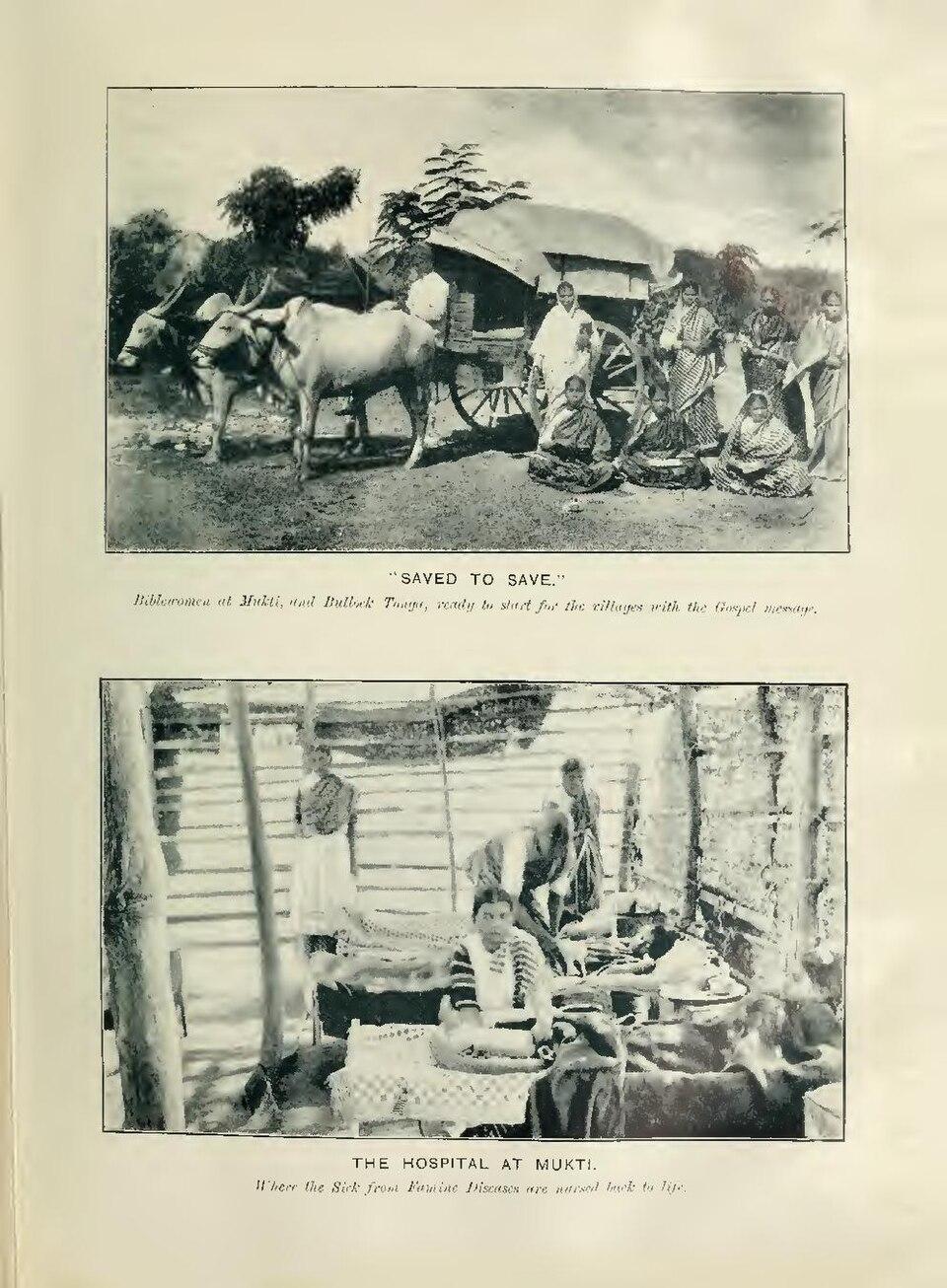
Saved to Save, in Helen S. Dyer's life of Ramabai, 1900. Public domain.
I baptize you with water for repentance, but after me will come One more powerful than I, whose sandals I am not worthy to carry. He will baptize you with the Holy Spirit and with fire.
Summary
Ramabai's mission stood at Kedgaon in western India. Six months of daily prayer came first, and Azusa Street came ten months after.
- Mukti means salvation, and Ramabai built it for the women and girls of the famine.
- Her friends counted 1,400 to nearly 2,000 people there, and none of them says how.
- The pundits of Calcutta called her Sarasvati for her Sanskrit when she was twenty-two.
The Texts of the Fire
Abrams preached one verse on fire, and the women of Mukti took it more plainly than she had.
Minnie Abrams preached Matthew 3:11 in the church at Mukti, and the second edition of her booklet is headed with it. She wrote that the girls expected fire in earnest.
They saw tongues like flames of fire that separated and came to rest on each of them.
Abrams says the tongues as of fire taught the girls to look for fire when the Spirit came.
Acts 2:3BSB
Do not fear, O worm of Jacob, O few men of Israel. I will help you,” declares the LORD. “Your Redeemer is the Holy One of Israel.
Ramabai cited this verse when she wrote that God had told her to take her proper place in the revival.
Isaiah 41:14BSB
Indeed, with mocking lips and foreign tongues, He will speak to this people
Ramabai quoted this verse after telling of the girls who prayed in tongues.
Isaiah 28:11BSB
So if you who are evil know how to give good gifts to your children, how much more will your Father in heaven give the Holy Spirit to those who ask Him!”
Willis Hoover of Chile quotes these words in telling what Abrams's booklet raised for him.
Luke 11:13BSB
Isaiah 41:14, Isaiah 28:11, Luke 11:13
Who Wrote It Down, and What Each One Leaves Out
The table runs from an eyewitness's account ten months after the outbreak to one written twenty-seven years after it.
Every account of the first weeks comes from a friend of the mission, and each carries part of the story.
| The account | What it reports | What it leaves out |
|---|---|---|
| Minnie Abrams, the Indian Witness, 26 April 1906 | 28 June, 30 June and the fire | Wales, the pail of water and tongues |
| Helen S. Dyer, Revival in India, 1907 | 29 June, the pail of water and the news from Wales | Tongues at Mukti |
| Albert Norton wrote in The Apostolic Faith that April | A Marathi woman praying in English, and 24 persons with tongues | The first revival |
| Ramabai signed A Testimony that July | A prayer circle of about seventy, and revival in six months | Wales and tongues |
| An unsigned report ran in the same paper that September | Seeking at Mukti after the American news | The first revival |
| Ramabai wrote in the Prayer Bell that September, as Macnicol prints it | Tongues as a gift, and love as the one necessary sign | The American news, in the part printed |
| Nicol Macnicol, his life of her, 1926 | The signs, her reserve and the doubts of her friends | A date for the first tongues |
| Willis C. Hoover, Elim Evangel, 22 July 1932 | When Abrams's book reached Chile | Any document of that year |
Nicol Macnicol, his life of her, 1926, Willis C. Hoover, Elim Evangel, 22 July 1932
From the Praying Band to the Villages
A call for volunteers in January ended in a school closed for prayer and bands going out by turns.
In January, Abrams wrote, Ramabai spoke to the girls of the need of a revival and called for volunteers. Seventy came forward, and 550 were meeting twice daily when it began. Thirty young women of the Bible school were praying then for power to go to the villages.
By her first print Abrams was called at half past three in the morning of 28 June. The matron and an old girl said “Come over and rejoice with us”. She found all the girls of that compound on their knees, weeping and confessing. Dyer gives 29 June and adds a senior girl who ran for a pail of water because she thought another girl was on fire.
Abrams came into the room after the outbreak of 30 June had begun. Dyer writes that children and young women “wept bitterly and confessed their sins”. She adds that some few saw visions and that two little girls prayed for hours. Lessons were suspended, and the Bible room became an inquiry room.
An unnamed worker wrote that “Waves of prayer go over the meetings, like the rolling thunder”. Ramabai wrote that “Some have laughed at us, for we have become fools,” and that the girls cried, laughed, shook, trembled and danced. On 5 July a senior girl, lately converted, fell ill in class and died within the hour, and Dyer gives no cause.
Ramabai at first refused to let the Rev. R. J. Ward of Coonoor publish an account, and then accounts went to the Bombay Guardian. She took a band to Poona, and in September Abrams went with eleven girls to Telegaon. On 7 November Ramabai closed the school for ten days of prayer, when misappropriated things were given back.
About sixty went out to the villages daily by turns, by Ramabai's letter, and Dyer's later life says about fifty. The Missionary Review reported the next July that the bands were interceding for more than 29,000 people by name.
Ramabai Before the Revival
Her first school split over the Bible, and the famine then filled her second with women of every caste.
Ramabai was baptized in the Church of England at Wantage in September 1883. She opened the Sharada Sadan in Bombay in March 1889, with money from an association at Boston. Clementina Butler says the school was to be non-sectarian, “which the Hindus took to mean non-Christian”.
In August 1893 Ranade, Bhandarkar and others of her Advisory Committee resigned. They wrote that “If the Sadan is to be conducted as an avowed proselytising institution we must disavow all connection with it”. Twenty of fifty-three girls attended her Scripture class shortly before the resignations, by Macnicol's figure. She answered in America in 1898 that the Bible and the Vedas stood together on the shelves. She would not, she said, shut her door at prayer.
In the famine she brought three hundred girls and women from the Central Provinces, and plague in Poona moved them out to land near Kedgaon. She gave up taking only high-caste girls there. Her daughter Manoramabai wrote that “Every death that occurred in the school was thought by them to have been caused by the devil”.
How Tongues Came Into It
Abrams's account was printed a week after Bartleman first found the meeting at Azusa Street, and the first dated report of tongues at Mukti itself came later.
Soonderbai Powar's “bands of their tongues loosed,” at her school in Poona, means shy girls praying aloud. An unsigned report in The Apostolic Faith, the movement's paper, which Gary McGee gives to Max Wood Moorhead, says that Ramabai and Abrams were moved by the news from Los Angeles. It says that seekers assembled at Mukti before Christmas of that year.
Albert Norton, a neighbouring missionary, wrote the next March that a week earlier he had heard a Marathi woman pray in English she could not otherwise speak. The next weekend, he says, 24 persons received tongues. None of those at Kedgaon, he says, understood the other languages.
Ramabai wrote that she was not surprised and that she sat apart so as not to stumble the girls. She added that some “were simply groaning”. Macnicol reports that she once uttered some sentences in Hebrew alone, while Edith Blumhofer says she did not speak in tongues.
How the Key Verse Was Taught
Four teachers from the fifth century to the nineteenth on this verse.
Cyril of Alexandria (died 444)
Fragment 27, on Matthew 3:11
Cyril of Alexandria took the fire as a sign of the Spirit's energy.
“This was not to imply that through Christ we shall all be baptized with fire but to indicate through the designation fire that the life-giving energy of the Spirit is given.”
Patristic
Matthew Henry (1662 to 1714)
Commentary on the Whole Bible, on Matthew 3:11
Matthew Henry turned from the fire to the comfort of the preacher who knows his own weakness.
“It is a great comfort to the faithful ministers, to think that Jesus Christ is mightier than they, can do that for them, and that by them, which they cannot do; his strength is perfected in their weakness.”
Puritan
John Wesley (1703 to 1791)
Explanatory Notes upon the New Testament, on Matthew 3:11
John Wesley read the fire as love, and he pointed to Pentecost for its visible form.
“He shall fill you with the Holy Ghost, inflaming your hearts with that fire of love, which many waters cannot quench. And this was done, even with a visible appearance as of fire, on the day of pentecost.”
Evangelical
Jamieson, Fausset & Brown (1802 to 1910)
Commentary Critical and Explanatory on the Whole Bible, on Matthew 3:11
Jamieson, Fausset and Brown set John's outward sign against what Christ alone can give.
“I administer but the outward symbol of purification; His it is, as His sole prerogative, to dispense the inward reality.”
Evangelical
In Their Own Words
Ramabai twice, the woman who preached on the fire, and a missionary who heard the tongues there.
Minnie F. Abrams (1859 to 1912)
The Baptism of the Holy Spirit at Mukti, The Missionary Review of the World, from the Indian Witness, 26 April 1906, pages 629 to 630
What fire had meant
“To me, this word fire had always meant the trials, losses, sicknesses and difficulties which God allows to come into our lives to bring us nearer to Him”
Methodist Episcopal missionary
About this saying1 paragraph
Abrams wrote this in 1906 of how she had understood the word until then.
Pandita Ramabai (1858 to 1922)
A letter on the revival, in Helen S. Dyer, Revival in India, the chapter on Mukti
Our old civilised ways
“I wanted to be proper and conduct meetings in our old civilised ways. But God would have none of it.”
Christian
About this saying1 paragraph
Ramabai wrote of trying to set rules for the meetings, as Dyer prints her in 1907.
Pandita Ramabai
The Mukti Prayer Bell, page 11, in Nicol Macnicol, Pandita Ramabai (1926), the chapter on the revival
The only necessary sign
“Love, perfect divine love, is the only and most necessary sign of the baptism of the Holy Spirit.”
Christian
About this saying1 paragraph
She gave this ruling in 1907, after the tongues had come to Mukti, as Macnicol prints it from her magazine.
Albert Norton
Letter from Dhond, 21 March 1907, The Apostolic Faith (Los Angeles), number 7
As one raised to life
“I was impressed very much as I would have been, had I seen one whom I knew to be dead, raised to life.”
Independent faith missionary at Dhond
About this saying1 paragraph
Norton wrote this in 1907 after hearing the woman at Mukti, and he wrote it for the movement's own paper.
Where Mukti Stands in the Story of Pentecost
The sources divide over Mukti's roots, its place among the Pentecostals and how far it reached Chile.
From Wales or from India?2 paragraphs
Dyer opens the January call with the news from Wales, and Macnicol has that news deepening Ramabai's desire. Ramabai wrote in 1907 that she was led by the Lord to start the circle.
Ramabai had asked Keswick in 1898 to pray for 100,000 men and 100,000 women to preach, and she had set up prayer circles with ten names each. Dyer was her friend and read her magazine, and Keswick is itself English, so the news from Wales and the earlier prayer both stand behind the January call.
Was Mukti Pentecostal?2 paragraphs
Stanley Burgess calls Ramabai “one of the principal modern pioneers in emerging Pentecostalism,” and Allan Anderson calls Mukti “one of the most important examples of a non-American origin”. Gary McGee writes that because she and Abrams allowed baptism without tongues “they could not be considered orthodox Pentecostals”.
Abrams wrote in 1908 that some who had received tongues in India took them as the only sign and that others did not. Yan Suarsana argues that “at no time has there been a common understanding” of what happened there. Macnicol quotes the C.M.S. missionary Butcher, who explained the signs physiologically, and Macnicol, quoting Pratt, allows “overwrought nerves”.
How far did Mukti reach Chile?2 paragraphs
Willis Hoover, the pastor at Valparaiso, wrote in 1932 that he received “a booklet of some eighty pages” in 1907, and no document of 1907 supports that date. Dyer in 1907 gives the booklet sixty pages, so the copy may be another edition. The revival at Valparaiso came in July 1909.
Juan Sepulveda sets prayer groups at Valparaiso and Hoover's visits to the United States beside the booklet, and Frodsham's text as the Revival Library carries it has Fransen from Chicago there in February 1908. “Sister Hoover” wrote to J. N. Arnold, in a letter Confidence printed in May 1910, that she and her husband had not yet received the baptism.
Books to Read Next
Revival in India
Helen S. Dyer · 1907
Dyer gathers the letters of Mukti's workers and Ramabai's own reports on the first two years.
Read Dyer free at the Internet ArchivePandita Ramabai Sarasvati
Clementina Butler · 1922
Butler chaired the American Ramabai Association's committee, and she prints Ramabai's answer on the Sadan.
Read Butler free at the Internet ArchivePandita Ramabai
Nicol Macnicol · 1926
Macnicol prints the Hindu advisers' letter and her words on the signs, and he reports the doubts of her friends.
What the Revival Left
Abrams wrote that many took it as an excitement that would burst. In a later letter Ramabai wrote that some 700 had given themselves to prayer and study. Dyer closed her book with about 300 at Mukti still regarded as unconverted.
Sources
Scripture is the Berean Standard Bible.
- The Holy Bible, Berean Standard Bible (read 2026)
- Minnie F. Abrams, "The Baptism of the Holy Spirit at Mukti", The Missionary Review of the World, August 1906, pages 629 to 630, from the Indian Witness, 26 April 1906.
- Helen S. Dyer, Revival in India (London: Morgan and Scott, 1907)
- Helen S. Dyer, Pandita Ramabai: The Story of Her Life, new edition, and Pandita Ramabai: Her Vision, Her Mission and Triumph of Faith.
- Clementina Butler, Pandita Ramabai Sarasvati (New York: Revell, 1922)
- Nicol Macnicol, Pandita Ramabai, Builders of Modern India (1926)
- Mary Lucia Bierce Fuller, The Triumph of an Indian Widow (copyright 1928)
- The Apostolic Faith (Los Angeles), November 1906, April and September 1907 and January 1908, the movement's own paper.
- The Missionary Review of the World, July 1906 and March 1908.
- Confidence (Sunderland), September 1908 and May 1910.
- W. C. Hoover, "Pentecost in Chile", Elim Evangel, 22 July 1932.
- W. B. Boggs, The Revival in India (American Baptist Missionary Union, undated)
- Juan Sepulveda, "Theological Characteristics of an Indigenous Pentecostalism: Chile", in Smith and Gutierrez, In the Power of the Spirit.
- Stanley H. Frodsham, With Signs Following (1946), as the Revival Library's page on Chile carries it.
- Gary B. McGee, "Latter Rain Falling in the East", Church History 68 (1999), the extract and notes, and "The Calcutta Revival of 1907", Asian Journal of Pentecostal Studies 6:1 (2003)
- Stanley M. Burgess, "Pentecostalism in India", Asian Journal of Pentecostal Studies 4:1 (2001)
- Edith Blumhofer, "Indian Pentecost", Christianity Today (copyright 2005)
- Yan Suarsana, "Inventing Pentecostalism", PentecoStudies 13:2 (2014), the abstract and references.
- Allan Anderson, interviewed by Joshua Keating, Foreign Policy, 26 March 2013.
- Frank Bartleman, How Pentecost Came to Los Angeles (1925)
- Cyril of Alexandria, Fragment 27, on Matthew 3:11.
- Matthew Henry, Commentary on the Whole Bible (1710), on Matthew 3:11.
- John Wesley, Explanatory Notes upon the New Testament (1755), on Matthew 3:11.
- Jamieson, Fausset and Brown, Commentary Critical and Explanatory on the Whole Bible (1871), on Matthew 3:11.
Keep Studying
People and groups9