
1 Kings 3:23
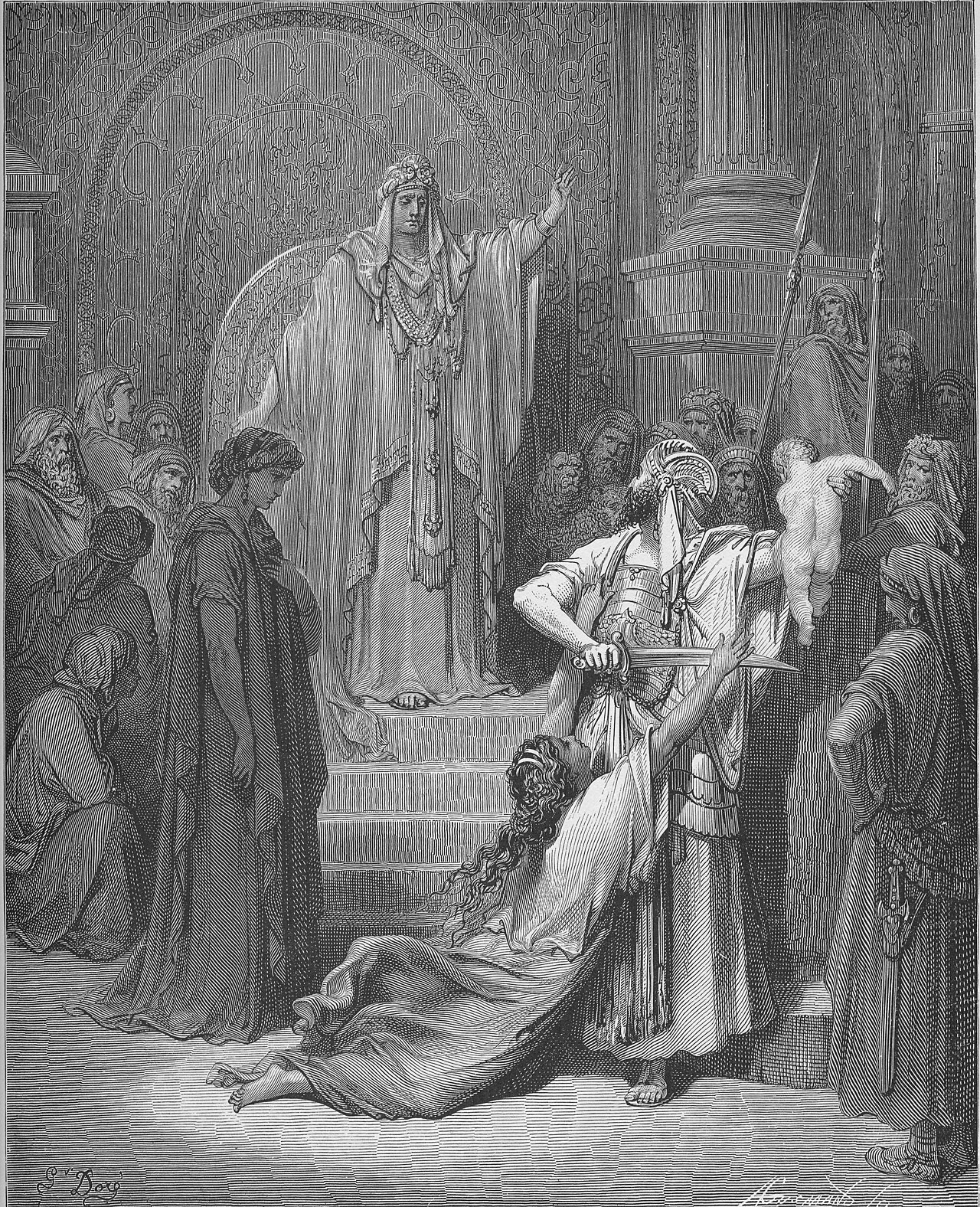
in 1 Kings 3Then the king replied, “This woman says, ‘My son is alive and yours is dead,’ but that woman says, ‘No, your son is dead and mine is alive.’”
BSB
The same verse in ASV and KJV ▾
ASV
Then said the king, The one saith, This is my son that liveth, and thy son is the dead: and the other saith, Nay; but thy son is the dead, and my son is the living.
KJV
Then said the king, The one saith, This is my son that liveth, and thy son is the dead: and the other saith, Nay; but thy son is the dead, and my son is the living.
⋯
This verse in 1 Kings 3
Commentary
9 notes on this verseThen said the king,.... As judge, summing up what had been said on both sides, which were only bare assertions without proof; the one affirming what the other denied, and the other denying what the other affirmed: the one saith, this is my son that liveth, and thy son is the dead; and the other saith nay; but thy son is the dead, and my son is the living; this he repeated to show to all present that no determination could be made by what had been said on each side, and that some other method must be taken.
This site's exposition
So they argued before the king
on 1 Kings 3:22-23
The two accounts contradict each other word for word, “the living one is my son” traded back and forth. The narrator records that “they argued before the king” and names no one as right. Solomon restates both claims at verse 23, laying the contradiction out in full before he acts.
This site's exposition
Then the king replied
John Gill hears the king summing up as a judge, showing the whole court that the two claims settle nothing and another method is needed. Matthew Henry names that method. The child could show no preference, so Solomon would test which woman loved the child.
The record, by era
The Church Fathers4 voices
The interpretation of Solomon's judgment on the quarrel of two harlot women (1 Kings 3) is clear as far as the simple history is concerned: that a boy of twelve years judged with an affection beyond his age for the depths of human nature. Hence, he was both admired and feared by all Israel, because he would not miss what was so skillfully concealed.
Is not that noble judgment of Solomon full of wisdom and justice? Let us see whether it is so. "Two women," it says, "stood before King Solomon, and the one said to him, 'Hear me, my lord, I and this woman dwell in one house, and before the third day we gave birth and bore a son apiece and were together; there was no witness in the house, nor any other woman with us, only we two alone. And her son died this night, because she laid on him, and she arose at midnight, and took my son from my breast and laid him in her bosom, and her dead child she laid at my breast. And I arose in the morning to nurse my child and found him dead. And I examined him at dawn, and behold, it was not my son.' And the other woman said, 'No, but the living is my son, and the dead is your son.' " This was their dispute, in which either tried to claim the living child for herself and denied that the dead one was hers. Then the king commanded a sword to be brought and the infant to be cut in half, and either piece to be given to one, one half to the one, and one half to the other. Then the woman whose the child really was, moved by her feelings, cried out, "Do not divide the child, my lord; rather, let it be given to her and live, and do not kill it." But the other answered: "Let it be neither mine nor hers; divide it." Then the king ordered that the infant should be given to the woman who had said "do not kill it," for, as it says, "her compassion earned over her son."It is not wrong to suppose that the mind of God was in him; for what is hidden from God? What can be more hidden than the witness that lies deep within; into which the mind of the wise king as though to judge a mother's feelings and elicited as it were the voice of a mother's heart? […]
The two women indicate to us the church and the synagogue. The latter, after it tried to suppress the sacrament of human redemption and persecuted and killed the Redeemer through false accusations, claims, nevertheless, that its child should still be alive, that is, that the …
Such a Shechem is the church; for Solomon chose her whose hidden love he had discerned. Such a Shechem is Mary, whose soul God's sword pierces and divides. Such a Shechem is a "coming up," even as it appears in the meaning of the word. As to what the "coming up" is, hear Solomon speaking in reference to the church, "Who is she that comes up clothed in white, leaning on her brother?" She is radiant, a word expressed in Greek as aktinodes, because she is resplendent in faith and in works. To her children it is said, "Let your works shine before my Father, who is in heaven."
The Puritans and the Awakening1 voice
To find out the true mother, he could not try which the child loved best, and must therefore try which loved the child best; both pretended to a motherly affection, but their sincerity will be tried when the child is in danger. (1.) She that knew the child was not her own, but in contending for it stood upon a point of honour, was well content to have it divided.
1 more voice on this verse
The Puritans and the Awakening1 voice
3 And Solomon loved the L ORD , walking in the statutes of David his father: only he sacrificed and burnt incense in high places. 4 And the king went to Gibeon to sacrifice there; for that was the great high place: a thousand burnt offerings did Solomon offer upon that altar. We are here told concerning Solomon, I.
quarantine:scripture (2026-07-29) — scripture-overlap:88%@v3-5
The words behind it
17 Hebrew wordsEvery Hebrew word of this verse in the order it stands, with what it means and the door to its own study. The last column counts the times a word stands in the whole Bible: the rarer the word, the more the places it appears belong together.
| Hebrew | Sound | Meaning | Word study | In the Bible |
|---|---|---|---|---|
| וַיֹּ֣אמֶר | vaiyomer | and he said | H559 → | 5305 times |
| הַמֶּ֔לֶךְ | hamelekh | the king | H4428 → | 2525 times |
| זֹ֣את | zot | this [one] | H2063 → | 603 times |
| אֹמֶ֔רֶת | ʾomeret | [is] saying | H559 → | 5305 times |
| זֶה־ | zeh- | this | H2088 → | 1180 times |
| בְּנִ֥י | beni | son my | H1121 → | 4930 times |
| הַחַ֖י | hachai | [is] the living one | H2416 → | 498 times |
| וּבְנֵ֣ךְ | uvenekh | and son your | H1121 → | 4930 times |
| הַמֵּ֑ת | hamet | [is] the dead [one] | H4191 → | 839 times |
| וְזֹ֤את | vezot | and this [one] | H2063 → | 603 times |
| אֹמֶ֙רֶת֙ | ʾomeret | [is] saying | H559 → | 5305 times |
| לֹ֣א | lo' | In- | H3808 → | 5168 times |
| כִ֔י | khi | deed | H3588 → | 4482 times |
| בְּנֵ֥ךְ | benekh | son your | H1121 → | 4930 times |
| הַמֵּ֖ת | hamet | [is] the dead [one] | H4191 → | 839 times |
| וּבְנִ֥י | uveni | and son my | H1121 → | 4930 times |
| הֶחָֽי׃ פ | hechai | [is] the living one | H2416 → | 498 times |
וַיֹּ֣אמֶרand he said
vaiyomerH559 →5305 times
הַמֶּ֔לֶךְthe king
hamelekhH4428 →2525 times
זֹ֣אתthis [one]
zotH2063 →603 times
אֹמֶ֔רֶת[is] saying
ʾomeretH559 →5305 times
זֶה־this
zeh-H2088 →1180 times
בְּנִ֥יson my
beniH1121 →4930 times
הַחַ֖י[is] the living one
hachaiH2416 →498 times
וּבְנֵ֣ךְand son your
uvenekhH1121 →4930 times
הַמֵּ֑ת[is] the dead [one]
hametH4191 →839 times
וְזֹ֤אתand this [one]
vezotH2063 →603 times
אֹמֶ֙רֶת֙[is] saying
ʾomeretH559 →5305 times
לֹ֣אIn-
lo'H3808 →5168 times
כִ֔יdeed
khiH3588 →4482 times
בְּנֵ֥ךְson your
benekhH1121 →4930 times
הַמֵּ֖ת[is] the dead [one]
hametH4191 →839 times
וּבְנִ֥יand son my
uveniH1121 →4930 times
הֶחָֽי׃ פ[is] the living one
hechaiH2416 →498 times
A shaded row is a word that stands 400 times or fewer in the Bible.
Where this verse is studied
About 1 Kings
This page draws on Ambrose of Milan, On the Duties of the Clergy 2.8.44-47; Ambrose of Milan, Interrogation of Job and David 4.4.16; Ephrem the Syrian, ON THE FIRST BOOK OF KINGS 3:16; Jerome, Letter 74; John Gill, Exposition of the Old Testament (1748-1763); John Gill, Exposition of the Old Testament; Keil, The Books of the Kings and Matthew Henry, Commentary on the Whole Bible.