
1 Kings 21:23
in 1 Kings 21And the LORD also speaks concerning Jezebel: ‘The dogs will devour Jezebel by the wall of Jezreel.’
BSB
The same verse in ASV and KJV ▾
ASV
And of Jezebel also spake Jehovah, saying, The dogs shall eat Jezebel by the rampart of Jezreel.
KJV
And of Jezebel also spake the Lord, saying, The dogs shall eat Jezebel by the wall of Jezreel.
⋯
This verse in 1 Kings 21
Commentary
7 notes on this verseFinally, even Jezebel herself was eaten by dogs and the birds of the air, in order to show that the spiritual wickedness becomes the prey of the rich burial. Therefore, flee, rich man, from such an end. But you will flee from such an end if you flee from such a disgrace. Do not be like Ahab, desiring a neighboring possession. Do not let that fatal greed of Jezebel dwell in you, which persuades you with bloodshed.
This site's exposition
The dogs shall eat Jezebel by the wall
on 1 Kings 21:23-24
Jezebel receives her own named sentence, the dogs shall eat Jezebel by the wall of Jezreel, distinct from the sentence just pronounced on Ahab's house and remembered at her death at 2 Kings 9:36 in nearly the same words spoken here. Verse 24 extends the same dogs and fowls formula to the whole house, city and field both covered, so that no member of it receives burial. Revelation 2:20 later makes Jezebel's name a standing label for the same seduction into idolatry inside a church at Thyatira, the queen's name outliving the queen by centuries.
The record, by era
The Church Fathers1 voice
And the Lord said to Elijah, "Get up, go down to meet King Ahab of Israel," and so on. Now, when Jezebel invited Ahab to come and take hold of the vineyard whose owners had been stoned, Elijah went out to meet him, precisely when …
The Puritans and the Awakening2 voices
And of Jezebel also spake the Lord,.... To Elijah, and by him: saying, the dogs shall eat Jezebel by the wall of Jezreel or in the inheritance or portion of Jezreel, as the Targum; Jarchi interprets it, the valley of Jezreel; the fulfilment of this see in 2Ki 9:30.
), which was fulfilled ( 2 Kings ix. 36 ),-- and, as for Ahab himself, that the dogs should lick his blood in the very same place where they licked Naboth's (
quarantine:debris (2026-07-29) — leading-punctuation
The Nineteenth Century2 voices
A commentator
Albert Barnes1798–1870
Notes, Explanatory and Practical, on the Old and New Testaments (1832-1869)
And of Jezebel also spake the Lord, saying - These are not the words of Elijah, but of the writer, who notes a special prophecy against Jezebel, whose guilt was at least equal to her husband’s. Wall - The marginal rendering “ditch,” is preferable. There is always in Oriental towns a space outside the walls which lies uncultivated, and which is naturally used for the deposit of refuse of every kind. Here the dogs prowl, and the kites and vultures find many a feast.
The dogs shall eat Jezebel - This was most literally fulfilled; see 2Ki 9:36. The carcasses of poor Hindoos, and of persons who have received public punishment, are thrown into the rivers, and floating to the side, are devoured by dogs, vultures, and crows.
The words behind it
11 Hebrew wordsEvery Hebrew word of this verse in the order it stands, with what it means and the door to its own study. The last column counts the times a word stands in the whole Bible: the rarer the word, the more the places it appears belong together.
| Hebrew | Sound | Meaning | Word study | In the Bible |
|---|---|---|---|---|
| וְגַ֨ם־ | vegam- | and also | H1571 → | 769 times |
| לְאִיזֶ֔בֶל | leizevel | of Jezebel | H348 → | 22 times |
| דִּבֶּ֥ר | diber | he has spoken | H1696 → | 1141 times |
| יְהוָ֖ה | yahweh | Yahweh | H3068 → | 6520 times |
| לֵאמֹ֑ר | lemor | <to> saying | H559 → | 5305 times |
| הַכְּלָבִ֛ים | hakelavim | the dogs | H3611 → | 32 times |
| יֹאכְל֥וּ | yokhelu | they will devour | H398 → | 810 times |
| אֶת־ | ʾet- | <obj.> | H853 → | 10935 times |
| אִיזֶ֖בֶל | ʾizevel | Jezebel | H348 → | 22 times |
| בְּחֵ֥ל | bechel | in [the] rampart of | H2426 → | |
| יִזְרְעֶֽאל׃ | yizreel | Jezreel | H3157 → | 36 times |
וְגַ֨ם־and also
vegam-H1571 →769 times
לְאִיזֶ֔בֶלof Jezebel
leizevelH348 →22 times
דִּבֶּ֥רhe has spoken
diberH1696 →1141 times
יְהוָ֖הYahweh
yahwehH3068 →6520 times
לֵאמֹ֑ר<to> saying
lemorH559 →5305 times
הַכְּלָבִ֛יםthe dogs
hakelavimH3611 →32 times
יֹאכְל֥וּthey will devour
yokheluH398 →810 times
אֶת־<obj.>
ʾet-H853 →10935 times
אִיזֶ֖בֶלJezebel
ʾizevelH348 →22 times
בְּחֵ֥לin [the] rampart of
bechelH2426 →
יִזְרְעֶֽאל׃Jezreel
yizreelH3157 →36 times
A shaded row is a word that stands 400 times or fewer in the Bible.
The walk
8 stopsEach card is a verse this one points to, and under it the verses that one points to in turn. Where several paths arrive at the same place, that place is listed first: the text keeps returning to it.
Through
1 Kings 21:25(Surely there was never one like Ahab, who sold himself to do evil in the sight of the LORD, incited by his wife Jezebel.
it leads to
- Proverbs 22:14
The mouth of an adulteress is a deep pit; he who is under the wrath of the LORD will fall into it.
- 1 Kings 21:20
When Elijah arrived, Ahab said to him, “So you have found me out, my enemy.” He replied, “I have found you out because you have sold yourself to do evil in the sight of…
- 1 Kings 16:30–33
However, Ahab son of Omri did evil in the sight of the LORD, more than all who were before him.
- Ecclesiastes 7:26
And I find more bitter than death the woman who is a snare, whose heart is a net, and whose hands are chains. The man who pleases God escapes her, but the sinner is…
- Acts 14:2
But the unbelieving Jews stirred up the Gentiles and poisoned their minds against the brothers.
- Proverbs 22:14
Through
2 Kings 9:10And on the plot of ground at Jezreel the dogs will devour Jezebel, and there will be no one to bury her.’” Then the young prophet opened the door and ran.
it leads to
- 2 Kings 9:35–36
But when they went out to bury her, they found nothing but her skull, her feet, and the palms of her hands.
- 2 Kings 9:3
Then take the flask of oil, pour it on his head, and declare, ‘This is what the LORD says: I anoint you king over Israel.’ Then open the door and run. Do not delay!”
- Jeremiah 22:19
He will be buried like a donkey, dragged away and thrown outside the gates of Jerusalem.
- 2 Kings 9:35–36
Where this verse is studied
On this page
Studies1
About 1 Kings
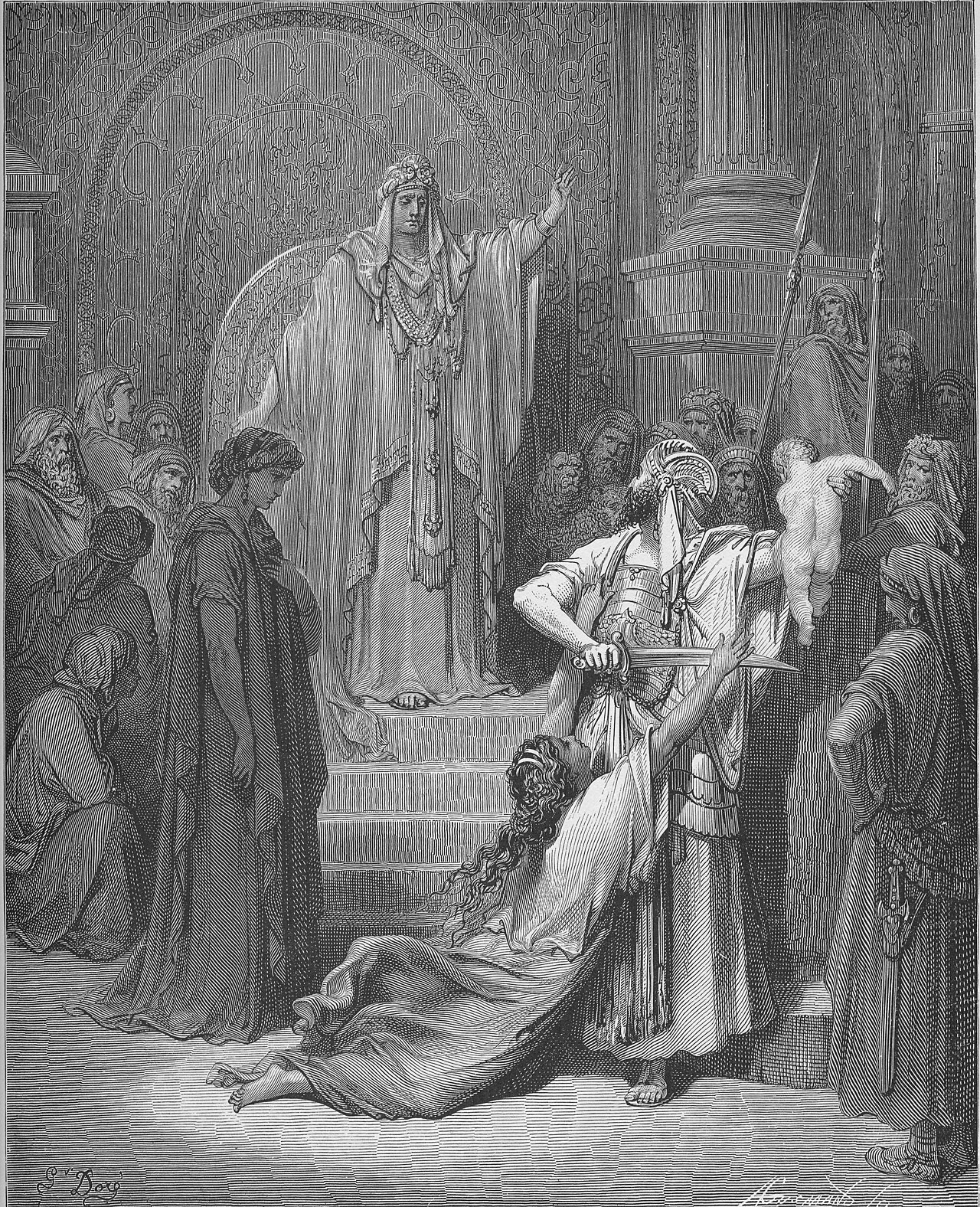
Who and where
2 names in this verse with a page on the site.
- PersonDivided kingdomJezebelSidonian princess and Ahab's queen who institutionalized Baal worship in Israel, ordered Elijah's death after Carmel, and engineer…
- PlaceNorthern IsraelJezreelAhab's summer capital beside Naboth's vineyard; the city of the dogs' prophecy, where Jezebel fell and Jehu's wheels rolled.
This page draws on Adam Clarke, Commentary on the Bible; Albert Barnes, Notes on the Old Testament; Albert Barnes, Notes, Explanatory and Practical, on the Old and New Testaments (1832-1869); Ambrose of Milan, On Naboth the Jezreelite, Chapter 11, 48-49; Ephrem the Syrian, ON THE FIRST BOOK OF KINGS 21:17; John Gill, Exposition of the Old Testament; John Gill, Exposition of the Old Testament (1748-1763) and Matthew Henry, Commentary on the Whole Bible.