
1 Timothy 1:18
in 1 Timothy 1Timothy, my child, I entrust you with this command in keeping with the previous prophecies about you, so that by them you may fight the good fight,
BSB
The same verse in ASV and KJV ▾
ASV
This charge I commit unto thee, my child Timothy, according to the prophecies which led the way to thee, that by them thou mayest war the good warfare;
KJV
This charge I commit unto thee, son Timothy, according to the prophecies which went before on thee, that thou by them mightest war a good warfare;
⋯
This verse in 1 Timothy 1
Commentary
16 notes on this verseWhat is this deposit? Is it so secret as to be supposed to characterize a new doctrine? or is it a part of that charge of which he says, "This charge I commit unto thee, son Timothy? " and also of that precept of which he says, "I charge thee in the sight of God, who quickeneth all things, and before Jesus Christ who witnessed a good confession under Pontius Pilate, that thou keep this commandment? " Now, what is (this) commandment and what is (this) charge?
This site's exposition
I entrust you with this command
on 1 Timothy 1:18-19
The charge that opened the letter returns by name: Timothy, my child, I entrust you with this command. The verb belongs to the family of the deposit he must guard at 6:20.
The record, by era
The Church Fathers5 voices
I entrust this command to you, Timothy, my child, according to the prophecies previously made about you, so that by them you may wage the good warfare. this command. It means careful observation. I entrust. As to a child, Paul says, I command, not according …
As the apostle also says in the Epistle to the Romans, "For therein is the righteousness of God revealed from faith to faith," teaching the one salvation which from prophecy to the Gospel is perfected by one and the same Lord. "This charge," he says, "I commit to thee, son Timothy, according to the prophecies which went before on thee, that thou by them mightest war the good warfare; holding faith, and a good conscience; which some having put away concerning faith have made shipwreck," because they defiled by unbelief the conscience that comes from God. Accordingly, faith may not, any more, with reason, be disparaged in an offhand way, as simple and vulgar, appertaining to anybody. For, if it were a mere human habit, as the Greeks supposed, it would have been extinguished. But if it grow, and there be no place where it is not; then I affirm, that faith, whether founded in love, or in fear, as its disparagers assert, is something divine; which is neither rent asunder by other mundane friendship, nor dissolved by the presence of fear.
It was according to divine revelation that I, Paul, laid hands on you and entrust to you the work of teaching.
A commentator
Theodoret of CyrusINTERPRETATION OF THE LETTER TO THE ROMANS · Written before 458.
proposed
With the name of "son," Paul gives his blessing to Timothy.
A commentator
Theodoret of CyrusINTERPRETATION OF THE FIRST LETTER TO TIMOTHY · Written before 458.
proposed
By recalling prophecy, Paul makes it clear that Timothy received the laying on of hands in accordance with divine revelation, and after numerous signs that he, Timothy, had been so elected.
9 more voices on this verse
The Church Fathers1 voice
The office of a Teacher and that of a Priest is of great dignity, and to bring forward one that is worthy requires a divine election. So it was of old, and so it is now, when we make a choice without human passion, not looking to any temporal consideration, swayed neither by friendship, nor enmity. For though we be not partakers of so great a measure of the Spirit as they, yet a good purpose is sufficient to draw unto us the election of God. For the Apostles, when they elected Matthias, had not yet received the Holy Spirit, but having committed the matter to prayer, they chose him into the number of the Apostles. For they looked not to human friendships. And so now too it ought to be with us. But we have advanced to the extreme of negligence; and even what is clearly evident, we let pass. Now when we overlook what is manifest, how will God reveal to us what is unseen? as it is said, "If ye have not been faithful in that which is little, who will commit to you that which is great and true?" But then, when nothing human was done, the appointment of Priests too was by prophecy. What is "by prophecy"? By the Holy Spirit. For prophecy is not only the telling of things future, but also of the present. It was by prophecy that Saul was discovered "hidden among the stuff." For God reveals things to the righteous. So it was said by prophecy, "Separate me Barnabas and Saul." In this way Timothy also was chosen, concerning whom he speaks of prophecies in the plural; that, perhaps, upon which he "took and circumcised him," and when he ordained him, as he himself says in his Epistle to him, "Neglect not the gift that is in thee." Therefore to elevate him, and prepare him to be sober and watchful, he reminds him by whom he was chosen and ordained, as if he had said, "God hath chosen thee. He gave thee thy commission, thou wast not made by human vote. […]
The Medieval Church2 voices
Since he used the word "charge," and a charge is something commanding, he added: "my son Timothy." For I do not say this to you in a commanding way, but as to a son. He also said: "I commit," in order to explain the strictness …
Then when he says, this precept, I commend to you, he instructs Timothy to keep certain things in mind: first, he reminds him of the task entrusted to him; second, he instructs him on its proper performance; third, he shows how to use it. He …
The Puritans and the Awakening3 voices
This charge I commit to thee - That thou mayest deliver it to the church. According to the prophecies concerning thee - Uttered when thou wast received as an evangelist, chap. iv, 14; probably by many persons, chap. vi, 12; that, being encouraged by them, thou mightest war the good warfare.
It seems, there had been prophecies before concerning Timothy, that he should be taken into the ministry, and should prove eminent in the work of the ministry; this encouraged Paul to commit this charge to him. The ministry is a warfare, it is a good warfare against sin and Satan: and under the banner of the Lord Jesus, who is the Captain of our salvation ( Heb. ii.
quarantine:debris (2026-07-29) — unbalanced-parens
This charge I commit unto thee, son Timothy,....
The Nineteenth Century3 voices
This charge - See the note on 1Ti 1:5. It was a charge that the Judaizing teachers should not teach differently from that doctrine which the apostle had delivered to him. See 1Ti 1:3. According to the prophecies - This may refer to some predictions by inspired men, relative to what Timothy should be: and he wishes him to act in all things conformably to those predictions.
A commentator
Jamieson, Fausset & Brown1802–1910
Commentary Critical and Explanatory on the Whole Bible (1871)
This charge--namely, "that thou in them (so the Greek) mightest war," that is, fulfil thy high calling, not only as a Christian, but as a minister officially, one function of which is, to "charge some that they teach no other doctrine" (1Ti 1:3).
A commentator
Albert Barnes1798–1870
Notes, Explanatory and Practical, on the Old and New Testaments (1832-1869)
proposed
This charge - This command or injunction. It does not refer to any “charge,” or “cure,” which he had as bishop or minister, as the word is sometimes used now, but to the commands or injunctions which he was delivering to him. The command particularly referred to is that in 1Ti 1:8. According to the prophecies which went before on thee - The general meaning of this is plain. It is, that Paul was committing to him an important trust, and one that required great wisdom and fidelity; and that in doing it he was acting in conformity with the hopes which had been cherished respecting Timothy, and with certain expressed anticipations about his influence in the church. From early life the hope had been entertained that he would be a man to whom important trusts might be committed; and it had been predicted that he would be distinguished as a friend of religion. These hopes seem to have been cherished in consequence of the careful training in religion which he had had 2Ti 2:1; 2Ti 3:15, and probably from the early indications of seriousness, prudence, and piety, which he manifested. It was natural to entertain such hopes, and it seems, from this place, that such hopes had even assumed the form of predictions. It is not absolutely necessary to suppose that these predictions referred to by the word prophecies were inspired, for the word may be used in a popular sense, as it is often now. We speak now familiarly of predicting or foretelling the future usefulness of a serious, prudent, studious, and pious youth. We argue from what he is, to what he will be, and we do not deem it unsafe or improper to hazard the prediction that, if he lives, he will be a man to whom important interests may be entrusted. As there were, however. prophets in the Christian church (Act 11:27 note; 1 Cor. […]
The words behind it
20 Greek wordsEvery Greek word of this verse in the order it stands, with what it means and the door to its own study. The last column counts the times a word stands in the whole Bible: the rarer the word, the more the places it appears belong together.
| Greek | Sound | Meaning | Word study | In the Bible |
|---|---|---|---|---|
| Ταύτην | tauten | This | G3778 → | 1381 times |
| τὴν | ten | <the> | G3588 → | 19766 times |
| παραγγελίαν | parangelian | charge | G3852 → | |
| παρατίθεμαί | paratithemai | I commit | G3908 → | |
| σοι, | soi | to you, | G4771 → | 2973 times |
| τέκνον | teknon | [my] child | G5043 → | 99 times |
| Τιμόθεε, | timothee | Timothy, | G5095 → | 24 times |
| κατὰ | kata | according to | G2596 → | 468 times |
| τὰς | tas | the | G3588 → | 19766 times |
| προαγούσας | proagousas | going before | G4254 → | |
| ἐπὶ | epi | as to | G1909 → | 883 times |
| σὲ | se | you | G4771 → | 2973 times |
| προφητείας, | propheteias | prophecies, | G4394 → | |
| ἵνα | ina | that | G2443 → | 668 times |
| στρατεύῃ | strateue | you may war | G4754 → | |
| ἐν | en | by | G1722 → | 2738 times |
| αὐταῖς | autais | them | G846 → | 5565 times |
| τὴν | ten | the | G3588 → | 19766 times |
| καλὴν | kalen | good | G2570 → | 101 times |
| στρατείαν | strateian | warfare | G4752 → |
ΤαύτηνThis
tautenG3778 →1381 times
τὴν<the>
tenG3588 →19766 times
παραγγελίανcharge
parangelianG3852 →
παρατίθεμαίI commit
paratithemaiG3908 →
σοι,to you,
soiG4771 →2973 times
τέκνον[my] child
teknonG5043 →99 times
Τιμόθεε,Timothy,
timotheeG5095 →24 times
κατὰaccording to
kataG2596 →468 times
τὰςthe
tasG3588 →19766 times
προαγούσαςgoing before
proagousasG4254 →
ἐπὶas to
epiG1909 →883 times
σὲyou
seG4771 →2973 times
προφητείας,prophecies,
propheteiasG4394 →
ἵναthat
inaG2443 →668 times
στρατεύῃyou may war
strateueG4754 →
ἐνby
enG1722 →2738 times
αὐταῖςthem
autaisG846 →5565 times
τὴνthe
tenG3588 →19766 times
καλὴνgood
kalenG2570 →101 times
στρατείανwarfare
strateianG4752 →
A shaded row is a word that stands 400 times or fewer in the Bible.
The walk
8 stopsEach card is a verse this one points to, and under it the verses that one points to in turn. Where several paths arrive at the same place, that place is listed first: the text keeps returning to it.
Through
1 Timothy 4:14Do not neglect the gift that is in you, which was given you through the prophecy spoken over you at the laying on of the hands of the elders.
it leads to
- 2 Timothy 1:6
For this reason I remind you to fan into flame the gift of God, which is in you through the laying on of my hands.
- 1 Peter 4:9–11
Show hospitality to one another without complaining.
- Acts 6:6
They presented these seven to the apostles, who prayed and laid their hands on them.
- 2 Timothy 1:6
Through
1 Timothy 6:20O Timothy, guard what has been entrusted to you. Avoid irreverent, empty chatter and the opposing arguments of so-called “knowledge,”
it leads to
- Colossians 2:8
See to it that no one takes you captive through philosophy and empty deception, which are based on human tradition and the spiritual forces of the world rather than on Christ.
- 2 Timothy 2:16
But avoid irreverent, empty chatter, which will only lead to more ungodliness,
- 2 Timothy 1:12–14
For this reason, even though I suffer as I do, I am not ashamed; for I know whom I have believed, and I am convinced that He is able to guard what I have…
- 2 Timothy 3:14–16
But as for you, continue in the things you have learned and firmly believed, since you know from whom you have learned them.
- Colossians 2:18
Do not let anyone who delights in false humility and the worship of angels disqualify you with speculation about what he has seen. Such a person is puffed up without basis by his unspiritual…
- Colossians 2:8
Where this verse is studied
On this page
Studies12
On this verse
About 1 Timothy
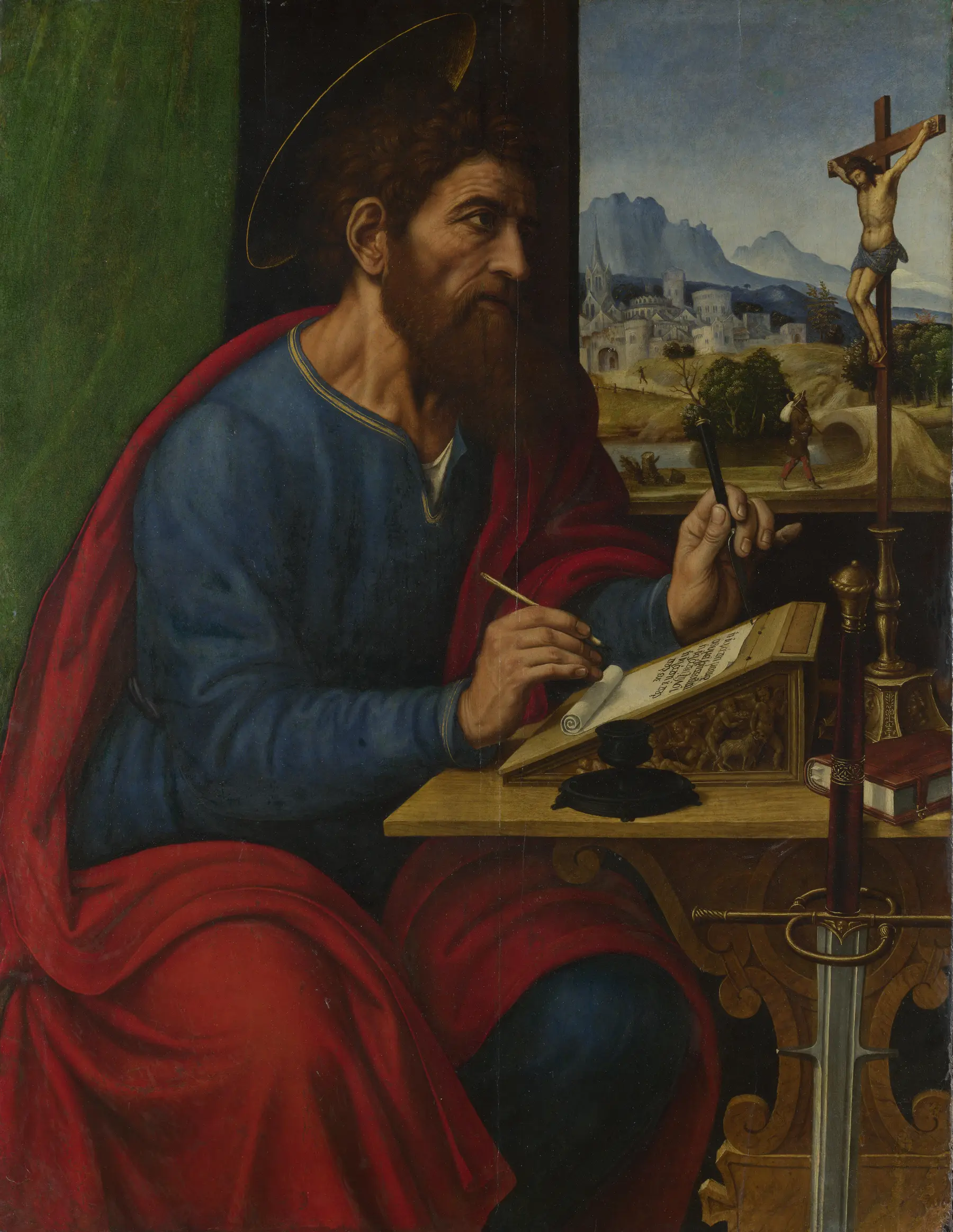
Who and where
1 name in this verse with a page on the site.
This page draws on 17 works. Open the list of works
This page draws on Adam Clarke, Commentary on the Bible; Albert Barnes, Notes on the New Testament; Albert Barnes, Notes, Explanatory and Practical, on the Old and New Testaments (1832-1869); Clement of Alexandria, The Stromata Book 2; Jamieson, Fausset & Brown, Commentary Critical and Explanatory on the Whole Bible; John Chrysostom, Homily on 1 Timothy 5; John Gill, Exposition of the New Testament; John Gill, Exposition of the New Testament (1746-1748); John Wesley, Explanatory Notes upon the New Testament; Matthew Henry, Commentary on the Whole Bible; Oecumenius, COMMENTARY ON 1 TIMOTHY; Tertullian, The Prescription Against Heretics; Theodore of Mopsuestia, COMMENTARY ON 1 TIMOTHY; Theodoret of Cyrus, INTERPRETATION OF THE LETTER TO THE ROMANS; Theodoret of Cyrus, INTERPRETATION OF THE FIRST LETTER TO TIMOTHY; Theophylact of Ohrid, Commentary on 1 Timothy and Thomas Aquinas, Commentary on 1 Timothy.