
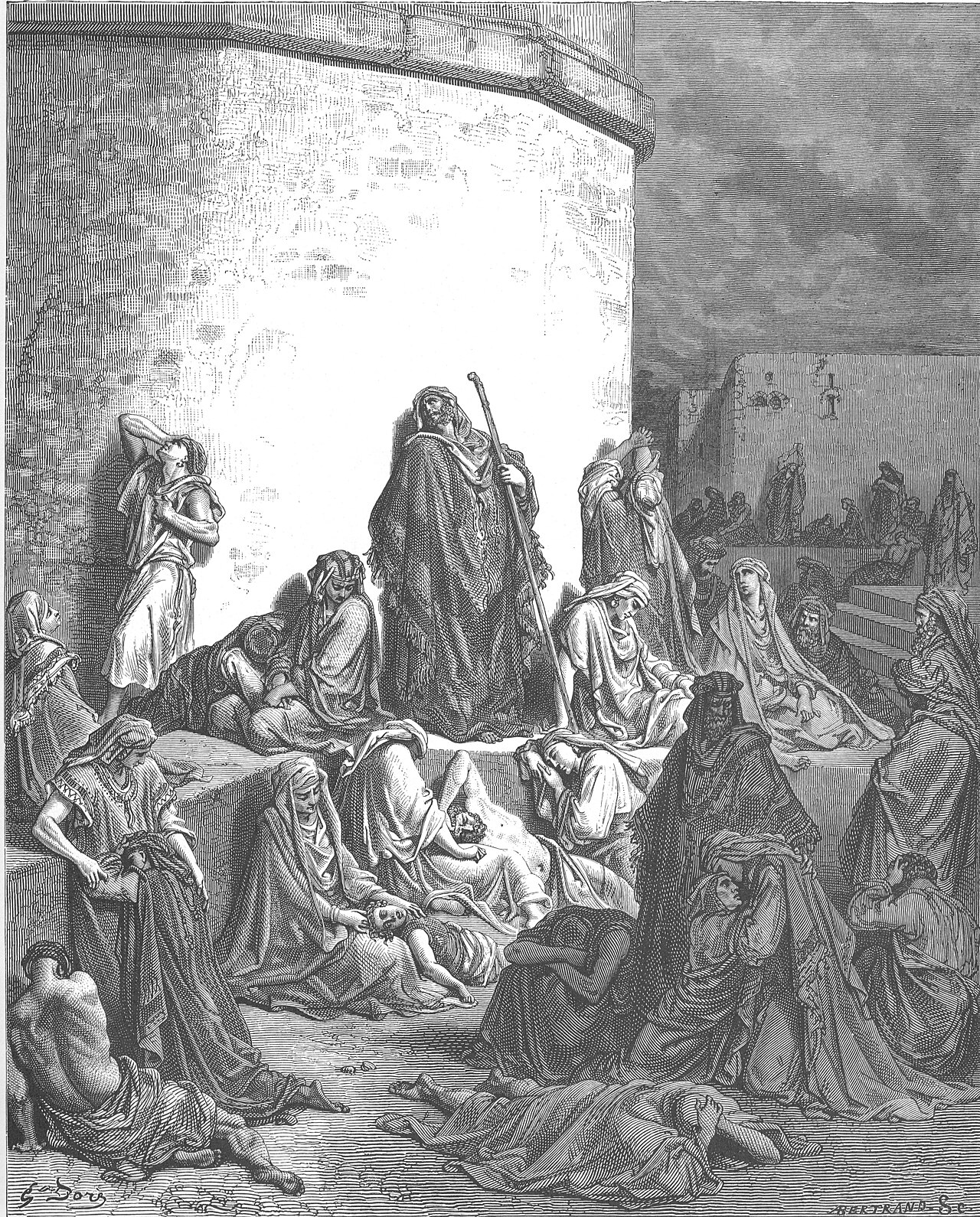
Lamentationschapter 2
22 verses · Jeremiah, by tradition · about 586 BC · The Prophets
How the Lord has covered the Daughter of Zion with the cloud of His anger! He has cast the glory of Israel from heaven to earth. He has abandoned His footstool in the day of His anger.
Introduction
Jeremiah, by tradition, The Prophets, Lamentations Overview.
Tradition gives this poem to Jeremiah, who watched the temple burn after years of warning that it would. It was written for survivors who needed to know who had brought the disaster on them. Like the first poem it runs through the Hebrew alphabet one verse to a letter, though here two of the letters trade places. Listen for who does the acting in almost every line, and for how seldom the invading army is mentioned. Listen also for what is said about the prophets, and for the call to prayer near the end. It is the hardest chapter of the book to read aloud.
Context
- Who
- People who had watched the sanctuary burn and needed to know who did it
- What
- A lament that names the LORD Himself as the one who tore down His city, His temple and His altar.
- Where
- The temple mount and the streets of Jerusalem, where the sanctuary had burned and children fainted from hunger.
- When
- The first years after the fall of Jerusalem in 586 BC; the poem gives no date of its own.
- Why
- To make the survivors own the judgment as God's, and to send them to Him in prayer for their children.
Historical context
This chapter is another alphabet poem, and its subject is not the Babylonians. Almost every line has God as the one acting: he has swallowed up, he has broken down, he has bent his bow like an enemy, he has scorned his altar and disowned his sanctuary. The army that came over the wall barely appears.
Show the rest of the historical context, 3 more paragraphs
Two images treat the temple as something small. His footstool is a way of speaking about the ark and the sanctuary, God's throne is heaven, and this is where his feet rest. And he has laid waste his booth like a garden hut: farmers built a rough shelter of branches in a field for the harvest weeks and abandoned it when the picking was done. The most sacred building in the nation is compared to a temporary shed.
The mourning is described from life. The elders sit on the ground in silence, throwing dust on their heads and wearing sackcloth, coarse dark goat-hair cloth worn next to the skin. The young women bow their heads to the ground. Eyes are worn out with weeping.
The famine of the siege is here too, in the hardest lines in the book: children and infants faint in the streets of the city, asking their mothers where there is bread and wine, and pouring out their lives on their mothers' bosom. The chapter blames the prophets directly, they saw for you false and deceptive visions, and did not expose your sin to restore your fortunes.
Significance
The first hearers were being kept from two easy escapes. They could not say Babylon was too strong, and they could not say God had lost. He had done this, and he had done it justly.
Show the rest of the significance, 1 more paragraph
The chapter ends by telling them to pray anyway: pour out your heart like water before the face of the Lord, lift your hands to him for the lives of your children. The one being addressed as the destroyer is the only one worth crying to.
This chapter in Jewish lifeWhat this chapter is in Jewish life and reading.
What is done
No part of this chapter is read on a weekly Sabbath. The site's own table in src/lib/hebraic/readings.ts printed parashot total 0 and haftarah uses total 0 for this book. It records one public reading instead, the whole book, on the eve of the fast of Tisha B'Av. The book is read at night in a darkened room, and the congregation sits on the floor or on low stools as mourners sit. It sources the practice to Shulchan Aruch, Orach Chayim 559. The chapter is heard in that reading, in its own mournful melody.
How it is read
Rashi is the one commentator on this chapter whose English the corpus carries, quoted here from The Metsudah Five Megillot, Lakewood, N.J., 2001, which Sefaria reports as CC-BY. The translation is modern, so every quotation is held to fifty words or fewer. The edition sets numbered notes of its own inside Rashi's text, and only Rashi's own words are quoted as his.
Rashi reads the opening verse as a fall from a height. After God lifted Israel up to heaven, "He cast them to earth all at once, and not gradually" (Rashi on Lamentations 2:1:2). The entry ends with the image "from a lofty roof to a deep pit" (Rashi on Lamentations 2:1:2). At the third verse God withholds His right hand. He stands back from battle "as though withdrawing His right hand from waging war for his children" (Rashi on Lamentations 2:3:1). The arched bow of the fourth verse he explains from the way strong archers work. They "place their foot upon them [bows] when he bends them" (Rashi on Lamentations 2:4:1).
At the eighth verse Rashi says the ruin was long in coming. "It had been many days since this entered His mind" (Rashi on Lamentations 2:8:1), and he cites Jeremiah 32:31 for it. The gates of the ninth verse that sank into the ground draw two readings. The Midrash Aggadah says they sank because they gave honor to the Ark, so that no one had power over them. Rashi then adds that "our Rabbis said that they were Dovid’s handiwork, therefore, the enemies had no power over them" (Rashi on Lamentations 2:9:1). The edition points to Sotah 9a.
The elders sitting on the ground at the tenth verse he takes first "According to its apparent meaning." He then tells the Midrash Aggadah at length. Nevuchadnetzar summoned the Sanhedrin after Tzidkiyahu broke his oath. "He sat them down in golden chairs" and had them recite the Torah to him. When they reached the chapter on vows and said a sage could release a vow, he concluded that they had released the king. He had them pushed down and sat on the ground (Rashi on Lamentations 2:10:1).
At the sixteenth verse the order of the alphabet itself carries a teaching. Rashi asks why the verse beginning with pei stands before the one beginning with ayin. The edition's notes gloss the two letters as mouth and eye. His answer is: "Because they [i.e., the prophets] were saying with their mouths what they did not see with their eyes" (Rashi on Lamentations 2:16:1). Rashi explains the hissing of the fifteenth verse as a common habit. "It is customary for a person to do so upon seeing an important thing that was ruined and destroyed" (Rashi on Lamentations 2:15:1).
The watches of the nineteenth verse are "Two parts of the night, for the night is divided into three parts" (Rashi on Lamentations 2:19:1), and Rashi names Tractate Berakhot for it. At the twentieth verse he gives the plain sense of the infants first, "Tender children". He then reports that the Rabbis read it of Do’eg, "whose mother would measure him with [her] handbreadth every day" (Rashi on Lamentations 2:20:1). She gave gold to the Temple by his growth, "and in the end she devoured him." The edition points to Yoma 38b.
The corpus carries two further notes on this chapter without an English text, each marked linked because Sefaria holds no English version of the ref. They stand cited and unquoted at Ibn Ezra on Lamentations 2:12:1 and 2:21:1.
What the rabbis say
The corpus carries forty rabbinic locators on this chapter and the text of none, so each is cited and linked here rather than quoted. Eikhah Rabbah stands under the second verse at 2:4 and 2:5, under the fourth at 1:3 and 2:8, and under the fifth through the eighth at 2:9, 2:10, 2:11 and 2:12. It stands under the tenth at 2:14 and at Petichta 7, and under the eleventh through the fourteenth at 2:15, 2:16, 2:17, 1:54 and 2:18. It stands under the sixteenth at 2:20, under the seventeenth at 1:1 and 2:21, under the twentieth at 1:51, under the twenty-first at 2:24 and under the twenty-second at 2:25.
Other Midrashim stand beside it. Aggadat Bereshit is set at 67:3 on the first verse, at 24:1 and 47:1 on the third, and at 68:2 on the fifteenth. Mekhilta DeRabbi Yishmael, Tractate Shirah 5:15, stands on the fifth verse. Midrash Lekach Tov on Lamentations stands at 2:6:1, 2:7:1, 2:12:1 and 2:18:1. Bamidbar Rabbah stands at 15:13 on the ninth verse and 13:2 on the fifteenth. Bereshit Rabbah stands at 91:1 on the eleventh verse and 2:4 on the nineteenth. Midrash Aggadah, Deuteronomy 1:1:8, stands on the thirteenth, and Kohelet Rabbah 1:16:1 on the eighteenth.
The Talmud stands at three places. Chagigah 5b:16 is set on the first verse, Jerusalem Talmud Pesachim 7:12:3 on the eighth, and Bava Kamma 55a:5 on the ninth. Ein Yaakov (Glick Edition), Sanhedrin 11:89, stands on the sixteenth. What each of them teaches is a saying of the rabbis, and is reported as theirs wherever this site quotes one. The quotations wait on a fetch that carries the text.
Sources: Rashi, Rashi on Lamentations 2:1:1 to 2:22:1, The Metsudah Five Megillot, Lakewood, N.J., 2001, reported CC-BY; Ibn Ezra, Ibn Ezra on Lamentations 2:12:1 and 2:21:1, cited by ref because the corpus carries no English text; The Sefaria corpus, scripts/data/sources/sefaria/lamentations/2.json, the 40 Talmud and Midrash locators of this chapter; The site's own files, src/lib/hebraic/readings.ts, probed for this book and printing parashot total 0, haftarah uses total 0, and the festival reading on the eve of the fast of Tisha B'Av, sourced there to Shulchan Aruch, Orach Chayim 559.
The heads below are this chapter's scenes. The numbered points under each are its verses.
The Lord Become as an Enemy to Zion
Lamentations 2:1-3
How the Lord has covered the Daughter of Zion with the cloud of His anger!: Lamentations 2 is a twenty-two verse acrostic, and it names who stood behind the enemy. The Lord is the subject of its opening verbs: He “has abandoned His footstool in the day of His anger”. The footstool is the ark's resting place in 1 Chronicles 28:2 and Psalm 99:5.
Lamentations 2:1
“The beauty of Israel is now cast down from heaven to the earth; their princes ( 2 Sam. i. 19 ), their religious worship, their beauty of holiness, all that which recommended them to the affection and esteem of their neighbours and rendered them amiable, which had lifted them up to heaven, was now withered and gone, because God had covered it with a cloud.”
Matthew Henry · Commentary on the Whole Bible (1707-1721)puritan
2 more voices on this verseWhat preachers and commentators have said about this verse, in their own words.
Lamentations 2:1
“For though men were a hundred times perfidious, yet God never changes, but remains unchangeable in his faithfulness; and we know that his covenant was not made to depend on the merits of men. Whatsoever, then, the people might be, yet it behooved God to continue in his purpose, and not to annul the promise made to Abraham.”
John Calvin · Commentaries (1554)reformed
Lamentations 2:1
“His footstool - His temple; but suffered the Chaldeans to destroy it. Cast down - That is, thrown them down from the highest glory and honour, to the meanest degree of servitude.”
John Wesley · Explanatory Notes upon the Old Testament (1765)evangelical
Without pity the Lord has swallowed up: The verb swallowed up returns twice in 2:5, and in 2:16 the enemy boasts of the same deed. Albert Barnes reads the dwellings as the shepherds' homes in the open country, lost as in an earthquake, beside the walled cities. To defile the kingdom is to make the holy common.
Lamentations 2:2
“The Lord hath swallowed up - It is a strange figure when thus applied: but Jehovah is here represented as having swallowed down Jerusalem and all the cities and fortifications in the land: that is, he has permitted them to be destroyed. See Lam 2:6.”
Adam Clarke · Commentary on the Bible (1810-1826)evangelical
In fierce anger He has cut off every horn: Adam Clarke explains the horn as strength, an image taken from cattle. Albert Barnes reads the withdrawn right hand as the end of the care that guarded Israel, and he adds that the Lord lights the fire. The horn returns in Lamentations 2:17, raised for her foes.
Lamentations 2:3
“Since the horn is the symbol of power, the cutting off of every horn means the depriving Israel of all power of resistance. The drawing back of God’s right hand signifies the withdrawal of that special Providence which used to protect the chosen people. And he burned ... - Or, “and” he kindled a fire in Jacob: as the active enemy of “Jacob,” Himself applying the torch.”
1 more voice on this verse
Lamentations 2:3
“The horn - All their beauty and strength. Drawn back - God hath drawn back his assistance which he was wont to give the Jews against their enemies. Round about - God consumed them, not in this or that part, but round about, as a fire seizing an house at once on all sides.”
John Wesley · Explanatory Notes upon the Old Testament (1765)evangelical
Lamentations 2:4-6
He has bent His bow like an enemy: The covenant God is described in an invader's terms: “He has bent His bow like an enemy; His right hand is positioned”. He “has laid waste His tabernacle like a garden booth”. Each loss in the unit is traced to the LORD's own hand, behind Babylon's siege.
Lamentations 2:4
“He hath bent his bow - he stood with his right hand - This is the attitude of the archer. He first bends his bow; then sets his arrow upon the string; and, lastly, placing his right hand on the lower end of the arrow, in connection with the string, takes his aim, and prepares to let fly.”
Adam Clarke · Commentary on the Bible (1810-1826)evangelical
1 more voice on this verse
Lamentations 2:4
“He - That is, God, (whom by their sins they had provoked and made their enemy) behaved himself as an enemy. And slew - All their young men, and maidens who were pleasant to look upon.”
John Wesley · Explanatory Notes upon the Old Testament (1765)evangelical
The Lord is like an enemy: Albert Barnes notes that the title here is Adonai, and the Lord has become as an enemy to Israel. John Gill hears grief past bearing in the repeated swallowed up, first Israel and then her palaces and strongholds. Mourning and lamentation rhyme in the Hebrew.
Lamentations 2:5
“The Lord was as an enemy,.... Who formerly was on their side, their God and guardian, their protector and deliverer, but now against them; and a terrible thing it is to have God for an enemy, or even to be as one; this is repeated, as being exceeding distressing, and even intolerable.”
He has laid waste His tabernacle like a garden booth: Albert Barnes compares the booth of boughs built for the Feast of Tabernacles and torn down like a garden shed, the image of Isaiah 1:8. Matthew Henry sees the king and priest despised in Zedekiah's humbling and the execution of Seraiah the chief priest, 2 Kings 25:18-21.
Lamentations 2:6
“As if it were of a garden - “As it were the garden of his own hedging.” - Blayney. The Lord hath caused the solemn feasts - By delivering us up into the hands of the enemy our religious worship is not only suspended, but all Divine ordinances are destroyed.”
Adam Clarke · Commentary on the Bible (1810-1826)evangelical
1 more voice on this verse
Lamentations 2:6
“He has abandoned them; he looks upon them as no longer worthy of the honours conveyed to them by the covenants of royalty and priesthood, but as having forfeited both; and then Zedekiah the king was used despitefully, and Seraiah the chief priest put to death as a malefactor.”
Matthew Henry · Commentary on the Whole Bible (1707-1721)puritan
Lamentations 2:7-9
The Lord has rejected His altar: The enemy shouts in the temple “as on the day of an appointed feast”, the sound of worship turned to mockery. The silence is named as judgment too: “the law is no more, and even her prophets find no vision from the LORD”.
Lamentations 2:7
“They have made a noise in the house of the Lord - Instead of the silver trumpets of the sanctuary, nothing but the sounds of warlike instruments are to be heard.”
Adam Clarke · Commentary on the Bible (1810-1826)evangelical
The LORD determined to destroy the wall: The LORD stretched a measuring line to mark the wall of Zion for ruin, the line of Isaiah 34:11 and 2 Kings 21:13. Albert Barnes calls the destruction systematic and thorough. John Wesley notes workmen used a line to mark what to cut down as well as what to build.
Lamentations 2:8
“The wall - The strength and security of the Jews. A line - Artificers used with lines not only to mark out places for building, but also for destruction, to direct them what to cut off; and such a line is here meant.”
John Wesley · Explanatory Notes upon the Old Testament (1765)evangelical
Her gates have sunk into the ground: The king and princes in exile fulfil the warning of Deuteronomy 28:36, as Jamieson, Fausset & Brown note. Albert Barnes reads the end of the law as the loss of the temple that housed it. The prophets without a vision recall Psalm 74:9.
Lamentations 2:9
“Her gates are sunk into the ground - So completely destroyed, that one might suppose they had been swallowed up in an abyss. Her king - The prophet’s lamentation, occupied before chiefly with the buildings of the city and temple, now turns to the people, beginning with their temporal rulers. The law is no more - The Jewish Law, the Torah, came to an end when it no longer had a local habitation.”
2 more voices on this verse
Lamentations 2:9
“Among the Gentiles - In miserable captivity. The law - Is no more read, opened or observed. Her prophets - They had but very few prophets, from this time to the time of the gospel, and very few of those at this time alive had any Revelation from God.”
John Wesley · Explanatory Notes upon the Old Testament (1765)evangelical
Lamentations 2:9
“Note, It is just with God to debase those by his judgments who have by sin debased themselves. Time was when the ordinances of God were administered among them in their power and purity, and they had those tokens of God's presence with them; but now those were taken from them, that part of the beauty of Israel was gone which was indeed their greatest beauty.”
Matthew Henry · Commentary on the Whole Bible (1707-1721)puritan
Lamentations 2:10-12
The elders of the Daughter of Zion sit on the ground in silence: “The elders of the Daughter of Zion sit on the ground in silence”, men whose place was speech at the city gate. The young women bow beside them, so the grief crosses every rank. The famine is then stated plainly: children “cry out to their mothers” for grain and wine.
Lamentations 2:10
“Sit upon the ground - See the note on Lam 1:1. Keep silence - No words can express their sorrows: small griefs are eloquent, great ones dumb.”
Adam Clarke · Commentary on the Bible (1810-1826)evangelical
1 more voice on this verse
Lamentations 2:10
“The "elders," by their example, would draw the others to violent grief. the virgins--who usually are so anxious to set off their personal appearances to advantage.”
Jamieson, Fausset & Brown · Commentary Critical and Explanatory on the Whole Bible (1871)reformed
Children Fainting in the Streets; the Prophets Saw Vain Things
My eyes fail from weeping: The narrator weeps in the first person. The Hebrew speaks of the liver poured out on the ground, and Albert Barnes explains the liver as the seat of feeling. The words I am churning within repeat Zion's cry in Lamentations 1:20, so the poet grieves with the city he describes.
Lamentations 2:11
“Troubled - See the margin reference note. Liver - As the heart was regarded by the Jews as the seat of the intellect, so the liver (or bowels) was supposed to be the seat of the emotions. The pouring out of the liver upon the ground meant that feelings had entirely given way under the acuteness of sorrow, and he could no longer restrain them.”
1 more voice on this verse
Lamentations 2:11
“Mine eyes - This whole verse is but expressive of the prophets great affliction for the miseries come upon the Jews. He wept himself almost blind. Bowels - His passion had disturbed his bodily humours, that his bowels were troubled.”
John Wesley · Explanatory Notes upon the Old Testament (1765)evangelical
They cry out to their mothers: Albert Barnes reads the verb as a cry repeated again and again, even as the children die. Grain and wine were the covenant blessing of Deuteronomy 7:13. Adam Clarke pictures infants dying at the breasts of their exhausted mothers.
Lamentations 2:12
“When their soul was poured out into their mothers’ bosom - When, in endeavoring to draw nourishment from the breasts of their exhausted mothers, they breathed their last in their bosoms! How dreadfully afflicting was this!”
Adam Clarke · Commentary on the Bible (1810-1826)evangelical
Lamentations 2:13-17
What can I say for you?: The poet speaks in his own voice, “What can I say for you?”, and finds no comparison for a wound “as deep as the sea”. Verse 17 reads the enemy's triumph as an old word fulfilled: “He has accomplished His decree, which He ordained in days of old”.
Lamentations 2:13
“What thing shall I take - Or, rather, as Dr. Blayney, “What shall I urge to thee?” How shall I comfort thee? Thy breach is great like the sea - Thou hast a flood of afflictions, a sea of troubles, an ocean of miseries.”
Adam Clarke · Commentary on the Bible (1810-1826)evangelical
The visions of your prophets were empty: Jamieson, Fausset & Brown read the Hebrew as a veil the prophets left over her guilt. To expose that guilt would have warded off captivity, the charge of Jeremiah 23:22. Albert Barnes calls their burdens oracles that proved empty.
Lamentations 2:14
“They have not discovered thine iniquity - They did not reprove for sin, they flattered them in their transgressions; and instead of turning away thy captivity, by turning thee from thy sins, they have pretended visions of good in thy favor, and false burdens for thy enemies.”
Adam Clarke · Commentary on the Bible (1810-1826)evangelical
1 more voice on this verse
Lamentations 2:14
“Literally, "They have not taken off (the veil) which was on thine iniquity, so as to set it before thee." burdens--Their prophecies were soothing and flattering; but the result of them was heavy calamities to the people, worse than even what the prophecies of Jeremiah, which they in derision called "burdens," threatened.”
Jamieson, Fausset & Brown · Commentary Critical and Explanatory on the Whole Bible (1871)reformed
All who pass by clap their hands: The passers-by of Lamentations 1:12 return here, now mocking. Their taunt echoes Psalm 48:2 and Psalm 50:2, where Zion is praised as the joy of all the earth and perfect in beauty. Albert Barnes compares the crowd that shook their heads at the cross in Matthew 27:39.
Lamentations 2:15
“The perfection of beauty - This probably only applied to the temple. Jerusalem never was a fine or splendid city; but the temple was most assuredly the most splendid building in the world.”
Adam Clarke · Commentary on the Bible (1810-1826)evangelical
All your enemies open their mouths: This verse opens on pe, the letter whose name means mouth, as the enemies open their mouths against Zion. Albert Barnes hears their joy in the heap of short cries: swallowed, waited, lived to see it. Chapters 3 and 4 also set pe before ayin.
The LORD has done what He planned: The enemy boasts in Lamentations 2:16 of swallowing Zion, and this verse answers that the LORD did it. John Gill traces the decree ordained in days of old to Moses, Leviticus 26:17 and Deuteronomy 28:20. The horn cut off in Lamentations 2:3 now rises for her foes.
Lamentations 2:17
“Note, In all the providences of God concerning his church it is good to take notice of the fulfilling of his word; for there is an exact agreement between the judgments of God's hand and the judgments of his mouth, and when they are compared they will mutually explain and illustrate each other.”
Matthew Henry · Commentary on the Whole Bible (1707-1721)puritan
Pour Out Thy Heart Like Water Before the Lord
Lamentations 2:18-19
The hearts of the people cry out to the Lord: Grief is given the discipline of prayer through the watches of the night: “Pour out your heart like water in the presence of the Lord”. The plea names who the prayer is for, “the lives of your children who are fainting from hunger on the corner of every street”.
Lamentations 2:18
“O wall of the daughter of Zion - חומת בת ציון chomath bath tsiyon, wall of the daughter of Zion. These words are probably those of the passengers, who appear to be affected by the desolations of the land; and they address the people, and urge them to plead with God day and night for their restoration. But what is the meaning of wall of the daughter of Zion? I answer I do not know.”
Adam Clarke · Commentary on the Bible (1810-1826)evangelical
2 more voices on this verse
Lamentations 2:18
“Think how great that weeping must be that deserves to be compared with a flood of waters. Whoever so weeps and says with the prophet Jeremiah, "let not the apple of my eye cease," shall straightway find the words fulfilled of him: "mercy and truth are met together; righteousness and peace have kissed each other." If righteousness and truth terrify him, mercy and peace may encourage him to seek salvation.”
Jerome · written before 420 · LETTER 122.3patristic
Lamentations 2:18
"Their heart," that is, the Jews'; while their heart is lifted up to the Lord in prayer, their speech is addressed to the "wall" (the part being put for the whole city). let tears, &c.-- (Jer 14:17).
Jamieson, Fausset & Brown · Commentary Critical and Explanatory on the Whole Bible (1871)reformed
Arise, cry out in the night: The Hebrews divided the night into three watches, and Albert Barnes takes the first watch as the start of a vigil kept all night. The call to pour out the heart uses the verb of the poet's own grief in Lamentations 2:11. The fainting children of Lamentations 2:11 appear again.
Lamentations 2:19
“Arise, cry out in the night,.... That is, O daughter of Zion, or congregation of Israel, as the Targum; who are addressed and called upon by the prophet to arise from their beds, and shake off their sleep, and sloth, and stupidity, and cry to God in the night season; and be earnest and importunate with him for help and assistance.”
1 more voice on this verse
Lamentations 2:19
“In - (or at) the beginning of the watches “At the beginning of each night-watch” means all the night through. The Hebrews divided the night into three watches.”
Lamentations 2:20-22
Look, O LORD, and consider: The hardest of the chapter's questions to the LORD, “Should women eat their offspring, the infants they have nurtured?”, names the siege's worst horror plainly. Moses warned of this curse in Deuteronomy 28:53. The chapter closes on “the day of the LORD’s anger”, when no one escaped.
Lamentations 2:20
“Consider to whom thou hast done this - Perhaps the best sense of this difficult verse is this: “Thou art our Father, we are thy children; wilt thou destroy thy own offspring?”
Adam Clarke · Commentary on the Bible (1810-1826)evangelical
Both young and old lie together: John Gill reads the dead in the streets as young men and old, virgins and aged women, killed by hunger or the Chaldean sword. The words without compassion answer the without pity of Lamentations 2:2 and 2:17, the same Hebrew verb. The day of Your anger recalls Lamentations 2:1.
Lamentations 2:21
“The young and the old lie on the ground in the streets,.... Young men and old men, virgins and aged women; these promiscuously lay on the ground in the public streets, fainting and dying for want of food; or lay killed there by the sword of the enemy; the Chaldeans sparing neither age nor sex.”
You summoned my attackers on every side: The Hebrew behind attackers on every side is the watchword of Jeremiah 6:25 and 20:10, terror on every side, as Albert Barnes notes. John Gill pictures the Chaldeans flocking in like pilgrims to the three great feasts. The summons to a feast in Lamentations 1:15 returns here.
Lamentations 2:22
“Thou hast called, as in a solemn day, my terrors round about,.... Terrible enemies, as the Chaldeans; these came at the call of God, as soldiers at the command of their general; and in as great numbers as men from all parts of Judea flocked to Jerusalem on any of the three solemn feasts of passover, pentecost, and tabernacles.”
How this psalm is built
The form: An alphabetic acrostic of twenty-two verses, one letter to each verse, with Pe standing before Ayin, as Clarke classes it.
The patterns in this chapter
| Device | What it does | Where to see it |
|---|---|---|
| The alphabet with Pe before Ayin | Each verse opens with the next letter of the Hebrew alphabet, and counted over the store's own tagged Hebrew all twenty-two stand in place. Verse 16 opens with Pe and verse 17 with Ayin, the reverse of the order chapter 1 keeps. Adam Clarke and Jamieson, Fausset and Brown both remark on the exchange, and chapters 3 and 4 keep the same order.Adam Clarke, Commentary on the Bible, on Lamentations 2:17. | Lamentations 2:1, Lamentations 2:16, Lamentations 2:17, Lamentations 2:22 |
| The LORD as the one who acts | Verses 1 to 8 are a list of the LORD's acts against His own city, one verb after another: He has swallowed up, demolished, cut off, bent His bow and laid waste His tabernacle. The Babylonian army that came over the wall is hardly named. The list ends at verse 8 with the walls and ramparts lamenting together.the site's Lamentations guide, src/components/book/guides/lamentations/LamentationsGuide.tsx, the chapter spine, chapter 2. | Lamentations 2:1, Lamentations 2:2, Lamentations 2:4, Lamentations 2:6, Lamentations 2:8 |
| From the mourner to the city's prayer | The mourner describes the ruin through verse 12 and then speaks to the city directly from verse 13, asking what he can say to comfort her. At verses 18 and 19 he tells her to cry out to the Lord for the lives of her children. Verses 20 to 22 are her answer, a prayer that begins by asking the LORD to look.the site's Lamentations guide, src/components/book/guides/lamentations/LamentationsGuide.tsx, the chapter spine, chapter 2. | Lamentations 2:13, Lamentations 2:18, Lamentations 2:19, Lamentations 2:20 |
How this chapter is built
2 more paragraphs on the patterns
The poem runs through the Hebrew alphabet one verse to a letter, with Pe at verse 16 standing before Ayin at verse 17. Verses 1 to 8 list the LORD's acts against His city. Verses 9 to 12 turn to the people, the prophets and the starving children. From verse 13 the mourner speaks to the city, and verses 20 to 22 are her prayer.
The letters are counted from the store's tagged Hebrew. Adam Clarke notes the exchange in his Commentary on the Bible at Lamentations 2:17. Jamieson, Fausset and Brown note it in their Commentary Critical and Explanatory on the Whole Bible at Lamentations 2:15. The outline follows the chapter spine of the site's Lamentations guide.
Key words
The words this chapter repeats, each one a lemma of the store’s tagged Hebrew however the chapter inflects it, with the verses it stands in. The grammar words are struck out, and the eight terms the psalm says the word of God by stand in the figure above the patterns rather than here. Every row opens that word’s own page.
| Word | Said | No.Strong’s | Meaning | Where it stands |
|---|---|---|---|---|
| בָּלַע | bâlaʻ | H1104 | to swallow up | 2, 5, 8, 16 |
| צִיּוֹן | Tsîyôwn | H6726 | Zion | 1, 4, 6, 8, 10, 13 and 1 more |
| בַּת | bath | H1323 | daughter | 1, 2, 4, 5, 8, 10 and 4 more |
| חָמַל | châmal | H2550 | to spare | 2, 17, 21 |
| בְּתוּלָה | bᵉthûwlâh | H1330 | virgin | 10, 13, 21 |
| אֹיֵב | ʼôyêb | H341 | enemy | 3, 4, 5, 7, 16, 17 and 1 more |
Show the next 12 words
| Word | Said | No.Strong’s | Meaning | Where it stands |
|---|---|---|---|---|
| שָׁפַךְ | shâphak | H8210 | to pour | 4, 11, 12, 19 |
| אַף | ʼaph | H639 | face | 1, 3, 6, 21, 22 |
| חוֹמָה | chôwmâh | H2346 | wall | 7, 8, 18 |
| אֲדֹנָי | ʼĂdônây | H136 | Lord | 1, 2, 5, 7, 18, 19 and 1 more |
| מוֹעֵד | môwʻêd | H4150 | meeting | 6, 7, 22 |
| הָרַג | hârag | H2026 | to kill | 4, 20, 21 |
| רֹאשׁ | rôʼsh | H7218 | head | 10, 15, 19 |
| אֶרֶץ | ʼerets | H776 | land | 1, 2, 9, 10, 11, 15 and 1 more |
| יוֹם | yôwm | H3117 | day | 1, 7, 16, 17, 21, 22 |
| יְרוּשָׁלַ͏ִם | Yᵉrûwshâlaim | H3389 | Jerusalem | 10, 13, 15 |
| יְהֹוָה | Yᵉhôvâh | H3068 | LORD | 6, 7, 8, 9, 17, 20 and 1 more |
| יִשְׂרָאֵל | Yisrâʼêl | H3478 | Israel | 1, 3, 5 |
Keep studying
Sources for this chapter
The summary
Jamieson, Fausset & Brown, Commentary Critical and Explanatory; John Calvin, Commentaries; John Wesley, Notes on the Old Testament and Matthew Henry, Complete Commentary.
The form and classifications
Adam Clarke, Commentary on the Bible, on Lamentations 2:17.
The exposition
Adam Clarke, Commentary on the Bible; Albert Barnes; Carl Friedrich Keil, Lamentations; Jamieson, Fausset & Brown, Commentary Critical and Explanatory on the Whole Bible; Jamieson, Fausset and Brown, Commentary Critical and Explanatory on the Whole Bible; John Gill; John Wesley, Explanatory Notes upon the Old Testament and Matthew Henry, Commentary on the Whole Bible.