
Lamentations 2:22
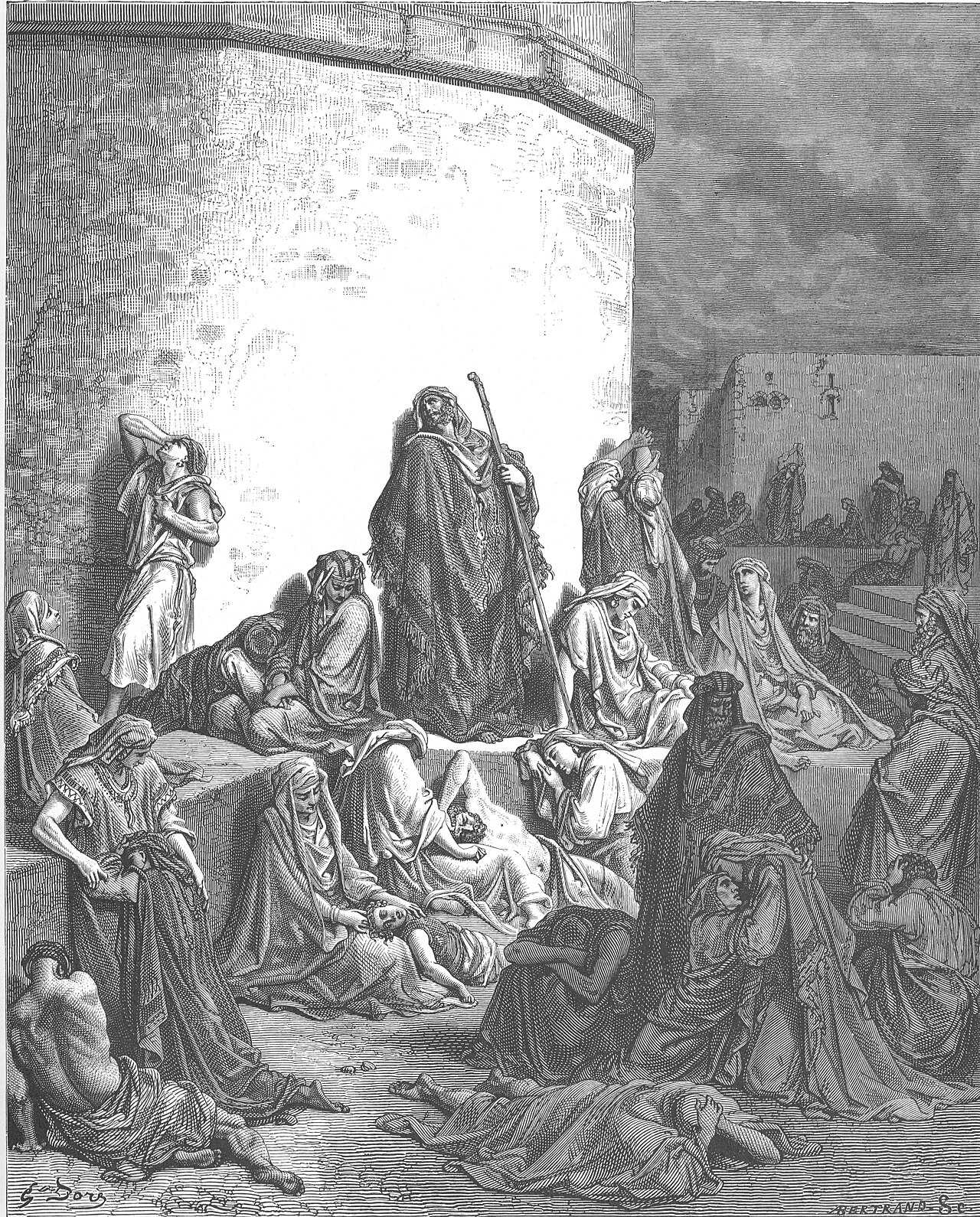
in Lamentations 2You summoned my attackers on every side, as for the day of an appointed feast. In the day of the LORD’s anger no one escaped or survived; my enemy has destroyed those I nurtured and reared.
BSB
The same verse in ASV and KJV ▾
ASV
Thou hast called, as in the day of a solemn assembly, my terrors on every side; And there was none that escaped or remained in the day of Jehovah’s anger: Those that I have dandled and brought up hath mine enemy consumed.
KJV
Thou hast called as in a solemn day my terrors round about, so that in the day of the Lord’s anger none escaped nor remained: those that I have swaddled and brought up hath mine enemy consumed.
⋯
This verse in Lamentations 2
Commentary
9 notes on this verseThou hast called, as in a solemn day, my terrors round about,.... Terrible enemies, as the Chaldeans; these came at the call of God, as soldiers at the command of their general; and in as great numbers as men from all parts of Judea flocked to Jerusalem on any of the three solemn feasts of passover, pentecost, and tabernacles.
This site's exposition
Look, O LORD, and consider
on Lamentations 2:20-22
The hardest of the chapter's questions to the LORD, “Should women eat their offspring, the infants they have nurtured?”, names the siege's worst horror plainly. Moses warned of this curse in Deuteronomy 28:53. The chapter closes on “the day of the LORD’s anger”, when no one escaped.
This site's exposition
You summoned my attackers on every side
The Hebrew behind attackers on every side is the watchword of Jeremiah 6:25 and 20:10, terror on every side, as Albert Barnes notes. John Gill pictures the Chaldeans flocking in like pilgrims to the three great feasts. The summons to a feast in Lamentations 1:15 returns here.
The record, by era
The Medieval Church1 voice
The impossibility of escaping is set forth here. To this idea three more notions are presented. First, is the siege, as Verse 22 begins: "Thou didst invite as to the day of an appointed feast my terrors on every side." Namely, like to the Jewish …
The Puritans and the Awakening3 voices
): " Thou hast called in, as in a solemn day, my terrors round about, that is, the Chaldeans, who are such a terror to me;" enemies crowded into Jerusalem now as thickly as ever worshippers used to do on a solemn festival, so that they were quite overpowered with numbers, and none escaped nor remained; Jerusalem was made a perfect slaughter-house.
quarantine:debris (2026-07-29) — leading-punctuation+unbalanced-parens
9 Her gates are sunk into the ground; he hath destroyed and broken her bars: her king and her princes are among the Gentiles: the law is no more; her prophets also find no vision from the L ORD .
quarantine:scripture (2026-07-29) — scripture-overlap:95%@v9
My terrors - As my people were wont to be called together from all parts in a solemn day, so now my terrible enemies, or terrible things are by thee called together.
The Nineteenth Century1 voice
Thou hast called as in a solemn day - It is by thy influence alone that so many enemies are called together at one time; and they have so hemmed us in that none could escape, and none remained unslain or uncaptivated, Perhaps the figure is the collecting of the people in Jerusalem on one of the solemn annual festivals. God has called terrors together to feast on Jerusalem, similar to the convocation of the people from all parts of the land to one of those annual festivals.
1 more voice on this verse
The Nineteenth Century1 voice
A commentator
Albert Barnes1798–1870
Notes, Explanatory and Practical, on the Old and New Testaments (1832-1869)
proposed
Thou hast called as in a solemn day - i. e. “Thou” callest “like a feast day,” i. e. like the proclaiming of a festival. My terrors round about - The prophet’s watch-word (Jer 6:25 note). God now proclaims what Jeremiah had so often called out before, “Magor-missabib.” On every side were conquering Chaldaeans.
The words behind it
17 Hebrew wordsEvery Hebrew word of this verse in the order it stands, with what it means and the door to its own study. The last column counts the times a word stands in the whole Bible: the rarer the word, the more the places it appears belong together.
| Hebrew | Sound | Meaning | Word study | In the Bible |
|---|---|---|---|---|
| תִּקְרָא֩ | tikra' | you have summoned | H7121 → | 733 times |
| כְי֨וֹם | kheyom | like [the] day of | H3117 → | 2304 times |
| מוֹעֵ֤ד | moed | an appointed feast | H4150 → | 223 times |
| מְגוּרַי֙ | megurai | terrors my | H4032 → | |
| מִסָּבִ֔יב | misaviv | from round about | H5439 → | 336 times |
| וְלֹ֥א | velo' | and not | H3808 → | 5168 times |
| הָיָ֛ה | hayah | he was | H1961 → | 3559 times |
| בְּי֥וֹם | beyom | in [the] day of | H3117 → | 2304 times |
| אַף־ | ʾaf- | [the] anger of | H639 → | 276 times |
| יְהוָ֖ה | yahweh | Yahweh | H3068 → | 6520 times |
| פָּלִ֣יט | palit | an escapee | H6412 → | |
| וְשָׂרִ֑יד | vesarid | and a survivor | H8300 → | |
| אֲשֶׁר־ | ʾasher- | [those] whom | H834 → | 5497 times |
| טִפַּ֥חְתִּי | tipachti | I had given birth | H2946 → | |
| וְרִבִּ֖יתִי | veribiti | and I had reared | H7235 → | |
| אֹיְבִ֥י | ʾoyevi | enemy my | H341 → | 282 times |
| כִלָּֽם׃ פ | khilam | he has made an end of them | H3615 → | 208 times |
תִּקְרָא֩you have summoned
tikra'H7121 →733 times
כְי֨וֹםlike [the] day of
kheyomH3117 →2304 times
מוֹעֵ֤דan appointed feast
moedH4150 →223 times
מְגוּרַי֙terrors my
meguraiH4032 →
מִסָּבִ֔יבfrom round about
misavivH5439 →336 times
וְלֹ֥אand not
velo'H3808 →5168 times
הָיָ֛הhe was
hayahH1961 →3559 times
בְּי֥וֹםin [the] day of
beyomH3117 →2304 times
אַף־[the] anger of
ʾaf-H639 →276 times
יְהוָ֖הYahweh
yahwehH3068 →6520 times
פָּלִ֣יטan escapee
palitH6412 →
וְשָׂרִ֑ידand a survivor
vesaridH8300 →
אֲשֶׁר־[those] whom
ʾasher-H834 →5497 times
טִפַּ֥חְתִּיI had given birth
tipachtiH2946 →
וְרִבִּ֖יתִיand I had reared
veribitiH7235 →
אֹיְבִ֥יenemy my
ʾoyeviH341 →282 times
כִלָּֽם׃ פhe has made an end of them
khilamH3615 →208 times
A shaded row is a word that stands 400 times or fewer in the Bible.
The walk
8 stopsEach card is a verse this one points to, and under it the verses that one points to in turn. Where several paths arrive at the same place, that place is listed first: the text keeps returning to it.
Through
Psalms 31:13For I hear the slander of many; there is terror on every side. They conspire against me and plot to take my life.
it leads to
- Jeremiah 20:10
For I have heard the whispering of many: “Terror is on every side! Report him; let us report him!” All my trusted friends watch for my fall: “Perhaps he will be deceived so that…
Reached by 3 separate paths from here.
- Matthew 27:1
When morning came, all the chief priests and elders of the people conspired against Jesus to put Him to death.
- 1 Samuel 20:33
Then Saul hurled his spear at Jonathan to kill him; so Jonathan knew that his father was determined to kill David.
- Matthew 26:3–4
At that time the chief priests and elders of the people assembled in the courtyard of the high priest, whose name was Caiaphas,
- Jeremiah 20:10
Through
Jeremiah 20:3The next day, when Pashhur released Jeremiah from the stocks, Jeremiah said to him, “The LORD does not call you Pashhur, but Magor-missabib.
it leads to
- Psalms 31:13
For I hear the slander of many; there is terror on every side. They conspire against me and plot to take my life.
Reached by 2 separate paths from here.
- Jeremiah 46:5
Why am I seeing this? They are terrified, they are retreating; their warriors are defeated, they flee in haste without looking back; terror is on every side!” declares the LORD.
- Psalms 31:13
Through
Jeremiah 6:25Do not go out to the fields; do not walk the road. For the enemy has a sword; terror is on every side.
it leads to
- Jeremiah 49:29
They will take their tents and flocks, their tent curtains and all their goods. They will take their camels for themselves. They will shout to them: ‘Terror is on every side!’
- Jeremiah 14:18
If I go out to the country, I see those slain by the sword; if I enter the city, I see those ravaged by famine! For both prophet and priest travel to a land…
- Jeremiah 49:29
Where this verse is studied
About Lamentations
This page draws on Adam Clarke, Commentary on the Bible; Albert Barnes, Notes on the Old Testament; Albert Barnes, Notes, Explanatory and Practical, on the Old and New Testaments (1832-1869); Carl Friedrich Keil, Lamentations; John Gill, Exposition of the Old Testament (1748-1763); John Wesley, Explanatory Notes upon the Old Testament; Matthew Henry, Commentary on the Whole Bible and Thomas Aquinas, Commentary on Lamentations.