
Lamentations 2:11
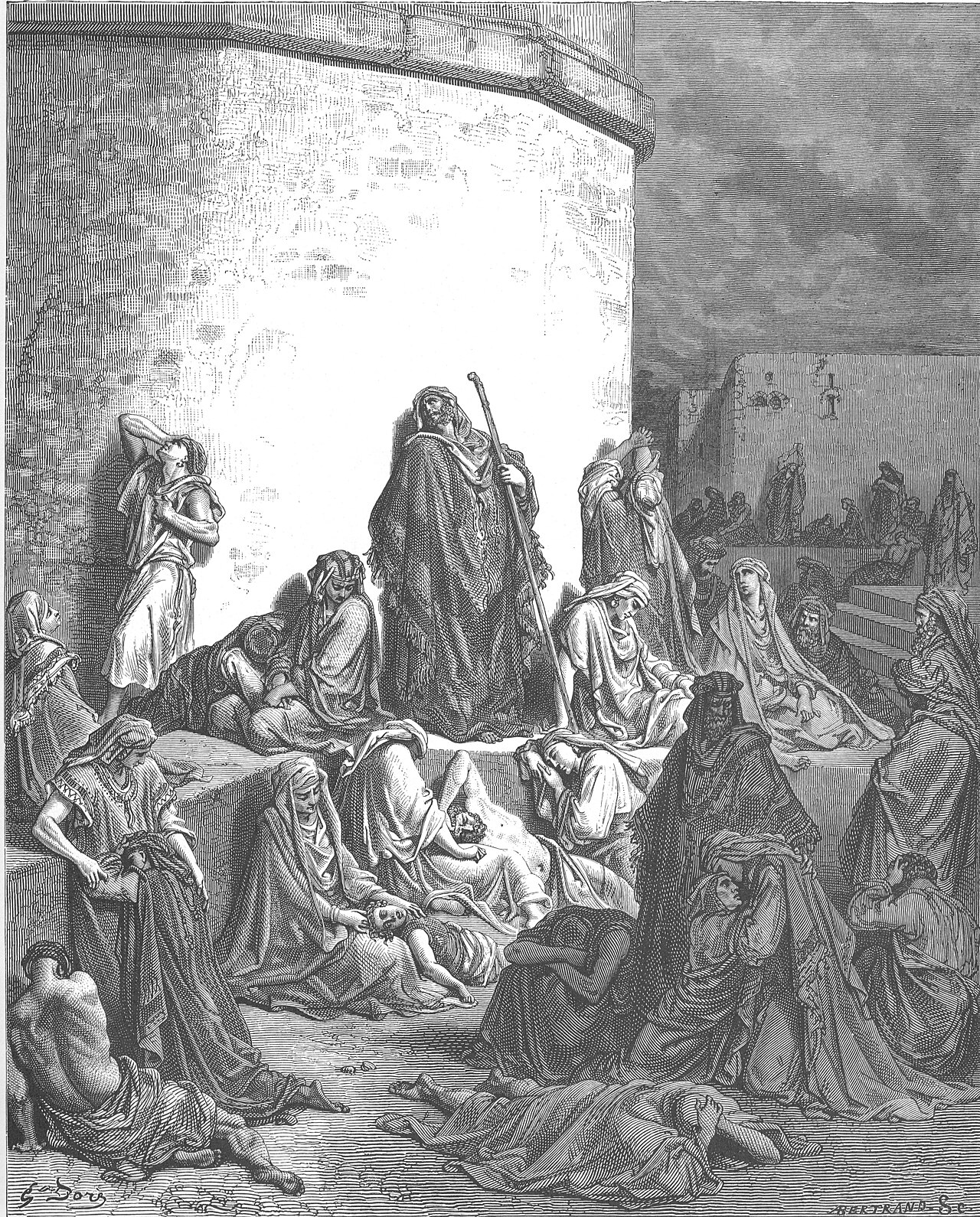
in Lamentations 2My eyes fail from weeping; I am churning within. My heart is poured out in grief over the destruction of the daughter of my people, because children and infants faint in the streets of the city.
BSB
The same verse in ASV and KJV ▾
ASV
Mine eyes do fail with tears, my heart is troubled; My liver is poured upon the earth, because of the destruction of the daughter of my people, Because the young children and the sucklings swoon in the streets of the city.
KJV
Mine eyes do fail with tears, my bowels are troubled, my liver is poured upon the earth, for the destruction of the daughter of my people; because the children and the sucklings swoon in the streets of the city.
⋯
This verse in Lamentations 2
Commentary
9 notes on this verseHere, miserable persons, due to defect of age, are mourned. First is indicated the death of such persons, second, the order of their death. As verse 12 says: "They cry to their mothers, 'Where is bread and wine?'" And as Jeremiah 9:1 expresses it: "O …
This site's exposition
The elders of the Daughter of Zion sit on the ground in silence
on Lamentations 2:10-12
“The elders of the Daughter of Zion sit on the ground in silence”, men whose place was speech at the city gate. The young women bow beside them, so the grief crosses every rank. The famine is then stated plainly: children “cry out to their mothers” for grain and wine.
This site's exposition
My eyes fail from weeping
The narrator weeps in the first person. The Hebrew speaks of the liver poured out on the ground, and Albert Barnes explains the liver as the seat of feeling. The words I am churning within repeat Zion's cry in Lamentations 1:20, so the poet grieves with the city he describes.
The record, by era
The Puritans and the Awakening3 voices
Mine eyes - This whole verse is but expressive of the prophets great affliction for the miseries come upon the Jews. He wept himself almost blind. Bowels - His passion had disturbed his bodily humours, that his bowels were troubled.
Mine eyes do fail with tears,....
Note, The judgments of God upon the land and nation are to be lamented by us, though we, for our parts, may escape pretty well. Calls to lamentation are here given: The heart of the people cried unto the Lord,
The Nineteenth Century2 voices
A commentator
Albert Barnes1798–1870
Notes, Explanatory and Practical, on the Old and New Testaments (1832-1869)
Troubled - See the margin reference note. Liver - As the heart was regarded by the Jews as the seat of the intellect, so the liver (or bowels) was supposed to be the seat of the emotions. The pouring out of the liver upon the ground meant that feelings had entirely given way under the acuteness of sorrow, and he could no longer restrain them.
A commentator
Jamieson, Fausset & Brown1802–1910
Commentary Critical and Explanatory on the Whole Bible (1871)
proposed
liver is poured, &c.--that is, as the liver was thought to be the seat of the passions, "all my feelings are poured out and prostrated for," &c. The "liver," is here put for the bile ("gall," Job 16:13; "bowels," Ps 22:14) in a bladder on the surface of the liver, copiously discharged when the passions are agitated. swoon--through faintness from the effects of hunger.
quarantine:debris (2026-07-29) — starts-lowercase
1 more voice on this verse
The Nineteenth Century1 voice
Swoon in the streets of the city - Through the excess of the famine.
How the passage was read
What the Jewish commentators add
Shriveled. Regrezilerent [shriveled up] in O.F. Intestines— when a person casts them into a fire— shrivel up and burn.
1 more on this passage, in their own words ▾
They sit on the ground, etc. According to its apparent meaning. But the Midrash Aggadah [states] that Nevuchadnetzar sat them on the ground when Tzidkiyahu rebelled against him and transgressed his oath. He came and stationed himself in Dophnei. Nevuchadnetzar’s headquarters was situated in Rivlah as indicated in Yirmiyahu:5.
This section is reception history: how the passage was read and kept in the Jewish tradition. Where a reading parts from an essential of the Christian faith, the section says so at that point.
Texts and citation data: Sefaria; each excerpt follows its version’s licence. 2 further sources are cited on this chapter that carry no English text this site may quote or only restate the verse.
The words behind it
17 Hebrew wordsEvery Hebrew word of this verse in the order it stands, with what it means and the door to its own study. The last column counts the times a word stands in the whole Bible: the rarer the word, the more the places it appears belong together.
| Hebrew | Sound | Meaning | Word study | In the Bible |
|---|---|---|---|---|
| כָּל֨וּ | kalu | they have failed | H3615 → | 208 times |
| בַדְּמָע֤וֹת | vademaot | by <the> tears | H1832 → | 23 times |
| עֵינַי֙ | ʾeinai | eyes my | H5869 → | 887 times |
| חֳמַרְמְר֣וּ | chomarmeru | they are in turmoil | H2560 → | |
| מֵעַ֔י | meai | inward parts my | H4578 → | |
| נִשְׁפַּ֤ךְ | nishpakh | it has been poured out | H8210 → | 114 times |
| לָאָ֙רֶץ֙ | laaretz | to the ground | H776 → | 2504 times |
| כְּבֵדִ֔י | kevedi | liver my | H3516 → | |
| עַל־ | ʾal- | on | H5921 → | 5755 times |
| שֶׁ֖בֶר | shever | [the] brokenness of | H7667 → | 45 times |
| בַּת־ | bat- | [the] daughter of | H1323 → | 588 times |
| עַמִּ֑י | ʾami | people my | H5971 → | 1873 times |
| בֵּֽעָטֵ֤ף | beatef | because faint | H5848 → | 15 times |
| עוֹלֵל֙ | olel | child | H5768 → | 20 times |
| וְיוֹנֵ֔ק | veyonek | and suckling-child | H3243 → | 33 times |
| בִּרְחֹב֖וֹת | birchovot | in [the] open places of | H7339 → | 43 times |
| קִרְיָֽה׃ ס | kiryah | a town | H7151 → |
כָּל֨וּthey have failed
kaluH3615 →208 times
בַדְּמָע֤וֹתby <the> tears
vademaotH1832 →23 times
עֵינַי֙eyes my
ʾeinaiH5869 →887 times
חֳמַרְמְר֣וּthey are in turmoil
chomarmeruH2560 →
מֵעַ֔יinward parts my
meaiH4578 →
נִשְׁפַּ֤ךְit has been poured out
nishpakhH8210 →114 times
לָאָ֙רֶץ֙to the ground
laaretzH776 →2504 times
כְּבֵדִ֔יliver my
kevediH3516 →
עַל־on
ʾal-H5921 →5755 times
שֶׁ֖בֶר[the] brokenness of
sheverH7667 →45 times
בַּת־[the] daughter of
bat-H1323 →588 times
עַמִּ֑יpeople my
ʾamiH5971 →1873 times
בֵּֽעָטֵ֤ףbecause faint
beatefH5848 →15 times
עוֹלֵל֙child
olelH5768 →20 times
וְיוֹנֵ֔קand suckling-child
veyonekH3243 →33 times
בִּרְחֹב֖וֹתin [the] open places of
birchovotH7339 →43 times
קִרְיָֽה׃ סa town
kiryahH7151 →
A shaded row is a word that stands 400 times or fewer in the Bible.
The walk
8 stopsEach card is a verse this one points to, and under it the verses that one points to in turn. Where several paths arrive at the same place, that place is listed first: the text keeps returning to it.
Through
Isaiah 22:4Therefore I said, “Turn away from me, let me weep bitterly! Do not try to console me over the destruction of the daughter of my people.”
it leads to
- Jeremiah 9:1
Oh, that my head were a spring of water, and my eyes a fountain of tears! I would weep day and night over the slain daughter of my people.
Reached by 2 separate paths from here.
- Jeremiah 9:1
Through
Jeremiah 4:19My anguish, my anguish! I writhe in pain! Oh, the pain in my chest! My heart pounds within me; I cannot be silent. For I have heard the sound of the horn, the alarm…
it leads to
- Isaiah 16:11
Therefore my heart laments for Moab like a harp, my inmost being for Kir-heres.
Reached by 2 separate paths from here.
- Habakkuk 3:16
I heard and trembled within; my lips quivered at the sound. Decay entered my bones; I trembled where I stood. Yet I must wait patiently for the day of distress to come upon the…
- Isaiah 22:4
Therefore I said, “Turn away from me, let me weep bitterly! Do not try to console me over the destruction of the daughter of my people.”
- Isaiah 16:11
Through
Job 16:13His archers surround me. He pierces my kidneys without mercy and spills my gall on the ground.
it leads to
- Job 20:25
It is drawn out of his back, the gleaming point from his liver. Terrors come over him.
- Job 20:25
Through
Lamentations 1:16For these things I weep; my eyes flow with tears. For there is no one nearby to comfort me, no one to revive my soul. My children are destitute because the enemy has prevailed.
it leads to
- Psalms 119:136
My eyes shed streams of tears because Your law is not obeyed.
- Lamentations 1:2
She weeps aloud in the night, with tears upon her cheeks. Among all her lovers there is no one to comfort her. All her friends have betrayed her; they have become her enemies.
- Psalms 119:136
Through
Lamentations 1:20See, O LORD, how distressed I am! I am churning within; my heart is pounding within me, for I have been most rebellious. Outside, the sword bereaves; inside, there is death.
it leads to
- Deuteronomy 32:25
Outside, the sword will take their children, and inside, terror will strike the young man and the young woman, the infant and the gray-haired man.
- Deuteronomy 32:25
Where this verse is studied
About Lamentations
This page draws on Adam Clarke, Commentary on the Bible; Albert Barnes, Notes, Explanatory and Practical, on the Old and New Testaments (1832-1869); Jamieson, Fausset & Brown, Commentary Critical and Explanatory on the Whole Bible; John Gill, Exposition of the Old Testament (1748-1763); John Wesley, Explanatory Notes upon the Old Testament; Matthew Henry, Commentary on the Whole Bible and Thomas Aquinas, Commentary on Lamentations.