
Lamentations 2:18
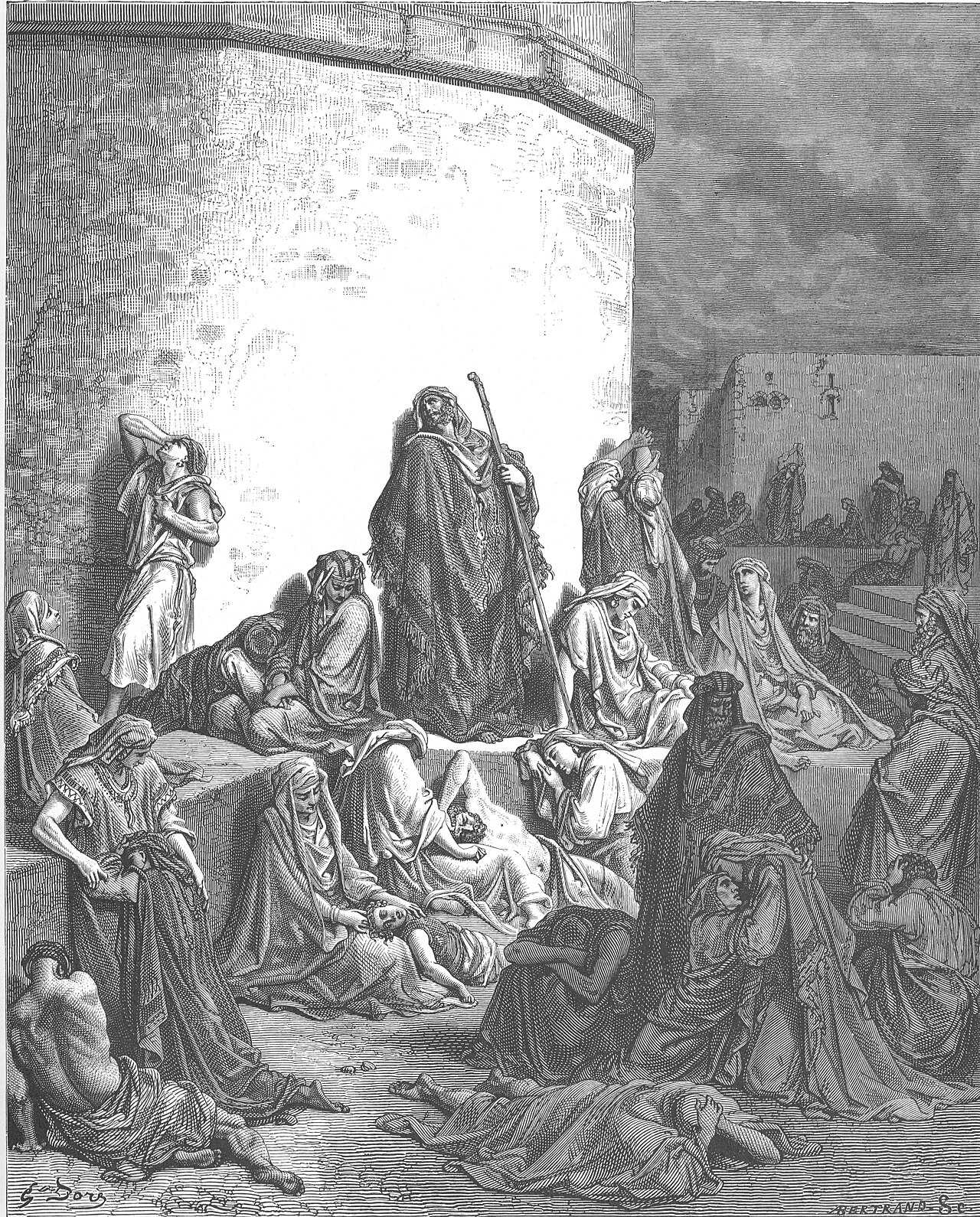
in Lamentations 2The hearts of the people cry out to the Lord. O wall of the Daughter of Zion, let your tears run down like a river day and night. Give yourself no relief, and your eyes no rest.
BSB
The same verse in ASV and KJV ▾
ASV
Their heart cried unto the Lord: O wall of the daughter of Zion, let tears run down like a river day and night; Give thyself no respite; let not the apple of thine eye cease.
KJV
Their heart cried unto the Lord, O wall of the daughter of Zion, let tears run down like a river day and night: give thyself no rest; let not the apple of thine eye cease.
⋯
This verse in Lamentations 2
Commentary
11 notes on this verseThink how great that weeping must be that deserves to be compared with a flood of waters. Whoever so weeps and says with the prophet Jeremiah, "let not the apple of my eye cease," shall straightway find the words fulfilled of him: "mercy and truth are met together; righteousness and peace have kissed each other." If righteousness and truth terrify him, mercy and peace may encourage him to seek salvation.
This site's exposition
The hearts of the people cry out to the Lord
on Lamentations 2:18-19
Grief is given the discipline of prayer through the watches of the night: “Pour out your heart like water in the presence of the Lord”. The plea names who the prayer is for, “the lives of your children who are fainting from hunger on the corner of every street”.
The record, by era
The Church Fathers3 voices
The Savior also wept over the city of Jerusalem because its inhabitants had not repented; and Peter washed out his triple denial with bitter tears, thus fulfilling the words of the prophet: "rivers of waters run down my eyes." Jeremiah too laments over his impenitent people, saying, "O that my head were waters and my eyes a fountain of tears, that I might weep day and night for … my people!" And farther on he gives a reason for his lamentation: "do not weep for the dead," he writes, "neither bemoan him, but weep bitterly for him that goes away, for he shall return no more." The Jew and the Gentile therefore are not to be bemoaned, for they have never been in the church and have died once for all (it is of these that the Savior says, "Let the dead bury their dead"15); weep rather for those who by reason of their crimes and sins go away from the church and who, suffering condemnation for their faults, shall no more return to it. It is in this sense that the prophet speaks to ministers of the church, calling them its walls and towers and saying to each in turn, "O wall, let tears run down." In this way, it is prophetically implied, you will fulfill the apostolic precept: "Rejoice with them that rejoice and weep with them that weep." By your tears you will melt the hard hearts of sinners until they too weep. However, if they persist in evildoing they will find these words applied to them: "I … planted for you a noble vine, wholly a right seed; how then are you turned into the degenerate plant of a strange vine to me?" He says again, "saying to a stock, you are my father; and to a stone, you have brought me forth; for they have turned their back to me, and not their face." He means they would not turn toward God in penitence but in the hardness of their hearts turned their backs on him to insult him. […]
Not every kind of shedding of tears is produced by one feeling or one virtue. For in one way does that weeping originate that is caused by the pricks of our sins striking our heart, of which we read, "I have labored in my groaning, every night I will wash my bed; I will water my couch with my tears." And again, "Let tears run down like a torrent day and night; give yourself no rest, and do not let the apple of your eye cease." In another, that which arises from the contemplation of eternal good things and the desire of that future glory, owing to which even richer well-springs of tears burst forth from uncontrollable delights and boundless exultation, while our soul is thirsty for the mighty living God, saying, "When shall I come and appear before the presence of God? My tears have been my meat day and night," declaring with daily crying and lamentation, "Woe is me that my sojourning is prolonged," and, "Too long has my soul been a sojourner."In another way do the tears flow forth, which without any conscience of deadly sin yet still proceed from the fear of hell and the recollection of that terrible judgment, with the terror of which the prophet was smitten and prayed to God, saying, "Enter not into judgment with your servant, for in your sight shall no one living be justified." There is too another kind of tears, which are caused not by knowledge of one's self but by the hardness and sins of others; whereby Samuel is described as having wept for Saul. Both the Lord in the Gospel and Jeremiah in former days wept for the city of Jerusalem, the latter thus saying, "O, that my head were water and my eyes a fountain of tears! […]
From these tears those are vastly different that are squeezed out from dry eyes while the heart is hard, and although we cannot believe that these are altogether fruitless (for the attempt to shed them is made with a good intention, especially by those who have not yet been able to attain to perfect knowledge or to be thoroughly cleansed from the stains of past or present sins), yet certainly the flow of tears ought not to be thus forced out by those who have already advanced to the love of virtue, nor should the weeping of the outward person be with great labor attempted, as even if it is produced it will never attain the rich copiousness of spontaneous tears. For it will rather cast down the soul of the suppliant by his endeavors, and humiliate him, and plunge him in human affairs and draw him away from the celestial heights, wherein the awed mind of one who prays should be steadfastly fixed, and will force it to relax its hold on its prayers and grow sick from barren and forced tears.
The Medieval Church1 voice
Here one turns toward seeking divine justice through prayer. First, one is invited to pray, second to consider the prayer itself. As Verse 20 says: "Look, O Lord, and see! With whom hast thou dealt thus?" Regarding an invitation to pray, two notions are proposed. …
The Puritans and the Awakening1 voice
Their heart cried unto the Lord,....
4 more voices on this verse
The Puritans and the Awakening1 voice
Causes for lamentation are here assigned, and the calamities that are to be bewailed are very particularly and pathetically described. Multitudes perish by famine, a very sore judgment, and piteous is the case of those that fall under it.
The Nineteenth Century3 voices
O wall of the daughter of Zion - חומת בת ציון chomath bath tsiyon, wall of the daughter of Zion. These words are probably those of the passengers, who appear to be affected by the desolations of the land; and they address the people, and urge them to plead with God day and night for their restoration. But what is the meaning of wall of the daughter of Zion? I answer I do not know.
A commentator
Jamieson, Fausset & Brown1802–1910
Commentary Critical and Explanatory on the Whole Bible (1871)
"Their heart," that is, the Jews'; while their heart is lifted up to the Lord in prayer, their speech is addressed to the "wall" (the part being put for the whole city). let tears, &c.-- (Jer 14:17).
A commentator
Albert Barnes1798–1870
Notes, Explanatory and Practical, on the Old and New Testaments (1832-1869)
proposed
Their heart - That of the inhabitants of Jerusalem. The prophet bids the wall, as the representative of the people who had dwelt secure under its protection, shed floods of tears on their behalf. Broken up by the enemy, it could be their guardian no longer, but by its ruins it might still cry unto the Lord in their behalf. A river - Or, a brook or torrent. Rest - Properly, the torpor and numbness which follows upon excessive grief. Apple of thine eye - See Psa 17:8 note.
The words behind it
20 Hebrew wordsEvery Hebrew word of this verse in the order it stands, with what it means and the door to its own study. The last column counts the times a word stands in the whole Bible: the rarer the word, the more the places it appears belong together.
| Hebrew | Sound | Meaning | Word study | In the Bible |
|---|---|---|---|---|
| צָעַ֥ק | tzaak | it has cried out | H6817 → | |
| לִבָּ֖ם | libam | heart their | H3820 → | 595 times |
| אֶל־ | ʾel- | to | H413 → | 5510 times |
| אֲדֹנָ֑י | ʾadonai | [the] Lord | H136 → | 440 times |
| חוֹמַ֣ת | chomat | O wall of | H2346 → | 133 times |
| בַּת־ | bat- | [the] daughter of | H1323 → | 588 times |
| צִ֠יּוֹן | tziyon | Zion | H6726 → | 154 times |
| הוֹרִ֨ידִי | horidi | send down | H3381 → | 381 times |
| כַנַּ֤חַל | khanachal | like <the> river | H5158 → | |
| דִּמְעָה֙ | dimah | tear[s] | H1832 → | 23 times |
| יוֹמָ֣ם | yomam | by day | H3119 → | |
| וָלַ֔יְלָה | valaylah | and night | H3915 → | 233 times |
| אַֽל־ | ʾal- | may not | H408 → | 724 times |
| תִּתְּנִ֤י | titeni | you give | H5414 → | 2011 times |
| פוּגַת֙ | fugat | rest | H6314 → | |
| לָ֔ךְ | lakh | to yourself | ||
| אַל־ | ʾal- | may not | H408 → | 724 times |
| תִּדֹּ֖ם | tidom | it be still | H1826 → | 30 times |
| בַּת־ | bat- | [the] daughter of | H1323 → | 588 times |
| עֵינֵֽךְ׃ ס | ʾeinekh | eye your | H5869 → | 887 times |
צָעַ֥קit has cried out
tzaakH6817 →
לִבָּ֖םheart their
libamH3820 →595 times
אֶל־to
ʾel-H413 →5510 times
אֲדֹנָ֑י[the] Lord
ʾadonaiH136 →440 times
חוֹמַ֣תO wall of
chomatH2346 →133 times
בַּת־[the] daughter of
bat-H1323 →588 times
צִ֠יּוֹןZion
tziyonH6726 →154 times
הוֹרִ֨ידִיsend down
horidiH3381 →381 times
כַנַּ֤חַלlike <the> river
khanachalH5158 →
דִּמְעָה֙tear[s]
dimahH1832 →23 times
יוֹמָ֣םby day
yomamH3119 →
וָלַ֔יְלָהand night
valaylahH3915 →233 times
אַֽל־may not
ʾal-H408 →724 times
תִּתְּנִ֤יyou give
titeniH5414 →2011 times
פוּגַת֙rest
fugatH6314 →
לָ֔ךְto yourself
lakh
אַל־may not
ʾal-H408 →724 times
תִּדֹּ֖םit be still
tidomH1826 →30 times
בַּת־[the] daughter of
bat-H1323 →588 times
עֵינֵֽךְ׃ סeye your
ʾeinekhH5869 →887 times
A shaded row is a word that stands 400 times or fewer in the Bible.
The walk
8 stopsEach card is a verse this one points to, and under it the verses that one points to in turn. Where several paths arrive at the same place, that place is listed first: the text keeps returning to it.
Through
Jeremiah 9:1Oh, that my head were a spring of water, and my eyes a fountain of tears! I would weep day and night over the slain daughter of my people.
it leads to
- Jeremiah 13:17
But if you do not listen, I will weep in secret because of your pride. My eyes will overflow with tears, because the LORD’s flock has been taken captive.
Reached by 2 separate paths from here.
- Lamentations 2:11
My eyes fail from weeping; I am churning within. My heart is poured out in grief over the destruction of the daughter of my people, because children and infants faint in the streets of…
Reached by 2 separate paths from here.
- Jeremiah 13:17
Through
Psalms 119:136My eyes shed streams of tears because Your law is not obeyed.
it leads to
- Jeremiah 9:1
Oh, that my head were a spring of water, and my eyes a fountain of tears! I would weep day and night over the slain daughter of my people.
- Ezekiel 9:4
“Go throughout the city of Jerusalem,” said the LORD, “and put a mark on the foreheads of the men sighing and groaning over all the abominations committed there.”
- Jeremiah 9:18
Let them come quickly and take up a lament over us, that our eyes may overflow with tears, and our eyelids may gush with water.
- 1 Samuel 15:11
“I regret that I have made Saul king, for he has turned away from following Me and has not carried out My instructions.” And Samuel was distressed and cried out to the LORD all…
- Psalms 119:53
Rage has taken hold of me because of the wicked who reject Your law.
- Jeremiah 9:1
Through
Psalms 119:145I call with all my heart; answer me, O LORD! I will obey Your statutes.
it leads to
- Psalms 119:10
With all my heart I have sought You; do not let me stray from Your commandments.
- Psalms 119:10
Where this verse is studied
About Lamentations
Who and where
1 name in this verse with a page on the site.
This page draws on 11 works. Open the list of works
This page draws on Adam Clarke, Commentary on the Bible; Albert Barnes, Notes, Explanatory and Practical, on the Old and New Testaments (1832-1869); Carl Friedrich Keil, Lamentations; Jamieson, Fausset & Brown, Commentary Critical and Explanatory on the Whole Bible; Jerome, LETTER 122.3; Jerome, LETTER 122.1-2; John Cassian, CONFERENCE 1:9.29; John Cassian, CONFERENCE 1:9.30; John Gill, Exposition of the Old Testament (1748-1763); Matthew Henry, Commentary on the Whole Bible and Thomas Aquinas, Commentary on Lamentations.