
Lamentations 2:19
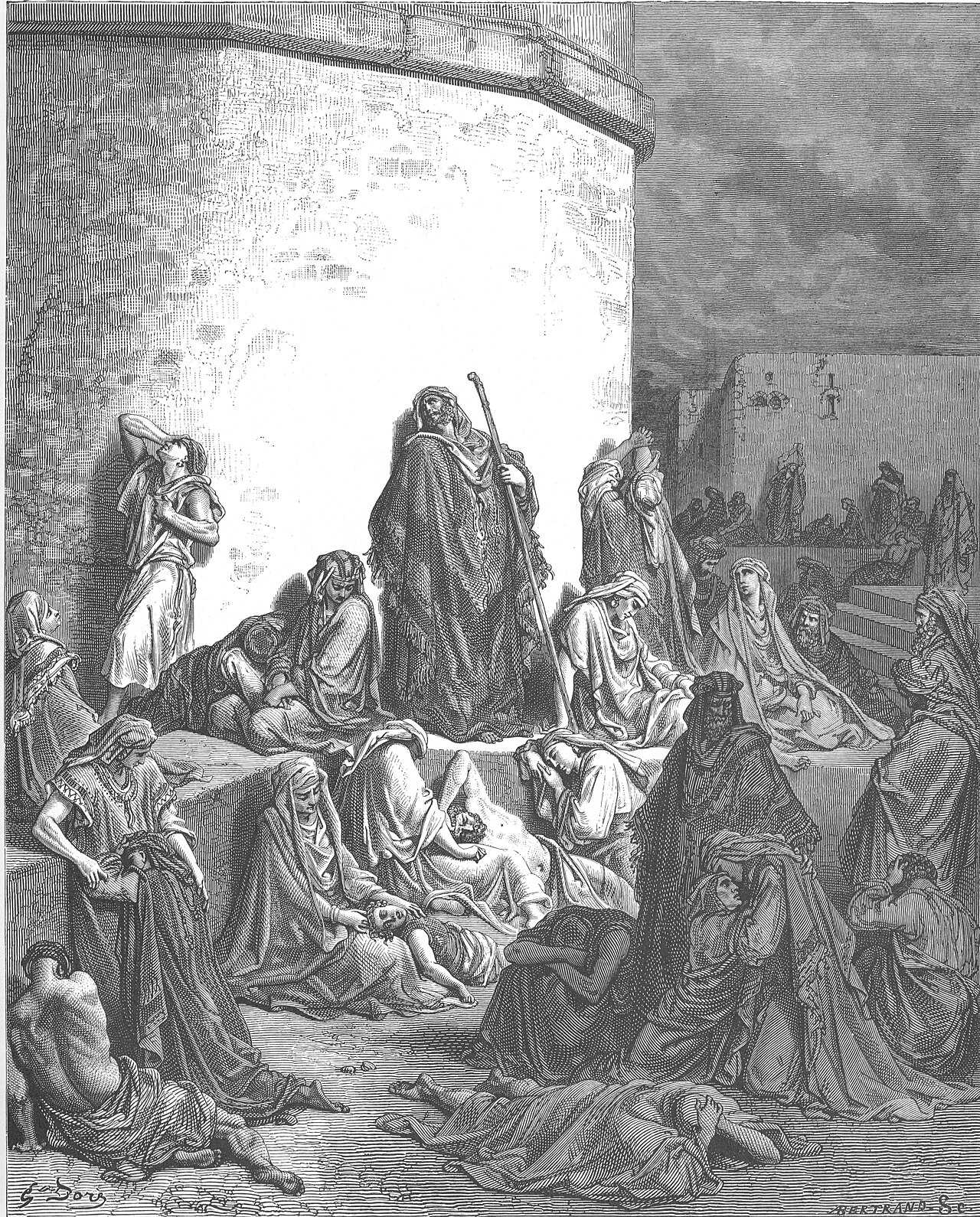
in Lamentations 2Arise, cry out in the night from the first watch of the night. Pour out your heart like water in the presence of the Lord. Lift up your hands to Him for the lives of your children who are fainting from hunger on the corner of every street.
BSB
The same verse in ASV and KJV ▾
ASV
Arise, cry out in the night, at the beginning of the watches; Pour out thy heart like water before the face of the Lord: Lift up thy hands toward him for the life of thy young children, that faint for hunger at the head of every street.
KJV
Arise, cry out in the night: in the beginning of the watches pour out thine heart like water before the face of the Lord: lift up thy hands toward him for the life of thy young children, that faint for hunger in the top of every street.
⋯
This verse in Lamentations 2
Commentary
12 notes on this verseArise, cry out in the night,.... That is, O daughter of Zion, or congregation of Israel, as the Targum; who are addressed and called upon by the prophet to arise from their beds, and shake off their sleep, and sloth, and stupidity, and cry to God in the night season; and be earnest and importunate with him for help and assistance.
This site's exposition
The hearts of the people cry out to the Lord
on Lamentations 2:18-19
Grief is given the discipline of prayer through the watches of the night: “Pour out your heart like water in the presence of the Lord”. The plea names who the prayer is for, “the lives of your children who are fainting from hunger on the corner of every street”.
This site's exposition
Arise, cry out in the night
The Hebrews divided the night into three watches, and Albert Barnes takes the first watch as the start of a vigil kept all night. The call to pour out the heart uses the verb of the poet's own grief in Lamentations 2:11. The fainting children of Lamentations 2:11 appear again.
The record, by era
The Medieval Church2 voices
A manner of prayer is here taught, and about this two notations are proposed. First, the manner is taught, as to time. As expressed: "Arise, cry out in the night": that is, from sleep. "Cry out": namely, praise the Lord God. Then: "in the night": …
A commentator
BonaventureCollations on the Hexaemeron, Collation 22 · Written in the 13th century.
proposed
When the soul does what it can, grace lifts it up easily and God works in it, so that there be a worthy admission, a worthy inspection, and a worthy induction. A worthy admission of divine matters corresponds to the Thrones. And it is in …
The Puritans and the Awakening2 voices
): They faint for hunger in the top of every street. Yet this is not the worst, (2.) There were some little children that were slain by their mothers' hands and eaten,
quarantine:debris (2026-07-29) — leading-punctuation+unbalanced-parens
): " Arise out of thy dust, out of thy despondency, cry out in the night, watch unto prayer; when others are asleep, be thou upon thy knees, importunate with God for mercy; in the beginning of the watches, of each of the four watches, of the night (let thy eyes prevent them, Ps. cxix.
quarantine:debris (2026-07-29) — leading-punctuation+odd-straight-quotes
The Nineteenth Century1 voice
A commentator
Albert Barnes1798–1870
Notes, Explanatory and Practical, on the Old and New Testaments (1832-1869)
In - (or at) the beginning of the watches “At the beginning of each night-watch” means all the night through. The Hebrews divided the night into three watches.
4 more voices on this verse
The Nineteenth Century4 voices
A commentator
Jamieson, Fausset & Brown1802–1910
Commentary Critical and Explanatory on the Whole Bible (1871)
proposed
cry . . . in . . . night-- (Ps 119:147). beginning of . . . watches--that is, the first of the three equal divisions (four hours each) into which the ancient Jews divided the night; namely, from sunset to ten o'clock. The second was called "the middle watch" (Jud 7:19), from ten till two o'clock.
quarantine:debris (2026-07-29) — starts-lowercase
If it be enquired why I held a Watch-night, let the answer be—because I hoped that the Lord would own the service, and thus souls might be saved. I have preached at all hours the gospel of Jesus, and I see no reason why I may not preach at midnight, if I can obtain hearers. I have not done it from imitation, but for the best of reasons—the hope of doing good, and the wish to be the means of gathering in the outcasts of Israel.
If it be enquired why I held a Watch-night, let the answer be—because I hoped that the Lord would own the service, and thus souls might be saved. I have preached at all hours the gospel of Jesus, and I see no reason why I may not preach at midnight, if I can obtain hearers. I have not done it from imitation, but for the best of reasons—the hope of doing good, and the wish to be the means of gathering in the outcasts of Israel. God is my witness, I would preach every hour of the day, if body and mind were equal to the task. When I consider how souls are being damned and how few there are who mourn and cry over them, I am constrained to cry with Paul, “Woe is me if I preach not the gospel.” Oh, that the new year may be far better than the last. I am almost sorry to see this service in print, and fear it will rob many of their week’s food from the regular sermon; but as it is done, I pray the Lord to own it for Jesus’ sake.—C.H.S. The chapel being densely crowded in every part, the preacher entered the pulpit, and after prayer, solemnly read the verse—which the congregation then sang— “Ye virgin souls, arise! With all the dead awake; Unto salvation wise; Oil in your vessels take: Upstarting at the MIDNIGHT CRY, Behold Your heavenly bridegroom nigh.” Two brethren then offered prayer for the Church and the World, that the new year might be clothed with glory by the spread of the knowledge of Jesus.—Then followed the EXPOSITION Psalm 90:1-22 “Lord, thou hast been our dwelling place in all generations. Yea Jehovah, WE, they children, can say that thou hast been our home, our safe dwelling-place. And oh, what joy, what peace have we found in his sacred bosom. No home like the breast of the Lord, to which, in all generations, true believers fly. Let me ask the unbelievers where their joy is.
Arise, cry out in the night - This seems to refer to Jerusalem besieged. Ye who keep the night watches, pour out your hearts before the Lord, instead of calling the time of night, etc.; or, when you call it, send up a fervent prayer to God for the safety and relief of the place.
The words behind it
22 Hebrew wordsEvery Hebrew word of this verse in the order it stands, with what it means and the door to its own study. The last column counts the times a word stands in the whole Bible: the rarer the word, the more the places it appears belong together.
| Hebrew | Sound | Meaning | Word study | In the Bible |
|---|---|---|---|---|
| ק֣וּמִי׀ | kumi | arise | H6965 → | 628 times |
| רֹ֣נִּי | roni | cry out | H7442 → | |
| בַלַּ֗יְלָה | valayil | in the night | H3915 → | 233 times |
| לְרֹאשׁ֙ | lerosh | to [the] head of | H7218 → | 599 times |
| אַשְׁמֻר֔וֹת | ʾashmurot | [the] night-watches | H821 → | |
| שִׁפְכִ֤י | shifkhi | pour out | H8210 → | 114 times |
| כַמַּ֙יִם֙ | khamayim | like <the> water | H4325 → | 581 times |
| לִבֵּ֔ךְ | libekh | heart your | H3820 → | 595 times |
| נֹ֖כַח | nokhach | before | H5227 → | |
| פְּנֵ֣י | penei | [the] presence of | H6440 → | 2123 times |
| אֲדֹנָ֑י | ʾadonai | [the] Lord | H136 → | 440 times |
| שְׂאִ֧י | sei | lift up | H5375 → | 656 times |
| אֵלָ֣יו | ʾelav | to him | H413 → | 5510 times |
| כַּפַּ֗יִךְ | kapayikh | hands your | H3709 → | 192 times |
| עַל־ | ʾal- | on | H5921 → | 5755 times |
| נֶ֙פֶשׁ֙ | nefesh | [the] life | H5315 → | 754 times |
| עֽוֹלָלַ֔יִךְ | olalayikh | children your | H5768 → | 20 times |
| הָעֲטוּפִ֥ים | haatufim | the ones enfeebled | H5848 → | 15 times |
| בְּרָעָ֖ב | beraav | by hunger | H7458 → | 101 times |
| בְּרֹ֥אשׁ | berosh | at [the] head of | H7218 → | 599 times |
| כָּל־ | kol- | all | H3605 → | 5413 times |
| חוּצֽוֹת׃ ס | chutzot | [the] streets | H2351 → | 164 times |
ק֣וּמִי׀arise
kumiH6965 →628 times
רֹ֣נִּיcry out
roniH7442 →
בַלַּ֗יְלָהin the night
valayilH3915 →233 times
לְרֹאשׁ֙to [the] head of
leroshH7218 →599 times
אַשְׁמֻר֔וֹת[the] night-watches
ʾashmurotH821 →
שִׁפְכִ֤יpour out
shifkhiH8210 →114 times
כַמַּ֙יִם֙like <the> water
khamayimH4325 →581 times
לִבֵּ֔ךְheart your
libekhH3820 →595 times
נֹ֖כַחbefore
nokhachH5227 →
פְּנֵ֣י[the] presence of
peneiH6440 →2123 times
אֲדֹנָ֑י[the] Lord
ʾadonaiH136 →440 times
שְׂאִ֧יlift up
seiH5375 →656 times
אֵלָ֣יוto him
ʾelavH413 →5510 times
כַּפַּ֗יִךְhands your
kapayikhH3709 →192 times
עַל־on
ʾal-H5921 →5755 times
נֶ֙פֶשׁ֙[the] life
nefeshH5315 →754 times
עֽוֹלָלַ֔יִךְchildren your
olalayikhH5768 →20 times
הָעֲטוּפִ֥יםthe ones enfeebled
haatufimH5848 →15 times
בְּרָעָ֖בby hunger
beraavH7458 →101 times
בְּרֹ֥אשׁat [the] head of
beroshH7218 →599 times
כָּל־all
kol-H3605 →5413 times
חוּצֽוֹת׃ ס[the] streets
chutzotH2351 →164 times
A shaded row is a word that stands 400 times or fewer in the Bible.
The walk
8 stopsEach card is a verse this one points to, and under it the verses that one points to in turn. Where several paths arrive at the same place, that place is listed first: the text keeps returning to it.
Through
Psalms 62:8Trust in Him at all times, O people; pour out your hearts before Him. God is our refuge. Selah
it leads to
- Philippians 4:6
Be anxious for nothing, but in everything, by prayer and petition, with thanksgiving, present your requests to God.
- Isaiah 26:4
Trust in the LORD forever, because GOD the LORD is the Rock eternal.
- Psalms 142:2
I pour out my complaint before Him; I reveal my trouble to Him.
- 1 Samuel 1:15
“No, my lord,” Hannah replied. “I am a woman oppressed in spirit. I have not had any wine or strong drink, but I have poured out my soul before the LORD.
- Psalms 18:2
The LORD is my rock, my fortress, and my deliverer. My God is my rock, in whom I take refuge, my shield, and the horn of my salvation, my stronghold.
- Philippians 4:6
Through
Mark 1:35Early in the morning, while it was still dark, Jesus got up and slipped out to a solitary place to pray.
it leads to
- Luke 6:12
In those days Jesus went out to the mountain to pray, and He spent the night in prayer to God.
- Luke 5:16
Yet He frequently withdrew to the wilderness to pray.
- Luke 22:39–46
Jesus went out as usual to the Mount of Olives, and the disciples followed Him.
- Luke 6:12
Where this verse is studied
On this page
Studies2
On this verse
On this chapter
About Lamentations
This page draws on 9 works. Open the list of works
This page draws on Adam Clarke, Commentary on the Bible; Albert Barnes, Notes, Explanatory and Practical, on the Old and New Testaments (1832-1869); Bonaventure, Collations on the Hexaemeron, Collation 22; Carl Friedrich Keil, Lamentations; Charles Spurgeon, The New Park Street Pulpit, Sermon No. 59: “Watch-Night Service” (lightly modernized text, CCEL edition); Jamieson, Fausset & Brown, Commentary Critical and Explanatory on the Whole Bible; John Gill, Exposition of the Old Testament (1748-1763); Matthew Henry, Commentary on the Whole Bible and Thomas Aquinas, Commentary on Lamentations.